

Today, applications are being attacked more than ever. Whether we are talking about a web app, mobile app, or enterprise app, the threats are real and are growing exponentially. Throughout the applications, hackers explore how they can destroy and exploit the weakness in the application to illicitly gain entry, like stealing data or capturing control over the application. That’s why we need to use security processes across the board and not as an afterthought at the end of a project. This blog post will summarize the top 10 application security best practices every development team should adopt in 2025. These are more than recommendations; they are crucial for the safety of your users and security of your apps.
Discover hidden vulnerabilities with Qualysec’s expert VAPT services. Schedule a call now
Top 10 Application Security Best Practices
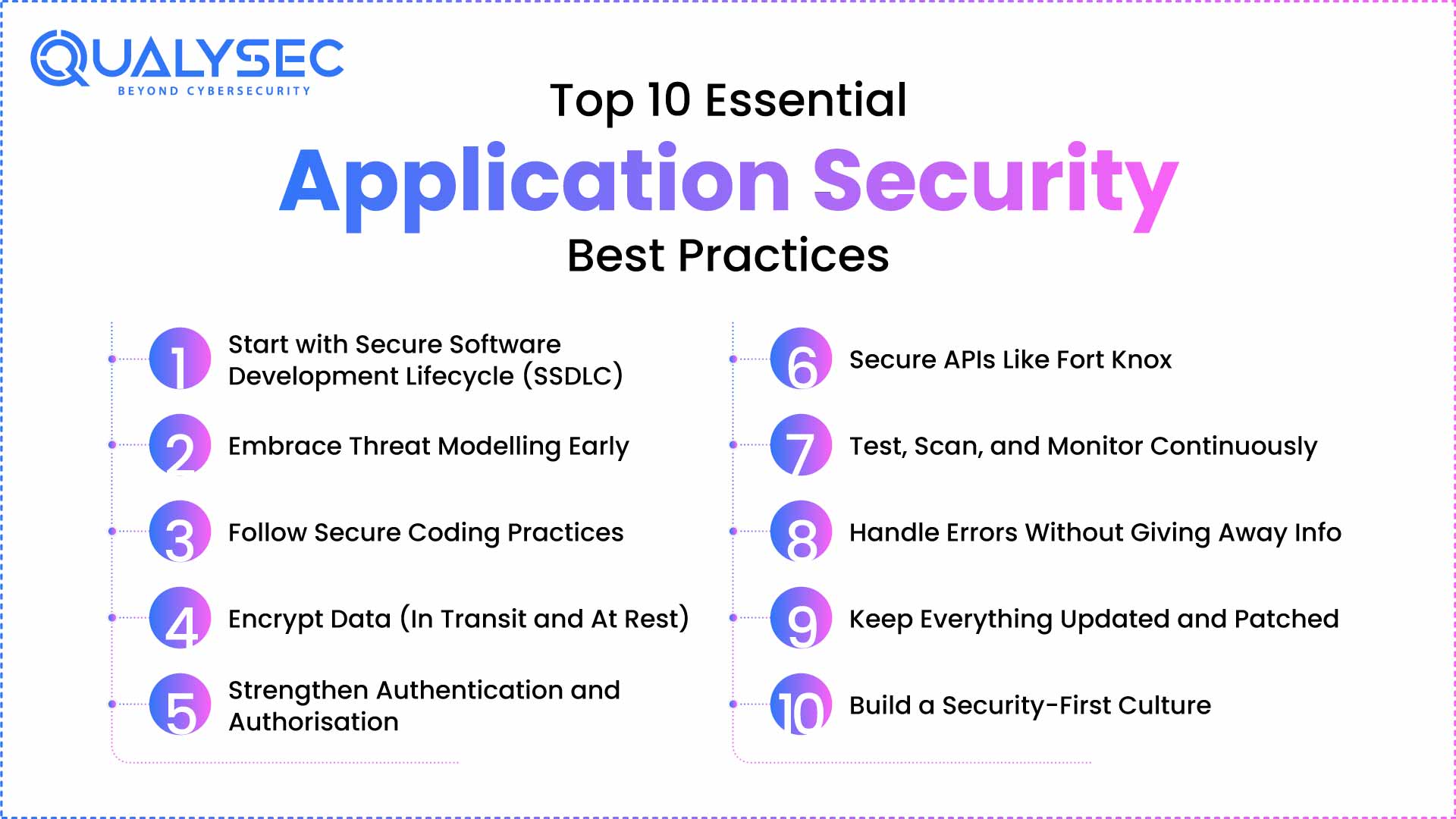
Here you can explore best practices for application security services.
1. Start with Secure Software Development Lifecycle (SSDLC)
During the software development process, businesses should not look at security as a secondary task to look into. Instead, it should be their first priority because a secure software development lifecycle (SSDLC) means you consider the security implications in every step. Begin by looking into security requirements and applying secure design principles.
You must enforce secure coding standards and couple secure scanning tools into the development and testing stages of the project. The sooner you catch security issues, the better.
Automate security into CI/CD pipeline so that you can catch security issues and vulnerabilities before the code reaches to the production stage. Breakdown security into workflows as it will reduce the risks and respond well to adjustments or even fixing issues faster.
2. Embrace Threat Modelling Early
Threat modelling allows you to adopt an attacker’s mentality so you can prevent attacks before they happen. It is a process that enables you to identify vulnerabilities within your app during the planning or design phase. Threat modelling frameworks, such as STRIDE or PASTA, can assist in the analysis.
Identify the assets that have value, the different threats that can happen, and how an attacker could potentially break that asset. And then plan how to mitigate that threat.
Practising threat modelling could save you a lot of time and money from re-designing your app later on (potentially larger costs than you had intended). Thus, threat modelling allows you to secure your architecture and app.
3. Follow Secure Coding Practices
The quality of your code has a significant impact on application security testing. Writing secure code includes things such as validating every input, sanitising your data, and avoiding common pitfalls such as hardcoded secrets and poor error handling.
The best approach is to always presume the input is malicious and never trust the user data provided. Use industry standards such as those provided by OWASP as your guidance.
Peer review and automated scans through tools such as SAST can help with identifying software vulnerabilities sooner rather than later in the lifecycle of the software. Secure coding is not the exclusive domain of the security team; all developers need to adopt the secure coding habit.
Discover OWASP top 10 vulnarabilites.
4. Encrypt Data (In Transit and At Rest)
Data is a key target, and encryption protects it from all kinds of attacks. Always use encryption to get rid of the data theft risks. Whether you’re protecting data in transit, such as under TLS 1.2 or better, or some sensitive information using robust symmetric algorithms such as AES-256, always employ encryption.
While you may feel safe storing a plain-text password, always opt to only store salted hashes, utilising bcrypt, Argon2, or similar algorithms. The management and storage of your encryption keys should be an artefact of the key management system, which is required to further secure your products, applications, services, and systems.
Encryption works best when the level of encryption is sufficiently strong and protects users from exfiltration of their data, even in the event of a compromise.
5. Strengthen Authentication and Authorisation
The code quality is directly proportional to application security. This means, while writing secure code, you are validating all inputs.
But, experts believe that it’s a good practice to always consider that code inputs can cause a threat, especially when they’re obtained from untrusted sources. That’s why you should never trust embedded user data. There are industry standards for secure coding, like the OWASP Top 10, to guide developers.
Furthermore, peer code reviews and automated code scans using Static Application Security Testing (SAST) can help expose vulnerabilities before hackers can exploit them. Secure software development isn’t just the duty of security teams to take care; developers at every level need to adopt these practices.
6. Secure APIs Like Fort Knox
APIs are the most targeted assets for attackers since they provide visibility into business logic and sensitive data. As part of Application Security Best Practices, make sure to authenticate every endpoint properly, and do not show data that is not required. Use API gateways to restrict and manage traffic.
Make sure you validate what is being sent in or sent back to prevent injection attacks. Enforce strict CORS policies and keep an eye on patterns of behaviour that appear unusual. If an API is secured, it can mitigate everything from data leakage to full compromise of a system. Do not ignore APIs; they are the front door.
7. Test, Scan, and Monitor Continuously
Security is not something to be done once. It’s a process. Regularly scan code using SAST and DAST tools. Analyze third-party dependencies using Software Composition Analysis (SCA). Regularly run penetration tests to identify real-life paths to attack.
Utilize monitoring tools for real-time detection of abnormal activities. Add security testing to CI/CD for automated testing of code. Continuous security testing and monitoring help with bad actors being detected sooner and providing faster feedback on any threats.
” Learn how to choose the right tools—read our blog on Application Security Testing Tools. “
8. Handle Errors Without Giving Away Info
Error messages are helpful to developers, but dangerous to attackers. Following Application Security Best Practices, exposing full-stack traces or detailed error logs to end users is never a good idea! Only show generic messages to your users, and log the full details internally.
Also, make sure your logs are not only stored securely, but also do not include sensitive data. Good error handling can help make your app easy to use while preventing the possibility of leaking out information that hackers could use to identify vulnerabilities.
9. Keep Everything Updated and Patched
Outdated software is one of the most simplistic ways for hackers to gain access. You need to be diligent about keeping your application dependencies, libraries, framework, and systems up to date. Sign up for all security advisories on all the tools you use.
Consider using automated tools like Dependabot or Snyk to automate updates when it makes sense. And, make sure you have a regular patching schedule, so what needs to be patched does not get ignored. By staying current, you can stay ahead of known exploits.
10. Build a Security-First Culture
Security doesn’t fall to the developers alone. It’s a team effort. Everyone who works on your team should receive basic training on security. Discuss new threats as they come up, report things without casting fingers, and acknowledge team members who might raise security ideas early.
Security should form a new aspect of your workflow, as part of your team’s conversation, and as part of your team’s objectives. Importantly, a culture where everyone has some stake in security can help lower risk at all levels.
” For more insights, check out our blog on Application Security Testing Services. “
How Qualysec Can Help
Qualysec is a security testing organisation, and we secure applications on behalf of organisations and enable them to identify and remediate vulnerabilities during the development cycle before they can be exploited by attackers.
No matter if you are launching a new product or maintaining an existing one, Qualysec offers a variety of services, including VAPT (Vulnerability Assessment and Penetration Testing on applications), API testing, Mobile App security, Cloud Infrastructure security and several other services.
Qualysec uses a combination of manual and automated tools to find[real] risks and not just generic results from [automated] scans. Qualysec differentiates itself by providing clear reporting and remediation support to help your dev team understand what they need to remediate and how to fix it.
We also provide compliance support to help you meet industry standards (OWASP, ISO 27001, PCI-DSS, GDPR, etc). With Qualysec, your company does not just test for security; you build a security-first mindset across your entire development cycle.
Secure your app with Qualysec — book a free security consultation today!
Final Thoughts
Application security is always changing. The threats you experience today won’t be the same as those you face tomorrow. That’s why Application Security Best Practices are not just suggestions—they’re essential requirements. Every phase of your application, from development to deployment, should include security planning and checks.
Keep your platforms up-to-date, your teams educated, and your processes tight. Your users rely on you to protect their information. Do it right, and your application will be more secure, stronger, and ready for whatever comes.
” Find top Application Security Companies—check out our blog. “

FAQ’s
1. What is application security, and why is it important?
Application security means complete app protection from cyberthreats or other vulnerabilities. It can be possible only by following some useful practices like secure coding, testing, and monitoring. It’s important because it helps business prevent data breaches or cyberattacts which could damage the company reputation.
2. What are the types of application security?
Common types include:
- Authentication And Authorisation
- Encryption
- Secure Coding Practices
- Firewalls
- Regular Vulnerability Assessments
These layers work together to keep your application safe from various types of attacks.
3. What tools are recommended for application security testing?
Popular tools like:
- Snyk
- Burp Suite
- OWASP ZAP
- Nessus
There are many more such tools that can help in finding security gaps during different stages of software development.