

Cyber threats are evolving every day, and strong passwords or antivirus software are not enough. To keep hacking systems ahead of hackers, companies are taking a more proactive approach by putting their systems to the test before someone else tests them. Offensive security services assess whether companies are vulnerable by mimicking real-life attackers to assess and fix engagement weaknesses. It is a smarter way to protect data, customers, and brands in the digital ecosystem.
What Are Offensive Security Services?
Offensive security services are about purposeful pre-emptive action ahead of the cybercriminals. The objective is to utilize cybersecurity experts to attack your systems before a real attack takes place.
Unfortunately, while some businesses wait for that attack to take place, hackers have already exploited them for multiple vulnerabilities. A good offensive security firm will highlight weak spots and fix them prior to hackers utilising them anyway.
It is a timely approach to ensure that everything from websites to internal tools is as secure as possible. It is just like a regular check-up, but for every facet of your business’s digital safety.
Read the related blog on: Offensive Cyber Security
Why Offensive Security Is Important in 2025
In 2025, online threats will be faster and more advanced than ever. Hackers have smarter information, and businesses cannot afford to wait for something bad to happen.
Offensive security practices help a business remain firm and in control by identifying issues sooner and resolving them promptly. It’s not just about protecting the data; it’s about ensuring that the business can continue functioning with a lower risk of disruption and no surprises that could be costly.
By taking measures proactively today, they may be saving themselves much more trouble tomorrow.
Types of Offensive Security Services
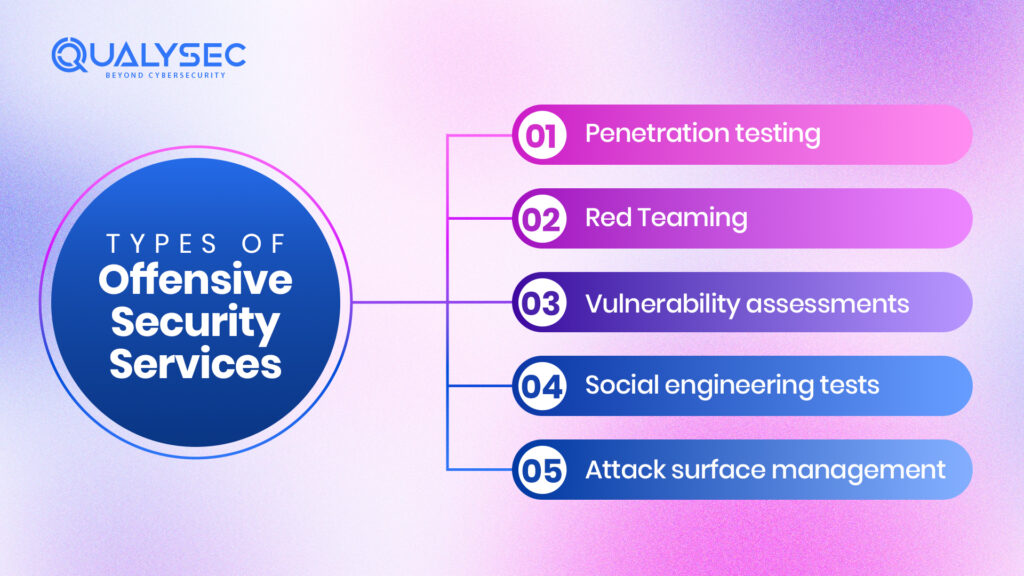
There is offensive security, and there are many types of offensive security that will test your systems differently. These services all work together to help you recognise weaknesses, strengthen your defensive strategy, and preemptively protect against threats. Below is a brief overview of the most common forms of offensive security.
1. Penetration testing
This is sort of like hiring a guy to break into your system (legally)! Penetration testing involves the tester will attempt to find weaknesses that a hacker might take advantage of, then report back to you (the business owner) how to fix them before any real damage is done.
2. Red Teaming
Red teaming is a more advanced attack assessment simulation for your business. Instead of a tester, a group of individuals act like real hackers to assess how well your business can detect and respond to a live cyberattack.
3. Vulnerability assessments
These are regularly scheduled scans of your systems and could be a regular tool that runs against common exposures like outdated software, missing software updates, etc., as part of routine vulnerability assessments. Built to help you ensure your systems are updated and protected.
4. Social engineering tests
These types of tests are used to assess how easily susceptible individuals or groups are being fooled. The assessments may be executed in the form of fake emails or phone calls. To see if employees voluntarily give up their sensitive business information, without any reasonable knowledge, they are giving it away.
5. Attack surface management
Attack Surface Management (ASM) helps find everything you have exposed to the internet, such as websites, applications, or other forgotten systems, so it can be secured and controlled in advance of a hacker discovering it.

Tools & Technologies in Offensive Security
Offensive security teams take advantage of different types of tools, including open-source tools, commercial platforms, and internally developed scripts. Some common ones are:
| Tool Name | Use Case |
| Metasploit | Exploitation framework |
| Burp Suite | Web app security testing |
| Cobalt Strike | Red team operations |
| Wireshark | Network traffic analysis |
| Nmap | Network scanning |
| NodeZero | Automated red teaming |
| Mindgard | AI-powered adversarial testing |
Benefits of Offensive Security Services
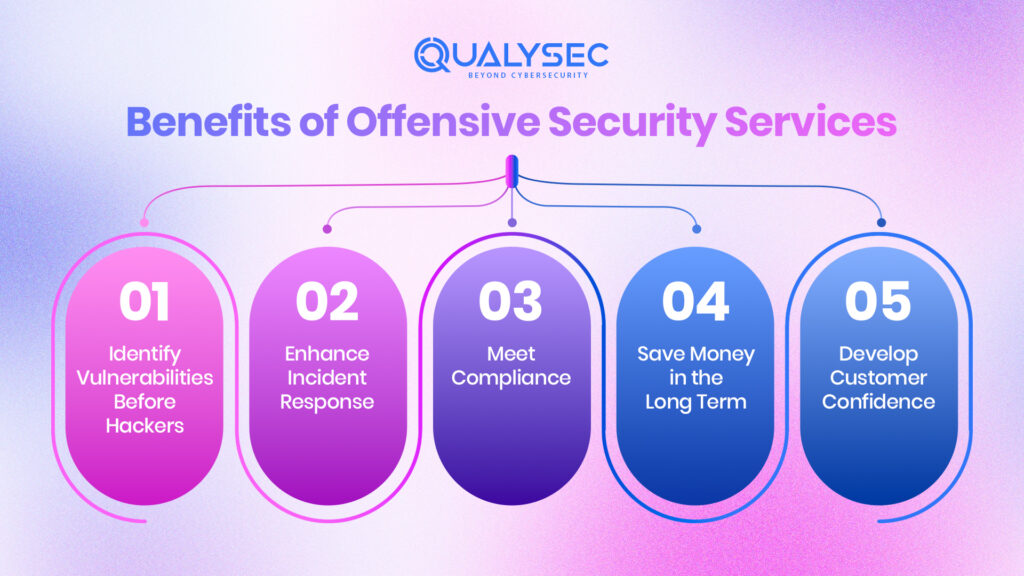
Here’s what businesses get from proactive testing:
1. Identify Vulnerabilities Before Hackers
Testing your systems early allows you to discover and fix problems before a hacker exploits them. This will help you avoid data leaks, downtime, and damage to your systems.
2. Enhance Incident Response
Simulated attacks provide practice for your security team, allowing them to learn from these drills and enhance their response. Having a rehearsal will prepare your security team to react quickly and help with more effectively managing the current threat.
3. Meet Compliance
Many industries have regulations that may require you to undergo testing and have evidence to show that you are secure as per the regulations. Offensive security testing can help you maintain compliance and avoid enforcement measures.
4. Save Money in the Long Term
Addressing the vulnerabilities before an attack is always less expensive than after an attack. If you find issues early on and fix them, you will be saved from significant revenue losses, enforcement penalties, or lawsuits.
5. Develop Customer Confidence
Customers will have greater confidence when they know that you are taking a strong stand to protect their data. This level of confidence is important as it shows that you are both a responsible organisation and serious about protecting your operations.
How Qualysec Can Help You
Qualysec is an industry-leading provider of offensive security services, helping companies protect digital assets by providing expert-led testing and actionable results. Whether you’re a startup or a massive organisation, Qualysec has services to suit your needs and industry.
Using real-world attack techniques, its team of certified professionals find impedance and hidden vulnerabilities in your systems before hackers do. For any aspect or facet of offensive security, Qualysec has you covered from penetration tests and red team tests to vulnerability assessments and social engineering tests, etc. You will get a complete picture of your risks and the actions necessary to remediate them.
An advantage of Qualysec’s services is their clear communication. Qualysec provides you with very clear expectations and outcomes, and once we finish a project, we do not just hand you a technical report but explain every finding, the risks involved in normal, non-technical language, and help you decide what needs to be remediated first.
With the help of our tools and methodology, you will improve your security posture, maintain compliance, and have comfort in knowing that your systems are being tested like an attacker would test them.
Conclusion
Offensive security services are not just optional, they are needed. With cybersecurity threats becoming more sophisticated by the day, companies are forced to take a proactive stance to secure their systems, data and reputations. By mimicking real-world attackers, offensive security services can uncover weaknesses before they become a real-world issue.
Commencing with either penetration testing service, red teaming or social engineering to achieve the same objective as those who are being mimicked – simply be ahead of the hacker. Investing in offensive security today means a better and safer future for your company.

FAQ’s
1. How is offensive security different from defensive security?
Offensive security is about determining and correcting faults by mirroring an attack scenario, while defensive security is meant to thwart and respond to real attacks. One is proactive, the other reactive, and both are necessary to provide complete and full protection.
2. What are the main types of offensive security services?
The main types of offensive security services are penetration testing, red teaming, vulnerability assessments, social engineering testing, and attack surface management. Each of these uses testing procedures to identify different types of risks in your systems.
3. Why should businesses invest in offensive security services?
Offensive security services can discover security vulnerabilities or flaws that are hidden before an attacker can find them. This can save a business costly breaches. Offensive security services can prepare you to respond accordingly when incidents happen, can protect customer data from theft, and help your customers trust you.
4. Who provides offensive security services?
Cybersecurity firms provide offensive security services, managed security service providers (MSSPs) provide offensive security services, and specialised companies exist as well to provide testing. They use many certified professionals and have advanced tools and technology to simulate real-world threats.
5. Do offensive security services help with regulatory compliance?
Yes, various types of regulations require regular testing and assessments of risk. Offensive security can help organisations address their compliance requirements and prove that their systems are built and maintained properly and securely (e.g., HIPAA, PCI-DSS, GDPR)
6. What should I look for in an offensive security service provider?
A service provider with the appropriate industry experience, with certified professionals, communications, an approach to testing, and a history of appropriate testing mattered most. Make sure the offered service suits your organisation and your compliance goals.