

Connected devices are expected to experience an explosion by 2025. The number of IoT device vulnerabilities on these devices every day has already hit 820,000, a 40 percent increase over the previous year: more devices increase the risk. The PSTI Act in the UK is one of the new regulations that have compelled a 33 per cent increase in spending on security in the world to comply with regulations. Retail, health care, and financial companies are currently spending on IoT security testing and remedies 17 billion every year. The average risk score of the devices increased by 15% from the average score of 7.73 in 2024 to 8.98 in 2025. Understandably, IoT risks have become one of the priorities of business leaders focused on achieving comprehensive IoT security.
Strengthen and make your business compliant. Discover how a professional cybersecurity audit and analysis by a qualified partner or an established IoT security testing company can be used to achieve your online objectives – contact us now!
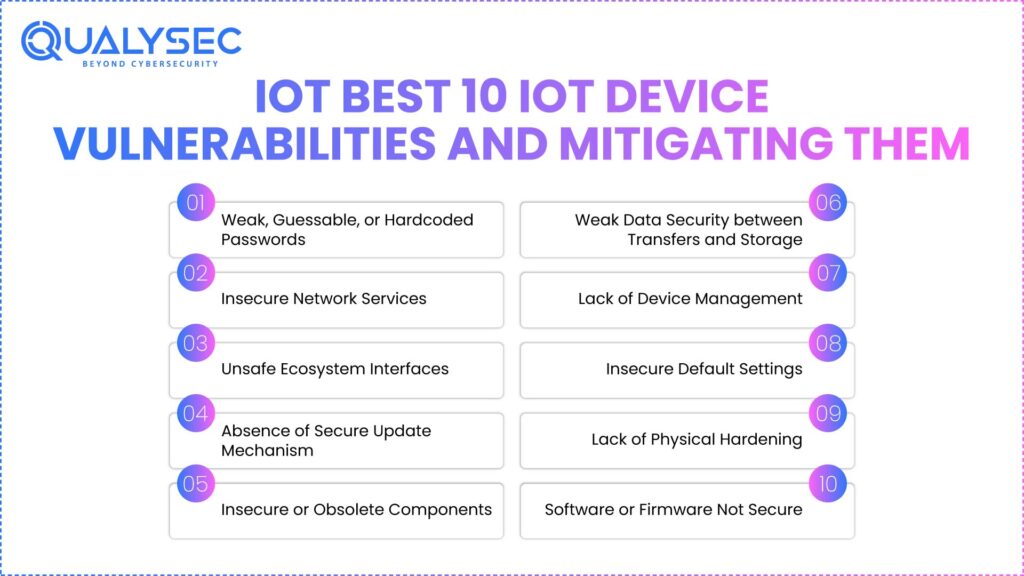
10 Best IoT Device Vulnerabilities and Mitigation Strategies
IoT keeps growing fast. The large and dynamic threat territory is in the form of smart TVs, wearables, industrial gateways, medical devices, and connected cars. IoT-based risks occur across all industries, and in most cases, the largest IoT threats and vulnerabilities are posed by improperly secured network systems and devices.
A step-by-step tutorial on the 10 IoT device vulnerabilities most popular in 2026, the latest tools to identify and manage them, and effective methods to conduct IoT security assessments, device penetration tests, and maintain protection will be provided below.
1. Weak, Guessable, or Hardcoded Passwords.
About
Default passwords or hard-coded passwords remain the most prevalent vulnerability in homes and industries. Hackers use them to construct large botnets as well as gain unauthorized access to devices.
How To
- Multi-factor authentication should be used.
- Auto password verification.
Mitigation
- Modify all default passwords immediately after the installation of the device.
- Use powerful and dynamic passwords.
- However, everywhere, use password managers and central login services.
- The use of strong passwords is a simple guideline in the IoT.
2. Insecure Network Services
About
Open ports, improperly configured services, and unpatched firmware would allow attackers to attack directly, such as deploying them as a DDoS or to spy on their network.
How To
Survey the network and put up firewall policies.
Mitigation
- Shut down extraneous ports and services
- Periodically scan networks of devices with a complex IoT vulnerability scanner.
- Isolate IoT networks and business systems that are critical to the business.
- Patch software and operating systems.
Learn more about Network Security Services
3. Unsafe Ecosystem Interfaces
About
Poor web, API, or mobile app interfaces permit an attacker to bypass the available security and steal sensitive device controls or data.
How To
- Check application security
- API Internet of Things vulnerabilities analysis.
Mitigation
- Apply powerful authentication, e.g., OAuth2 or single sign-on.
- All API traffic and web communication should be encrypted.
- Perform regular IoT Security Testing.
4. Absence of Secure Update Mechanism
About
There are no rollback options and unguarded firmware updates, which expose devices to malware and daily IoT security threats.
How To
- Updates on audit secure firmware.
- Check updates using cryptography.
Mitigation
- Apply trusted and signed firmware.
- Send update notifications and version management.
- Confirm the origin of all the update files.
5. Insecure or Obsolete Components
About
IoT software commonly uses old libraries and parts, which are prone to known issues that introduce risk to most deployments.
How To
Monitor elements and measure the risk.
Mitigation
- Implement a tough vulnerability-management initiative.
- Include frequent additions of components to development processes.
- Automated IoT scanners should be used to identify ancient dependencies.
6. Weak Data Security between Transfers and Storage
About
Unencrypted communication systems or poor local storage will allow attackers to steal data, collect credentials, and violate compliance.
How To
- Audit encryption policies
- Review secure storage
Mitigation
- Encrypt both the data that is transferred and the data stored in devices using TLS/SSL.
- Hinder illegal entry by extremely tight restrictions and supervision.
- Encrypt the key test every so often.
Learn more about on Data Security service
7. Lack of Device Management
About
Most companies do not operate the entire life cycle of IoT resources, leaving them behind as lost, unpatched, or forgotten, which increases risk.
How To
Discover and track assets
Mitigation
- Having a real-time list of all the devices connected.
- Use obvious onboarding and de-commissioning regulations.
- Periodically carry out an online IoT security assessment to identify gaps.
8. Insecure Default Settings
About
The defaults in factories commonly provide wide access to administration and unrestricted ports, and lax user privileges.
How To
Review security posture
Mitigation
- Always make sure that you prepare the settings of your device in advance.
- Disability of unnecessary services and ports.
- Use the least privilege principle on all the device roles.
9. Lack of Physical Hardening
About
In the absence of tamper-proofed ports, secure enclosures, or secure debugging plugs, an attacker may access ports, circuits, or debug plugs to steal data or put things down.
How To
Test physical security
Mitigation
- Apply tamper-evident cases and sensors.
- Restrict the accessibility of critical devices.
- Auto monitoring of environmental anomalies.
10. Software or Firmware Not Secure
About
The operating system, firmware, and slow response to the emerging vulnerabilities remain unpatched, leaving the systems vulnerable to more advanced IoT security threats and malware.
How To
- Conduct vulnerability scans on a regular basis.
- Audit secure code
Mitigation
-
- Arrange weekly evaluations and reviews.
- Collaborate with specialists in IoT Device Penetration Testing.
- Patch all the Internet of Things vulnerabilities detected by trusted tools as quickly as possible.
How Qualysec Technologies Can Help You
Qualysec Technologies has a global reputation for securing the future of IoT. Every project is about preventing attacks rather than identifying the vulnerability of devices, but making your business resistant to the rapidly evolving IoT device issues throughout every tier.
We offer complete IoT Security Testing, deploy an IoT vulnerability scanner, complete IoT device penetration testing, and offer industry-specific IoT security tests. Our team is well-rounded and focused because it has worked in retail, healthcare, finance, manufacturing, and infrastructure.
What sets Qualysec apart?
- Verified Process-Based IoT Security Testing – All tests are based on international IoT Security Standards and local regulations and are performed with the help of over 200 checkpoints and real-time threat information. This transparent procedure eliminates speculation, demonstrates actual business effect, and allows the leaders to ensure that we comply with local and worldwide regulations, be it is a simple IoT Security Audit or an in-depth device examination.
- Human + Machines – The human-centric approach is not just a scan or a general list. Specialists certify what they discover, experiment with fixes, and ensure that IoT threats and vulnerabilities are actually eliminated. All discovered, fixed, and procedures are recorded in a dashboard that is easy to view. This combination of professional advice, automation, and sound process provides you with protection that you can rely on and evidence at each level.
- Robust Solutions – Qualysec provides credible coverage from IoT device vulnerabilities. We remain partners, conduct frequent security exercises, simulate instant breaches, and provide profound remediation assistance. This makes all this better to achieve compliance and ensure your business runs smoothly. Select Qualysec to transform the way you cope with IoT Security – planned, repeatable, verified, and audit-ready.
Take charge of your surroundings actively – get an instant IoT security audit and professional evaluation at Qualysec Technologies!
Conclusion
Due to the increasing number of devices, data, and processes that are being transferred online, the risks of IoT device vulnerabilities are not abating. A layered program based on the global common IoT Security Standards, continuous scanning, and valid test skills can achieve the lasting security of this high-risk zone. The more time you delay, the higher the exposure, losses, and compliance issues. Join a current and proven impact-based protection force and partner with Qualysec Technologies.

FAQs
Q1. What are the most common IoT device vulnerabilities?
The typical IoT device vulnerabilities include weak or default passwords, outdated firmware, unprotected network services, weak encryption, and a lack of device management. These issues have made it easy to get into devices through attackers since they have an opportunity to use open ports, steal data, and propagate malware to many connected devices.
Q2. How can unsecured IoT devices be exploited by attackers?
Attackers steal logins, monitor network traffic, leave backdoors in firmware, and make use of weak APIs. After accessing data, they can steal, unlawfully access devices, become members of botnets to wage attacks in DDoS attacks, or infiltrate bigger networks, increasing risk.
Q3. How can organizations secure their IoT devices effectively?
Use robust logins, perform regular updates of firmware, encrypt data, utilize secure APIs, and divide networks. Monitor the activity of the devices, establish restrictive access policies, and scan the security regularly to eliminate vulnerabilities and address the issue before it expands, and keep up with the standards.
Q4. Why are IoT devices vulnerable to cyber attacks?
IoT devices are characterized by poor built-in security, hasty releases, and out-of-date software. The numerous interfaces, default settings, and minimal updates make them easy targets for the attackers.
Q5. Which IoT devices are most vulnerable to hacking?
The most vulnerable ones are routers, point-of-sale terminals, medical equipment, smart TVs, and wireless access points. They normally operate outdated software, have numerous network ports open, and default passwords, hence easy to hack and launch big attacks.
Q6. How can I identify vulnerable IoT devices on my network?
It lists all assets, automated scanning, and verification of default passwords or old firmware. Periodical IoT Security Audit and real-time behavior scans are used to identify and correct high-risk devices.
Q7. What are the consequences of IoT device vulnerabilities?
Poor IoT device vulnerabilities may lead to loss of data, network connections, loss of business, fines, broken reputation, and even loss of life in the health or industrial sector. A smaller infrastructure that is attacked by a hacked IoT system can result in increased risk as well.