

Cybersecurity is necessary in Singapore’s rapidly developing digital economy. Getting an official vulnerability assessment and penetration testing or VAPT certification, can help companies in the area show their security maturity, create confidence with interested parties, and meet compliance and regulatory expectations. This blog will cover a step-by-step procedure and major criteria on what VAPT certification in Singapore entails, why it is important in Singapore, and how to acquire it.
What is VAPT Certification?
VAPT is Vulnerability Assessment and Penetration Testing. It combines two closely related but different tasks:
- Automatic or semi-automated scans of systems, networks, and applications to detect security flaws and misconfigurations are known as vulnerability assessment (VA).
- Manual or semi-automated testing by ethical hackers simulating real-world threats to expose vulnerabilities, increase permissions, breach into systems, and learn how Penetration Testing (PT) deep the compromise could go.
- A VAPT certification means an organization has conducted manual or semi-automated testing and perhaps remediation to confirm its security posture.
Why Does this Matter in Singapore?
Doing VAPT is a proactive means to demonstrate that your company is fulfilling modern cybersecurity needs with Singapore’s digital infrastructure and rising regulatory expectations for data protection.
VAPT helps you expose flaws before hackers do, test your incident response and security measures realistically (instead of only depending on vulnerability scans).
Having a formal VAPT report or certificate can provide credibility and a competitive edge for tendering, partner evaluations, vendor selection, or compliance frameworks (e.g., ISO 27001, SOC2).
Process to Get VAPT Certification in Singapore
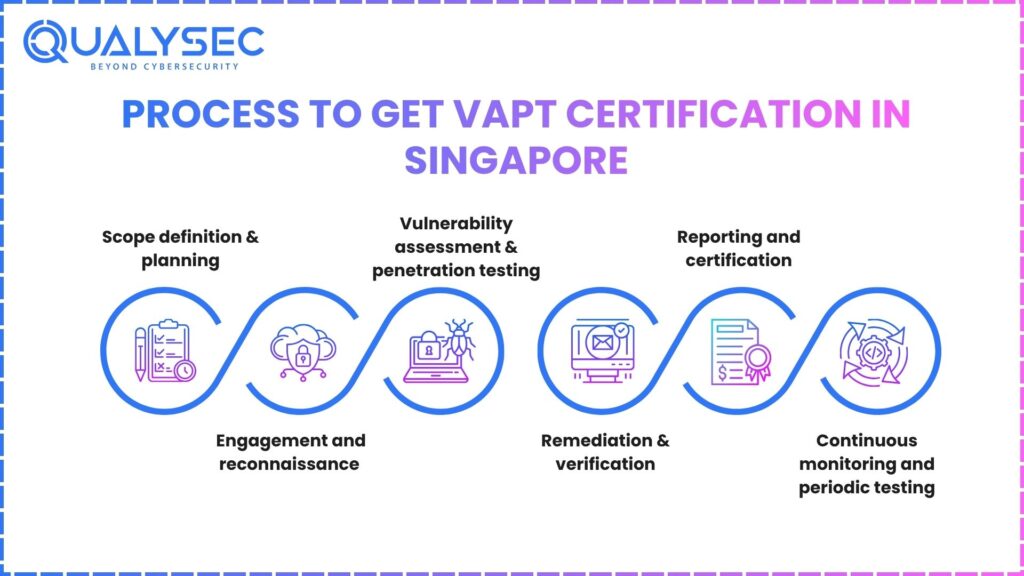
This is a step-by-step approach that an organization in Singapore would generally follow to get VAPT certification, aligning with regulatory requirements set by the Cybersecurity Services Regulation Office (CSRO) under the Singapore government.
1. Scope definition & planning
Decide first what systems will be within scope. Networks, cloud infrastructure, applications, APIs, IoT devices, and what kind of VAPT you are conducting: external vs internal vs combined; black-box, white-box, or grey-box. There are 3 scopes: black box (external, no prior knowledge), white box (internal/full knowledge), and the target’s grey box with partial knowledge.
2. Engagement and reconnaissance
You have to contact a VAPT vendor after the scope has been defined to perform reconnaissance, asset discovery, network mapping, application enumeration, and gather data about your environment.
Let Qualysec take care of the reconnaissance and inventory of assets; contact us to begin your VAPT with an expert team.
3. Vulnerability assessment & penetration testing
The core testing phase is this:
- Vulnerability scanning over specified assets and networks.
- Manual pentesting of vulnerabilities to verify risk and exploitability.
- For instance, categorizes phases: access acquisition, access upkeep, evidence gathering, and report generation.
You will probably want a local provider who is familiar with the threat environment and compliance expectations in the Singapore setting.
Schedule your VAPT implementation with Qualysec—expert-led vulnerability assessment and penetration testing customized for Singapore companies.
4. Remediation & verification
Once the vulnerabilities are found and used (proof-of-concept may be offered), your internal team (or the same vendor) will focus on repair: patching, reconfiguring, removing unneeded perks, etc. Some VAPT providers in Singapore often do a verification test or re-scan after fixes are implemented to make sure problems are handled. will include re-testing as part of their package.
5. Reporting and certification
You get a thorough report following security testing and verification: results, severity grades, exploitability, business effect, and remediation strategy. Some companies also send a “certificate” or “certification.” To be sure the VAPT has been finished correctly, Qualysec, for instance, records how they create a comprehensive list of vulnerabilities and a risk score.
Though Singapore has no single government-issued “VAPT certificate,” many providers will provide their own attestation or certificate of completion that you can provide to clients or authorities.
6. Continuous monitoring and periodic testing
Cyber threats change quickly. Following your first VAPT, it would be best to arrange periodic follow-up testing (annual, bi-annual) or following significant modifications (new applications, cloud migrations, significant network changes). Some Singaporean VAPT providers specifically advise continuous evaluations in place of one-time tests.
Download a sample penetration testing report for deep and actionable security insights.
Key Requirements & Considerations for VAPT Certification
What you’ll need internally
- Asset inventory: Understand your networks, applications, endpoints, VAPT services, and cloud instances.
- Access: Internal or white-box testing can call for credentials, code examples, or architectural specifics.
- Change window: Plan test dates (off-hours if required) as testing could affect services.
- Remediation ability: Patch and verify; be prepared to respond immediately to results.
- Governance and documentation: Keep VAPT audit trails, rectification records, and ideally link the VAPT findings to your more general information security management system.
Types of tests (so you can pick the right one)
- Black-box testing: External threat simulation devoid of interior knowledge.
- White-Box Testing: Complete system visibility and insider knowledge given
- Grey-Box Testing: Partial information given (some credentials or limited architectural description).
- You can also choose by asset type: network VAPT, application VAPT, wireless VAPT, and social engineering.
You may like to know more about Types of Penetration Testing – Black, White, and Grey box testing
Cost & Timeline Factors
The VAPT certification cost and duration in Singapore depend on variables including: number of assets, complexity (cloud + APIs vs plain website), level of testing (just Scope (external only versus internal + external) and vulnerability scans versus complete exploit-based pentest are two factors to consider. Costs span SGD 260 to SGD 13,000+, one study claims. For an in-depth effort, penetration testing can require 4–7 days.
Compliance and Legal Aspects
Although VAPT itself is not always legally required, many rules (for finance, healthcare, service providers, etc.) demand regular security testing; a VAPT report helps to prove compliance.
Select a provider that follows legal/ethical rules, non-disclosure agreements, and data protection legislation (especially if you’re dealing with personal data in Singapore under the Personal Data Protection Act 2012 (PDPA)). Make sure your scope includes all the assets under “control” for cloud, APIs, and third-party services.
Conclusion
In Singapore, obtaining a VAPT certification is a strategic move, not only a tick-box activity. Before hackers do, it helps you identify vulnerabilities, match with regulatory compliance and market expectations, and build resilience and trust.
Following a defined procedure guarantees your the defenses of the organization are strong and obvious. Partnering with an accomplished partner like Qualysec will simplify this process, offer specialized knowledge, and support you in producing significant VAPT security and compliance results.
Ready to go ahead? Contact Qualysec, assess your assets, choose the proper type of VAPT, and start a security-driven strategy suited to Singapore’s changing threat and regulatory environment.

FAQs
1. What significance does VAPT certification have?
It describes documentation/certification that your company has had a Vulnerability Assessment and Penetration Testing initiative and has been evaluated by a competent supplier who produced a report and certificate.
2. How much does a VAPT certificate cost?
Rates range widely depending on scale, assets, intricacy, and depth of the test. One source quotes SGD 260 up to SGD in Singapore. 13,000+, depending on asset size and complexity.
3. How long does a VAPT test last?
It varies: a limited scope could take a few days; a full cybersecurity penetration test across several assets could take 4–7 days (or more) for implementation. Plus more time for verifying and reporting.
4. Who can conduct VAPT?
Every company, from startups and small to medium-sized businesses to major corporations, is looking to evaluate its cybersecurity stance. Companies managing sensitive data in fintech, SaaS, essential infrastructure, healthcare, etc., should especially be concerned about this. The examination is also carried out by trained suppliers or in-house teams with VAPT testing credentials and ethics.
5. Is VAPT required by law?
Though not everywhere required for every company, many rules and frameworks essentially expect security audits and penetration testing; thus, while VAPT may not be the Law by itself is often a required component of compliance, vendor governance, and risk management.
6. How many types of VAPT are there?
There are many types, including:
- Knowledge of target: black-box, white-box, grey-box.
- External (outside network), Internal (inside network) by test site
- By asset class: Network penetration testing, application penetration testing, wireless testing, social-engineering testing, IoT testing.
Explore more about: Advanced Penetration Testing Services.