

Penetration testing enables the business to recognize vulnerabilities of their business in advance before hackers can exploit them. This is one of the most vital security practices that businesses in Singapore, where legislation like the Personal Data Protection Act (PDPA) and the Technology Risk Management (MAS TRM) guidelines of the Monetary Authority of Singapore are strictly applied, cannot afford to ignore. Qualysec Technologies is here to discuss the concept of web application penetration testing and how a trusted organisation can assist businesses to enhance their security.
Start your web app pentest now with Qualysec Technologies to be compliant and trusted!
What is Web Application Penetration Testing?
The web application penetration testing usually includes authentication, session management, data validation, encryption, API endpoints, and third-party integrations. The objective is to define the risks that include –
- SQL injection
- Cross-site scripting (XSS)
- Broken authentication
- Sensitive data exposure
- Security misconfigurations
These are congruent with the OWASP Top 10, an internationally accepted web application security testing standard.
Web App Pentesting vs. Vulnerability Scanning
Although vulnerability scanning provides a computer-generated list of problems, web app pentesting incorporates the human aspect of ingenuity and skill. Penetration testers reason as a hacker and combine vulnerabilities to show that relatively small problems may result in major violations.
Why Web App Pentesting is a Requirement in Singapore
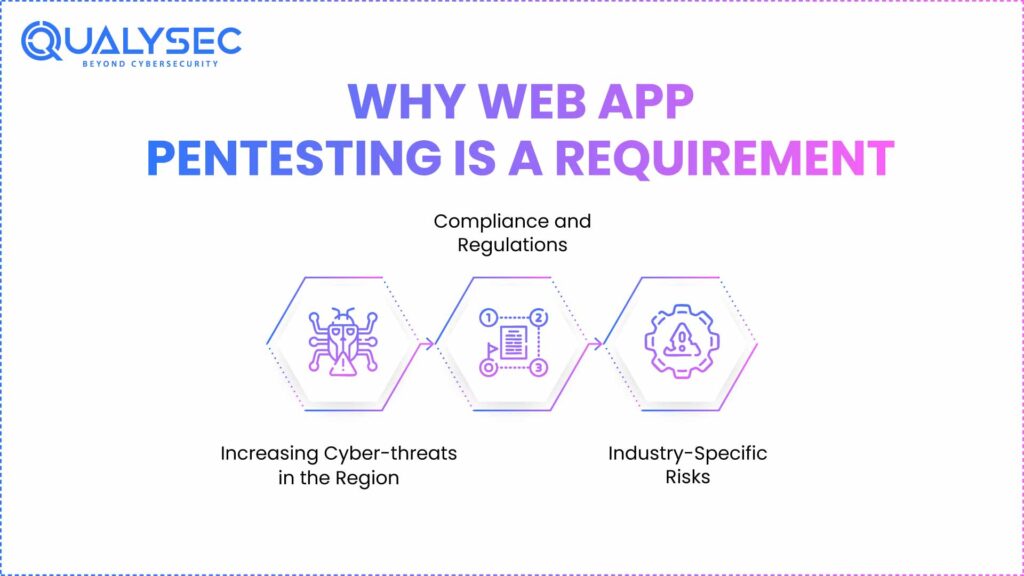
Increasing Cyber-threats in the Region
The Cyber Security Agency of Singapore (CSA) claims that attacks by ransomware and phishing targeting web-based platforms are on the rise. It means that businesses that poorly secure their applications can cost them money, damage their reputation, and cause regulatory sanctions.
Compliance and Regulations
Singapore implements very strict cybersecurity standards –
- Cybersecurity Act – Regulates the securing of critical information infrastructure.
- PDPA – Businesses are required to ensure that personal data is not accessed by unauthorized individuals.
- MAS TRM Guidelines – Require financial institutions to have solid IT and cybersecurity controls.
In the case of businesses that conduct their operations in these controlled lines, performing periodic penetration testing on web application is not only an option but a compliance requirement.
Read Also: Data Security Compliance: A Step-by-Step Guide
Industry-Specific Risks
- Finance – There are threats of data theft, insider threats, and fraud.
- Healthcare – Patient information security breaches may be both legally and ethically damaging.
- E-commerce – Hacked websites can result in loss of payment details and credibility of the company.
Penetration testing on web application is an immense benefit to these industries in particular.
How Penetration Testing Works
Web application security testing and penetration testing on website methodology typically includes the following steps –
Pre-engagement and Planning
Scope is determined, objectives are established, and approvals are secured. This makes testing legal and business-oriented.
Threat Modeling
Testers get to learn the application architecture, business logic, and potential attackers.
Exploitation and Vulnerability Test
Testers will use automated tools and manual techniques in an effort to take advantage of vulnerabilities such as weak authentication or an injection flaw.
Reporting and Remediation
Critical reports provide vulnerability, exploit techniques, and mitigation recommendations.
Download our Sample Penetration Testing Report to understand how vulnerabilities are reported and mitigated.
Methods of Web Application Penetration Tests
Manual vs Automated Testing
Although the automated scrollers are more rapid, manual pen testing will find logic bugs and chained exploits that are not typically found with tools. The combination of the two is the best strategy to use.
Testing Approaches
- Black Box Testing – No prior knowledge of the application; represents an external attacker.
- Grey Box Testing – Biased information; tries to mimic a threat by an insider or a hacked account.
- White Box Testing – Ubiquitous knowledge of the codebase; most suitable for total security validation.
Explore more: Types of Penetration Testing – Black, White, and Grey box testing
Common Tools
Popular tools like Burp Suite, OWASP ZAP, and custom scripts are also available, but these are used in combination with human knowledge to cover all grounds.
Web App Penetration Testing Benefits
- Risk Mitigation – Identifying and eliminating vulnerabilities will minimize the risk of cyberattacks.
- Compliance Alignment – Assists the business in complying with PDPA and MAS TRM.
- Customer Data Protection – Provides protection of sensitive customer information, which builds customer trust.
- Brand Reputation – It helps in avoiding reputation losses that can almost always follow breaches.
- Cost Savings – It is much more affordable to deal with problems at the initial stage than to deal with them at the full-scale breach stage.
Investing in penetration testing on website can help businesses in Singapore to avoid both immediate losses and eventual losses that would arise in the long run.
Protect your business from costly data breaches. Get transparent pricing for Web Application Penetration Testing today.
Issues in Web App Pentesting
Even though it has been proven to be beneficial, there are still a lot of misconceptions about it –
- It is too costly – The reality is that testing is only very cheap relative to the loss that may be incurred once a data breach has occurred.
- Automated tools are sufficient – Automated scans are simply incapable of simulating human intelligence or detecting business logic errors.
- Once is enough – The applications are constantly updated, and they should be tested repeatedly.
Understanding the Right Partner for Pentesting in Singapore
In choosing a provider to test the security of web applications, the business should consider –
- Certifications – Target CREST, OSCP, and CEH-certified testers.
- Knowledge of compliance – Familiarity with the PDPA, MAS TRM, and other rules of Singapore.
- Reporting & Support – Specific remediation advice and not general reports.
Choosing Qualysec Technologies for Web Application Security
In a digital-first economy such as Singapore, organisations are under constant pressure to ensure that their web applications are secure, compliant, and trustworthy. There are always new vulnerabilities that cybercriminals are seeking to take advantage of, and the regulatory bodies are making stricter regulations on data protection. That is why organizations must use web application vulnerability assessment to find their vulnerabilities.
Qualysec Technologies, as a trusted cybersecurity ally, provides end-to-end web application penetration testing services that are specifically designed to address the challenges facing Singaporean businesses.
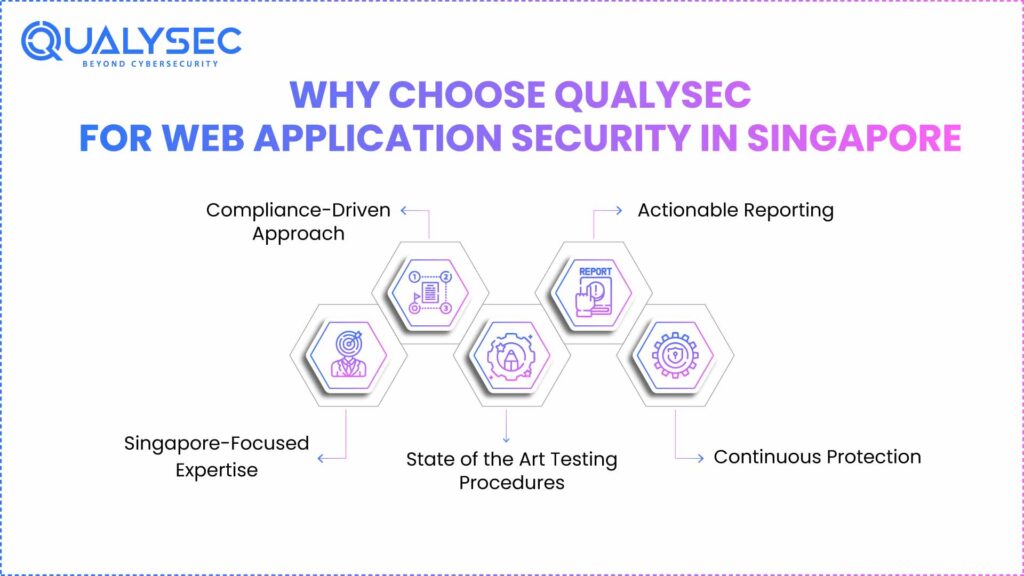
Singapore-Focused Expertise
Each region has personal compliance requirements and industry risk. Our team is knowledgeable of the Singapore digital landscape and can, therefore, align testing practices with the laws and industry needs. Whether it is financial services and healthcare organizations or government portals and e-commerce platforms, we are familiar with the threats that organizations in Singapore face daily. This allows us to come up with technically sound penetration tests that are also business-relevant.
Compliance-Driven Approach
Formal policies such as the Personal Data Protection Act (PDPA) and Technology Risk Management (MAS TRM) guidelines in Singapore require organizations to protect the data and other key systems of their customers. At Qualysec, we map our testing process to these frameworks and to global standards, including ISO 27001.
State of the Art Testing Procedures
Qualysec uses both manual skills and automated tools, unlike providers that use automated tools to ensure the highest accuracy in their work. Our certified ethical hackers apply practical attack methodologies to simulate the way cyber attackers will seek to crack into your system.
Actionable Reporting
The value of a penetration test is only as good as the insights that it gives. At Qualysec, we do not hand over a list of vulnerabilities. In its place, we provide comprehensive and simple-to-digest reports specifying the nature of each problem, its possible business impact, and step-by-step and clear remediation instructions.
Continuous Protection
Our continuous testing, monitoring, and advisory services help you keep your applications safe against any new threats. This ongoing strategy will make security less of a response endeavor, but it will become a business facilitator.
Through collaboration with Qualysec, Singapore companies will no longer have to be satisfied with compliance box-ticking. Instead, they can use penetration testing on website to gain customer trust, protect their reputation, and develop a sustainable competitive advantage.
Secure your apps with Qualysec Technologies today!
Conclusion
At the most fundamental level, web application penetration testing is a formal activity of assessing the security of a web application through active probing in search of vulnerabilities. According to the penetration testing, unlike the simple vulnerability scans that simply identify the existing vulnerabilities, the penetration testing services goes a notch higher by taking advantage of the vulnerabilities in a controlled way. This can enable organizations to see the actual consequences of a successful attack.
Don’t wait for a breach – get continuous protection. Book your assessment with Qualysec Technologies!

FAQs
1. What is web application penetration testing?
Web application penetration testing is a coordinated security activity in which ethical hackers replicate real attacks on a web application. The goal is to identify vulnerabilities like SQL injections, cross-site scripting, or broken authentication before malicious actors can use them.
2. What are the 5 stages of penetration testing?
There are usually five stages in the process –
- Planning – Scope, objective, and authorization.
- Reconnaissance – Collection of knowledge concerning the target application.
- Web application vulnerability assessment – This involves the identification of the weak points and flaws.
- Exploitation – Trying to take advantage of the vulnerabilities in a directed manner.
- Reporting – Writing a report that includes remediation measures.
3. Which tool is best for web application penetration testing?
No one “best” tool exists because it all comes down to context. The true power is using these tools in addition to the experience of trained pen testers capable of identifying problems that automated systems overlook.
4. Is it illegal to pentest a website?
Yes, penetration testing is not illegal, provided that it is carried out with the prior consent of the application owner. To make sure that the test fortifies security without affecting business, ethical hackers operate within a set scope and methodology. Unauthorized testing is unlawful, however, and qualifies as malicious hacking.