

Millions of users’ data can be exposed in minutes by a single cloud misconfiguration, and this is not an infrequent occurrence anymore. Organizations all throughout India are quickly switching to AWS to get operating flexibility, speed, and scalability. Regrettably, security maturity frequently does not develop at the same speed as cloud adoption, leaving holes that attackers actively use. Modern cloud breaches usually start with sophisticated malware. They instead begin with subpar storage, open APIs, poor IAM permissions, or workloads never properly scanned. Without the right AWS security tools in place, these problems are hard to detect.
Cloud ecosystems will be more automated, API-driven, and dispersed than ever by 2026. This renders manual security inspections useless. Companies must have organized AWS vulnerability scanning, real-world AWS penetration testing, and ongoing AWS security assessment to identify real threats.
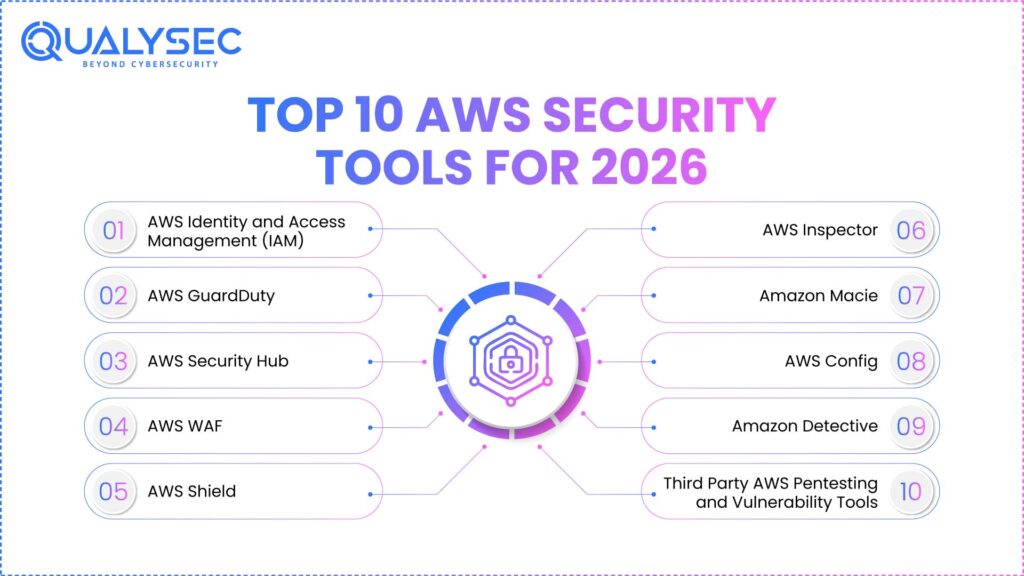
The Top 10 AWS Security Tools for 2026 are presented in this book, along with their relationships, limitations, and ways Indian companies might prevent the most common cloud security errors.
Why AWS Security Tools Matter More In 2026
Cloud threat models have changed tremendously. Attackers have abandoned infrastructure breaches as their main target. They take advantage of configuration errors that silently provide access without alerting. Over-permitted IAM roles let attackers move laterally across services once a single credential is compromised.
Though they are also among the most abused entrance points, APIs have become the foundation of cloud solutions. Data exfiltration without touching the application UI is made possible by exposed endpoints, poor authentication, and flawed authorization logic. These problems remain unseen without AWS Application Security Testing.
AWS environments are likewise always shifting. Automatically spinning up new EC2 instances, containers are recreated daily, and serverless capabilities inherit permissions dynamically. At size, manual audits miss these developments. Real-time awareness demands AWS cloud security services measures and up-to-date AWS security tools.
Layers define a mature strategy. Baseline monitoring and alarms are available via AWS native security tools. Regular AWS cloud penetration testing confirms whether defenses hold up against real attacker behavior. Third-party AWS pentesting tools validate whether findings are exploitable.
Many Indian businesses bridge this gap via validation-driven testing from Qualysec, notably before audits or big cloud growth.
What Are AWS Security Tools?
Designed to safeguard cloud identities, workloads, applications, APIs, and stored data, AWS Security Tools are services. To give visibility and control in dynamic cloud settings, they work across identification, network, applications, and data levels.
These tools enable teams to move from reactive incident response to proactive risk management. Early, security teams can pinpoint risky setups and suspicious activity instead of finding violations once damage is done.
Their participation in AWS vulnerability scanning tools, threat detection, compliance mapping, and application protection is direct. Set up properly, they simplify regulatory audits and shorten breach dwell time.
AWS tools mostly find signals and misconfigurations, though. They sometimes do not demonstrate actual global influence. Organizations usually think they are safe when they are not, unless they undergo regular AWS security assessments and exploit validation.
Best AWS Security Tools For 2026
1. AWS Identity and Access Management (IAM)
Best for: Identity control and least privilege enforcement
AWS IAM forms the base of AWS security. Each user, service, and API interaction depends on an identity. Most AWS attacks start with hacked or improperly used credentials rather than with program flaws.
IAM lets companies define delicate user and service permissions. Role-based access helps to avoid hard-coded secrets within programs, but transient credentials help to minimize long-lived exposure.
Particularly for privileged users, multi-factor authentication provides still another layer of security. IAM complexity, though, frequently results in over-permissions over time, therefore generating hidden escalation pathways.
Every AWS security assessment checklist centers around IAM reviews. Often discovered during AWS pentesting are privilege escalation paths buried inside IAM policies.
2. AWS GuardDuty
Best for: Threat detection using behavior analytics
Constantly evaluating CloudTrail logs, VPC Flow Logs, and DNS activity, AWS GuardDuty. Rather than depending on fixed signatures, it identifies abnormalities using behavioral analysis.
It detects port scanning, credential abuse, aberrant API behavior, and communication with well-known bad IPs. Early breach detection benefits from this.
By giving relevant events first priority, GuardDuty helps to alleviate alert exhaustion. It does not, however, confirm attackers’ capacity to carry out activities once entry is achieved.
Usually, AWS cloud pentesting provides this validation by testing how observed behavior translates into actual effect.
3. AWS Security Hub
Best for: Centralized security posture management
Multiple native AWS security solutions’ results are collected in one dashboard by AWS Security Hub. This makes it possible to see across accounts and areas.
It lets ongoing AWS security assessments map results against compliance systems. For major Indian businesses, this streamlines governance and reporting.
The difficulty is deciding which to give first importance. Security Hub brings up concerns, yet it does not clarify which ones result in complete compromise. Hand verification is still needed.
4. AWS WAF (Web Application Firewall)
Best for: Protecting web apps and APIs
Common web assaults, including SQL injection and cross-site scripting, are shielded by AWS WAF on applications. It furthermore manages both traffic and API abuse.
WAF is a key line of defense for companies that openly make APIs available. Misconfigured rules, on the other hand, frequently generate blind spots that attackers take advantage of.
To find logic flaws, authentication bypasses, and business logic misuse that firewalls cannot identify, you must combine AWS Application Security Testing with WAF.
Qualysec validates WAF effectiveness during API and application pentesting!
5. AWS Shield
Best for: DDoS protection
AWS Shield safeguards against availability-targeting distributed denial of service attacks. Shield Standard gives basic protection; Shield Advanced incorporates improved monitoring and reaction.
For Indian fintech and e-commerce security solutions, downtime affects credibility and revenue directly. Shield absorbs massive-scale strikes on its own, therefore lowering operational disturbance.
Attackers sometimes mix application attacks with DDoS, however. This calls for more general testing.
6. AWS Inspector
Best for: Automated vulnerability scanning
Known vulnerabilities in AWS Inspector are searched for across EC2 instances, containers, and Lambda functions. It finds missing patches, antiquated libraries, and exposed services.
AWS vulnerability analysis tools built on Inspector’s base. It enables groups to give remediation top priority and lower acknowledged risk.
Inspectors eschew exploitation. Unless combined with AWS penetration testing technologies that verify actual attack paths, this produces false confidence.
7. Amazon Macie
Best for: Sensitive data discovery
Amazon Macie finds sensitive data kept in S3 by means of machine learning. It locates exposed PII, financial information, and improperly set up buckets.
This capacity is quite important under India’s DPDP Act, when data disclosure could result in penalties and reputation harm.
Macie enhances visibility but does not address access difficulties. Data security still relies on IAM policies and bucket setup.
8. AWS Config
Best for: Continuous configuration monitoring
AWS Config monitors configuration modifications and assesses their compliance with regulations. It catches divergence from security baselines.
Config strengthens long-term AWS security assessment initiatives, which also helps audit readiness. It is especially useful in controlled industries.
Config, however, reports misconfiguration, not exploitability. Testing is needed for validation.
9. Amazon Detective
Best for: Incident investigation
Amazon Detective combines data from VPC logs, CloudTrail, and GuardDuty. It maps paths of attack as well as chronologies.
This improves incident response correctness and cuts down research time. In the analysis following an event, a detective proves rather helpful.
It enhances preventative steps like AWS cloud pen testing, not replaces them.
10. Third-Party AWS Pentesting and Vulnerability Tools
Best for: Real-world attack simulation
AWS native tools concentrate on detection and monitoring. They do not reproduce assault behavior. AWS pentesting techniques address this void.
In actual assault scenarios, they evaluate IAM escalation, API logic defects, application vulnerabilities, and misconfigurations. This confirms whether controls really function.
A sophisticated cloud security services strategy uses skilled-led AWS pentesting in addition to AWS solutions.
Qualysec provides manual and automated AWS cloud pentesting for Indian enterprises!

AWS Native Security Tools Vs AWS Pentesting Tools
| Area | AWS Native Security Tools | AWS Pentesting Tools |
| Purpose | Monitoring and alerts | Exploitation and validation |
| Automation | High | Moderate |
| Attack realism | Limited | High |
| Compliance value | Strong | Strong |
| Risk confirmation | Partial | Complete |