

Undoubtedly, the APIs have become the foundation of this digital economy. But with the increase in the pace of API adoption, the risk is high. Research reveals that 71% of web traffic will pass through APIs. That makes them prime targets for cyberattacks, data leaks, and compliance violations. The selection of the best API security company does not rely only on technical aspects. It goes far beyond that. That is why in this blog, we have carefully selected a list of top API security companies that are well-recognised for their specialised focus, proven performance, and industry relevance.
Top 10 API Security Companies in 2026
1. Qualysec
Qualysec is one of the best api security companies, offering API, web, mobile, IoT, and cloud penetration testing solutions to assist companies in identifying and removing vulnerabilities before attackers exploit them. Our unique API testing protocol is aimed at detecting authentication vulnerabilities, data exposure vulnerabilities, misconfigurations, and logic-based attacks.
Qualysec has its testing practices in line with ISO 27001 and SOC 2 compliance. We offer detailed reports, risk prioritisation, and remediation guidance with tailored enterprise API security solutions.
Best suited for organisations seeking a hybrid approach for pen testing and vulnerability assessment, Qualysec has become one of the most trusted api security companies.
Key Features:
- Easy identification of vulnerabilities
- Enhanced API security
- Alignment with guidelines to maintain compliance
- Detailed remediation guidance
- Third-party pen test report

2. Salt Security
Salt Security, one of the leading api security companies, is known worldwide for introducing AI-based API security. The company protects businesses in the development, testing, and running processes. Its API Context Engine provides deep visibility into all active and shadow APIs, automatically identifying abnormal behaviour and potential attacks. The system is coupled with CI/CD pipelines and cloud computing. They provide dynamic learning and active monitoring to identify zero-day vulnerabilities in real-time.
Key Features:
- Security solutions across the entire lifecycle
- Reduce attack surface
- Create a unified inventory and full API landscape view
- Govern posture and compliance
- Extend data security to APIs to track sensitive data
3. Wallarm
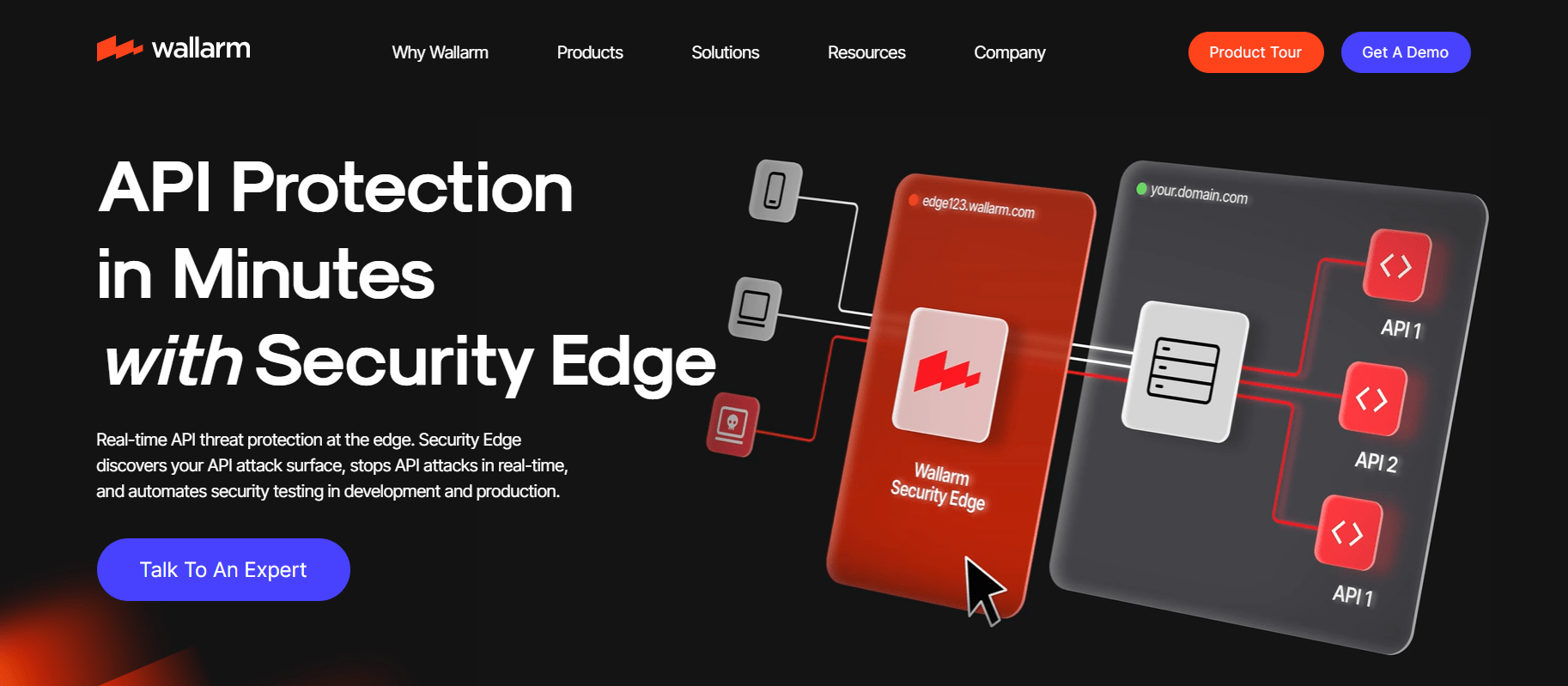
Wallarm delivers a comprehensive platform designed to discover, test, and block attacks on APIs, microservices, and even generative-AI endpoints in multi-cloud and hybrid environments. It covers the full spectrum from inventorying shadow APIs to real-time blocking of threats like OWASP API Top 10, L7 DDoS, and bot abuse, offering exceptional API security services.
Key Features:
- Discover and identify exposed APIs and services
- Mitigate threats against bots, AI, and L7 DDoS
- Monitor threats continuously
- Automate API security testing in CI/CD
- Fast and easy deployment
4. Traceable Inc
Traceable offers a purpose-built API security platform that automatically discovers and inventories every API. They also apply context-aware machine learning to detect abuse, logic flaws, and data exfiltration. Traceable incorporates API vulnerability testing as part of the SDLC and out-of-band protection of the runtime. As one of the most reliable api security companies, it is best for companies that have a dynamic and highly changing environment of cloud-native, microservices, and GenAI use cases.
Key Features:
- API testing with dynamic payloads
- Rapid scanning without disruptions
- In-depth vulnerability reports with CVSS/CWE scores
- Unified testing aligned with CI/CD Workflows
- Enterprise-scale API security testing
5. Imperva
Imperva is one of the longest-standing names in application and API security. They have been known to integrate web application firewalls (WAF), bot management, and API protection into one platform, WAAP. Its API security services also comprise auto endpoint discovery, schema validation, and live remediation.
Key Features:
- Continuous API discovery and monitoring
- Business-logic threat protection
- Secure APIs
- Extend protection through integration
- API risk assessment
6. Fortinet

Fortinet, one of the most well-known API security providers, has its cybersecurity ecosystem for API protection through its FortiWeb Web Application Firewall (WAF) and FortiADC Application Delivery Controllers. The platforms identify and prevent API-based vulnerabilities through machine learning, behavioural analysis, and signature intelligence based on FortiGuard Labs.
Key Features:
- Leverages AI and ML for threat detection
- Offers protection against bots
- Validation of API requests against defined schemas
- Seamless integration of API security into the CI/CD pipeline
- Supports mobile applications
7. Akto
Akto is a developer-centric, modern, and open-source API security platform automating API discovery, inventory, and testing. It also seamlessly integrates into CI/CD pipelines and forms misconfigurations automatically. It additionally addresses the exposure of sensitive data and OWASP API Top 10 vulnerabilities in development.
Key Features:
- Automatic discovery and catalog of APIs across infrastructure
- Automated API security testing
- Identify and safeguard sensitive data
- Detect and block API attacks
- Integrated API security in the CI/CD pipeline
8. Beagle Security
Beagle Security, one of the leading API security providers, is a web application, mobile application, and API-oriented penetration testing platform. Its API testing component replicates the attack environments. The platform creates in-depth vulnerability reports along with risk scores.
Key Features:
- Complete access & authentication control over all APIs
- Exceptional API compliance
- Prioritize vulnerabilities easily
- Seamless pen testing of all enterprise endpoints
- AI-powered API penetration testing
9. Akamai

Akamai is designed to secure modern, cloud-native applications and APIs at scale. It identifies APIs automatically, verifies schema conformance, and identifies exploits to logic errors or misuse of endpoints opened up. As one of the leading API security companies, Akamai’s global network provides seamless protection.
Key Features:
- Assess API traffic
- Discover, inventory, and tag all APIs
- Constant monitoring for compliance
- Block API attacks
- Identify data leaks, API attacks
10. Invicti
Invicti is most renowned because of its dynamic application security testing (DAST) and API security scanning. It allows organisations to constantly test web and API points for vulnerabilities like SQL injection, XSS, as well as misconfigurations. The scanning technology is based on proof to verify vulnerabilities automatically and to remove false positives. It is also compatible with CI/CD tools, issue trackers, among others.
Key Features:
- DAST-based API security testing
- Easy discovery of shadow APIs
- Zero-config API discovery
- Smooth AI gateway integration
- Unified remediation guidance and protection
Watch our on-demand webinar on why API penetration testing is important.
How to choose the best API security company in 2026?
Choosing the best API security companies in 2026 is not as easy as clicking on the first name that pops up on the search engine.
There are several factors that play a critical role in this selection. These are –
1. Discovery and inventory
It is important to know whether the API security companies you are looking into will be able to locate all APIs in production and staging, the shadow and deprecated ones. Confirm that it is capable of classifying sensitive information and tracing to the OWASP API Top 10 2023 risks.
2. Testing and validation
Check if the company can offer continuous testing of auth, authorisation, and business logic. This is absolutely essential.
3. Runtime protection
Dig even deeper and assess behavioural analytics, schema validation, rate limiting, bot and abuse controls. Talk with the team and confirm protection for BOLA and other logic abuse patterns.
4. Compliance alignment
It is critical that the evidence be mapped to ISO 27001 or SOC 2 controls. Make sure you talk in detail about this before making a decision.
Conclusion
APIs are gradually becoming one of the most notable and lucrative aspects of modern businesses. While they seamlessly connect cloud services, data, and digital experience, they also lead to the introduction of complex threats that need modern solutions. Choosing the best API security companies is super-critical for your business.
At Qualysec, our experts understand the underlying threat and the importance of accurate pen testing and vulnerability assessments. With years of experience, we deliver exceptional testing services, including API penetration testing, for various industries.
FAQs
1. How does cloud security architecture differ from traditional IT security?
Traditional security assumed a fixed perimeter and stable assets on premises. Cloud security shifts to elastic, distributed services with shared responsibility. Controls are identity-centric and software-defined.
2. What are the common cloud security threats and risks?
The typical examples of cloud security threats and vulnerabilities are identity and access vulnerabilities, insecure interfaces and APIs, misconfiguration, untrustworthy third parties, and poor visibility. These threats are, in fact, directly related to real incidence.
3. How can organizations assess the effectiveness of their cloud security architecture?
Organizations can assess the effectiveness by testing whether controls actually stop threats. For this, it is best to start with visibility. Opt for audit identity access, encryption, and API configurations. Use posture management tools to detect misconfigurations, then validate through penetration testing and API vulnerability assessment.
4. What is zero-trust architecture in cloud security?
Zero Trust assumes no implicit trust. That means every user, device, and API request must be verified each time. It enforces least privilege, continuous authentication, and micro-segmentation across cloud workloads.