

Key Takeaways
- Only 6.5% of firms passed every check in the ESAs’ 2024 dry-run, which is why external DORA compliance expert advice has become common practice rather than an exception.
- Good DORA compliance consulting services combine regulatory knowledge with hands-on technical testing, not just policy documentation.
- DORA compliance software can handle tracking and reporting, but it doesn’t replace the judgment a consultant brings to gap remediation.
- The right DORA compliance consultant should be able to name specific RTS articles relevant to your entity type, not just describe the five pillars generically.
- TLPT now has binding technical detail: Commission Delegated Regulation (EU) 2025/1190 mandates purple teaming and a minimum 12-week active red team phase for in-scope entities.
What does DORA compliance consulting cover? It typically spans a readiness assessment against DORA’s five pillars, gap remediation planning, Register of Information support, third-party risk documentation, and, for significant entities, coordination of Threat-Led Penetration Testing through CREST-accredited providers.
Introduction
The ESAs’ own 2024 dry-run exercise found that only 6.5% of nearly 1,000 firms tested across the EU passed every requirement checked, a number that explains why demand for DORA Compliance Consulting has climbed so sharply since enforcement moved from guidance to active review in 2026. Passing on paper and actually holding up under a real supervisory check turned out to be two very different things for most of the sector.
The EBA’s own 2024 progress survey backs this up from another angle: roughly 60 to 70% of EU financial institutions still described their Register of Information as “work in progress” at the January 2025 deadline. For firms in that position, DORA compliance consulting services aren’t a nice-to-have anymore. They’re often the fastest way to close a gap that’s already being actively reviewed by national competent authorities. This guide covers what DORA compliance consulting actually involves, how to tell a genuinely capable audit firm from one that’s just added DORA to a services list, and where Threat-Led Penetration Testing fits into the picture.
Why Firms Are Turning to DORA Compliance Consulting
The regulatory timeline hasn’t left much room for firms to figure this out entirely on their own. DORA has been directly applicable since January 17, 2025. The Register of Information deadline has already passed once and cycles annually, and the ESAs have started naming Critical ICT Third-Party Providers directly, nineteen so far, including major cloud and infrastructure vendors. National authorities are now cross-referencing submissions with automated tools that flag inconsistencies immediately, which means gaps that went unnoticed in year one are becoming visible in year two.
That combination – tight timelines, technical depth, and active supervisory review – is exactly the situation DORA compliance consulting exists to handle. A capable consultant brings both the regulatory fluency to interpret what a specific RTS actually requires for your entity type. And the technical capability to test whether your controls hold up in practice, not just on paper. Firms trying to build that combination entirely in-house often find the regulatory interpretation side alone requires more dedicated headcount than the compliance function was ever budgeted for.
What a DORA Compliance Consulting Engagement Covers
A properly scoped engagement moves through a consistent sequence, regardless of which firm delivers it.
| Stage | What Happens |
| Readiness assessment | Current ICT risk framework, policies, and controls benchmarked against DORA’s five pillars |
| Gap analysis | Specific deficiencies identified and prioritized based on regulatory and operational risk |
| Remediation roadmap | Concrete actions, owners, and timelines assigned to close each identified gap |
| Register of Information support | Contractual data mapped to the ESA’s required templates and fields |
| Resilience testing | Vulnerability scanning for all entities and TLPT for entities designated as significant |
| Ongoing monitoring | Continuous tracking to ensure compliance does not lapse between audit cycles |
The last stage is where a lot of firms fall short even after a successful initial engagement. DORA compliance isn’t a one-time project with a finish line. Contracts change, vendors get added, and the Register of Information has to be resubmitted every year, which means the consulting relationship that only shows up once tends to leave clients exposed by year two.
Consulting vs. DORA Compliance Software: Where Each Fits
DORA compliance software has genuine value for tracking obligations, flagging renewal dates, and maintaining the Register of Information in the right format. What it can’t do is exercise judgment about whether a specific control is adequate for your risk profile, or whether a vendor contract’s exit clause would actually hold up under Article 30’s requirements. Software is good at consistency. It’s not good at the interpretive work a real gap analysis requires.
| Task | Software | Consulting |
| Register of Information tracking | Strong fit | Supporting role |
| Deadline and renewal alerts | Strong fit | Not applicable |
| Gap analysis and interpretation | Not applicable | Strong fit |
| Vulnerability scanning and TLPT | Not applicable | Strong fit |
| Contract clause adequacy review | Not applicable | Strong fit |
Most firms end up using both: DORA management solutions for the ongoing tracking and reporting layer, paired with a consulting engagement for the assessment, remediation planning, and technical testing that software alone can’t perform. Treating one as a substitute for the other is a common and avoidable mistake. It’s usually the mistake that shows up first in a supervisory review, since a well-populated dashboard doesn’t answer whether the underlying controls actually work.
How to Choose a DORA Compliance Consultant or Audit Firm
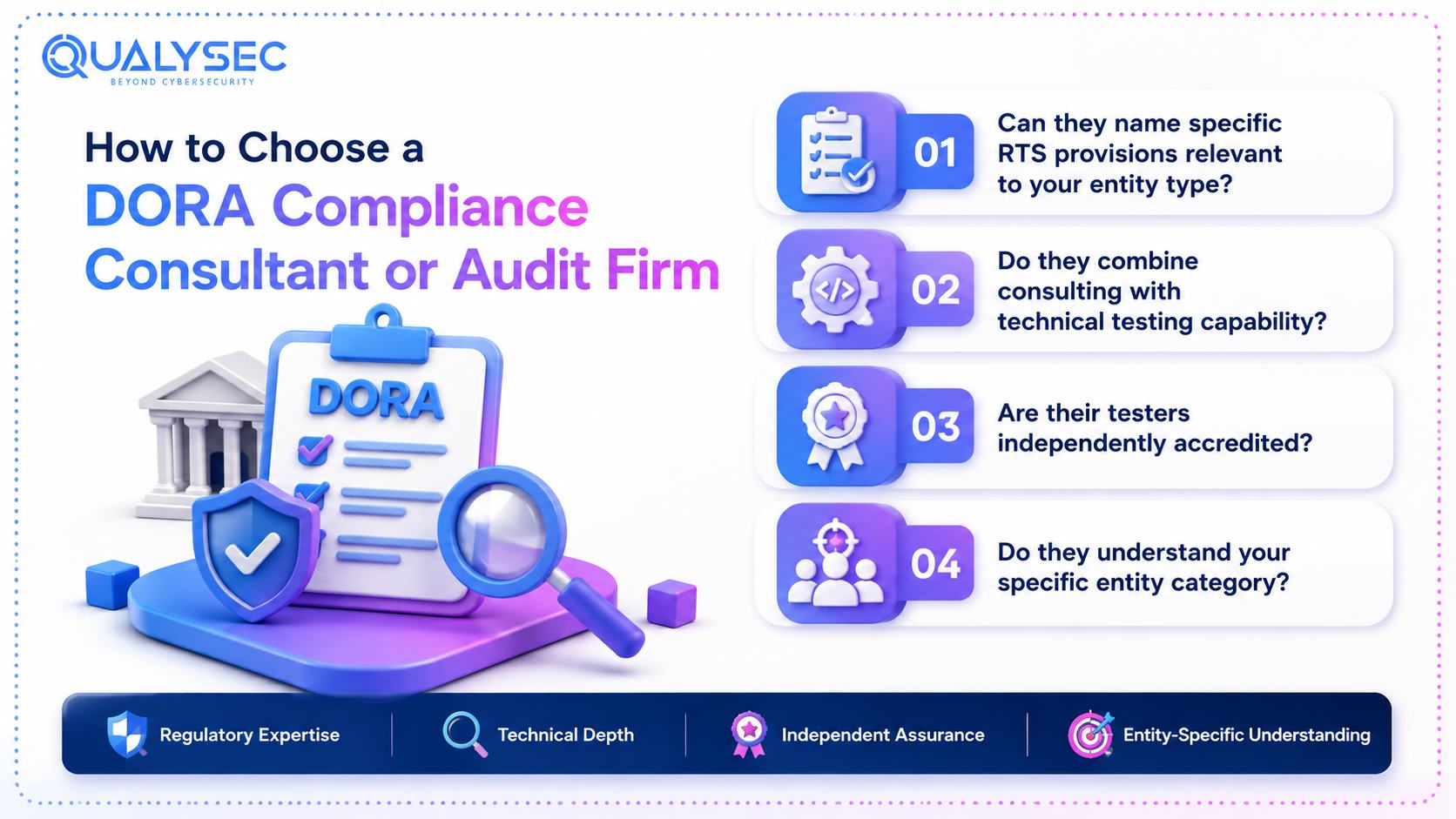
Not every firm offering DORA services is equipped to actually deliver on it. A few questions separate the ones worth hiring from the ones that added a DORA page to their site without building real capability behind it.
Can they name specific RTS provisions relevant to your entity type?
A consultant who can only describe the five pillars in general terms hasn’t done the work of mapping requirements to your specific situation. One who references the actual technical standards, like the RTS on subcontracting under Commission Delegated Regulation (EU) 2025/532, is operating at the right level of depth.
Do they combine consulting with technical testing capability?
Among EU DORA compliance services, the strongest firms don’t outsource the technical testing piece. If a firm can only produce policy documents and hands off penetration testing to a third party, coordination gaps are likely, and accountability for results gets murky.
Are their testers independently accredited?
For TLPT specifically, CREST accreditation is the credential regulators and boards recognize without needing to independently verify a tester’s competence. A DORA consulting company that can point to CREST-accredited testers on staff, rather than subcontracted out, is a meaningfully stronger choice.
Do they understand your specific entity category?
A bank, an insurer, and a crypto-asset service provider face different applicable requirements under DORA. A generic audit firm that treats all financial entities identically is likely to miss category-specific obligations.
Threat-Led Penetration Testing: The Advanced Layer of DORA Audit Services
For entities designated as significant, resilience testing goes well beyond basic vulnerability scanning. Commission Delegated Regulation (EU) 2025/1190, in force since July 8, 2025, sets binding technical details for TLPT: a mandatory external threat intelligence provider, purple teaming between red and blue teams, and a minimum twelve-week active red team testing phase. That’s a substantially more demanding standard than most firms’ existing penetration testing programmes were built around.
This is where DORA compliance audit firms differentiate most clearly. Running a threat-led penetration testing engagement that actually satisfies the RTS requires CREST-accredited red team testers, documented threat intelligence sourcing, and reporting structured for regulatory submission, not just an internal security readout. Firms that ran informal red team exercises in the past will find the twelve-week active phase and mandatory purple teaming component considerably more demanding than what they’ve done before.
How Qualysec Delivers DORA Compliance Consulting
Readiness Assessment and Gap Remediation
Qualysec benchmarks an entity’s existing ICT risk framework against all five DORA pillars, producing a prioritized remediation roadmap rather than a generic findings list. This is the core of our DORA compliance consulting engagement, built to hold up under the same scrutiny national authorities are now applying to Register of Information submissions.
CREST-Accredited TLPT for Significant Entities
For entities within TLPT scope, Qualysec delivers testing aligned to Commission Delegated Regulation (EU) 2025/1190’s specific requirements. This includes the mandated twelve-week active testing phase, run by CREST-accredited red team testers with documented threat intelligence sourcing built in from the start.
Ongoing DORA Management Solutions
Beyond the initial engagement, Qualysec supports continuous monitoring, annual Register of Information updates, and vendor risk tracking, so compliance holds up year over year rather than degrading quietly between formal reviews.
Conclusion
The gap between firms that treat DORA as a completed project and firms that treat it as an ongoing operating discipline is exactly where most enforcement findings are showing up in 2026. Good DORA Compliance Consulting closes that gap by combining regulatory fluency with real technical testing, not a policy binder that looks complete until an examiner asks for evidence. Whether you’re just starting a readiness assessment or coordinating your first TLPT engagement under the new RTS. The firms getting through this cleanly are the ones that started building the relationship before the review, not during it.
Contact Qualysec for DORA compliance consulting and audit support.

Frequently Asked Questions
1. Do UK companies have to comply with DORA?
UK-based companies aren’t directly subject to DORA unless they operate as an EU-regulated financial entity or as an ICT third-party provider supplying services to EU financial entities. In that second case, DORA applies regardless of where the provider is headquartered. So a UK cloud or software vendor supporting EU banks or insurers can fall within scope even without any EU presence of its own.
2. What does it mean to be DORA compliant?
Being DORA compliant means an entity has a documented, functioning ICT risk management framework, reports major incidents within DORA’s fixed timelines, tests its resilience through vulnerability scanning and, where required, TLPT, maintains a complete Register of Information for third-party ICT contracts, and can demonstrate all of this to a national competent authority on request, not just describe it in policy. Given how the ESAs’ dry-run results turned out, demonstrating it in practice is clearly the harder bar to clear.
3. Who is responsible for DORA compliance?
Ultimate responsibility sits with the financial entity’s management body, which DORA holds accountable for approving and overseeing the ICT risk management framework. That accountability doesn’t transfer to an external consultant. In practice, compliance work is usually coordinated by a CISO or risk function, often supported by external DORA compliance consulting where technical testing or specialized regulatory interpretation is needed, but the board remains on the hook for the outcome.
4. What are the 5 pillars of DORA regulation?
The five pillars are ICT risk management, incident reporting, digital operational resilience testing, third-party risk management, and information sharing. They function as one connected system: risk management sets the baseline, testing validates it, incident reporting captures what happens when something fails, third-party oversight extends the same standards to vendors, and information sharing spreads threat awareness across the sector.
5. Who does DORA regulation apply to?
DORA applies to around 20 categories of financial entities across the EU, including banks, insurers, investment firms, payment and e-money institutions, and crypto-asset service providers, along with the ICT third-party providers supporting them. Providers meeting specific criticality thresholds fall under direct EU-level oversight as Critical ICT Third-Party Providers, regardless of where they’re headquartered.