

If you’ve landed here, chances are someone just told you that your ADGM licence comes with cybersecurity obligations you didn’t know about, or you’ve heard the FSRA expects regular security testing and you’re not sure what that means for a firm your size. Maybe you assumed this was a big-bank problem. For many ADGM firms, it no longer is.
Take Omar’s situation as an example. He built his remittance app around one promise. A worker in Abu Dhabi could send money home to Manila or Lahore in minutes, not days. By the time his company had a few thousand active users and a licence from the Financial Services Regulatory Authority, he had stopped thinking of himself as a small operation. He still was one. Eleven people, one developer handling security on the side, and an API connecting his app to a banking partner, a currency conversion service, and a KYC vendor that verified new customers.
He assumed FSRA’s cybersecurity rules were written for the big banks down the road in the ADGM FSRA vulnerability assessment services. Then a compliance consultant pointed out that the new Cyber Risk Management Rules apply to firms within their scope regardless of headcount, with requirements applied proportionately. For a small team like Omar’s, limited security resources could make it harder to keep testing, remediation and oversight on track. Omar is a fictional example; the rules and security risks discussed here are not. What applies to a firm depends on its regulatory status and the rules governing its activities, not simply on how many people it employs.
What Is the FSRA Cyber Risk Management Framework?
ADGM, or Abu Dhabi Global Market, is the financial free zone where firms like Omar’s operate. The FSRA, the Financial Services Regulatory Authority, regulates it. In July 2025, the FSRA announced new Cyber Risk Management Rules for the Authorised Persons and Recognised Bodies it supervises. A six-month transition period followed, and compliance became required from 31 January 2026.
The ADGM cyber risk management framework requires firms to manage cyber risks through their existing risk management processes, with the governing body responsible for oversight. There’s also an incident-reporting duty to keep in mind. Authorised Persons must immediately notify the FSRA of incidents affecting their operations. Under FSRA Notice No. 13 of 2025, they must also report a material Cyber Incident no later than 24 hours after becoming aware of it or receiving information that reasonably suggests one has occurred.
Who has to comply? The framework applies to Authorised Persons and Recognised Bodies within its scope, with requirements applied in proportion to the nature, size and complexity of their activities. A firm handling customer payments and identity data may face different risks from one whose services rely less on technology. ADGM FSRA cybersecurity compliance isn’t just about firm size. It also depends on the services a firm provides, the systems it relies on and the risks those systems carry.
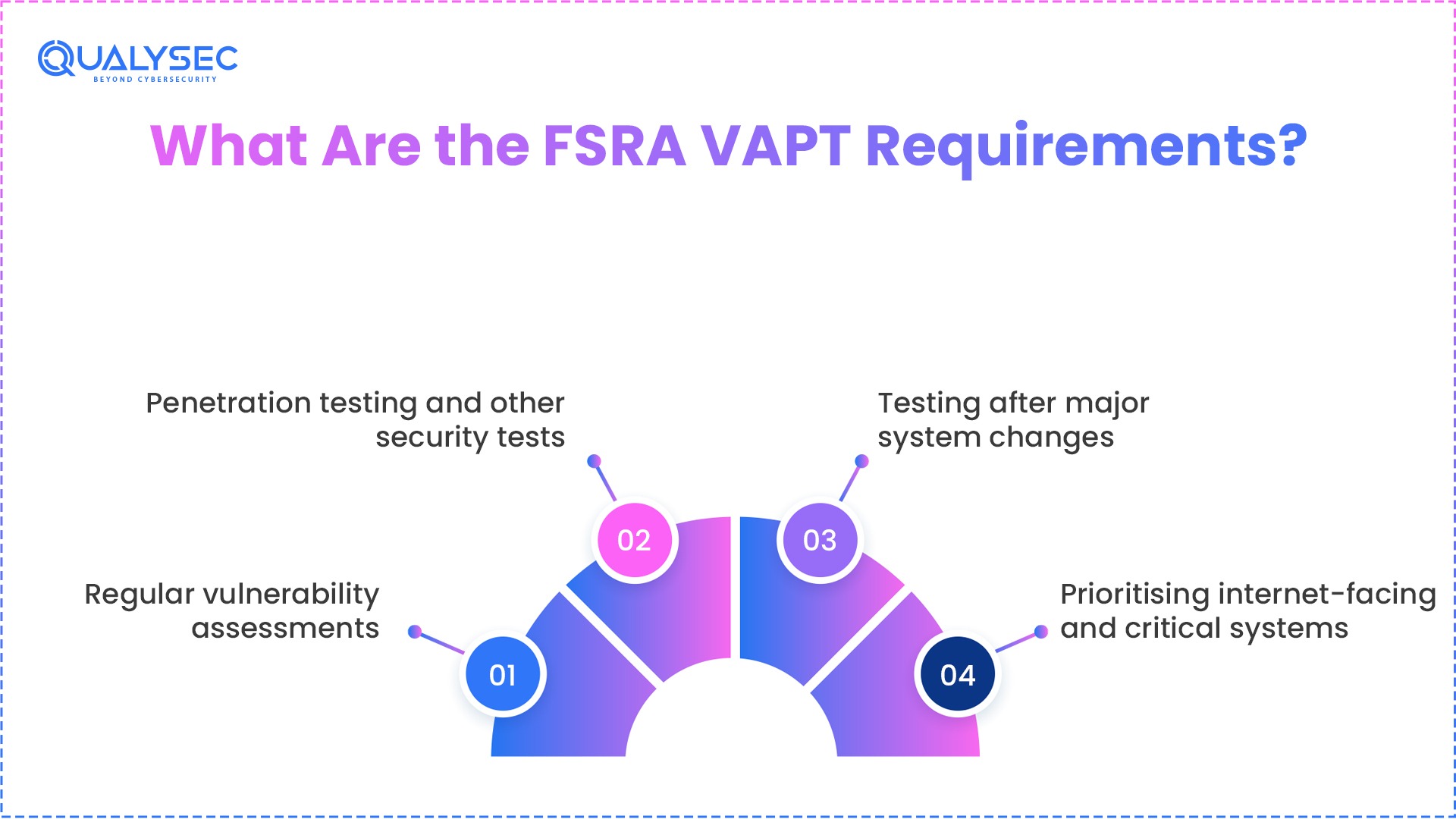
What Are the FSRA VAPT Requirements?
VAPT stands for vulnerability assessment and penetration testing. They are related, but they do different jobs. A vulnerability assessment checks systems for known weaknesses, such as outdated software or insecure settings. A penetration test goes further by having a tester try to exploit weaknesses within an agreed scope, helping the firm understand how an attacker might gain access or move through its systems.
When choosing ADGM FSRA vulnerability assessment services, firms should consider their regulatory obligations, the systems they use and the risks those systems face.
Regular vulnerability assessments
The FSRA’s IT Risk Management Guidance recommends assessing IT systems regularly and when new information about cyber threats comes to light. The aim is to find weaknesses before someone exploits them. The firm should assess each finding and fix weaknesses according to their severity, giving critical systems priority.
Penetration testing and other security tests
The guidance also recommends regular testing of live systems and networks to check how well security controls hold up. This can include penetration testing of online platforms, phishing exercises or red-team tests, where specialists simulate an attack. The tests should have safeguards to prevent disruption to customer services, and the findings should lead to fixes or improvements to security controls.
The FSRA requires Authorised Persons to test their IT systems, networks, processes and controls regularly. Under GEN 3.5.14, internet-facing systems must be tested at least annually. The rule requires a regular testing programme, but it does not say that every test must be a penetration test. The type and scope of testing should reflect the systems being tested and the risks they face.
Testing after major system changes
A major application or infrastructure change can introduce new weaknesses. For example, a new release of a customer-facing app or a change to the API connecting it to a banking partner may call for additional security testing. The FSRA guidance covers change management and testing, but it does not explicitly require a new penetration test after every major change. Firms should assess whether extra security testing is needed rather than rely only on a fixed schedule.
Prioritising internet-facing and critical systems
The FSRA guidance says critical systems should come first in vulnerability assessments. Internet-facing applications and APIs also deserve close attention because attackers can try to reach them directly. Internal systems still need attention, since a compromised employee account or an exposed connection could give an attacker access to other parts of the network.
What Should VAPT Cover?
A testing programme that only covers the company website can miss weaknesses elsewhere in a fintech’s systems. The scope should match the services a firm provides, the systems it uses and the risks it faces. When planning VAPT, consider areas such as:
- Internet-facing applications and APIs – Check the systems customers and external users can reach, including the APIs that connect an app to banking or payment services.
- Mobile and fintech applications – Test mobile apps used for account access, payments and money transfers, not just the company website.
- Cloud infrastructure and networks – Assess the security of cloud services, network connections and the systems that support customer-facing platforms.
- Internal systems and privileged access – Review internal applications and accounts with elevated access, since an attacker who takes control of them may reach sensitive data or other systems.
- Third-party and outsourced services – Consider the risks linked to payment processors, KYC vendors and other providers. Testing a provider’s systems requires permission and agreed arrangements.
- Digital-asset, payment and transaction platforms – Give these systems close attention where a weakness could lead to financial loss or exposure of customer data.
The FSRA’s IT Risk Management Guidance supports a risk-based approach to testing. This list is a starting point, not a checklist that every firm must follow in the same way.
Like many founders, Omar’s first instinct was to test the public website and stop there. His biggest risk was the API linking his app to his banking and KYC partners, a part of the system his small team had barely examined.
What Should Penetration Testing Test?
Once the scope is agreed, penetration testing can check whether weaknesses in a financial firm’s systems could let an attacker gain access or misuse its services.
Authentication and access control are a good place to start. Can someone log in as another user or reach an admin panel meant only for staff? Authorisation is a related but separate question. Can a logged-in customer see someone else’s data just by changing an ID number in a request? Application and business logic security covers the app’s own rules, such as whether a transfer limit can be bypassed by sending two requests at once instead of one.
Tests of encryption and data protection check whether sensitive details, such as account numbers and identity documents, are protected while being sent between systems and when stored. Cloud and network configuration checks look for storage left open to the public or firewall rules that allow more traffic than intended. Transaction and payment testing looks at the logic that moves money. Third-party and supply-chain risks matter too, because a weakness in a connected vendor’s system could expose your own.
On 9 October 2026, India’s national cyber agency, CERT-In, and its financial-sector response team issued an advisory warning that attackers were targeting payment and disbursement APIs connected to core banking systems. They used stolen API credentials to call fund-transfer functions directly, bypassing checks such as KYC and beneficiary verification. The advisory concerns Indian financial firms, not ADGM entities, but the attack method is worth noting. An exposed or poorly monitored API can give attackers a way in, especially if the firm has not checked what access it allows.
How to Build an FSRA-Aligned VAPT Programme
A working VAPT programme helps firms plan ADGM FSRA vulnerability assessment services around their systems and risks. It doesn’t need to be complicated, but each step should have a purpose.
- Build an inventory of critical systems, assets and data. Before testing begins, the firm needs to know what it owns, where its data is stored and which systems its services depend on.
- For Abu Dhabi financial penetration testing, set the scope in writing and get authorisation signed off. Make clear which systems can be tested and what the testing team is allowed to do.
- Run risk-based vulnerability assessments, giving priority to systems that hold sensitive customer data or handle payments.
- Plan regular FSRA-regulated entity penetration testing and other security tests based on the firm’s risks and the systems involved. For Authorised Persons, make sure the programme meets GEN 3.5.14, including at least annual testing of internet-facing systems.
- Consider extra testing after major system changes instead of waiting for the next planned test. A new app release or a change to an important API may introduce weaknesses.
- Rank findings by the harm they could cause and start with the most serious ones. A flaw that could expose customer accounts or allow unauthorised transfers needs prompt attention.
- Retest the fixes. A firm needs to check that a change has resolved the weakness and has not caused another problem.
- Keep records of each step. An auditor or the FSRA may ask for evidence of the scope, test results, remediation work and follow-up checks.
ADGM expects firms to manage technology and cyber risks as part of their overall risk management work, rather than treat security testing as a once-a-year task. The FSRA’s IT Risk Management Guidance sets out recommended practices, while the Cyber Risk Management Rules establish requirements for firms within their scope.
What Evidence Should Be Maintained?
When an examiner or auditor comes asking, loose memories of “we tested it last year” don’t hold up. A firm should keep records that explain what was tested, how the work was carried out and what happened after the findings came in.
Firms should keep records such as:
- Approved testing scope and written authorisation.
- Testing methodology and evidence of tester qualifications.
- Full vulnerability assessment and penetration-testing reports, not just a summary slide.
- Remediation plans and records tracking progress.
- Retest results and evidence that findings were closed.
- Records of management reviewing the results.
The framework puts accountability on senior management and the governing body, not on the IT team quietly patching things in the background.
How Qualysec Supports ADGM Compliance
Omar’s example shows why a fintech needs more than a website scan. His app, API gateway and third-party integrations all need attention, and his governing body needs clear evidence of the security work being done.
Qualysec helps businesses assess security weaknesses across their technology stack. For ADGM-regulated firms preparing for security reviews, this can include:
- Vulnerability assessments and penetration testing to find weaknesses before attackers exploit them.
- Testing across web, API, mobile, cloud and network environments so the assessment covers more than the public-facing website.
- Risk-ranked findings and remediation guidance to help the team decide which issues to fix first.
- Retesting after fixes to check whether reported weaknesses have been resolved.
Qualysec’s Human-Led, AI-Powered approach combines automated tools with expert human validation. These services can support an organisation’s security and audit preparation, but testing alone does not establish FSRA compliance.

Conclusion
Cyber risk management in an ADGM firm works best as an ongoing programme, not a once-a-year scramble. For Omar, that shift turned security testing from an abstract line item into part of running his business, helping him manage cyber risks and protect the people sending money home through his app.
If your firm needs ADGM FSRA vulnerability assessment services, Qualysec can help assess web applications, APIs, cloud environments and networks. Talk to Qualysec’s team to discuss your testing needs.
Frequently Asked Questions
1. Does the FSRA require annual penetration testing?
The FSRA requires Authorised Persons to test their IT systems and controls regularly, with internet-facing systems tested at least annually. The rules do not require every test to be a penetration test; the testing programme should reflect the firm’s risks.
2. What systems should ADGM entities test?
Internet-facing apps and APIs, mobile platforms, cloud infrastructure, internal systems with privileged access, third-party integrations, and any system handling payments, transactions, or digital assets.
3. Is vulnerability assessment the same as penetration testing?
No. A vulnerability assessment checks systems for known weaknesses. Penetration testing goes further, with a tester actively trying to exploit weaknesses the way an attacker might.
4. What evidence should ADGM entities retain?
Testing scope and authorisation, tester qualifications, full assessment and test reports, remediation tracking, retest results, and records showing management reviewed the findings.