Key Takeaways
- A vulnerability scanner can tell you what is wrong, but a penetration test can show you how an attacker could use it to take control of your organisation.
- Attackers test cyber resilience when they get through, and penetration testing reveals whether your SOC detects the activity, whether your IR team responds quickly, and whether critical operations can continue.
- UAE businesses face different penetration testing expectations depending on their sector and regulator, with IAS, DESC ISR, CBUAE, and ADHICS creating requirements that organisations need to understand before planning an assessment.
- The right pentest needs to cover more than the network perimeter, including applications, APIs, cloud environments, mobile apps, wireless infrastructure, employees, and the attack paths connecting them.
- This guide explains why penetration testing is a foundation of cyber resilience for UAE businesses, covering UAE regulatory expectations, testing types and methodologies, common mistakes, and how organisations can use a layered approach to turn penetration testing findings into stronger security and resilience.
Why Cyber Resilience Matters for UAE Businesses
When I speak with businesses about cybersecurity, one question comes up more often than it should: “Are our security controls enough to stop an attack?” My answer is always the same: security controls are important, but organisations also need to know what happens when those controls are tested by a real attacker.
The UAE’s cyber threat landscape makes this question increasingly important. In the UAE, the UAE Cyber Security Council reported blocking 200,000-800,000 attempted cyberattacks daily in 2025. The average cost of a data breach in the Middle East has reached around $8 million, with financial-sector and technology breaches exceeding $ 10 million each. For a business, a successful attack is no longer just an IT problem. It can disrupt operations, expose sensitive data, damage customer trust, and create regulatory consequences.
This is why I see penetration testing as a foundation of cyber resilience, rather than simply another compliance requirement. A properly conducted pentest shows whether security controls actually work against realistic attack techniques. It can uncover how attackers chain seemingly minor weaknesses together, whether security teams detect their activity, and how effectively the organisation responds.
This guide explains how penetration testing strengthens cyber resilience, meets UAE compliance requirements (IAS, DESC, ISR, CBUAE, and ADHICS), and helps organizations build an effective security testing strategy.
What Is a Cyber Resilience Framework?
In common parlance, a cyber resilience framework is a structured approach that combines governance, risk management, and business continuity to help organisations withstand and recover from cyber attacks.
In the UAE, cyber resilience is supported through a combination of national cybersecurity strategies, governance frameworks, information assurance standards, and sector-specific policies overseen by the UAE Cyber Security Council.
UAE Cybersecurity Regulations That Support Cyber Resilience
- UAE Information Assurance (IA) Standard v2.1: It mandates risk-based security controls, emerging technology safeguards (AI/Cloud/IoT), and resilience architecture across government entities and critical national infrastructure.
- CBUAE Cyber Resilience Framework: It enforces risk governance, continuous security operations, and third-party risk management specifically for Central Bank-regulated financial institutions.
- NCEMA 7000 Business Continuity Management Standard: It integrates cyber disaster recovery and IT service availability into overarching national emergency and business continuity protocols.
- Federal Decree-Law No. 34 of 2021 (Combating Rumours and Cybercrimes): It establishes severe legal penalties for unauthorised hacking, system tampering, extortion, and malware distribution.
- Federal Decree-Law No. 45 of 2021 (Personal Data Protection Law – PDPL): It regulates data privacy, processing consent, mandatory breach notifications, and international data transfers.
- Dubai Information Security Regulation (ISR v3): It regulates cybersecurity governance, regular risk assessments, and auditing for Dubai government bodies and vendor supply chains.
- Federal Decree-Law No. 46 of 2021 (Electronic Transactions and Trust Services): It regulates digital identity protection, secure e-signatures, and trusted e-commerce infrastructure.
- DIFC Data Protection Law No. 5 of 2020 / ADGM Data Protection Regulations: It mandates financial-grade privacy, cyber governance, and data security standards within UAE offshore financial free zones.
- National Policy for Internet of Things (IoT) Security: It establishes security-by-design requirements, cloud safeguards, and operational resilience for connected devices nationwide.
Why Cyber Resilience Is Critical for UAE Businesses?
In 2026, the UAE Cyber Security Council has advanced a model of sovereign digital resilience by shifting from voluntary guidelines to mandatory standards under the National Cybersecurity Strategy (2025–2031). Resulting in the evolution of cyber resilience from a technical preference into a fundamental pillar of operational continuity and national security. For businesses operating in the UAE, cyber resilience is critical due to the following reasons:
Increased number of cyberattacks
According to the UAE Cyber Security Council, the UAE faces between 600,000 and 800,000 attempted cyberattacks every day. Automated tools and state-sponsored groups are targeting systems by scanning for unpatched vulnerabilities.
The cost of a cyber breach is 8 million dollars!
IBM’s Cost of a Data Breach Report shows that the average cost of a data breach for organisations in the Middle East reached $8 million; breaches in the financial and technology sectors are estimated at $10.67 million each. Cyberattacks result in operational downtime impacting services and clients.
Strict regulatory mandates
The UAE mandates organisations to adhere to rigorous national frameworks, such as the UAE Information Assurance (IA) Standards (v2.1)) and sector-specific mandates from the CBUAE, which require them to develop documented recovery strategies, conduct independent audits, and establish board-level accountability to enhance organisational resilience to cyber threats.
Protect the digital supply chain.
Organisations in the UAE are aggressively integrating cloud services and third-party AI tools. In such a scenario, cyber resilience ensures that risks are managed not just internally, but across the entire vendor ecosystem, to prevent a single breach that can compromise the security system.
Preserve sovereign trust
In the UAE’s ultra-connected, state-backed digital system, cyber resilience is the ultimate protection for your enterprise’s right to operate. Because a single breach will not just destroy a company’s reputation, it will risk blacklisting your organisation from core government contracts, national critical infrastructure partnerships, and the broader sovereign economy.
Core Components of a Cyber Resilience Framework
Organizations build a strong Cyber Resilience Framework by aligning key components with UAE requirements, including IAS, the National Cybersecurity Strategy, TDRA and aeCERT guidance, the Cybercrimes Law, and the UAE PDPL.
We align these 10 pillars with the NIST Cyber Resilience Framework to support security and compliance for UAE organisations.
Risk Assessment
Every UAE Cybersecurity Framework starts with identifying and prioritising risks in the system’s data and operations. UAE’s IAS requires organisations to run formal risk assessments that evaluate threats, vulnerabilities, and business impact before selecting appropriate controls. It is an ongoing exercise that helps organisations identify emerging risks and adjust their security measures accordingly.
Asset Identification
You can’t protect what you don’t know. Therefore, organisations are mandated to maintain an accurate inventory of hardware, software, data, and third-party connections. This includes cloud assets, legacy systems, and shadow IT. Any outdated or unaccounted-for systems can become easy entry points that attackers can exploit.
Vulnerability Management
Vulnerability Assessment scans systems on a regular basis to identify vulnerabilities and ranks the findings based on their severity and impact on the business. This helps organisations continuously monitor their systems and address critical vulnerabilities before they can be exploited. Regulators in the UAE expect continuous monitoring and patch management as mandatory baseline controls because unpatched software is one of the most common reasons for cyber breaches in the UAE, as reported to aeCERT each year.
Penetration Testing
Penetration Testing UAE engagements simulate real attacker behaviour to test whether security controls can actually withstand real-world cyberattacks, or they just exist on paper. IAS and sector regulators like DESC and the Central Bank expect periodic, accredited testing of networks, applications, and infrastructure. The results from penetration testing are incorporated into remediation plans.
Security Monitoring
Continuous monitoring detects suspicious activity before it becomes a full cyber breach incident. Organisations need to have incident-response readiness controls and continuous visibility across critical systems. Businesses must implement continuous security monitoring, integrate security monitoring with relevant Security Operations Center (SOC) capabilities, and maintain formal incident response plans to strengthen cyber resilience.
Incident Response
UAE organizations must have a documented incident response plan and report major cyber incidents to authorities like aeCERT, the UAE Cybersecurity Council, or TDRA. Reporting timelines include 24 hours for FSRA and 72 hours for DFSA incidents.
Organisations need a robust incident response plan covering detection, containment, reporting, threat removal, remediation, and safe system recovery.
Business Continuity Planning
A robust Business Continuity Planning (BCP) and cyber resilience framework in the UAE combines traditional disaster recovery with active cyber defence. Organisations need to have properly documented continuity plans that will cover critical processes, dependencies, and communication protocols. They also need to implement immutable data architecture and cyber-vaulting to recover from a possible ransom siege.
Disaster Recovery
Disaster Recovery Planning defines how systems and data are restored after a major cyber incident or disruption. UAE cybersecurity requirements and sector regulators expect organisations to define Recovery Time Objectives (RTOs) and Recovery Point Objectives (RPOs), maintain secure and tested backups, and assign clear ownership for recovery activities. This includes conducting Business Impact Analysis (BIA) to identify critical systems and acceptable downtime, documenting recovery procedures, and regularly testing disaster recovery plans through simulations. Disaster recovery works alongside business continuity planning.
Employee Security Awareness
People are equally important as an organisation’s systems because employees remain one of the most exploited layers in cybersecurity. UAE organisations should provide regular, role-based security training covering phishing, social engineering, credential hygiene, data handling, AI-powered threats, and deepfakes. Simulations help reduce human error and support cybersecurity and data protection compliance.
Continuous Improvement
Cyber resilience is not static because threats, technology, and regulations continue to evolve. Organisations should regularly reassess their security posture, align controls with applicable UAE requirements, and integrate frameworks such as ISO 27001, ISO 22301, or NIST where appropriate. Continuous monitoring, regular red-team exercises and crisis simulations, executive-level risk reporting, and root-cause analysis after incidents help identify gaps. Additionally, lessons from audits, incidents, and testing should then be used to update policies, strengthen controls, and improve business continuity and disaster recovery.
Why Penetration Testing Is the Foundation of Cyber Resilience
To understand why penetration testing is the ultimate foundation of cyber resilience, we must clear up confusion. Cybersecurity and cyber resilience are not the same.
Cybersecurity is preventative. It asks: “Have we built strong firewalls and installed the right software to keep attackers out?”
Vs.
Cyber resilience is operational: It assumes that despite best security defences, adversaries will come, and therefore, asks: “When an attack occurs, can our organization detect it and still maintain critical operations without collapsing.”
This is where penetration testing becomes important. A penetration test (pentest) is not an automated vulnerability scan or a compliance checklist. It is a controlled simulation of real world cyberattack, where qualified security professionals use the same Tactics, Techniques, and Procedures (TTPs) as cyber attackers to simulate real world cyberattack against networks, applications, and cloud environments to identify exploitable vulnerabilities, assess their potential impact, and determine how effectively an organisation’s security controls can detect and prevent an attack.
Penetration testing creates the bridge between static security controls and dynamic operational resilience through a three-stage flow:
Step 1: Attack system
Penetration testing systematically tests security systems to determine whether security controls work in the real world effectively when subjected to evasion techniques.
Step 2: Uncover “Chained” attack vectors
Automated security tools inspect systems in isolation. However, real attackers rarely rely on a single critical vulnerability. A pentester shows how a how an attacker can chain three seemingly low-risk vulnerabilities, such as a misconfigured CORS policy, an unpatched internal portal, and a weak service account password, to gain unauthorised access and ultimately take control of the organisation’s domain.
Step 3: Test human response
Cyber resilience is not only about preventing an attack. It is also about how quickly an organisation can detect, contain, and respond. A penetration test stress-tests your Security Operations Center (SOC) and Incident Response (IR) by measuring Mean Time to Detect (MTTD) and Mean Time to Respond (MTTR) under these conditions:
- Did the SOC raise an alert when the pentester dumped memory?
- Was the alert prioritised, or was it lost in the noise?
- Did the incident response playbook successfully isolate the compromised endpoint before the attacker could move laterally?
This focus on real-world testing is also reflected in UAE cybersecurity requirements:
- UAE Information Assurance Standards (IAS): Require penetration testing by qualified, independent testers, with findings incorporated into the organisation’s risk management process.
- Dubai DESC ISR v3: Requires annual penetration testing of external-facing services and quarterly vulnerability assessments.
- CBUAE Cyber Risk Regulation: Requires regulated financial institutions to conduct annual independent penetration testing, quavulnerability assessmentsrterly targeted assessments, and pre-production testing before launching applications.
- Abu Dhabi ADHICS: Requires healthcare organisations to maintain regular security testing for systems handling patient data.
Types of Penetration Testing UAE Businesses Should Perform
The UAE has some of the strictest cybersecurity laws in the region, and Penetration Testing is a legal requirement. To meet these requirements effectively, UAE businesses should conduct a combination of penetration testing approaches that assess their external, internal, application, cloud, and human attack surfaces.
Types of Penetration Testing for UAE Businesses
| Penetration Testing Type | What the Pentester Tests | Coverage |
| External Network Penetration Testing | Simulates attacks against internet-facing systems to identify exposed services, weak configurations, exploitable vulnerabilities, and possible paths into the internal environment. | Public IPs, firewalls, VPNs, remote-access services, DNS, email infrastructure, and externally exposed servers. |
| Internal Network Penetration Testing | Simulates what an attacker could achieve after gaining access to the internal network, including privilege escalation and lateral movement. | Active Directory, internal servers, workstations, network devices, authentication controls, and internal applications. |
| Web Application Penetration Testing | Manually tests applications for vulnerabilities that automated scanners may miss, including authentication, authorisation, business logic, and data-access flaws. | Customer portals, banking platforms, e-commerce websites, APIs, admin panels, and other web applications. |
| Mobile Application Penetration Testing | Examines mobile applications and their backend services for weaknesses that could expose user accounts, sensitive data, or application functionality. | Android and iOS applications, APIs, authentication, local storage, communications, and backend services. |
| API Penetration Testing | Tests whether APIs properly enforce authentication, authorisation, input validation, and access controls. | REST APIs, GraphQL APIs, microservices, authentication endpoints, and third-party integrations. |
| Cloud Penetration Testing | Assesses cloud environments for exploitable misconfigurations, excessive privileges, exposed services, and weaknesses in cloud-hosted workloads. | AWS, Microsoft Azure, Google Cloud, cloud storage, IAM, virtual machines, containers, and cloud networking. |
| Social Engineering Testing | Simulates realistic phishing, impersonation, and other human-targeted attacks to assess whether employees can recognise and resist manipulation. | Phishing emails, credential-harvesting simulations, phone-based social engineering, and controlled employee scenarios. |
| Wireless Network Penetration Testing | Tests wireless networks for weak authentication, insecure configurations, and unauthorised access paths into corporate environments. | Wi-Fi networks, wireless authentication, access points, guest networks, and segmentation controls. |
| Cyber-Attack Simulation / Red Teaming | Conducts a broader, objective-based attack simulation that combines multiple techniques and attack paths to test both technical controls and the organisation’s detection and response capabilities. | External and internal networks, applications, social engineering, identity systems, security monitoring, and incident response. |
The Three “Styles” of Penetration Testing
Penetration testing can also be performed using different levels of information and access:
- Black Box Testing: The tester starts with little or no prior knowledge of the target environment.
- Grey Box Testing: The tester receives limited information or access, such as a standard employee account.
- White Box Testing: The tester receives detailed information about the environment, such as architecture diagrams, configurations, credentials, or source code.
Benefits of Penetration Testing for UAE Organisations
Penetration testing enables UAE organisations to identify security weaknesses, demonstrate compliance with regulatory requirements, and strengthen their overall cyber resilience. Here is why penetration testing is beneficial for organisations in the UAE:
Meet regulatory compliance
You can use conducting an independently owned and documented penetration test as a compliance artefact for applicable standards like IAS, DESC ISR, CBUAE regulations, and ADHICS. It not only serves as an internal security exercise, but also provides evidence for regulators that they can request during an inspection.
Proactive Risk Detection
Prior to regulators or attackers, vulnerabilities are identified. Penetration Testing, combined with a Cyber Resilience Assessment, will uncover and fix potential security vulnerabilities before they become security breaches, audit findings, or public incidents.
Protect business reputation
In finance, healthcare, and e-commerce, data breaches can severely damage reputation and violate PDPL and industry regulations. Regular penetration testing demonstrates a strong commitment to security and compliance.
Business Continuity
Penetration testing identifies network weaknesses such as poor segmentation, excessive privileges, and unmonitored access paths, helping strengthen Business Continuity UAE and Disaster Recovery Planning.
Regulatory fine mitigation
Fines for PDPL violations can go up to AED 5 million per violation, and fines for failing to comply with DESC requirements can include being removed from Dubai government procurement lists. Regularly testing the penetration provides the organisations with a chance to discover potential security flaws at the start and minimise regulatory and financial risks.
How to Build a Cyber Resilience Framework Using Penetration Testing
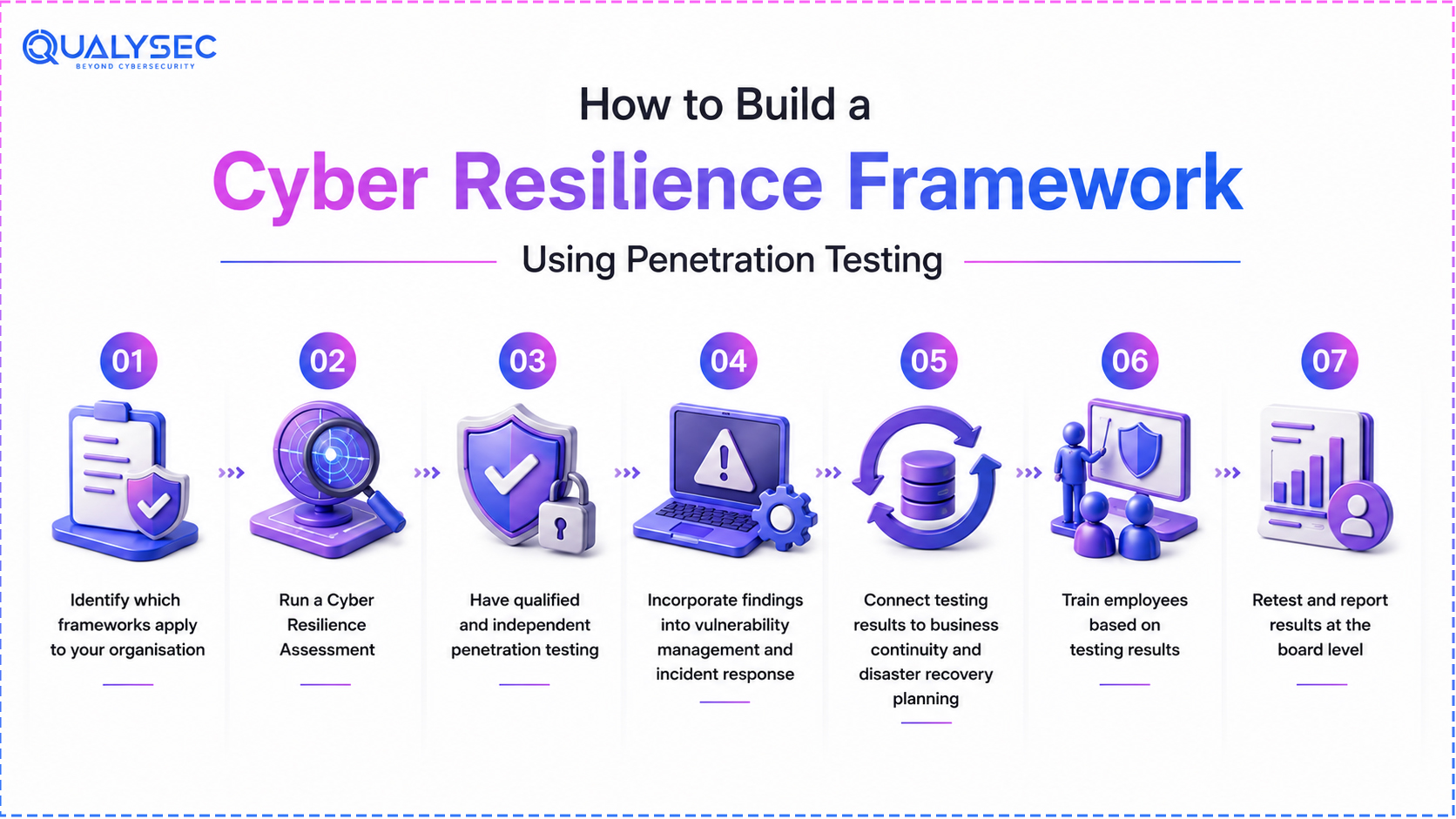
Step 1: Identify which frameworks apply to your organisation
Start by identifying your location, sector, and data types. CII operators may fall under IAS, Dubai government suppliers may be subject to DESC ISR, banks and payment firms may fall under CBUAE requirements, and healthcare providers in Abu Dhabi may be subject to ADHICS. Organisations processing UAE resident data may also need to consider PDPL requirements, including where the organisation is based.
Step 2: Run Cyber Resilience Assessment
Map your existing security controls against the relevant regulatory framework before testing begins. This ensures that the penetration testing scope reflects your actual regulatory requirements and business risks rather than relying on a generic checklist.
Step 3: Have qualified and independent penetration testing
Organisations should engage qualified testers who are independent of the system owner and conduct testing according to the frequency required by the applicable framework.
Step 4: Incorporate findings into vulnerability management and incident response
Penetration testing findings should be assigned to responsible owners, tracked through remediation, and verified through retesting. Organisations should also establish the documented escalation path required for aeCERT and sector-specific incident reporting timelines before an actual incident occurs.
Step 5: Connect testing results to business continuity and disaster recovery planning
Use weaknesses identified during penetration testing, including single points of failure and inadequate segmentation, to strengthen recovery time, recovery procedures, and business continuity plans.
Step 6: Train employees based on testing results
When social engineering or phishing simulations identify weaknesses in employee behaviour, organisations should convert those findings into targeted security awareness training. The training objective should be to improve employee resilience and reduce the likelihood of similar attacks in the future.
Step 7: Retest and report results at the board level
Retesting confirms whether identified vulnerabilities have actually been fixed and whether security controls now perform as expected. Periodic board-level reporting, including security trends and remediation progress, gives leadership a clearer view of whether the organisation’s cyber resilience is improving or not.
Common Mistakes UAE Businesses Make
Even if an organisation has robust security controls in place, it can undermine its cyber resilience by adopting a compliance mindset when performing penetration testing. To ensure testing brings measurable security benefits, it is important to avoid these common mistakes.
Testing and Compliance Mistakes
- Treating penetration testing as a routine process: Some small- to medium-sized enterprises execute a single pen test to meet a contractual or audit requirement and then sit on the results for years, as their applications and code evolve, even as their systems evolve.
- Misinterpreting vulnerability scanning with penetration testing: Automated vulnerability scans can find vulnerabilities that are known to attackers, but manual penetration testing can reveal logic flaws, chained-up attack paths, privilege escalation opportunities, and business-process abuse capabilities that automated scans may fail to discover.
- Conformity to ISO 27001 is a prerequisite for UAE compliance: While ISO 27001 offers a solid base in information security, there might be additional UAE-specific compliance aspects, such as data protection, incident reporting, and other regulatory requirements, that need to be addressed.
- Not addressing penetration testing results: When organizations do not follow up vulnerability reports with remediation and retesting, they fail to solve vulnerabilities. The organization must document significant findings as evidence that it owns, remediates, closes, and retests vulnerabilities.
Security Gaps Beyond Penetration Testing
- Addressing third party & vendor risk: Organisations can be exposed even when their own security controls are robust, as other organisations they rely on, such as suppliers and service providers, can be weak. In addition, UAE requirements may mandate organisations to perform a cybersecurity evaluation of third parties.
- Forgetting to test the cloud and API: Some common cloud weaknesses such as identity permissions, exposed storage, API authorisation and CORS configuration might not be discovered by standard network penetration testing. These environments need testing techniques designed to tackle their attack surface.
- Failing to invest adequately in employee security awareness: Technical controls are defeated if employees are still susceptible to phishing and social engineering attacks. Wardens are trained regularly, and simulations are used to find out which weaknesses lie in their behaviour, and improve the human part of security.
- Not having a documented incident escalation process: Organisations may have robust technical protections but may not have a clear and proven procedure for escalating and reporting qualifying incidents to aeCERT and/or the relevant sector regulator within any relevant timeframe.

Why Choose Qualysec for Penetration Testing in the UAE?
Effective penetration testing requires more than simply identifying known vulnerabilities. Qualysec combines automated scanning, AI-powered analysis, and expert-led testing to provide deeper coverage across an organisation’s attack surface, helping UAE businesses identify logic flaws, chained exploits, and business-process weaknesses that can lead to real-world breaches.
Qualysec’s penetration testing strategy is based on a Three-Layered Defence System, and each layer has a specific purpose:
Layer 1: Automated security scanning
Automated vulnerability scanners scan apps, cloud resources, networks, and APIs for known vulnerabilities, insecure configurations, and outdated software that may be exposing personal data.
Layer 2: AI-Assisted Security Analysis
Complex attack paths, risky data flows, and application logic issues can be identified through AI-powered analysis. For example, a login flow where password-reset tokens don’t expire
This provides deeper insights into security threats and supports organisations during Data Protection Impact Assessments (DPIAs).
Layer 3: Human-Led Penetration Testing
Automated results are confirmed by Vulnerability Assessment and Penetration Testing (VAPT) services done by experienced security experts. They emulate actual attack methods to expose advanced and business logic vulnerabilities that automated tools might not find.
This multi-layered approach eliminates the traditional balance between speed and accuracy. The first two layers are automated, providing fast, broad coverage while freeing experts to focus on complex vulnerabilities. This improves speed and accuracy for UAE organisations following DESC and CBUAE testing cycles.
CERT-qualified testers add another important layer of assurance for organisations operating under UAE regulatory requirements. IAS requires qualified, independent parties to carry out penetration testing. CBUAE examiners look for remediation traceability and retest evidence, while DESC ISR expects testers to align testing with its applicable security standards. Working with a CERT-qualified testing partner helps ensure that penetration testing reports are structured around the evidence and documentation that auditors and regulators expect.
Organisations can also gain visibility into findings and remediation as a live dashboard throughout a project, closing a common gap that occurs when organisations finish a penetration test, but lose visibility after the assessment. The findings are tracked through the 3 layers of the process: discovery, triage, remediation and resolution.
Conclusion
Real cybersecurity isn’t about creating a clean audit report; it’s about what happens when an attacker gets in. In the UAE, penetration testing reveals how vulnerabilities can lead to operational, regulatory, data, and reputational risks. Combined with vulnerability assessment, incident response, business continuity, and disaster recovery, it helps measure preparedness and align security with UAE IAS, DESC ISR, CBUAE, ADHICS, and PDPL requirements.
Frequently Asked Questions (FAQs) –
What is the difference between cybersecurity and cyber resilience?
| Cybersecurity | Cyber Resilience |
| Focuses on preventing attacks and unauthorised access. | Focuses on maintaining operations despite a successful attack. |
| Relies on controls such as firewalls, endpoint protection, IAM, and security monitoring. | Combines prevention with detection, response, recovery, and business continuity. |
| Asks: “How do we stop the attacker?” | Asks: “What happens if the attacker gets through?” |
| Relies heavily on security controls and vulnerability management. | Uses penetration testing, incident response exercises, business continuity, and disaster recovery simulations to test readiness. |
| Protects systems, applications, networks, and data. | Protects technology and the organisation’s ability to continue operating. |
What are the core components of a cyber resilience framework?
Cyber Resilience Framework encompasses risk assessment, asset identification, vulnerability management, penetration testing, security monitoring, incident response, business continuity, disaster recovery, employee security awareness, and continuous improvement. These components should not be individual security activities, but rather a connected cycle.
How does penetration testing improve an organisation’s cyber resilience?
Penetration testing can help determine if security controls are able to withstand realistic attack techniques and not just the fact that they are in place. It can discover exploitable vulnerabilities, sequential attack vectors, privilege escalation, insecure configurations, and vulnerabilities on networks, applications, APIs, cloud resources, and human attack surfaces.The findings from the penetration testing can be utilised by organisations to enhance their Vulnerability Assessment UAE, Incident Response UAE, Business Continuity UAE, and Disaster Recovery Planning.