

Introduction
Information is the backbone of any business, making room for SOC 2 certification in Philippines. Over three-quarters of large and small companies will have already received at least one data-compliance check by the middle of 2025. More than forty per cent desire a SOC 2 certificate built on a robust SOC 2 compliance framework to satisfy global standards and retain partners. The adoption of the cloud has been rapid, and the Philippine cloud security market has reached above PHP 12 billion, up from 21% growth in 2024. FinTech companies, health tech startups, and outsourcing vendors facilitate this demand.
Philippine firms were estimated to spend an average of PHP 9.4 million per incident in the 2024 data breach, and the cost will increase to PHP 11 million in 2025 due to more serious cyberattacks and fines. The new partners in fields focused on cloud services are currently required to have AWS certifications, SOC 2, which increases trust and responsibility in the Philippine business.
The SOC2 Compliance Checklist for Philippine Businesses
The Philippines is not easy to receive SOC2 compliance. The SOC 2 certification in the Philippines requires that all SOC 2 controls be prepared before the commencement of an audit.
Checklist –
- Policies – Regulations on data use, data retention, and data privacy.
- IT controls – Firewalls, anti-virus, and monitoring threats.
- Roles and responsibilities – What can be seen and what rights can be granted.
- Incident response – Plans on how to deal with security incidents.
- Continuous monitoring – These tools track activity, particularly cloud monitoring, which is applied by AWS SOC 2 clients to validate security through regular SOC 2 penetration testing.
- Vendor and third-party – Review risks, review contracts.
- Training – Routine programs to remind the staff about security.
By 2025, the audit timeline for SOC 2 certification in the Philippines will have reduced to 4 months due to automation and AI monitoring, particularly when the companies adhere to the rules of AWS SOC 2.
Need the future-proof data strategy? Know how the SOC 2 certification in the Philippines provides you with the security, trust, and access to the global market. Contact QualySec Technologies Today!
How SOC 2 Certification in Philippines Protects Your Data
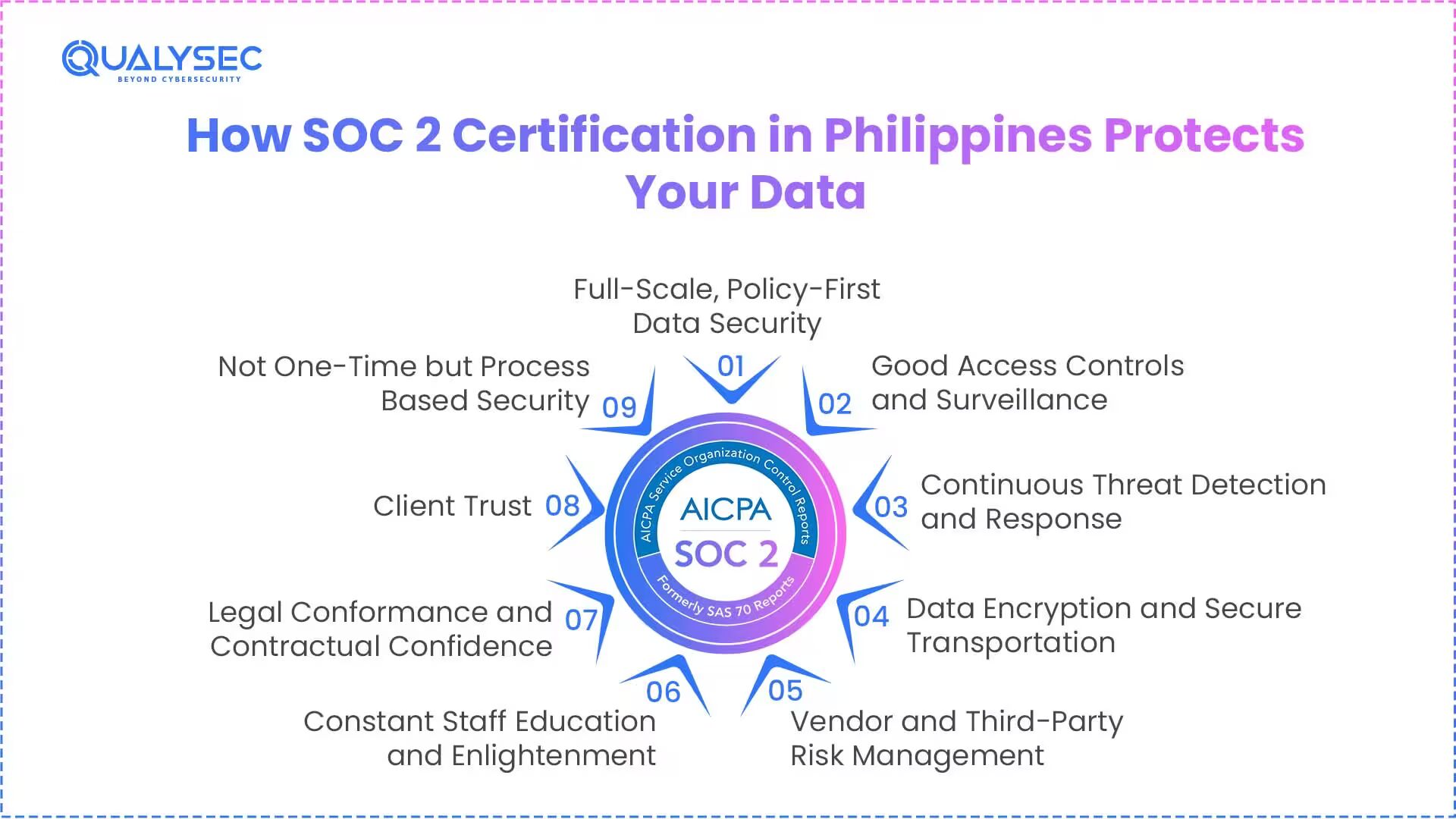
1. Full-Scale, Policy-First Data Security
The PHP SOC 2 requests firms to develop unambiguous policies and procedures concerning every aspect of data processing, such as storage, processing, access, and deletion. The above are in line with SOC 2 compliance certification requirements in the Philippines: security, availability, data integrity, confidentiality, and privacy.
- An independent person reviews every policy during the compliance security audit process, and the company adheres to best practices and complies with them.
- Chief information security officers believe that first-line defense with solid policy enforcement can reduce cyber risk exposure by up to 37 percent of certified firms by 2025.
2. Good Access Controls and Surveillance
SOC 2 compliance certification in the Philippines renders the process of controlling access to sensitive data necessary. Required controls are –
- Only provide the authorization required for each role.
- Have two or more methods of checking the identity of significant systems.
- Monitor identity during a logged-in session, and check the session.
- Each data access and change is logged automatically to form a permanent record.
Due to such controls, after receiving SOC 2 certification in the Philippines, the number of issues with internal data mishandling of companies reduces by up to 60 percent. Read also SOC 2 Compliance Requirements for SaaS Platforms
3. Continuous Threat Detection and Response
SOC 2 certification in the Philippines demands –
- Detection instruments that could locate threats immediately, such as intrusion detection and automatic warnings.
- Written procedures of incident response, including responsibilities.
- Handbooks on how to stop the problem, eliminate it, and learn from it later.
- It is not just prevention. Attack of certified firms is 40 per cent quicker than that of certification-free firms.
These defenses tend to be addressed by AWS SOC 2 monitoring, with the addition of local rules to cloud controls.
4. Data Encryption and Secure Transportation
The SOC 2 requires encryption and –
- Strong encryption, such as AES-256 and above, should be used when storing data.
- In cases where data is transferred, it is always best to use secure protocols such as TLS 1.2 or 1.3.
Safe deletion and encrypted backups seal additional loopholes, reducing the external and internal risks.
5. Vendor and Third-Party Risk Management
Firms are dependent on external services in SOC 2 certification in Philippines, such as cloud, payroll, IT, logistics, and so forth, at which point data may be compromised.
The PH SOC 2 requires companies to –
- Ensure that the vendors and partners comply with their standards in security standards.
- In addition to the requirements of important integrations of AWS SOC 2, make sure contracts contain guidelines regarding how to react to an incident, access audit, and data privacy.
- Statistics indicate that companies that scrutinize third-party risk are breached 28 percent less by the supply-chain attack.
6. Constant Staff Education and Enlightenment.
Human beings continue to rank high among breach causes – a single negligent act may expose a good amount of information. The current guidelines of SOC 2 certification in Philippines demand that all staff members undergo routine, documented training concerning safety practices, phishing, and how to report such cases.
Those companies that maintain such training enjoy two-figure reductions in social engineering and credential theft per annum.
7. Legal Conformance and Contractual Confidence
The SOC 2 in the Philippines assists companies to align with the Data Privacy Act of 2012 and other local regulations in the fields of finance, retail, and health authorities. Numerous global supply contracts today require the completion of the SOC 2 compliance checklist, particularly for US and EU clients, mirroring the demand seen for SOC 2 compliance in international markets like the UAE. The chances of breach of risk pools are reduced as legal defense and insurance premiums decline for certified firms.
8. Client Trust
In B2B negotiations, nothing demonstrates that a company is a hard-working company more than an independent SOC 2 report in the Philippines. Certified firms are viewed as more reliable by clients and partners – 44% of Philippine BPO buyers claimed that the companies understand that their information is secured by tight security audit measures. Under AWS SOC 2, cloud providers are able to provide real-time evidence to international clients, and tend to secure improved or high contracts.
9. Not One-Time but Process-Based Security
The Philippines’ SOC 2 is more than a general one-time tech fix program. It demands discipline in the process. Control works with new cyber threats and technological advances every day, week, and quarter due to the need to revise controls. It is that feedback loop that causes 92 per cent of certified businesses to evade audit delays or big fixes two years after the initial audit.
Download Our Sample SOC 2 Penetration Testing Report. See how we help businesses validate SOC 2 compliance with in-depth security testing and actionable insights.
How QualySec Technologies Can Help You
QualySec Technologies is an elite cybersecurity player in the Philippine market, and its services have been a complete hit in assuring data and SOC 2 audits for fast-growing companies.
Services
As an experienced SOC 2 Type 2 compliance partner, QualySec provides SOC 2 audits, gap assessment, penetration testing, and managed compliance services to cloud-first, SaaS, and BPO businesses.
Why Qualysec Aces in Testing
- Process-based Strategy – QualySec has an exclusive process-based strategy that is trusted by its clients. All SOC 2 audits are written checks, and all controls are adequately tested, both manually and automatically. Such confirmed procedures offer accuracy, traceability, and audit resistance, which make QualySec unique from copy-pasting or template-based auditing in the Philippines.
- No Error Approach – The process at QualySec is not merely a check box process. Analysts collaborate, chart all risks and controls, document all findings, and assist in remedying problems and maintaining cybersecurity compliance service levels high. In case of those companies that rely on AWS SOC 2 or even match their systems to SOC 2 in the Philippines, with the help of QualySec, strong cloud analytics and custom logic make sure that every security control is clear and fully checked.
- Solutions for All – QualySec expands along with you, providing the cybersecurity solutions to multi-site operations or targeted start-ups. Contrary to identity and other providers, real-time visibility, no shortcuts, and continual improvement are the unique selling points of QualySec that will make your SOC 2 process go flawlessly and robustly.
The verified process testing provided by QualySec is suitable to meet the dynamic requirements of such sectors as fintech, BPO, and healthcare and surpass expectations every time, guaranteeing an audit success on the first attempt.
You might like to know more about A Comprehensive Guide to SOC 2 Penetration Testing
Conclusion
New threats and global standards are affecting Philippine companies in 2025. Customers and suppliers are likely to have confidence in businesses whose data controls are real and demonstrated. The SOC 2 certification in Philippines prevents fines and violations and also contributes to development, reputation protection, and entry into new markets. SOC 2 is not expensive in regard to the payback of enhanced security, compliance, and retention of customers.
Regardless of the size of a business organisation, passing the SOC 2 compliance checklist and certification demonstrates the level of responsibility and desire to succeed. In case you do not want to take the longest path to reach an AWS certifications SOC 2, or you need assistance on every step, QualySec is available to offer you proven testing and unsurpassed experience.
Ready to be really safe and trustworthy? Start your SOC 2 certification in the Philippines with QualySec Technologies!

FAQs
1. What is SOC 2 compliance in the Philippines?
The SOC 2 Compliance in Philippines implies the establishment and maintenance of data protection controls. It deals with security, data availability, proper processing, privacy protection, and data confidentiality. It is compliant with international data safety and risk standards. Cloud and tech companies in particular should take note of it.
2. How do I get SOC 2 certification?
On the way to SOC 2 Compliance in Philippines, you have to identify lapses in your controls. Then add the required security measures, document procedures, and finally, outsource an independent auditor to verify that you are within the SOC 2 rules. Continue tracking and keep improving to remain certified.
3. Who provides SOC 2 certification?
The SOC 2 checks are done by certified auditors, who are normally CPA firms licensed by the AICPA. They audit your controls and report.
4. How much does SOC II cost?
SOC 2 certification in the Philippines costs between PHP 380,000 and PHP 750,000 in the case of small and medium firms. Multi-site or larger firms are more expensive. Type 2 audits are more expensive as they are time-consuming.
5. Is SOC 2 legally required?
It is required by most industries to comply with regulations and contracts. It is not legislation in many countries, but it is frequently demanded by clients.