NBFCs and Indian banks face unprecedented cyber threats in 2025. BFSI attacks are increasing 25% per year and may impose losses of 50,000 crore annually. The last security line of defence is the RBI Cybersecurity Compliance Checklist to seal SOCs, VAPT, and Zero Trust frameworks, helping prevent ransomware and deepfake attacks. With this guide, you have a data-driven game plan supported by the most recent rules by RBI to successfully execute it without failure. Explore the procedures that will transform compliance into a competitive advantage.
Are you not going to upgrade your defences? Choose Qualysec Technologies to get assistance on the RBI cybersecurity compliance checklist!
RBI Cybersecurity Framework Overview.
The Cybersecurity Framework provided by RBI provides banks and NBFCs with a good playbook to enhance their cyber defences. The RBI Cybersecurity Framework establishes cyber baselines by banks, operates Cyber Security Operations Centres (Cx -SOC), and reports incidents (CSIR). The RBI cybersecurity guidelines are aligned with the emerging threats, such as Zero Trust Architecture (ZTA), and are geared towards higher resilience. The institutions conduct frequent risk assessments, maintain tight governance, and deploy tech controls. This RBI checklist will ensure that you are operating within the rules of RBI by focusing on risk and response.
The Importance of RBI Cybersecurity Compliance
The cyber threat is pandemic in the Cybersecurity in Banking sector, and future predictions forecast an even larger and more sophisticated types of attack on BFSI. Otherwise, the RBI can fine you heavily. After the RBI reduced the compliance list, there is less risk of breaches and increased customer confidence. The number of cyber incidents in India in 2025 declined by 26, but gaps remain in finance due to structures such as those of the RBI. Adherence to the rules prevents the loss of money and regulatory inconveniences.
Who Needs to Adhere to the RBI Cybersecurity Compliance Checklist
The RBI cybersecurity framework checklist has to be used by scheduled commercial banks, small finance banks, payments banks, and numerous NBFCs (top, middle, upper tier). All key players, such as EXIM Bank and NABARD, fit in as well. NBFCs strengthen data protection, controls, and reporting according to RBI orders. The digital lenders and cooperative banks align with the framework. Foreign banks in India either adhere to or justify their way.
Major Elements of RBI Cybersecurity Compliance Checklist
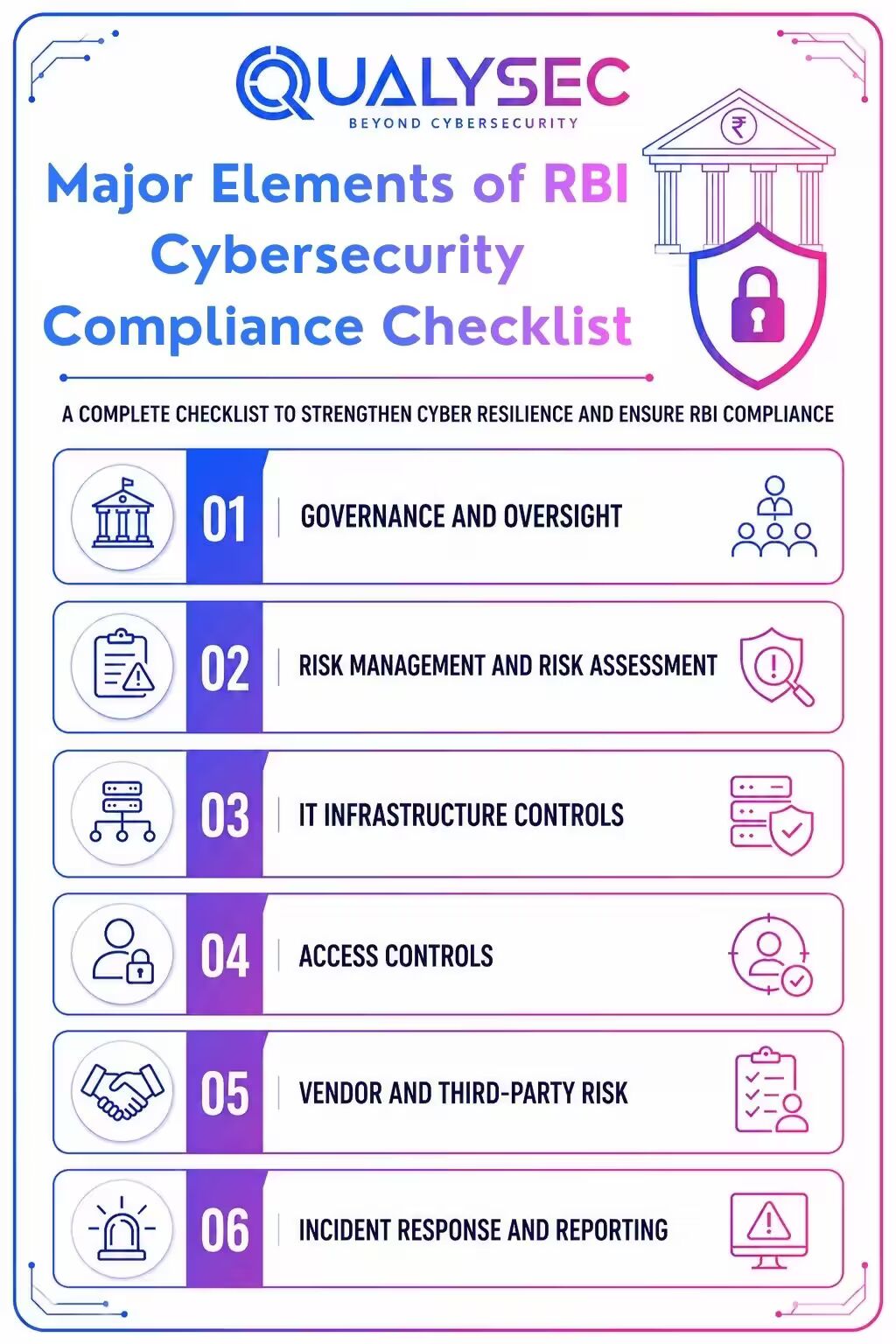
The RBI cybersecurity framework checklist includes tech controls, risk management, and governance.
1. Governance and Oversight
Boards also sign cyber policies, and IT Strategy Committees (ITSC) are established and staffed with external directors familiar with IT. ITSCs also hold quarterly meetings to ensure IT is on track, manage risk, and adhere to budgets. Top managers operate, through IT Steering Committees, to drive a risk-driven culture.
2. Risk Management and Risk Assessment
Institutions complete a comprehensive cyber risk assessment, label assets by sensitivity, identify threats, undertake vulnerability assessment, and mitigate them using a policy. The CISOs are at the forefront and are not answerable to the IT arm, but directly to the risk leaders.
3. IT Infrastructure Controls
They put up different levels of defences, firewalls, DMZs, IPS/IDS, keep inventory, enforce secure configurations, and patch within hours. Capacity and change plans make it all smooth. Categorise all data, people, and IT assets. Allow whitelist software; deny non-approved software.
4. Access Controls
MFA is used to protect privileged access, and the least-privilege rule is used. Monitors and central logs administer movements. Logins by customers are checked safely.
5. Vendor and Third‑Party Risk
Perform due diligence, audits, and lock in audit rights in contracts. Control supply-chain problems – the majority of companies encounter third-party breaches.
6. Incident Response and Reporting
Write a Cyber Crisis Management Plan (CCMP) regarding detection, response, and recovery. Emergencies can be reported to RBI and CERT as soon as possible. SOCs enable real‑time watch.
Component 1 – Essential Requirements
- Vulnerability Assessment (VA) – Scan critical systems/DMZ every 6 months.
- Penetration Testing (PT) – Tests internet-facing applications/applications annually.
- DR Drills – Full-day DR site switching on a half-year basis.
- IS Audit – Risk-based coverage annual review.
RBI Cybersecurity Compliance Checklist
Adhere to this cybersecurity RBI checklist framework step by step.
1. Cyber Security Policy endorsed by the Board
Write down a clear policy on threats, risks, and tactics. Reports to the CSITE Cell of Tell RBI when it is ready.
2. Security Operations Centre (SOC)
Establish a SOC to carry out 24/7 surveillance, intelligence of threats, and detection of anomalies.
3. Network and Database Security
Check connections; sever illegal entry. Apply micro- segmentation and artificial intelligence surveillance.
4. Vulnerability and Vulnerability Management
Fast, particularly when there is a familiar adventure. Run VA/PT cycle‑wide.
5. Application Security Lifecycle
Secure coding, threat modelling, OWASP. Separate dev, test, and prod.
6. Data Protection Measures
Protect data on rest and in transit; prevent leaks with DLP. Intelligence test backups and restores.
7. Authentication and Access
Access control, multifactor authentication, passwords. Record watch logins and kill inactive accounts.
8. Environmental and Physical Controls
Install cameras on secure DCs/ DRs, monitor breaches.
9. Training and Awareness
Train personnel on hazards, train boards. Diffuse cyber hygiene among stakeholders.
10. Business Continuity and DR
Test BCP/DR after every 6 months; strike low RTO/RPO. Include vendor testing.
11. Audit and Metrics
Monitor such KPIs as patch lag and malware coverage. ACB audits Run IS.
12. Forensics and Reporting
Analyse the cases, disseminate through IB-CART.
13. Banking Cybersecurity – NBFC-Focused
According to the RBI, NBFCs conduct vendor audits, encryption, and training. They report them on time and adhere to circulars such as DoS.CO.CSITEG/SEC.7/31.01.015/2023-24. NBFCs have to monitor their oversight commissions.
14. Fintech and Financial Services Cybersecurity.
Fintechs integrate the RBI Framework with digital activities. Financial cyber defence is aimed at being prepared against AI-based attacks. Compliance drives institutions into proactive action.
15. Sanctions against Non-Compliance
In the IT Act, the amount of fine that the RBI may impose ranges from 1 lakh to 1 crore. The Banking Regulation Act incorporates additional shots. Recent cases – ICICI reached 97.8 lakh, Axis 29.6 lakh.
16. RBI Cybersecurity Checklist Future-proofed
Zero Trust will be required by 2030 due to digital growth. AI threats and cloud resilience checklists are updated on a yearly basis by banks. To remain on top, it depends on continuous tweaks.

How Qualysec Can Assist You
1. Verified Process-Based Testing of Qualysec
We all go on that RBI cybersecurity compliance checklist at Qualysec, and we have poured our own tested process-based testing into the brew. Our engineers also take you through a step-by-step guideline that covers all RBI requirements – scanning all the areas, including DMZs and the core banking systems.
Our simulation covers the 2023 Master Directions on the ground, and thus, you have 100 percent coverage with zero false positives. The result? The methodology enables the clients to be audit-ready in weeks rather than months because it compares findings with RBI circulars.
2. Fully Intensive Cybersecurity Audits by RBI
We conduct end-to-end audits on RBI compliance, which are bank and NBFC-specific. Our teams chart your infrastructure to the RBI cybersecurity framework with suggestions on gaps in governance, access control, and incident response.
After that, we give you custom checklists and dashboards that are transparent and automatically track everything, and you are never behind in quarterly ITSC reporting. We include VAPT cadences – semi-annual vulnerability testing, annual penetration testing, disaster-recovery testing, and vendor risk testing, etc., trimming remediation time.
3. SOC Implementation and Threat Monitoring 24×7
Qualysec implements fully run-up Security Operations Centres (SOCs), which form the foundation of your RBI framework. Round-the-clock monitoring of the crew is done with SIEM tools, threat intelligence feeds, and AI-powered anomaly detection. The system detects threats before they turn into an issue, which is in the same range as the standards of Cybersecurity in Banking, and avoids breaches.
4. Risk Remediation Expertise and VAPT.
Accuracy is required in the instance of VAPT, which is what we provide. Once we have completed the run, you have executive reports, which we present to RBI inspectors, together with evidence of patched vulnerabilities and retests. Our Cybersecurity in Fintech modules dedicated to digital-lending policies are the favourite of NBFCs.
5. Rules and Training Acceleration
To enhance board-level control, we prepare a cyber policy that is compliant with RBI cybersecurity guidelines and establish IT strategy committees. CISO sessions ensure that the execs are on board with Zero Trust and resilience requirements.
Staff training involves voluntary training packages in cyber hygiene, phishing exercise and incident management, reducing human-error breaches. Mock quarterly audits will get you ready to face real RBI audits so that you can establish your culture of risk awareness in your finance services.
6. Vendor and Third-Party Risk Mastery
We provide audit security of suppliers, implement SLAs with audit privileges, and hook supply-chain monitoring directly into your SOC. To maintain financial compliance, our tools maintain the scoring of third-party risks, indicating and highlighting any out-of-line moves that are against the RBI standards.
7. Continuing Tracking of Compliance and Metrics.
We are balling with KPI dashboards, which monitor patch latency, MTT, R, and compliance scores. ITSCs alert automatically when things go off track, and the recertifications remind you of the RBI updates at least once a year. According to clients, they are getting high compliance rates, which avoids fines such as the INR 97.8 lakh fine paid by ICICI.
The difference is that verifiable process-based testing, with no guesswork, only RBI-corresponding accuracy, is the distinguishing feature of Qualysec. Banks and NBFCs choose our RBI cybersecurity compliance because of fast ROI – faster by 80% than the closure of the vulnerability, audit by the number, and solutions that can scale between SFBs to top-layer NBFCs.
Get today’s unbeatable RBI compliance checklist support with Qualysec.
Conclusion
Understanding how to master the RBI cybersecurity compliance can enable Security Compliance for Financial Institutions to survive AI and supply-chain attacks of 2025. Close-up governance, VAPT, SOCs, and DR to avoid crores of fines and prevent the disruption of the operations. This evidence-based guide provides you with the low-down; apply and develop a rock-solid resilience and gain customer trust. Be vigilant, audit rigorously, and abreast with RBI developments.
Protect your future today – reserve the RBI cybersecurity compliance checklist consultation with Qualysec!

FAQs
1. What is an RBI cybersecurity compliance checklist?
RBI cyber security framework in banks is an all-inclusive road map that all banks & NBFCs follow to upgrade their digital walls against the cyber threat in the coming wave. It needs good governance, design IT strategy committees, stringent risk checks, and twenty-four-hour surveillance using SOCs. VAPT, MFA, encryption, and compulsory reporting to RBI and CERT will require these. It is based on Master Directions 2016 and updates of 2023 by RBI, meaning that ransomware, phishing, and insider threats do not safeguard you.
2. Why is an RBI cybersecurity compliance checklist important?
The cyber-hit list is real because of a 20 per cent penetration in BFSI in 2025. Any breach will cost you over 100 crore per time, and you may get fined up to 1 crore under the Banking Regulation Act alone, as well as reputation and churn. Adhering to the checklist fosters trust and enables businesses to continue with sound DR plans and positions you on top of Zero Trust requirements. Antivirus compliance is proactive and reduces exposure to vulnerability and secures sensitive data.
3. Who must follow the RBI cybersecurity compliance checklist?
This must be followed by all the scheduled RBI cyber security framework in banks, small finance banks, payment banks, and NBFCs (at all levels). In addition to any Indian financial institution, cooperative banks, digital lenders, Cybersecurity in Fintech, and foreign banks in India. In essence, every person who deals with the customer’s financial information should follow these rules to ensure that the level of cybersecurity remains the same across the board.
4. What are the key components of an RBI cybersecurity compliance checklist?
Key components of the cyber security framework RBI are –
- Technological controls – multi-tiered protection, patches, OWASP secured applications
- Authority – MFA and least privilege
- Data – encryption and DLP
- Reaction – cyber crisis plans, SOC monitoring, regular VAPT, DR drills, third-party security audit, and continuous improvement metrics.
5. Is VAPT mandatory in the RBI cybersecurity compliance checklist?
Yes, VAPT is a must for Cybersecurity in Financial Services. Vulnerability testing is conducted every six months, and penetration tests on internet-facing apps are conducted once a year. With authorised agencies, banks strive to identify and rectify weak points before the attackers have an opportunity to attack. RBI drives intricate reports and remedial schedules. This rule expanded between 2016 and counter API hacks and supply-chain attacks.
6. How often should RBI cybersecurity checklist assessments be performed?
Carry out vulnerability scans and Security Compliance for Financial Institutions after every six months, external application penetration tests after every year, and DR exercises after every six months with a full-system switch over. Yearly system audit, quarterly policy review, ongoing SOC monitoring, and monthly patch cycle. These are aligned with the 2023 directions and threats of AI by cyber security framework RBI.
7. What documents are required to support the RBI cybersecurity checklist?
Cybersecurity for Financial Services requires board, risk, SOC, VAPT, fixed, audit, incident, DR, test, vendor, and SLA, training, patch, ITSC, and minutes. Combine all this with RBI inspections, and then a hassle-free process of validation.