







Main Components of an AI-Driven Threat Management System
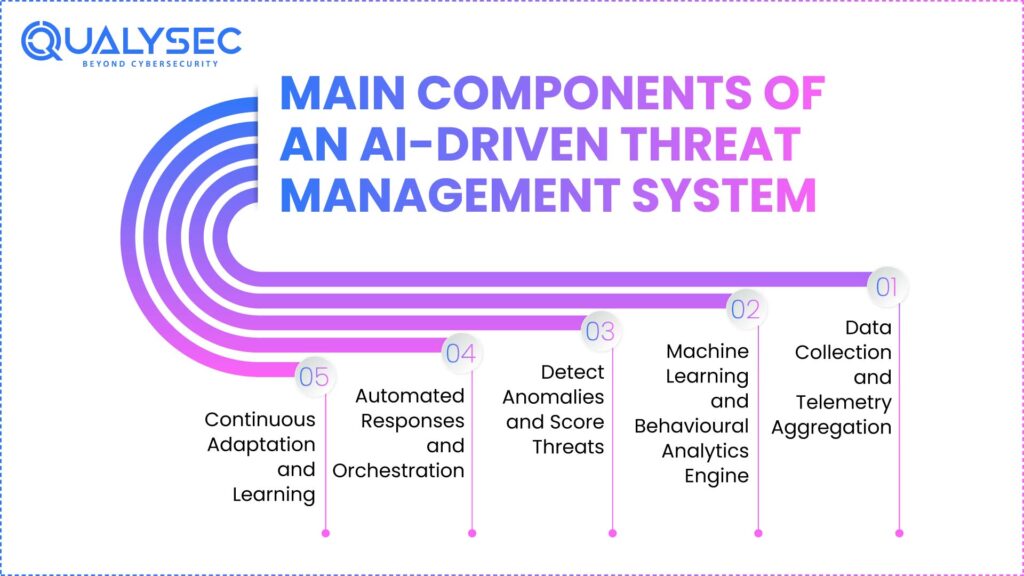
Artificial Intelligence (AI) dependent threat Management has several basic building blocks that play a major role in the activity of managing security events using AI. The primary building blocks for an AI-driven threat Management system are as follows:
Data Collection and Telemetry Aggregation:
The first building block that forms the base layer within any AI-driven security system is through extensive Data Collection, for example, Network logs, Cloud Services, User Activity, Endpoint Telemetry, Application behaviours and other forms of Telemetry.
Extensive and diverse sets of Data allow the AI to understand what is considered “normal” activity and then to identify, or detect, anomalies based on that understanding of “normal” behaviour.
Machine Learning and Behavioural Analytics Engine:
A machine learning system is at the center of the device, analysing real-time incoming data. The insight it provides through the evaluation of the behaviour of a User can reveal any changes from normal behaviour, such as an individual logging in at an atypical time, accessing typically unseen data, or experiencing a sudden spike in data movement, indicating potential harm or an Insider threat to your organisation. Learn more about Machine Learning in Cybersecurity.
Detect Anomalies and Score Threats:
When the system detects potentially dangerous behaviour, it will assign a threat score based on severity, context and history. The score will help the user prioritise alerts: incidents rated high-risk will require immediate action, while those with lower threat scores will be logged for future reference or monitoring.
Automated Responses and Orchestration:
Many systems with AI (artificial intelligence) technology include automated responses. These can include actions like isolating an endpoint that appears suspicious, blocking traffic deemed suspicious, and initiating workflows that produce alerts. Many systems include some type of Security Orchestration Automation and Response (SOAR) functionality, which minimises the need for human intervention and significantly reduces the time it takes to respond.
Continuous Adaptation and Learning:
Threats change over time with advancements in technology and new ways attackers become creative in their attempts to attack a company or obtain sensitive information. As threats are detected in nature, the system will retrain on newly created data, adjust its existing behaviour baselines, and redefine its rules for detecting future threats. Adaptive Learning will allow an AI Security Architecture to continue to be effective and useful after a succession of new techniques and methods employed by attackers.
Don’t leave your systems vulnerable. Connect with our AI security specialists now and get the right protection for your business.
Predictive Cybersecurity: Preventing Attacks Before They Happen
Cybersecurity today has transitioned from a reactive to a predictive approach, with artificial intelligence playing a major role in this transition by allowing organisations to forecast potential threats prior to their occurrence.
Organisations can identify potential threats by leveraging various data sources such as historical statistics of cybersecurity incidents, current real-time threat intelligence information, and real-time data analytics associated with those incidents, along with the different types of content that may be at risk based on these factors.
This allows organisations to take preemptive measures regarding threat mitigation to address vulnerabilities and at-risk assets in advance.
Forecasting Vulnerability Exploits
Organizations can use artificial intelligence (AI) technology to analyze various data sources for previous incidents, historical records, or logs, and develop a profile of an organization’s system based on these different data sources to identify software modules, endpoints, or cloud configurations that could be targeted for imminent exploitation, even prior to a successful attack or a zero-day exploit being successfully launched.
User-Device-Workload Behavioural Risk Profiling
Additionally, using AI technology, organisations can create user or user device risk profiles based on the behaviour of users based on their geographic location, how often a device is accessed, how often it is used, etc. Users or user devices that exhibit unusual risk profiles can be flagged for increased monitoring and/ or preemptive action against these types of users or devices.
Threat intel correlation
Threat intelligence from other sources can be ingested by AI and combined with internal telemetry. For example, if a business wanted to use all the current IOCs in a given region against its network, AI would predict those attacks based on past, current and future IOCs on their network.
Automated patch and config prioritisation
Using AI, organisations can rank and prioritise all vulnerabilities based on their level of exploitability, business impact, exposure, and likelihood of attack rather than applying patches to each vulnerability equally. This will enable an organisation to allocate resources optimally.
Pre-incident simulation/modelling
Many complex AI security systems operate by conducting what-if simulations, otherwise known as “digital twin” tests, to predict how a network’s security would hold up under different attack conditions and estimate damage that might occur. Such simulation tools allow organisations to better prepare for future breaches.
Ready to stop cyber threats with AI-powered network security? Connect with us today to explore the right solution for your business.
How Qualysec Strengthens AI Systems with Expert Penetration Testing
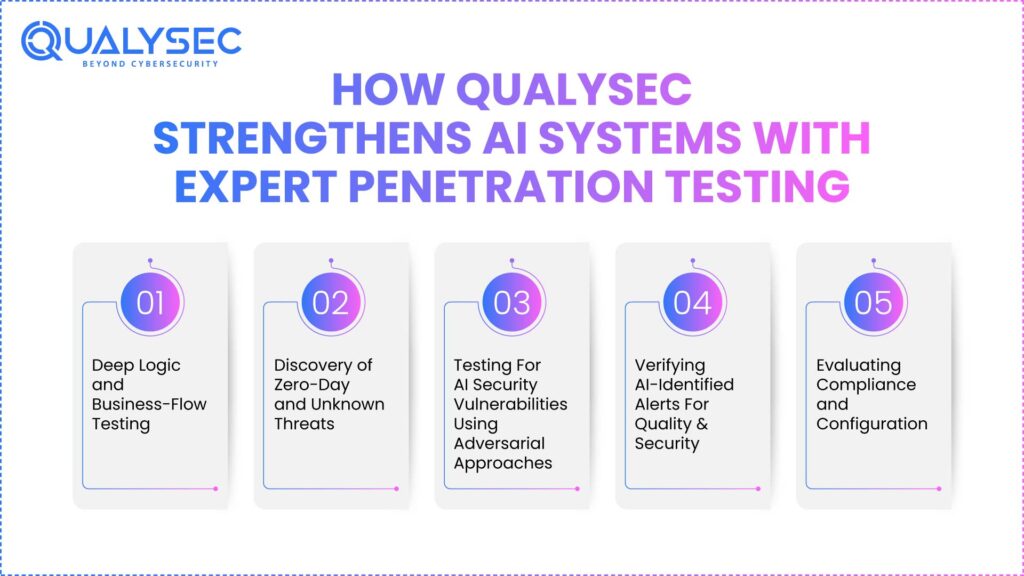
AI security frameworks are indeed very sophisticated, but can miss the subtle vulnerabilities resulting from bad business logic, incorrect configurations, and/or an accident made by the user. Because of this fact, manual penetration testing completes the process and shows the true value of companies like Qualysec. Qualysec partners its AI detection methods with expert human pentesting to uncover any hidden flaws that an AI scanning system may miss.
Deep Logic and Business-Flow Testing
QualySec’s team of human pentesters scrutinises application logic, user flows, user permissions, and edge cases that are normally beyond the scope of AI threat detection systems (which mainly rely on previously known patterns). Moreover, they simulate true scenarios of real-world attacks that bypass algorithm detection.
Discovery of Zero-Day and Unknown Threats
Furthermore, manual pentesting may identify zero-day vulnerabilities, misconfigurations, and chained weaknesses in complex environments (e.g., Cloud environments and custom application code together with legacy systems) that AI engines do not consider either anomalous or malicious.
Testing For AI Security Vulnerabilities Using Adversarial Approaches
Through utilising adversarial tactics (e.g., Data Poisoning, Model Manipulation and Prompt Injection as used with AI-assisted systems), Qualysec will perform penetration tests on AI-based security systems to identify vulnerabilities before an individual’s opportunity to benefit from exploiting them.
Verifying AI-Identified Alerts For Quality & Security
A penetration tester can verify any alerts identified by AI systems. They can also search for hidden threats that the AI did not detect. This process ultimately increases the overall accuracy of detection and reduces the occurrences of false positives and false negatives.
Evaluating Compliance and Configuration
In addition to reviewing code and logic, Qualysec’s penetration testing service can evaluate other areas associated with Security. Those are Configuration Hygiene, Identity & Access Management, Cloud Posture, and Compliance Gaps, all of which AI tools are often unable to assess, yet contribute significantly to the Security Architecture Process.
Schedule a 30-minute meeting with our cybersecurity experts today and get a clear, actionable roadmap to strengthen your security posture.

Benefits of Combining AI Technology with Manual Pentesting
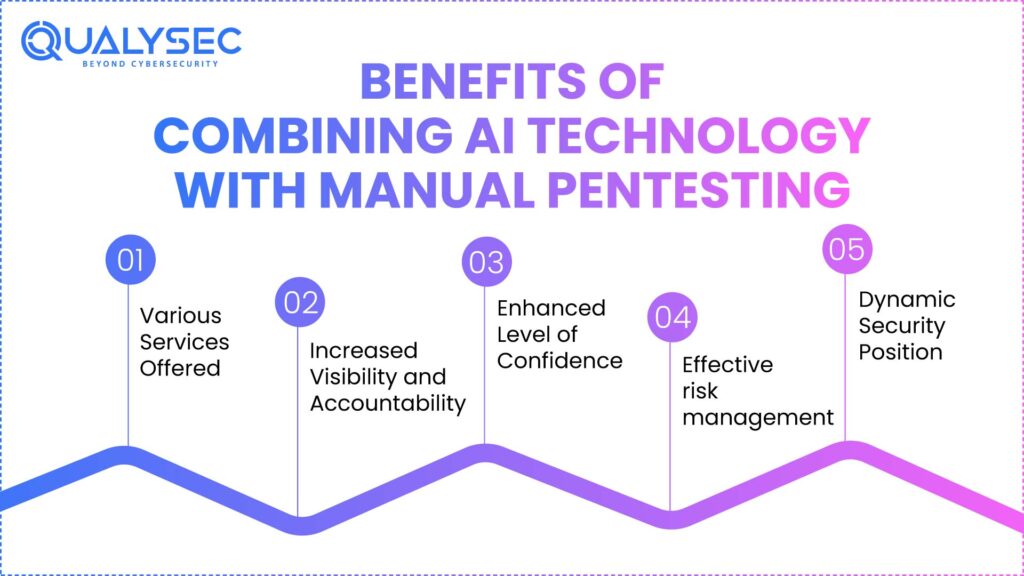
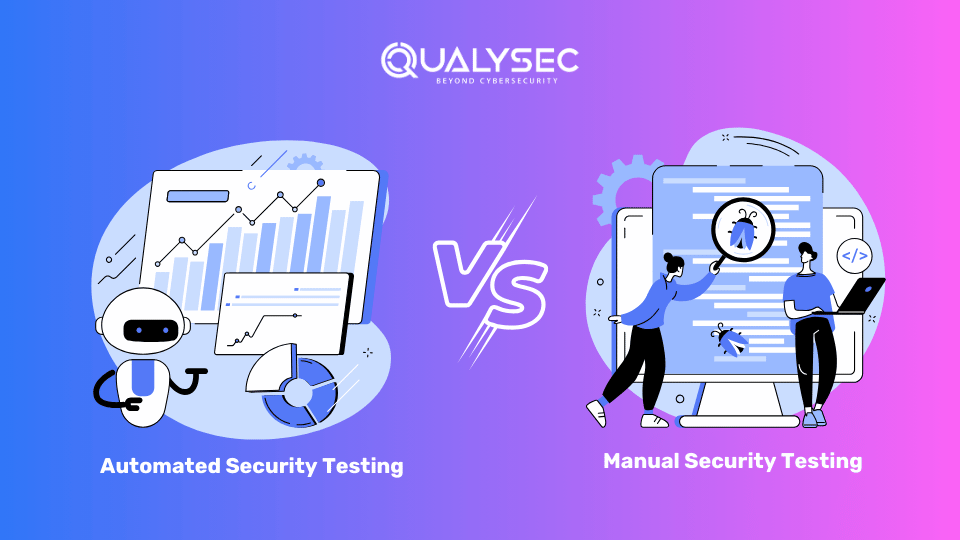
Many organisations use an integrated approach where both AI and human-led security tests are used together to create the strongest protection. This combination of technologies enhances coverage, depth and reliability of protection.
Various Services Offered
Through automation, AI offers monitoring at scale, anomaly detection across multiple endpoints and networks, and fast incident response. The human element adds value to the detection and investigation of more complex AI security risks that require human judgment, such as misconfigured business logic or human behaviours. Read about how to perform an AI risk assessment.
Increased Visibility and Accountability
As AI helps to reduce alert fatigue and provide rapid response, pentesting helps to identify limitations of the detection capabilities of AI, and prevents the exploitation of threats that would otherwise go undetected due to inherent limitations.
Enhanced Level of Confidence
Establishing human verification of AI alerts (and non-alerts) creates greater trust in the overall system’s reliability and reduces the potential for compliance difficulties in validating the effectiveness of the AI.
Effective risk management
Using artificial intelligence to manage the most frequent threats through routine monitoring (AI) allows you to concentrate your limited security resources on only the most severe and complex threats. Through penetration testing, which will help you optimize the total cost of security.
Dynamic Security Position
The growth of IT, including the introduction of cloud technologies, expanding endpoint devices, and new software applications, all require a change in the way we secure our networks. By combining AI with traditional penetration testing methods, you are able to continuously adapt your security position as required while also ensuring that you are validating and calibrating the AI’s ability to accurately identify potential threats to your network.
Read also: Role of AI in Cybersecurity: Benefits of AI on Security
Industries That Gain the Most from the AI + Pentest Approach
Multiple industries, such as those that have a large volume of regulatory requirements and/or complex infrastructures and/or extensive attack surfaces, thereby need a greater emphasis on Hybrid AI and Manual Pen Test as a Strategy.
Banking & Financial Services
Due to the high level of customer data security and regulatory compliance, along with vulnerability to fraud, Banking & Fintech Organisations. They can utilise AI-based Security Systems for continuous monitoring of Systems, and Pentest to identify Logical Flaws and Gaps in Privacy on their Systems.
Healthcare & Life Sciences
There are fundamental differences in the areas of Healthcare and Life Sciences. Organisations that store personal and/or health data must have unbreakable Access Security. AI can monitor the Access Logs of Users and identify unusual activity, while Pentest will identify potential vulnerabilities in Applications, Medical Devices and Data Flow.
Enterprise Cloud Providers & SaaS Providers
The Adoption of Hybrid AI + Manual Security Strategies will be of assistance to organisations that provide Cloud Services, operate in a Multi-Tenant Environment or manage Distributed Systems. Because they will be able to utilise the Capability of AI to monitor Large Amounts of Web Traffic and carry out a cybersecurity pentest audit to validate Configuration, Data Isolation, and Access Control.
Critical Infrastructure and Industrial/OT Environments
AI-supported monitoring systems identify abnormal patterns in data from networks. Penetration test inspections can identify supply-chain, Industrial Control System (ICS), or misconfiguration vulnerabilities in Operational Technology (OT), Internet of Things (IoT), and control system environments in industries such as Energy, Manufacturing and Utilities.
E-Commerce/Retail/Large Web-Facing Businesses
Retail, e-commerce, and other large web-facing businesses are changing regularly due to the rapid growth and change of web-based applications, payment systems, and authentication methods. Combining threat detection using AI with the use of penetration testing helps prevent data breaches, account theft or takeover and permission fraud on a mass scale.
Explore more about Cybersecurity Solutions for Every Industry.


















































































0 Comments