






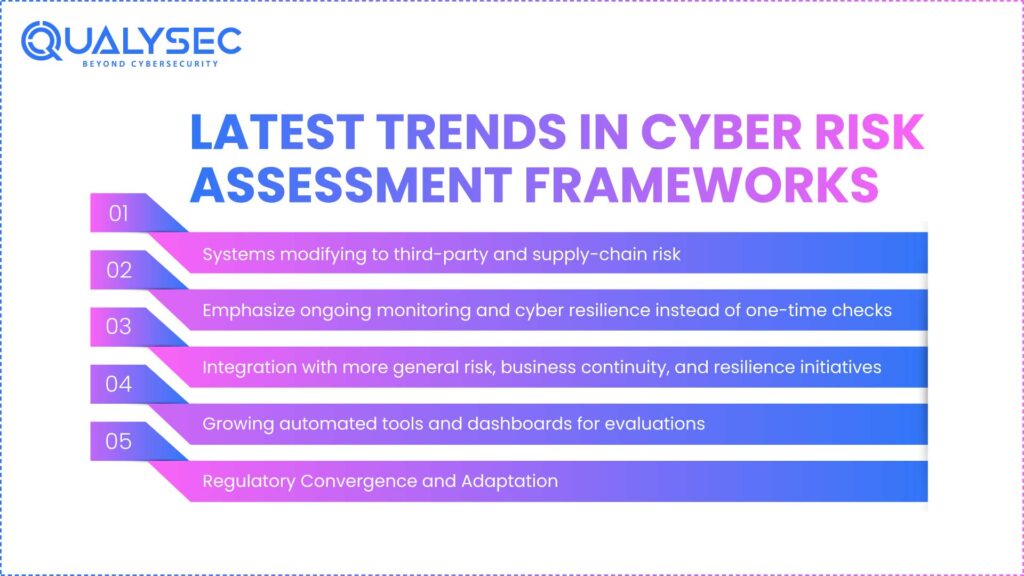
Latest Trends in Cyber Risk Assessment Frameworks
The main changes we are witnessing across systems are discussed here, along with how you ought to prepare for them.
• Systems modifying to third-party and supply-chain risk
Vendors, suppliers, and cloud platforms all present risk; therefore, it is no longer just about “your systems.” One group that the NIST CSF emphasizes is supply chain risk management.
This implies you have to evaluate not only your own measures but also those of major stakeholders and their dependencies.
• Emphasize ongoing monitoring and cyber resilience instead of one-time checks
Frameworks are changing from “audit once” to “monitor continuously.” Your evaluation turns into an ongoing process.
That entails designing dashboards, incorporating threat intelligence, and modifying control in near real time.
• Integration with more general risk, business continuity, and resilience initiatives
Many companies include cyber into enterprise risk, business continuity, and brand safety initiatives rather than acting alone.
This supports board-level participation and guarantees that cyber risk connects to corporate results instead of only IT indicators.
• Growing automated tools and dashboards for evaluations
Automation helps systems to be applied every day. You will see continuous vulnerability scanning, real-time dashboards, and analytics instead of conventional spreadsheets.
Particularly crucial for bigger estates and supply networks, these tools help to save time and improve accuracy.
• Regulatory Convergence and Adaptation
Although UK and EU systems are changing, many businesses still (or also) follow worldwide standards like NIST instead.
Staying ahead means you choose a flexible framework that integrates all pertinent rules, not only UK-only.
Want a full security assessment, gap analysis, and roadmap built for you? Check out Qualysec’s service overview and get started today!
Chief Structural Elements to Be Aware Of
This part offers a summary of several important frameworks you ought to think about, together with their distinctions.
A. The NIST Special Publication 800-30 Framework (and relevant)
Often, when people refer to “risk assessment framework,” they imply the NIST method. It offers thorough instructions on approach (identify assets, hazards, weaknesses, likelihood, effect, etc.).
Five basic processes make up the NIST Cybersecurity Framework: Identify, Protect, Detect, Respond, and Recover.
Its advantages:
- Across sectors worldwide, it is rather well used.
- Target profile, current condition, gap analysis, action plan procedure
- You customize it to your company; it is flexible, not too prescriptive.
The NIST CSF is a good option if you want a worldwide, acknowledged model.
B. The Cyber Assessment Framework (CAF)—UK
Developed by the NCSC, this is intended for UK companies (particularly basic services). Cybersecurity assessment revolves around governance and risk, protection, detection, response, and recovery as its high-level goals.
Advantages of it:
- It fits British legislation, say, the NIS Regulations.
- For the UK context, it supports self-assessment and development plans.
CAF naturally fits your needs if you run in the UK and seek alignment with UK rules.
C. The “5 C’s of Cybersecurity” framework
Though not a rigorous framework like NIST/CAF, this is a useful arrangement of ideas: Change, Compliance, Cost, Continuity, and Coverage.
- Change: Change is constant; thus, your safeguards must also change.
- Compliance: You have to follow pertinent laws and regulations.
- Cost: You must efficiently prioritize and control investments.
- Continuity: guarantee operation even under assault.
- Coverage: Every asset and layer has to be secured, not just the evident ones.
Use this template as a mental checklist to guarantee you are covering important aspects.
Check out: Compliance in IT Security: Checklist, Guidelines & More
Segmented by Type and Usage
Selecting or implementing a framework gets simpler as you divide by type, that is, sort of assessment and application, which is a division of the organisation.
By Type
- Qualitative vs quantitative: Some evaluations define descriptive risk levels low, medium, and high, while others give financial effect and probability.
- Control-based assessments: Assessments based on controls focus on your current required measures (password policies, multi-factor authentication, etc.).
- Threat/vulnerability assessments: Concentrate on what attackers might use in your surroundings through detailed threat assessments and vulnerability analyses.
- Maturity assessments: Examine your cyber activity’s degree of advancement, not only pass/fail in maturity evaluations. Many frameworks have maturity levels.
By Usage
- Enterprise-wide assessment: Enterprise-wide assessment includes every business unit, asset, technology, person, and procedure.
- Service or system-specific assessment: Target a crucial service, for example, a payment system or ICS/OT, for a specific assessment of the service or system.
- Supply-chain assessment: Given linked risks, assessing third-party suppliers, partners, and vendors is increasingly important.
- Project or change assessment: For fresh projects, mergers/acquisitions, and cloud migrations, evaluate before and after to help control risk.
Breaking the work down this way helps you apply the framework in manageable slices and prioritize where effort yields the most benefit.
Want to assess your current cyber readiness? Set a free 30-minute consultation with our security experts about your assessment needs.


Methods for putting a framework for cybersecurity risk assessment into action
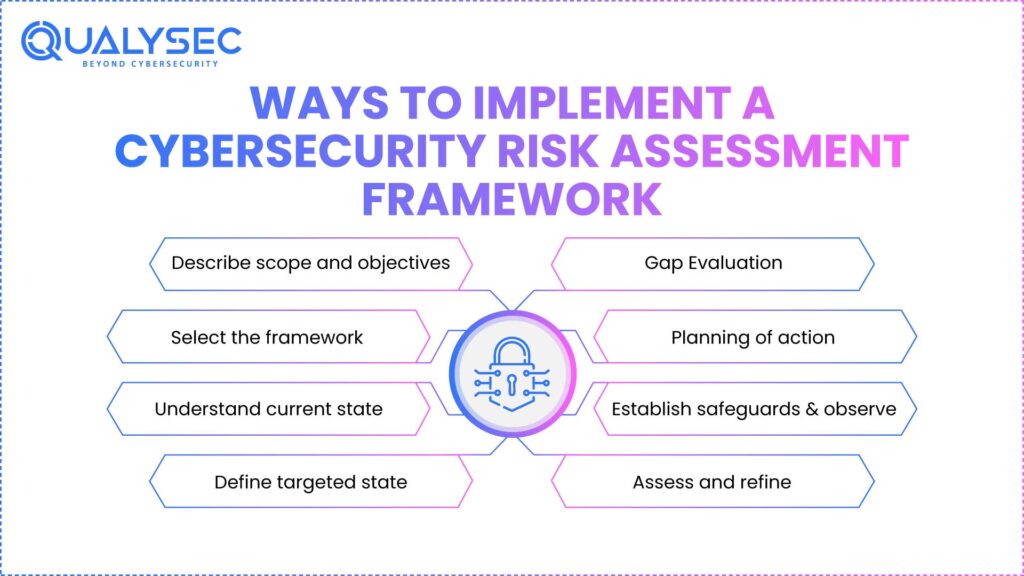
Here is a straightforward, step-by-step approach you may use to apply your framework; each step is explained for simplicity.
1. Describe scope and objectives
- Which component of your company will be evaluated? (Total business, service, supplier network?)
- What goals are you striving for? (Baseline maturity, compliance, vendor assurance)
- Who will be accountable (governance), and how frequently will this repeat?
These fundamentals properly guarantee you avoid a large evaluation without a defined goal.
2. Select the framework
- For UK alignment, think about CAF.
- For a widely used worldwide model, the NIST CSF SP 800-30 framework for thorough risk analysis fits.
- Perhaps construct a hybrid or fit it to your size or sector.
Your firm size, industry, regulatory requirements, and maturity level should guide your choice of framework.
3. Understand current state
- Chart your assets, data streams, and corporate procedures.
- Find existing controls, past occurrences, and known weaknesses.
- Using the basic features/categories of the framework, evaluate present performance (e.g., NIST’s Identify, Protect, Detect, Respond, Recover).
From this phase, you will enhance your baseline.
4. Define targeted state
- Define where you want to be based on financial objectives, risk tolerance, and budget.
- Design a “target profile” or preferred degree of maturity.
The target clarifies your north star and guides your action priority.
5. Gap Evaluation
- Compare the present with the goal. Find the vulnerable spots: lack of controls, underdeveloped procedures, and uncertain third-party risk.
- Give gaps priority depending on feasibility and corporate influence.
This gives a clear view of the order of work and required measures.
6. Planning of action
- Create a timetable with assigned parties, specified duties,
- Include strategic actions maturation over the long run, as well as tactical ones, and fast victories.
Having practical steps allows you to translate research into practice.
7. Establish safeguards and observe
- Begin the enhancements.
- Arrange monitoring, indicators, and dashboards.
- Review often, that is, every three months or following a significant change.
Implementation and monitoring guarantee accountability and progress.
8. Assess and refine
- Review what worked and what did not, following events or evaluations.
- Revise the roadmap, modify the target state, and update your assessment.
- In everyday operation, integrate risk analysis.
Your framework has to change because cyber risk is not constant.
Need help with data security compliance (PCI-DSS, ISO 27001, SOC 2) or supply-chain risk? Head to Qualysec’s compliance page and see how they support you!
Best Practice Advice
Emphasize the main points as you introduce your framework here:
- Early engagement with senior leadership; absent buy-in, frameworks frequently fail or turn into “tick-box” drills.
- Use business words rather than simply technical terms. Emphasize business effect (revenue, reputation, continuity).
- Start with a crucial service or business unit and grow; resist the urge to boil the ocean.
- Including third-party/supply-chain risk from day one, it’s no longer optional.
- Employ relevant metrics like time to detect, time to respond, and percentage of assets evaluated.
- Keep it living: your assessment has to change along with your surroundings and the threats.
- Connect your IT risk-assessment findings to budgeting and investment choices, therefore demonstrating cost-benefit and facilitating sponsorship.
- For smaller companies, scale the structure to your size; complete maturity right away may not be attainable.
These practical pointers aid in transforming a theoretical framework into workable value.
Read our recent guide about How to Perform an AI Risk Assessment.
How Qualysec Can Help
Qualysec is ready to work with you as you move from “we should probably do a risk assessment” to a strategic, repeatable, business-aligned assessment framework. We support you by:
- Helping you to select and customize the best framework (NIST CSF, CAF, or hybrid) for your industry and company size.
- Carry out a first maturity and vulnerability risk assessment map your present state across people, technology, processes, and supply chain.
- Doing a gap analysis helps you to give priority to activities that match budget limitations and business goals.
- Creating a practical plan with strategic projects and immediate benefits.
- Helping with implementation: process design, controls, measures, dashboards, and personnel training.
- Giving regular evaluations and ongoing improvement support lets your framework remain current over time.
Read our cybersecurity risk assessment case studies to learn how Qualysec assists companies in recognizing, prioritising, and eliminating security concerns.
Conclusion
Installing a well-chosen and thoroughly implemented cybersecurity risk assessment framework is now mandatory in the UK. The most important thing is to make it significant: connect it to corporate impact, whether you pick the NIST CSF, the UK CAF, or a customized hybrid. Frequently examine the results and act on them. With the correct strategy, you will not only lower your risk but also show cyber-maturity, improve company resilience, and foster partner and consumer trust.
Contact Qualysec to get a customized strategy when you’re ready for the next phase, starting small, scaling intelligently, and integrating ongoing development.
















































































































0 Comments