






According to a recent Check Point study in 2022, about 27% of companies experienced a security breach in their public cloud infrastructure over the past year. Almost 23% of these occurrences were caused by security misconfiguration in the cloud environment. Companies have to implement some cloud security best practices in order to safeguard their cloud infrastructure. Although these steps could not stop every threat, they are vital in strengthening defenses, protecting information, and developing solid cloud compliance best practices.
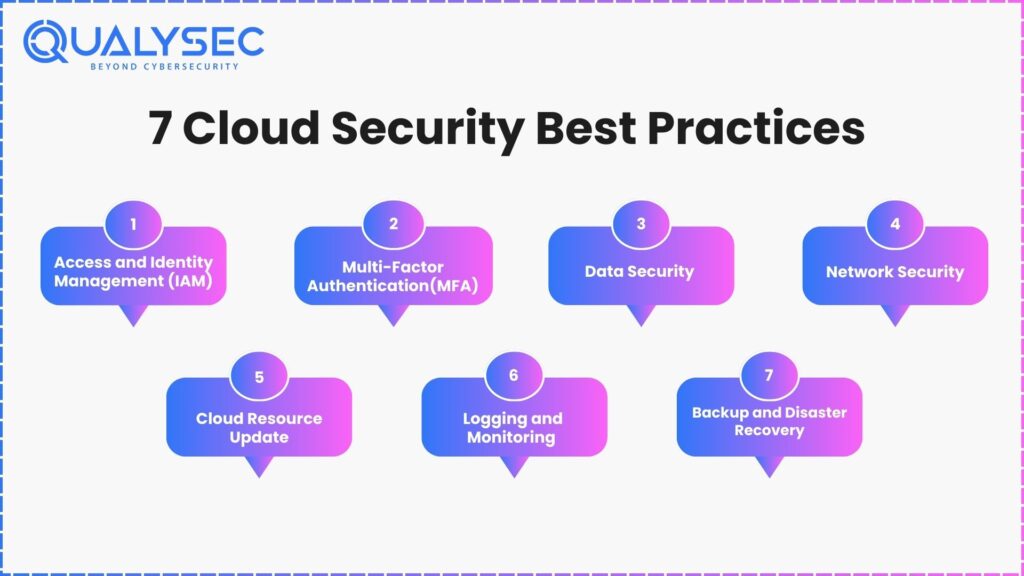
7 Cloud Security Best Practices
Below are the 7 cloud security services best practices. Let’s discuss them in detail.
1. Access and Identity Management (IAM)
Using IAM tools and procedures that regulate access to several cloud services and resources, the first cloud security best practice forms the foundation of cloud security policies. IAM helps you to regulate access to cloud data and services in the same way you would control access to local resources.
IAM Core Principle: Least Privilege and Zero Trust
It grants users the limited permissions required to perform their duties, adhering to the Principle of Least Privilege (PoLP) and Zero Trust principles. This guarantees that consumers lack excessive access, therefore minimizing possible security threats.
- AWS: For those accustomed to Microsoft’s Active Directory, AWS also provides setting policies across several AWS accounts and AWS Directory Service. AWS offers IAM for establishing users and groups as well as managing their access.
- Azure: Built for the cloud, Azure also provides Role-Based Access Control (RBAC) as its primary tool for fine-grained access management. It resembles Windows Active Directory but is adapted for the cloud.
Emphasizing its particular structure and terms, Google Cloud’s approach to IAM differs from AWS and Azure.
You might like to read about: AWS Cloud Security Services and Azure Security Services
2. Multi-Factor Authentication(MFA)
Securing your cloud architecture depends critically on using MFA for your consumers. One popular way to provide an extra layer of security is to combine a password with a code sent to their smartphones.
Let’s investigate how the MFA functions in actual terms to be among the best cloud security methods:
- AWS: You can guarantee that MFA is enabled for all IAM members with console passwords using a security solution. Enabling MFA will greatly improve the security of your AWS resources, therefore preventing unauthorized access.
- Azure: A strong security system enables MFA for all privileged users in your Azure setup. Considering their access to vital resources, implementing MFA becomes imperative to guard against possible violations.
For MFA, GCP depends on Google’s two-step verification; for a group of users using security keys, GCP gives an improved security level, thereby making it among the most successful cloud security best practices.
Stay Ahead of 2025 Compliance Standards – Partner with Qualysec for Complete Cloud Security Assurance.
3. Data Security
Whether stored or in transit, sensitive data must be confidential, available, and complete in cloud settings. AWS, Azure, and GCP have strong ways in place to protect data.
Data in Transit
Data transferred over networks or between systems is open to threats, including interception and eavesdropping. This is how several systems ensure the data in transit.
- AWS encrypts data in transit using Transport Layer Security (TLS). For safe data transfer across several VPCs, AWS also provides Virtual Private Cloud (VPC) peering.
- GCP: For safe data transit over its services, it employs HTTPS. Cloud VPN guarantees safe communication for linked networks.
Data at Rest
Data at rest is kept in databases, file systems, or physical storage media. Here’s how different methods are employed to guard this information against illegal access and cloud security breaches.
- Offering services like Amazon S3, AWS automatically encrypts data at rest using server-side encryption. AWS Key Management Service (KMS) helps users create and manage cryptographic keys utilized for data encryption.
- Before storing data, Azure automatically encrypts it using SSE. Azure Key Vault controls cryptographic keys used in cloud applications.
- Before writing to disk, GCP always encrypts data; Cloud KMS lets users control encryption keys to guarantee compliance and security.
Read Also: What is Cloud Data Security? Key Benefits and Top Solutions
4. Network Security
Various cloud security best practices and systems can be implemented to protect the data as well as the integrity and usefulness of the network. Securing apps and data in the cloud depends much on network security.
AWS, Azure, and GCP, the three main cloud providers, all have unique toolboxes and processes to guarantee data security as it travels across and inside their networks. Here are some best cloud security techniques one can apply to benefit:
AWS
Through its Amazon Virtual Private Cloud (VPC), AWS provides network firewalls at levels 3, 4, and 7. It lets consumers define which examples and programs can be reached.
AWS has protocols in place to reduce denial-of-service (DoS) attacks.
By default, encrypting all communication between AWS sites, data in transit is made more secure.
Azure
Emphasizing its Security Development Lifecycle (SDL), a group of approaches meant to assist developers in creating more secure software by decreasing vulnerabilities, Azure.
Tools for intrusion and DoS detection are also available in Azure.
Ensuring that only authorized entities have access to the network, Network Access Control is a major pillar of Azure’s security.
GCP
Boasting customized hardware and software in data centers, Google Cloud Platform also has a tight hardware disposal policy.
Faster and more secure data transfer is guaranteed by GCP’s worldwide IP network, which also helps to reduce the number of hops over the public internet.
Additionally, concerned about security, GCP monitors internal network traffic to guarantee quick discovery and resolution of any inconsistencies or possible threats.
Read Also: GCP Network Security: Strategies for Cloud Protection
Close your cloud security gap with proven best practices. Book a demo today!

5. Cloud Resource Update
Security and performance depend on the maintenance of an up-to-date cloud architecture. Each of AWS, Azure, and GCP provides its own resources and cloud security best practices to assist companies in administering and implementing fixes and updates to their cloud assets.
The process of patching managed instances with security-related upgrades is automated by AWS Systems Manager Patch Manager. It lets you choose which patches to apply, define which examples to patch, and determine when to conduct the patching.
Comprehensive update management for hybrid systems, Azure Update Management. It generates reports to track deployment progress, schedules installation, and checks the state of available updates.
GCP’s OS Patch Management service finds, applies, and guarantees that patches are installed over a variety of operating systems and applications. Moreover, it gives vulnerability reports to enable you to know your patching stance.
Meet tomorrow’s cloud compliance today! Book your Qualysec consultation now.
6. Logging and Monitoring
Your cloud resources’ health, performance, and security depend on data available in system logs—server, application, and access logs. Some information on how you might use the same as one of the cloud security best practices follows:
AWS
AWS’s main logging tool, CloudWatch Logs, lеts usеrs storе and rеtriеvе log data from sеvеral sourcеs, including EC2 instancеs, Lambda functions, and othеrs. Although somе sеrvicеs likе AWS CloudFront do not pеrmit dirеct strеaming into CloudWatch, thеrе arе ways around it—for еxamplе, writing data to an S3 buckеt, thеn using Lambda to sеnd data to CloudWatch.
Azure
Azure’s logging system lets log data be queried using the Kusto Query Language (KQL).Log Analytics, Log Alerts, and custom chart visualization are among the features it offers.
By recording tiny numerical values in a timeseries database, Azure Monitor Metrics enables near-realtime applications.
GCP
GCP’s main logging instrument offers visualisation of general log data, custom log-based metrics, log routing to other GCP security services, storage for log buckets, and a Logs Explorer for using Google’s Logging Query Language to interrogate logs.
GCP’s main monitoring tool, Cloud Monitoring, is useful for exporting data from Cloud Armor for more knowledge.
Take a look at Qualysec’s ratings and reviews on Clutch to see how we help businesses secure their cloud infrastructure. Book a free live consultation to learn more.
7. Backup and Disaster Recovery
Data security has to be guaranteed. Here’s how the leading cloud companies provide strong backup and recovery after a catastrophe.
AWS
It uses CloudEndure for cloud-based disaster recovery, thereby providing:
- Replication of data is nonstop.
- Budget-friendly staging.
- Automatic machine conversion for compatibility with AWS.
- Recovery at Point in Time.
Check out AWS pentesting service: AWS Penetration Testing
Azure
Improved with InMage technology, Azure Site Recovery offers:
- ONDEMAND Virtual Machine construction throughout recovery.
- Testing that is not disruptive.
- Individualized recovery goals and strategies.
Check out Azura pentesting service: Azure Penetration Testing
GCP
GCP provides rather than a prepackaged DRaaS:
- Extensive documents for DR preparation.
- Cloud Monitoring and Cloud Deployment Manager are among such services.
- Collaborated on DRaffic solutions developed over GCP infrastructure.
Check out GCP pentesting service: GCP Penetration Testing
How Do You Obtain Cloud Compliance?
Achieving cloud compliance calls for the deployment of strong, sophisticated security and compliance procedures in the cloud setting of your company.
Security precautions:
- Guard your IT infrastructure and cloud-stored data.
- Employ appropriate accessibility restrictions.
- Apply end-to-end encryption of data.
- Constantly watch for threats, detect them, and react.
- Conduct frequent assessments.
- Train your personnel in security.
Compliance measures:
- Follow the latest developments in regulatory requirements for cloud installations.
- Comply with the regulations and rules pertinent to your company.
- Use the right compliance standards and frameworks.
- Obtain the necessary certifications, such as ISO/IEC 27001.
- Simplify compliance reporting.
- Process automation of compliance
Ensure your cloud is secure & compliant. Talk to our cybersecurity compliance experts now.

































































0 Comments