







The PDPA Compliance Checklist is the list of obligations imposed by the Personal Data Protection Act (PDPA) on private business operators from all industries that handle personal data in Singapore. Unlike one-time certifications, PDPA compliance is ongoing and risk-based, which requires organisations to actively manage data protection and cybersecurity controls.
Singapore’s PDPA was enacted in 2012 to govern the collection, use, and storage of personal data by private organisations. It came into force in 2014, and, since then, it has strengthened enforcement actions through amendments and penalties under evolving PDPA Guidelines.
Why is PDPA Compliance Important?
The modern world is witnessing an increase in data breaches with high costs and worldwide impact. In 2025, the global average cost of a data breach reached around USD 4.44 million. Many breaches occurred due to ransomware or credential exploitation, in which detection and remediation took more than 241 days. A PDPA compliance checklist helps organisations manage data protection and lower the risk of breaches.
In Singapore itself, approximately 2,300 complaints were reported to the Personal Data Protection Commission (PDPC) for personal data breaches, which highlights persistent gaps in data protection and cybersecurity controls.
Apart from monetary penalties, PDPA non-compliance exposes organisations to regulatory directions, including orders to cease practices or destroy unlawfully retained personal data. The organisations may also face civil lawsuits from affected individuals, reputational damage from publicly published enforcement decisions, and long-term loss of customer trust.
Therefore, PDPA compliance is not a mere legal obligation but also crucial for managing business risk.
What does personal data include?
Personal data is information, whether on its own or combined with other information, that identifies an individual, including NRIC numbers, names, pictures, fingerprints, and contact information.
NOTE: The Personal Data Protection Act, 2012, applies to both non-electronic and electronic personal data records. PDPA guidelines are mandatory for any organisation handling personal data of Singapore residents, regardless of server location worldwide.
Who needs to comply with PDPA?
Under PDPA, organisations that collect, use, disclose, or store personal data of individuals in Singapore are mandated to comply with PDPA compliance requirements, irrespective of their size, revenue, or industry.
As per Section 2 (1) of the PDPA Act, 2012, all organisations, which include any individual, company, association, or body of persons, whether corporate or unincorporated, and whether operating on a commercial, non-profit, or voluntary basis, must follow the PDPA Guidelines. These include:
- Private companies, startups, SMEs, and multinational corporations
- Partnerships, sole proprietorships, and professional practices
- Associations, societies, clubs, and non-profit organisations
- Online platforms, marketplaces, SaaS providers, and digital service operators
- Financial institutions, fintech firms, healthcare providers, and educational platforms
- Employers that handle employee or contractor personal data
- Organisations based in Singapore that process personal data of individuals in Singapore in connection with their business activities
Who is exempted?
PDPA obligations apply to all organisations except:
- individuals acting in a personal or domestic capacity
- employees acting in the course of employment
- public agencies
Explore cybersecurity solutions for every industry to help organisations of all sizes protect personal data and meet PDPA obligations through practical, risk-based security controls.
What Are PDPA Compliance Requirements
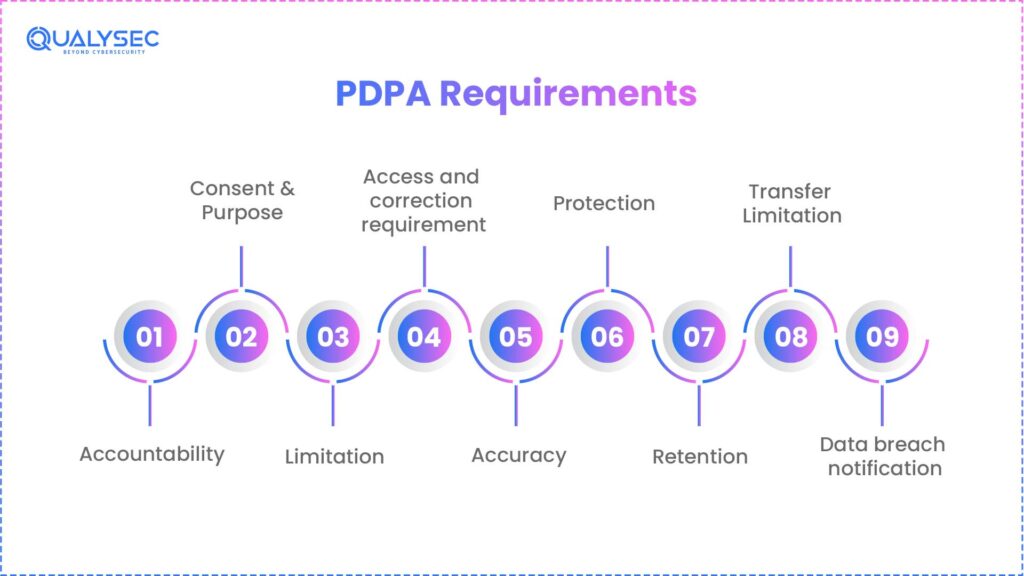
The PDPA sets out specific obligations that organisations must follow throughout the lifecycle of personal data, i.e., from collection to disposal. These requirements form the foundation of the PDPA compliance checklist and best practices.
1. Accountability: Organisations are mandated to –
- Appoint a Data Protection Officer (DPO) to ensure PDPA compliance
- Show compliance through policies, documentation, and practices.
- Make information about their data protection policies and practices available on request.
2. Consent & Purpose: Informed, specific, and revocable consent must be obtained before collecting, using, or disclosing personal data, unless a statutory exception applies. It is pertinent to note that the data collected for one purpose cannot be reused for another without fresh consent.
3. Limitation: Organisations may only collect, use, or disclose personal data for purposes that are reasonable and have notified the individual.
4. Access and correction requirement: Individuals have the right to access their personal data and request corrections.
5. Accuracy: Organisations must ensure that personal data is accurate and complete when it is used to make decisions or disclosed to others.
6. Protection: Reasonable security arrangements must be in place to protect personal data from unauthorised access, disclosure, loss, or misuse. It includes regular VAPT to identify and address security weaknesses.
7. Retention: Personal data must not be retained longer than necessary for legal or business purposes.
8. Transfer Limitation: organisations must ensure a comparable standard of protection to the data being transferred outside Singapore.
9. Data breach notification: Inform individuals of the purposes for which their personal data will be collected, used, or disclosed.
Ensure your organisation meets PDPA requirements. Contact us to review your compliance and security posture.
PDPA Singapore Compliance Checklist (2026 Updated)
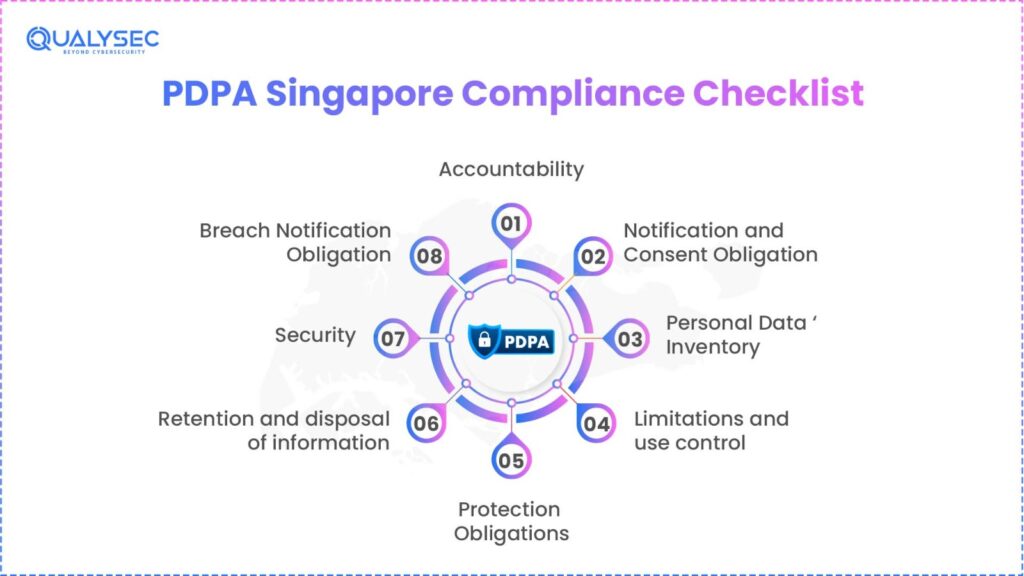
Organisations are mandated under the PDPA Compliance Singapore checklist to:
1. Accountability:
- Appoint at least one DPO and make contact details publicly available.
- Establish written data protection policies and procedures aligned with the PDPA Guidelines.
- Assign management oversight and accountability for the Personal Data Protection Act.
- Train employees on data protection responsibilities as part of PDPA Compliance best practices.
2. Notification and Consent Obligation:
- Obtain valid consent before collecting, using, or disclosing personal data unless an exception under the Personal Data Protection Act is applicable on them.
- Notify individuals of collection purposes for which personal data is collected, used, or disclosed before or at the time of collection.
- Only collect, use, or disclose personal data with the informed consent of the individual.
- Allow individuals to withdraw consent, with reasonable notice, and inform them of consequences.
- Cease processing of personal data once the consent is withdrawn or other legal basis/ordersunder the PDPA Singapore Guidelines apply.
3. Personal Data Inventory
- Identify and document all personal data collected, used, or stored under the Personal Data Protection Act.
- Map data flows, including cloud systems and third-party vendors.
- Classify data by sensitivity to apply appropriate controls.
Read also about Third-Party Risk Assessment.
4. Limitations and use control:
- Process personal data only for purposes that are reasonable and notified to the individual.
- Do not require consent for unrelated purposes as a condition of a product or service.
5. Protection Obligations:
- Make efforts to ensure that individuals keep their personal data accurate and complete, particularly if they may use it to make decisions that affect them or disclose it to others.
- Implement reasonable security arrangements to protect personal data in your possession or under your control against unauthorised access, collection, use, disclosure, copying, modification, disposal, or similar risks.
- Here, also include controls such as regular network penetration testing and access management, which can point out the weakness in the security.
6. Retention and disposal of information:
- Define retention periods for the basis of collecting personal data based on business and legal needs.
- Retain personal data only for as long as it is necessary to fulfil legal or business purposes.
- Cease retention or securely dispose of the personal data once those purposes are no longer served.
7. Security:
- Implement reasonable security arrangements to protect personal data from unauthorised access, disclosure, loss, misuse, or modification.
- This includes technical and organisational measures such as access controls, least-privilege permissions, encryption of data at rest and in transit, secure system configurations, timely patching, and regular security assessments or vulnerability testing.
8. Breach Notification Obligation:
- Set up and establish processes to assess all incidents that involve personal data to determine whether a data breach has occurred.
- Where a breach is assessed to be notifiable, organisations must notify the PDPC within 3 calendar days of the determination and inform affected individuals.
Now download a sample penetration testing report to understand common security gaps identified under PDPA requirements.
Role of Cybersecurity & Penetration Testing in PDPA Compliance
Cybersecurity and penetration testing are integral components of PDPA Compliance under the PDPA Singapore Guidelines. Effective cybersecurity measures, including penetration testing, help organisations follow the Personal Data Protection Act by:
- identifying system vulnerabilities,
- ensuring data protection mechanisms,
- and mitigating the risks of data breaches.
Penetration testing, which is often referred to as ethical hacking, is a simulated cyberattack performed on a computer system, network, or web application to identify vulnerabilities and assess the level of security. Penetration testing involves several phases, including preparation, reconnaissance, vulnerability scanning, exploitation, and reporting, and testers commonly employ tools such as Nmap, Nessus, and Metasploit in these phases to facilitate the identification and exploitation of vulnerabilities. Most PDPA Compliance enforcement actions in Singapore arise from:
- Web application vulnerabilities
- Poor access control
- Unpatched systems
- Insecure APIs
Cybersecurity and penetration testing support PDPA Compliance best practices by:
- Vulnerability identification of a system, network, or web application that could be exploited by unethical hackers.
- Data protection mechanisms that align with the principles of confidentiality, integrity, and authenticity (CIA) are fundamental to network security.
- Compliance verification that verifies the effectiveness of existing security controls, which is vital for meeting the requirements of data protection laws like the PDPA and the General Data Protection Regulation (GDPR).
- Supports threat mitigation by identifying internal vulnerabilities and access control weaknesses, and reduces the risk of insider threats.
- Aligns with recognised frameworks such as the NIST Cybersecurity Framework, contributing to the Identify, Protect, Detect, Respond, and Recover functions, with penetration testing to protect domains.
- Enhances security assessments through AI-driven solutions, including Large Language Models (LLMs) and Generative AI (GenAI) to improve assessment coverage, accelerate risk identification, and provide clear and actionable insight.
PDPA Compliance Timeline & Recent Updates
| Timeline / Trigger | What Organisations are mandated to do: |
| Before collecting personal data | Notify individuals of the purposes for collection, use, or disclosure and obtain valid consent unless an exception applies |
| At the start of operations involving personal data | Appoint at least one DPO, develop internal PDPA policies, and establish a complaints-handling process |
| From 2 July 2014 (core enforcement date) | Comply with all core PDPA obligations, including consent, purpose limitation, access & correction, accuracy, protection, retention limitation, and transfer limitation |
| Ongoing (continuous obligation) | Implement reasonable security arrangements, ensure data accuracy, limit use to notified purposes, and review compliance regularly |
| When personal data is no longer needed | Cease retention and securely delete or anonymise personal data unless required for legal or business purposes |
| Before transferring personal data outside Singapore | Ensure overseas recipients provide a comparable standard of data protection |
| Upon receiving an access or correction request | Respond within a reasonable time and provide access or correction unless an exception applies |
| From 1 February 2021 onwards | Assess every data incident to determine if it is a notifiable data breach |
| Within 3 calendar days after determining a notifiable breach | Notify the PDPC as soon as practicable and no later than 3 calendar days |
| When a notifiable breach affects individuals | Notify affected individuals if the breach is likely to result in significant harm |
| After a breach | Take remedial actions, document decisions, and prevent recurrence |
| At all times | Maintain evidence of compliance, such as policies, training records, audits, and risk assessments |
Focus of PDPA Compliance in 2026
In 2026, PDPA Compliance’s focus is on technical failures, such as vulnerabilities that arise from insecure systems, weak authentication controls, and inadequate patch management. As transparency is the foundation of trust, the PDPC now publicly publishes enforcement decisions to build the trust of the common man in the regulatory authority. The organisations are mandated to:
- Assess every data security incident to determine whether it qualifies as a notifiable data breach.
- Notify the PDPC within three calendar days once a breach is assessed as notifiable.
Need help keeping up with PDPA timelines and updates? Schedule a meeting to assess your data protection and PDPA compliance.
What are the Consequences of Non-Compliance
If an organisation breaches Singapore’s Personal Data Protection Act (PDPA), it will be subjected to enforcement actions and penalties imposed by the PDPC. The action may include any of the following:
| Penalty Type | Consequences |
| Financial PenaltiesDepends on | Fine up to 10% of annual Singapore turnover or SGD 1 million, whichever is higher. The nature, gravity, and duration of the breach, the sensitivity and volume of personal data affected, the financial circumstances of the organisation and its ability to continue operations and the organisation’s remedial actions and speed in mitigating harm. |
| Other enforcement actions | Fine up to 10% of annual Singapore turnover or SGD 1 million, whichever is higher. The nature, gravity, and duration of the breach, the sensitivity and volume of personal data affected, the financial circumstances of the organisation and its ability to continue operations and the organisation’s remedial actions and speed in mitigating harm. |
Criminal liability of individuals under PDPA
| Offence | Penalty |
| Unauthorised disclosure of personal data | Fine up to SGD 5,000 and/or imprisonment up to 2 years |
| Improper use of personal data | Fine up to SGD 5,000 and/or imprisonment up to 2 years |
| Unauthorised re-identification of anonymised information | Fine up to SGD 5,000 and/or imprisonment up to 2 years |
How Qualysec Can Help Singapore Businesses
Qualysec is your cybersecurity specialist, excelling in PDPA Compliance services to help organisations enhance their cybersecurity posture and meet obligations under the Personal Data Protection Act through penetration testing, cloud security strategy, and incident response planning. We provide:
- PDPA Awareness & Readiness Gap Assessment: Qualysec helps organisations assess their current PDPA compliance readiness by reviewing how personal data is collected, stored, and processed. With our detailed assessments, businesses can identify gaps in consent management, data flow mapping, notification procedures, and other PDPA obligations.
- Penetration Testing & Vulnerability Assessments: Penetration Testing on simulated cyberattacks helps in identifying vulnerabilities across web, mobile, API, cloud, and network systems, aligned with the PDPA compliance checklist and best practices. Qualysec is your trusted partner to help your organisation by conducting risk-driven penetration testing.
- Cloud Security Strategy: Qualysec supports organisations in securing cloud workloads by reviewing cloud configurations and access management controls in accordance with the PDPA Singapore Guidelines and the Personal Data Protection Act.
- Incident Response: In addition to identifying vulnerabilities, Qualysec assists organisations in improving their incident response readiness by designing breach assessment and response procedures.
Qualysec also helps organisations align security controls with MAS TRM Guidelines for regulated environments while being compliant with PDPA.
Conclusion
In 2026, the PDPA compliance checklist is crucial for all private organisations dealing with personal data on a day-to-day basis. Compliance with the PDPA requirements is one of the most important responsibilities of businesses. With the rise in cyber attacks, enforcement actions, and growing reliance on cloud and digital platforms, organisations in Singapore must treat personal data protection as an ongoing risk-management discipline. Technical weaknesses such as insecure applications, unpatched systems, and weak access controls remain the leading causes of violations of the Personal Data Protection Act. To address these risks, organisations must adopt a proactive and continuously tested security measure that integrates preventive controls + proactive governance + incident report capabilities.
Choose the right partner that bridges the gap between regulatory expectations and real-world security.
FAQs
1. Is PDPA compliance mandatory for all businesses in Singapore?
Yes, PDPA compliance is mandatory for all businesses, including private sector organisations that handle personal data, regardless of size or industry.
2. Does PDPA apply if data is stored outside Singapore?
Yes, the PDPA Singapore guidelines apply if the data relates to individuals in Singapore, even when servers or processing are located overseas.
3. What qualifies as a notifiable data breach under PDPA?
As part of the PDPA compliance checklist, a breach is notifiable if it is likely to cause harm to individuals or affects 500 or more individuals.
4. How quickly must organisations notify the PDPC of a data breach?
The PDPC mandates organisations to notify it within 3 calendar days after they determine that a breach is notifiable, in accordance with the PDPA Guidelines.

































































































































































0 Comments