







One unsecured vendor connection can undo months of security hardening. In a recent study of Indian suppliers, 52.6 % of companies experienced at least one third-party breach in the last year, leading to the critical need for third-party risk assessment.
If you are managing IT, security, or compliance in an Indian business, the pain is evident. You rely on external vendors, cloud services, and partners, yet you might have far less visibility into their controls than into your own.
In this blog, we dig deeper into third-party risk assessment, why it matters, and how you can implement the best practices efficiently.
What Is a Third-Party Risk Assessment?
Third party vendor risk assessment is the formal procedure of recognising, examining, and controlling the risks that we take when we depend on any of the external parties. With a reliable 3rd party cybersecurity risk assessment, you can evaluate vendors, service providers, and partners in whatever we do in business.
Why is a Third-Party Risk Assessment Important?
Third party vendor risk assessment is extremely critical for businesses. Here are the reasons why –
Vendor-driven breaches are rising
The data speaks for itself: in a recent study of Indian vendors, over half of the organisations examined suffered a third-party breach last year. If you outsource key functions or work with international clients, your vendor’s weak link can quickly become your incident. This clearly explains why third party security assessment is important.
Regulatory and contract pressures are increasing
India’s regulatory landscape is tightening. The draft rules and Digital Personal Data Protection Act (2023) put direct responsibilities on the data controller in the event of sharing the data with a third party. International customers are requiring information about vendor appraisals of the supply-chain security, especially when you are dealing with their information or systems, making third party security assessment super essential.
Risk visibility
A vendor failure doesn’t just cost financially. It costs reputation, operations, and client trust. One vendor breach can trigger downtime, data loss, or contractual penalties. By conducting structured assessments, you can build:
- A documented vendor risk landscape that supports internal governance
- Documents that can be provided to auditors, the client, and the regulators.
Get your free Information Security Risk Assessment today!
Full Risk Assessment vs. Partial Risk Assessment
There are a few things you should know before rolling out any vendor-risk initiative, but the first one is that not all vendor security assessments are born equal. There are some superficial checklists and some deep ones. The correct level is determined by the level of importance of the vendor to your operations.
Full Risk Assessment
Complete evaluation infringes on your vendors’ controls, systems, processes, and end-to-end compliance. It typically includes:
- Review of documentation (policies, audit reports, and certifications)
- This is referred to as technical testing (vulnerabilities, access controls, configuration).
- Face-to-face/telephone interview of vendor security/operations teams.
- Domestic inspiration of risk measurement or process (cyber, ops, financial, compliance).
- A report of findings, remediation roadmap, and retest plan.
You would perform this vendor security assessment for vendors whose failure would seriously impact your business. This includes a payroll system, a cloud infrastructure security provider, outsourced IT operations, or a data processor for regulated information.
Partial Risk Assessment
By contrast, a partial third party assessment covers only selected aspects of a vendor’s risk profile. It might involve:
- A questionnaire and documentation review only
- Focusing just on cybersecurity or compliance (not financial or operational risk)
- Applying to lower-risk vendors (e.g., non-critical service providers, local suppliers with limited access)
- A simpler report, fewer remediations, lower cost
When to use which?
- Full assessment is required when a vendor is dealing with sensitive data or has access to the system, or is crucial to the business.
- Partial assessment should be used when there is a low impact of the vendor, or when there is a limited budget/time, but visit them again in the future.
- A mixed solution could do the trick: begin semi-annual, increase to full in case of vendor risk or access alterations.
You may explore our detailed article on Risk Assessment vs Vulnerability Assessment
Steps to Conduct Third-Party Risk Assessment
A vendor risk assessment does not necessarily have to be an intimidating process. This is a simple six-step process that produces good results.
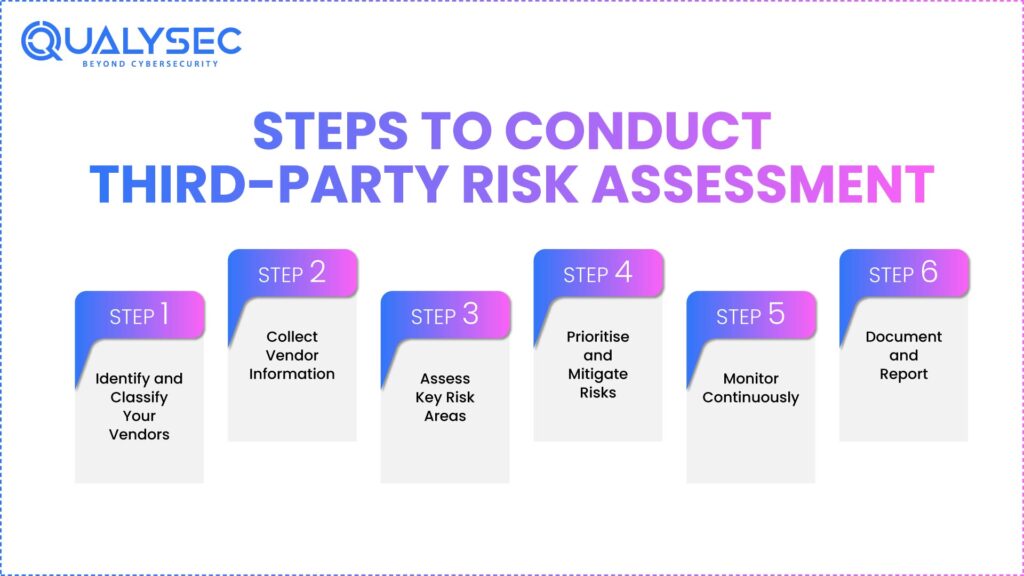
Step 1 – Identify and Classify Your Vendors
Firstly, enumerate all external partners that are connected with your systems and who process or provide important operations. Next, divide them according to the level of risk:
- High risk: Customer of employee data and core systems, and cloud infrastructure are available.
- Mediocre risk: indirect access (e.g. support or analytics vendors).
- Low risk: no information or system communication.
Step 2 – Collect Vendor Information
Collect the evidence of their controls and history. These include:
- A certificate of ISO 27001 or SOC 2 or audit report or a pen-test report.
- Information and trace records, incident-response, and training records of employees.
- Business continuity/disaster-recovery documentation.
- Test these assertions; do not in any case act on self-testimony.
Step 3 – Assess Key Risk Areas
Rate all vendors on key areas:
- Cybersecurity: patching rate, encryption, and network security.
- Compliance: the ability to comply with the applicable standards and laws (IT Act 2000, DPDP 2023, GDPR in case of cross-border).
- Operational: a stability of operations, maturity in processes, and change control.
- Financial: financial capability, service maintenance.
- Reputational: social accidents or fines imposed by the government.
Step 4 – Prioritise and Mitigate Risks
Rank vendors by overall score and apply proportional controls. Examples:
- Add stricter clauses in SLAs (breach notification, audit rights).
- Require remediation for identified weaknesses.
- Restrict sensitive data sharing until fixes are verified.
Step 5 – Monitor Continuously
Risks change over time. Re-evaluate vendors:
- Quarterly for high-risk, annually for low-risk.
- After any incident, merger, or scope change.
- When compliance certifications expire.
- Automated scanning and periodic reviews help keep assessments current.
Step 6 – Document and Report
Maintain a central vendor-risk register. Record the seller’s name, level, evaluation date, results, compliance status, the follow-up. Such records are satisfactory to the auditors and demonstrate due diligence, and generate institutional memory.
Download your free Cybersecurity Risk Assessment Report now!
Third-Party Risk Assessment – Best Practices

1. Centralise Vendor Inventory
Use a shared register that tracks vendor category, data access, assessment date, and renewal cycle. Even a structured spreadsheet is better than siloed records.
2. Adopt Risk-Based Segmentation
Don’t treat all vendors equally. Focus deeper third party assessment efforts on those handling personal data, financial records, or production systems.
3. Integrate Assessment into Procurement
Add security evaluation as a mandatory pre-contract step. This simple policy shift prevents risky onboarding decisions.
4. Use Independent Validation
Combine questionnaires with external security testing. Independent assessments, such as penetration testing or vulnerability scans, uncover issues that documentation may hide.
5. Monitor Continuously
Schedule reassessments and encourage vendors to share updated reports after major changes. Automation tools can alert you to domain expiries or exposed assets.
6. Promote Vendor Education
Provide support to minor vendors who are not aware of such frameworks as ISO 27001 or NIST. Teamwork is likely to enhance obedience more quickly than disciplinary provisions.
Third-Party Risk Management
Third party vendor risk management can be described as the lifecycle of detecting, evaluating, observing, and managing risks in your vendor environment.
Here’s what third party vendor risk management means –
- Vendor Onboarding and Due Diligence – vet new suppliers before contracts are signed. Assess reputation, certifications, and security readiness.
- Contract and SLA Governance – insert security obligations, reporting timelines, and right-to-audit clauses.
- Ongoing Monitoring – track incidents, new vulnerabilities, and compliance renewals.
- Remediation and Follow-up – ensure vendors close issues within agreed timeframes and share proof.
- Off-boarding Controls – confirm data is deleted or returned and access revoked when contracts end.
How can Qualysec help?
QualySec performs independent penetration testing and security assessments for web, mobile, API, cloud, and IoT environments. Our reports go beyond yes/no checklists. Our specialists report actual exploit paths, severity rating, and mitigation information.
Evaluations are based on OWASP and NIST protocols, and the evidence is consistent with the internationally recognized security baselines. This is a requirement of compliance audits like ISO 27001, SOC 2, or PCI DSS.
Having headquarters in India and serving clients all over the world, Qualysec is aware of the two-way pressure of local control and international customer demands. We are the right choice for organisations that juggle between the two since we have practical experience.
Talk to an Expert at Qualysec Now!
Conclusion
Third-party risk assessments aren’t just a compliance checkbox. They are, in fact, a reality check for your vendor ecosystem.
In an interconnected business environment like India’s, your security is only as strong as your weakest supplier. A structured risk assessment gives you something more valuable than paperwork; it gives you control.
At Qualysec, we deliver compliance-ready reports that assess the third-party risks your business might be exposed to. You can definitely rely on us to ensure your overall security is tight and reliable.
Book a Vendor Risk Assessment Call Today!
FAQs
1. What are third-party risk assessments?
Third-party risk assessment testing determines the security, compliance, and operational risks set forth when your organisation conducts business with third-party vendors, service providers, or partners. Simply put, it is due diligence that prevents your vendors not being your weakest link.
2. What are the 4 types of risk assessment?
Although the frameworks might vary, in most organisations, risk assessments undergo four main types, namely:
- Cybersecurity Risk Assessment – concerned with vulnerability, system configurations, and exposure to threats.
- Risk Compliance Assessment- checks compliance with legal, regulatory, and contractual requirements.
- Risk Arbitration of Operating – reviews internal ongoing operation, continuity, and dependency risks.
- Financial Risk Assessment- evaluation of the financial stability and viability of suppliers or partners.
3. What is the difference between TPRM and GRC?
Third-Party Risk Management (TPRM) is a particular issue related to the process of identifying, evaluating, and preventing the risks generated by external providers and vendors. Governance, Risk, and Compliance (GRC) is, in turn, a more general approach that regulates the alignment of an entire organisation in its strategy, risk management, and regulatory duties.







































































































0 Comments