








Cloud hosting has become the norm for many Australian organisations, from start-ups to enterprises. Teams demand fast deployment, flexible scaling, and less time on patching on-prem servers. This is all for nought if your data and systems are not secure. The facts are simple – cybercrime is increasingly prevalent, attackers are fast, and regulators are demanding security improvements. In Australia, the OAIC had 527 breach notifications in January–June 2024 and had 595 in July–December 2024 – cyber incidents and misconfigurations were a theme. That is a lot of disruption, cost, and loss of trust, none of which any business wants. Secure cloud hosting services allow you to benefit from the cloud without risking your reputation.
What Is Secure Cloud Hosting?
Secure cloud hosting services is the cloud framework, platforms, and services that are designed and run with strong security controls and a fast and repeatable, layered approach. On the secure cloud hosting side, that includes security all the way up and down the stack: IAM, DARET, network segmentation, logging and monitoring, threat detection, backups, and disaster recovery.
Cloud security also equates to a shared responsibility between you and your provider. In other words, the provider secures the cloud down to the physical layer (locks, data center personnel, host base services), and you secure everything that runs in the cloud (data, identities, applications, and settings).
Done right, secure cloud hosting gives you the speed and flexibility of cloud hosting but controls to serve your risk and compliance needs.
Learn about Cloud Security Compliance: Standards & Best Practices
Why Security in Cloud Hosting Matters
Threat actors are directing their attention towards the weakest identity controls, poorly configured exposed storage, or unpatched workloads. The Australian Signals Directorate reports that threat actors remain agile, and the ACSC (Australian Cyber Security Centre) has advised enterprises to migrate to mature, trusted cloud environments and apply patches promptly.
The OAIC has also highlighted cloud-based storage misconfiguration as a significant risk in terms of avoidable data exposure. For regulated industries such as financial services, a set of standards (eg, APRA CPS 234) exists that dictates that, at a minimum, an organisation must apply strong information security controls whenever they store or process information either on their own or on behalf of a third-party service provider. In all, the cloud can be a useful tool, but you have to set it up right, monitor it, and prove you’re fulfilling your obligations.
You might like to explore: NIST Cloud Security: Standards, Best Practices, and Benefits
Core Benefits of Secure Cloud Hosting Services
Cloud hosting is most people’s go-to for business hosting, though it can be a disaster if it’s not secure. With secure cloud hosting, your data, applications, and systems are protected even further, and you also get all the speed and freedom that comes with cloud services.
Secure cloud hosting services includes robust security controls, regulatory compliance and support, business continuity and disaster recovery capabilities, efficiencies, and cost savings. It is not just storage. For today’s businesses, secure cloud hosting is about protecting your growth and providing resilience against cyber threats.
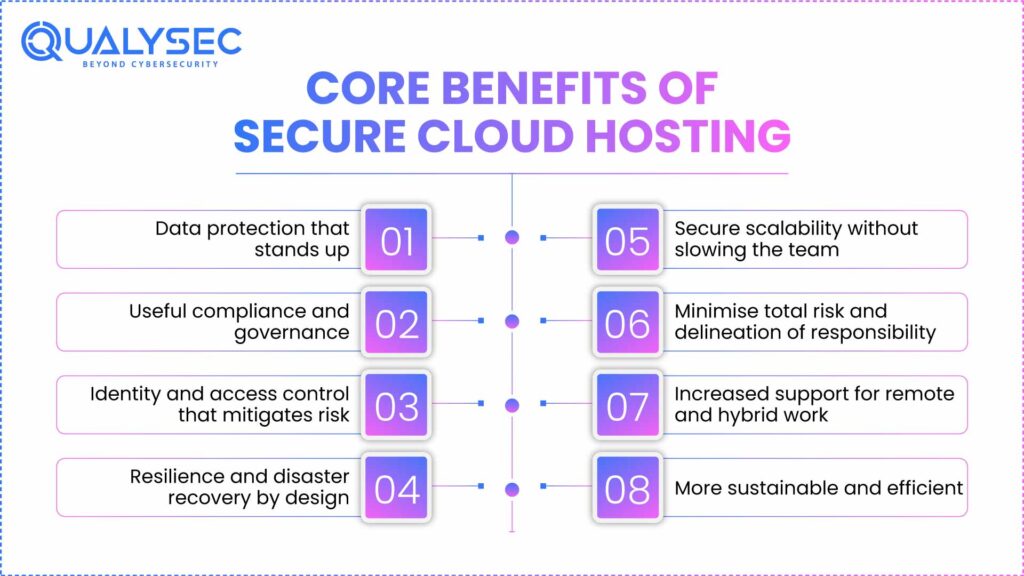
Data protection that stands up
A good cloud configuration will encrypt data at rest and in transit, implement least privilege to access, and have solid key management. You will also often be given versioned and cross-region backups to protect against ransomware, etc.
Having added log files and anomaly detection means you will be more likely to catch unusual access earlier and respond more quickly. Ultimately, the controls described above will at least lessen the blast radius when an account is compromised or a credential is lost.
Regulators will expect you to have at least done something like the above, and secure cloud hosting will make it easier to implement and maintain at scale.
Read our complete guide on What is Cloud Data Security? Key Benefits and Top Solutions
Useful compliance and governance
Australian organisations are accountable to the Privacy Act and sector rules like CPS 234. Secure cloud providers can provide the structure in formal controls, audit reports, and regions to support compliance programs such as ISO 27001 and SOM 2.
Your role is to map the secure controls of their reporting structure into your environment, validate the configuration, and curate evidence. When properly implemented, secure cloud hosting reduces the time spent on audit preparations, speeds up due diligence with customers, and eliminates risks of penalties and reputational damage by poorly managing personal information.
Read more about Governance, Risk, and Compliance Framework
Identity and access control that mitigates risk
A compromise typically starts with phishing and a reused password. In the cloud, you can implement MFA, conditional access, short-lived credentials, and strong role-based permissions.
You can even isolate workloads using separate accounts and limit machine-to-machine access using IAM policies and secrets managers. This is in line with ASD’s guidance to harden identities and never rely on single-factor access to critical systems.
These capabilities combine to ensure that credential theft cannot (as easily) become a compromise and ultimate breach.
Explore what is Cloud Security Risk Assessment and its Benefits.

Resilience and disaster recovery by design
Cloud offerings provide multi-AZ and multi-region architecture, early failovers, and infrastructure-as-code (IaC) to enable rapid rebuilds. Backups are automated and tested, and immutable storage ownership protects against tampering.
Practical options provide built-in resilience to quickly recover from incidents. Whether they are ransomware, human error, or regional outages, enabling you to restore and meet recovery objectives without the expense of a second data centre. This is a large component of business continuity by 2025.
Secure scalability without slowing the team
Conventional environments tend to prioritise speed over security. When working in the cloud, security controls can match demand: managed WAFs, DDoS protection, secret rotation, patch baselines, and managed databases.
Developers can deliver faster by taking advantage of secure defaults and templates, while guardrails (polices, service control policies, and a set of approved IaC modules) help manage risk. You receive elasticity while maintaining a consistent security posture across projects.
Discover More: Cloud Security Solutions: Challenges, Trends, and Best Practices
Minimise total risk and delineation of responsibility
Breaches are costly. The OAIC had 527 notifications in the first half of 2024 and 595 in the second half of the year. As reported, many incidents stem from malicious or criminal attacks, with phishing as a common precursor.
Secure hosting in the cloud reduces exposure with regard to reducing attack surface, and also allows for the detection of errors early. Maintaining an audit trail of who is responsible and accountable for each control area. This brings additional clarity for executives and boards to fulfil their duty of care obligations, and also improves conversations around cyber insurance.
Increased support for remote and hybrid work
Teams in Australia, and more broadly APAC, expect secure access everywhere. Cloud identity, device posture, and private access services (not a large VPN) allow staff access to applications with the least privilege possible. Logging provides visibility across users and devices. This complements a zero trust model that mitigates the risk that a laptop with a compromise on it escalates into an event for the whole company.
You may like to read about Small Business Cyber Attack Statistics
More sustainable and efficient
Modern cloud data centres tend to be more energy efficient than many on-premises footprints, and you only use what you need. Opportunity cost savings are allocated to budget and people resources that can focus on higher value security work, like threat hunting, practising incident response, and configuration management, as opposed to managing power, cooling, and hardware refresh cycles. Security improves when Teams have time to do things that are important and not just urgent.
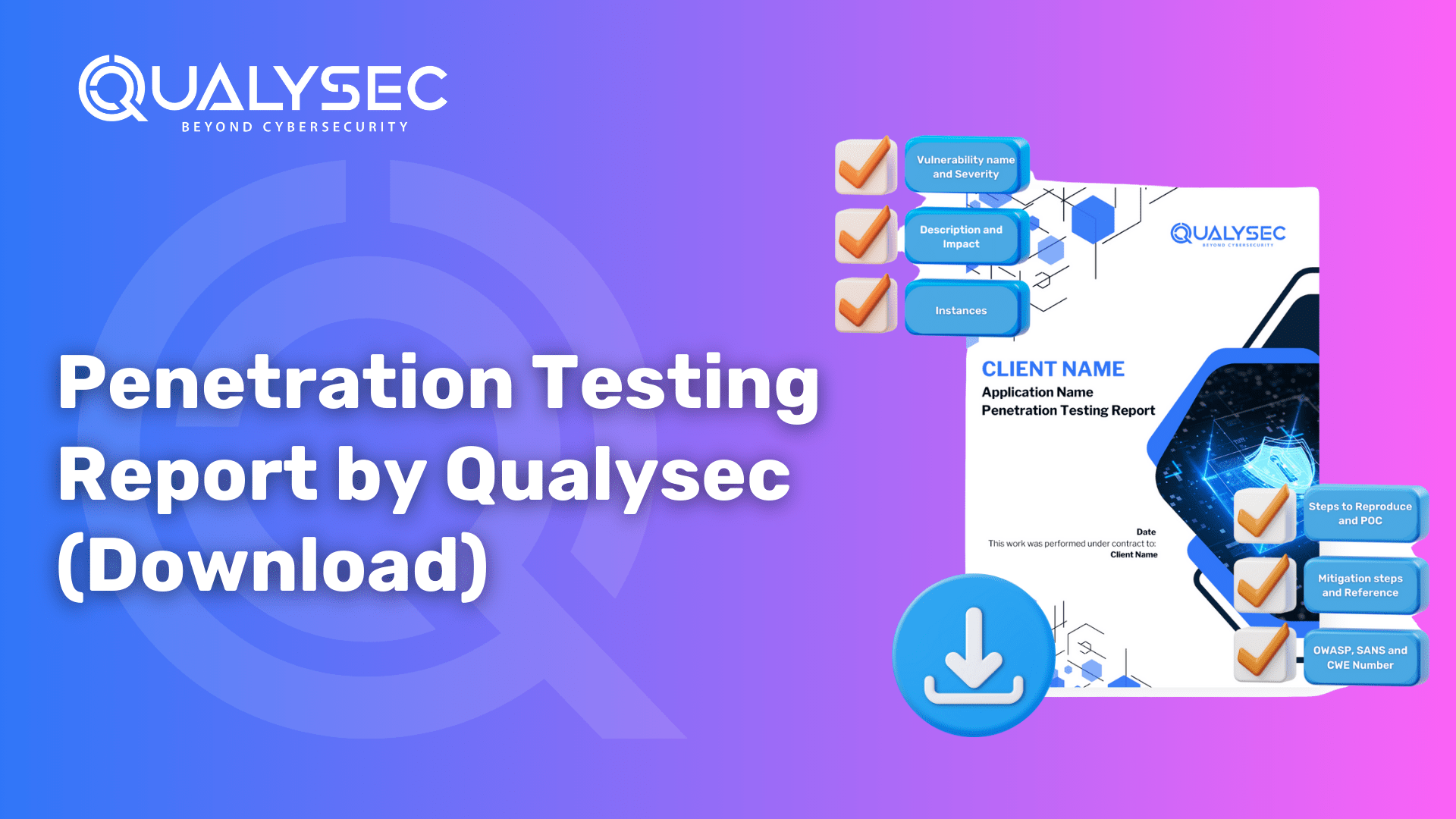
Don’t wait for a breach to test your cloud. Download a sample penetration testing report to uncover vulnerabilities before attackers do.








































































































































































0 Comments