







India is expanding its digital health services by Ayushman Bharat Digital Mission. Researchers estimate the cybersecurity market in the country to grow to a minimum of 5.56 billion by 2025 and 12.9 billion by 2030, or an annual growth of 18.33% per year. The best safety badge is the ABHA Web Application security certificate. You need to properly test it on the vulnerability to avoid exposing patient data to the most common cyber threats. The NHA requires the certificate for approval and live use of apps that use the ABHA APIs M1, M2, or M3. Hospitals and developers are provided the certificate to prevent breaches, comply with the DPDP Act, and be granted entry into the ABDM sandbox. Get your platform secured now, compliance becomes a source of trust, and it can help the Indian health technology to grow.
Contact Qualysec Technologies in the process of acquiring the ABHA Web Application Security Certificate now!
Get ABHA Web Application Security Certificate – Requirements
Healthcare organisations can obtain the ABHA Web Application Security Certificate. Developers in India to enable them to connect in a safe manner with the Ayushman Bharat Digital Mission (ABDM). According to the National Health Authority (NHA), all web applications consuming ABHA services, such as M1, M2, and M3 APIs, need to receive such a certificate.
Essential Technical Specifications
The NHA imposes high web application security. All OWASP Top 10 threats should be removed from the applications.
- Upgrading the server – Upgrade to the latest OS patches and security patches on production servers. Disability unnecessary services and provide users with read and script-execution privileges only. Several file-integrity checking applications.
- Encryption – TLS 1.3 should be used to encrypt all the data in transit. Turn off weak ciphers of weak certificates that are going to expire soon. Seal sensitive data at rest using AES- 256.
- Access Control – Multi-factor authentication of the admin panels. Enforce role-based access control. Record all access attempts using ABHA application audit trails that can’t edit.
- Web Application Firewall (WAF) – Put WAF rules that prevent SQL injection, XSS, and CSRF. Limit the set rate in case of DDoS.
- ABHA API Security – Protect the OAuth 2.0 endpoints of API: M1 (creation), M2 (linking), and M3 (data exchange). Match the inputs on the ABHA schemas.
Testing Scope Requirements
The audit should have automated and manual verifications of parts of the application that either authenticate or do not.
- VAPT Insurance – VAPT labs that are certified by CERT-In only. Dynamic scan content, forms, and APIs.
- Authenticated Testing – Insider threat simulation by using test user journeys. Ensure that application penetration testing is not hijacking any session management.
- Production Focus – This is run scanned on live servers, and not on staging. Ensure that there are no critical vulnerabilities or high-severity vulnerabilities.
- Documentation Standards – Provide detailed documentation of tools used, methodology, and fixes, and the duration required to fix any problem. NHA will review brief executive summaries.
Compliance Documentation
There is a lot of evidence that applicants need to collect regarding the certificate.
- Configuration Proofs – Display images of the security headers (HSTS, CSP, X 1 − Frame options). Performance logs Share WAF logs indicate blocked attacks.
- Patch Management Records – Indicate update schedules and verification thereof within a period of 90 days.
- Third-Party Library Audit – Displayed all the libraries and patch status versions. Remove outdated components.
- Backup and Recovery Plans – Display encrypted backup and recovery times should be 24 hrs RTO/RPO.
An application that fails to satisfy these requirements does not pass certification. The NHA does not accept compliance. Approximately 4-6 weeks are spent by developers in preparation before the start of web application penetration testing.
Suggested read: Best FDA Consultants in India
ABHA Web Application Security Certificate – Procedure
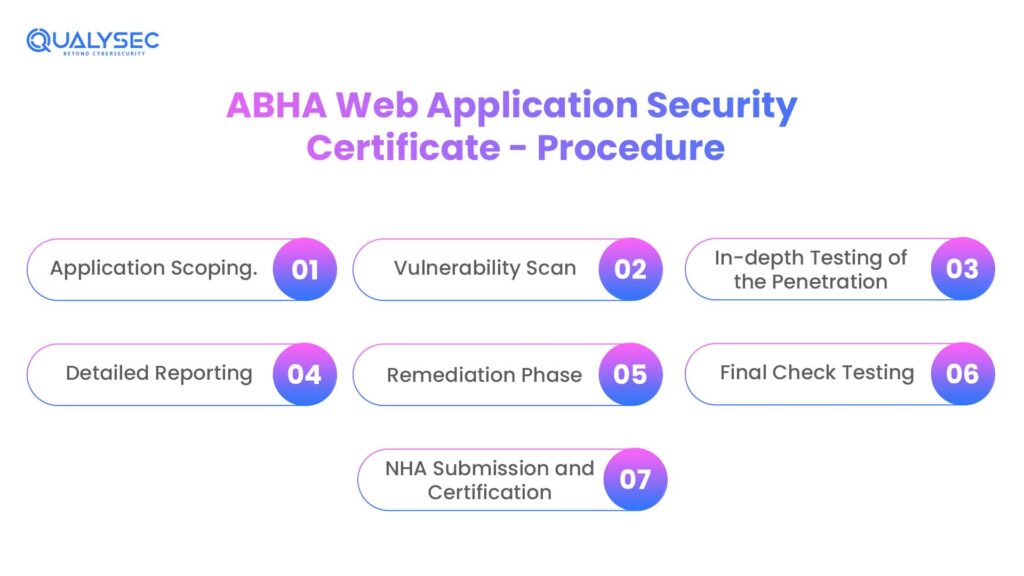
1. Application Scoping.
- Choose what it is specifically in the app that you want to test.
- Listing out all URLs, subdomains, and ABHA endpoints.
- Determine routes to be authenticated and administration areas.
- List integrations and static file third-party.
- Sign an NDA/scope contract with the lab.
2. Vulnerability Scan
- Use automated tools in order to have a wide coverage.
- Perform a website vulnerability scanner on the entire scope.
- Quick fixes of spot low and medium-severe problems.
- Prepare a baseline report, which indicates key gaps.
- Conduct an introductory call and discuss the findings.
3. In-depth Testing of the Penetration
- Conduct practical web application penetration testing like actual hackers.
- Test the OWASP Top 10 risks with the logged-in and out techniques.
- Check privilege checks and API leaks in the ABHA APIs.
- Find business logic errors and learn how to acquire more access.
- Check server configurations and security.
4. Detailed Reporting
- Prepare managerial reports and technical staff reports.
- Rank results based on CVSS levels of severity.
- Demonstrate evidence-based attacks on the most critical issues.
- Fixes in priority order. Suggest adding code snippets.
- Provide the approximate time to repair and the retest time.
5. Remediation Phase
- The developers solve the issues sequentially.
- Recover the most serious problems within 7 days.
- Introduce configuration patches and introduce security headers.
- Test in the lab prior to ultimate approval.
- Record the outcome of the documentation.
6. Final Check Testing
- The laboratory establishes that there are no serious flaws left.
- Re-scan the areas that you cannot move.
- Ensure that business logic issues are addressed.
- Accept the system as a production one.
- Send a draft certificate for the NHA reviews.
7. NHA Submission and Certification
- Complete regulatory handover.
- Submit the test reports using the ABDM portal.
- The NHA will review them in 10-15 working days.
- Obtaining ABHA Web Application Security Certificate, 1-year term.
- The records are maintained in the lab to be renovated.
Obtain ABHA Web Application Security Certificate – Cost
The price varies according to the size and complexity of the application, what it includes, and the level of testing. A start-up costs about 1.5-3 lakhs, whereas a big enterprise may cost 8-12 lakhs. Remediation is also an addition with an approximated 30% of the testing cost.
Breakdown of Testing Costs
- Small Applications (one domain, fewer than 50 endpoints) – Have elementary scans and manual inspection.
- Application of the mediums (Several subdomains, ABHA APIs) – Protects recognised testing and API probes.
- Enterprise Applications (micro services, high traffic) – More manual work, custom threat modelling.
Other Cost Factors
In addition to core VAPT, there are a number of additional costs.
- Pre-testing Preparation – For internal Web Application Security Audit and code-inspections. Some teams can use consultants to get low-hanging fruit early.
- Remediation Development – Developer charges as immediate solutions are necessary for critical fixes.
- Infrastructure – WAF licenses, TLS, and patch tools.
- Documentation and Compliance – Assist with formatting of reports and submission of NHA.
Cost‑Saving Ideas
Intelligent planning will reduce expenses significantly.
- Package Services – Have automated scans alongside manual tests to receive 15- 20 per cent off.
- Off-Peak Scheduling – Schedule your tests in the first or third quarter and receive 10% off.
- Self-Remediation – Utilise tools such as OWASP ZAP to use in scans to save on professional time.
- Multi-Year-Contracts – Renew at a fixed price at least once every year in order to prevent annual increases of 12-15%.
How Qualysec Technologies Can Help You
Expert VAPT Execution
Qualysec enrols accredited ethical hackers to test your app to obtain the ABHA certificate. The group also performs automatic checks using the best website scanners, as well as manual checks to identify vulnerabilities. They are concerned with the most frequent OWASP Top 10 issues that impact ABHA M1-M3 APIs, including SQL injection, cross-scripting, and broken login. Qualysec discovers errors that were not detected by the tools by posing as actual attackers. Clients receive an understandable report on examples of attacks and how to repair them.
Authenticated Process-Based Methodology
Qualysec has a tested, documented strategy that custom-crafts to check ABHA app security. Someone thoroughly checks each of the steps. Testers record all the actions with time, tools in use, and findings evidence. Such a Web Application Security Audit-ready procedure will ensure that you do not leave any serious issues unresolved prior to the NHA selecting your application. Qualysec also ensures first-time success through an additional post-fix scan.
Fast Turnaround Compliance
Qualysec takes care of the whole process – first ABHA application security assessment, instructions on remedies, and test renewal. Clients circumvent time wastages that impede the launch of the ABDM production.
Continued Post-credentialing Services
Qualysec ensures the safety of your app after the issuance of the certificate. The bugs are observed by them over a period of one year, all year round. The certificate is in force. They notify clients of any emerging threats and fix any zero-day problems as soon as they appear. Qualysec provides annual renewal website penetration testing at reduced prices, ensuring that tests are up-to-date with any code changes.
Cost-effective Fixed Pricing
Qualysec has transparent prices. More complexity leads to an increase in cost, which is predictable. No charges are hidden on retesting, and there are no restrictions on the number of scans. This assists Indian startups and hospitals with their budget planning in terms of ABHA WASA audits.
Partner with Qualysec for ABHA Success – Visit Qualysec Technologies now to schedule your ABHA Web Application Security Certificate audit!
Conclusion
The ABHA Web Application Security Certificate will be the key to the digital future of Indian health. The number of cyber attacks is on the increase, and thus, frequent testing is required to ensure that the 1 billion ABDM users are safe by 2030. This certification will help innovators win the trust of the patients, roll out products, and comply with NHA regulations.
Secure Your ABHA Compliance Now – Contact Qualysec Technologies today to kickstart your ABHA Web Application Security Certificate process and safeguard patient data!
FAQs
1. What is an ABHA Web Application Security Certificate?
The ABHA Web Application Security Certificate demonstrates that a health app conforms to the strict security regulations that a health app should have in order to become a part of ABHA. The labs selected by CERT-In are thorough in their vulnerability tests and address the highest quality OWASP issues, including: injection, broken login, and information leakage. The certificate indicates that the app will be safe to host ABHA M1, M2, and M3 APIs upon its launch. A successful audit allows the NHA to give the certificate and the app to leave the sandbox and become live. It stores patient information securely since cyber threats are increasing in India.
2. Why is the ABHA Web Application Security Certificate required?
The ABHA Web Application Security Certificate is needed to ensure that attackers do not compromise sensitive health records through cyber attacks on the ABHA systems. By the year 2025, 265 million attacks on health services had taken place in India, and that is why evidence of security is essential. The certificate applies TLS ciphering, fortifies servers, and corrects vulnerabilities before the launch of the app. In its absence, the apps are prohibited by law from connecting ABHA numbers or sharing health records. The certification is also in line with the DPDP Act and fosters trust in patients, which is crucial in achieving 1 billion users by 2030.
3. Who needs an ABHA Web Application Security Certificate?
Any person who develops or operates health applications, hospitals, clinics, telemedicine facilities, and EHR vendors that utilise ABH-A APIs requires the certificate. All organisations dealing with M1, M2, or M3 milestones must obtain it. SaaS vendors serving the Indian health sector are also eligible. The NHA aims at ensuring that all participants adopt the same safety standards. To be able to sell in the market, start-ups developing ABHA-compatible apps must obtain the certificate to be compliant.
4. Who issues the ABHA Web Application Security Certificate?
CERT-In selects the labs to perform the necessary VAPT and release the technical report. The NHA reads the report and awards the final ABHA Web Application Security Certificate to enable the app to be a part of ABDM. The process is based on NCIIPC regulations and is concerned with the security of the live environment. The approved labs only test the best OWASP issues in a standardised manner across all health apps in India.
5. What security testing do ABHA web applications require?
ABHA apps should receive extensive VAPT. It implies that the vendor runs an automatic web app vulnerability scanner and also performs the website penetration testing manually by examining the top OWASP risks, hardening the server, ensuring that TLS is configured correctly, and reviewing API risks at M1-M3 levels. Both logged-in and non-logged-in users are verified.
6. Is VAPT mandatory for ABHA Web Application Security Certification?
The ABHA Web Application Security Certificate should absolutely have VAPT. The NHA desires automated scans as well as manual usage of OWASP weaknesses to be conducted by approved labs of the CERT-In. No certificate will be provided unless all the critical findings are remedied in the live environment.
7. How often is ABHA web application security testing required?
The ABHA Web Application Security Certificate is renewed annually and expires one year after a year since the date it is issued. Whenever you change the code in a significant way or introduce new APIs and/or modify the infrastructure, you have to have an additional ABHA application audit immediately. To maintain the pace with the evolving threats, the National Health Authority (NHA) needs to undertake a new Vulnerability Assessment and Penetration Test (VAPT) with every renewal. The healthcare applications remain afloat by conducting periodic application penetration testing of the websites.
8. What vulnerabilities does ABHA certification check for?
ABHA certification considers the OWASP Top 10 issues, such as injections, SQLi, and XSS, broken access control, cryptographic failures, flawed design, misconfigurations, outdated or vulnerable components, identity issues, data integrity failures, logging and monitoring weaknesses, and supply-chain issues. In the case of APIs, it caters to ABHA M13 M3 endpoint and server hardening.












































































































































0 Comments