







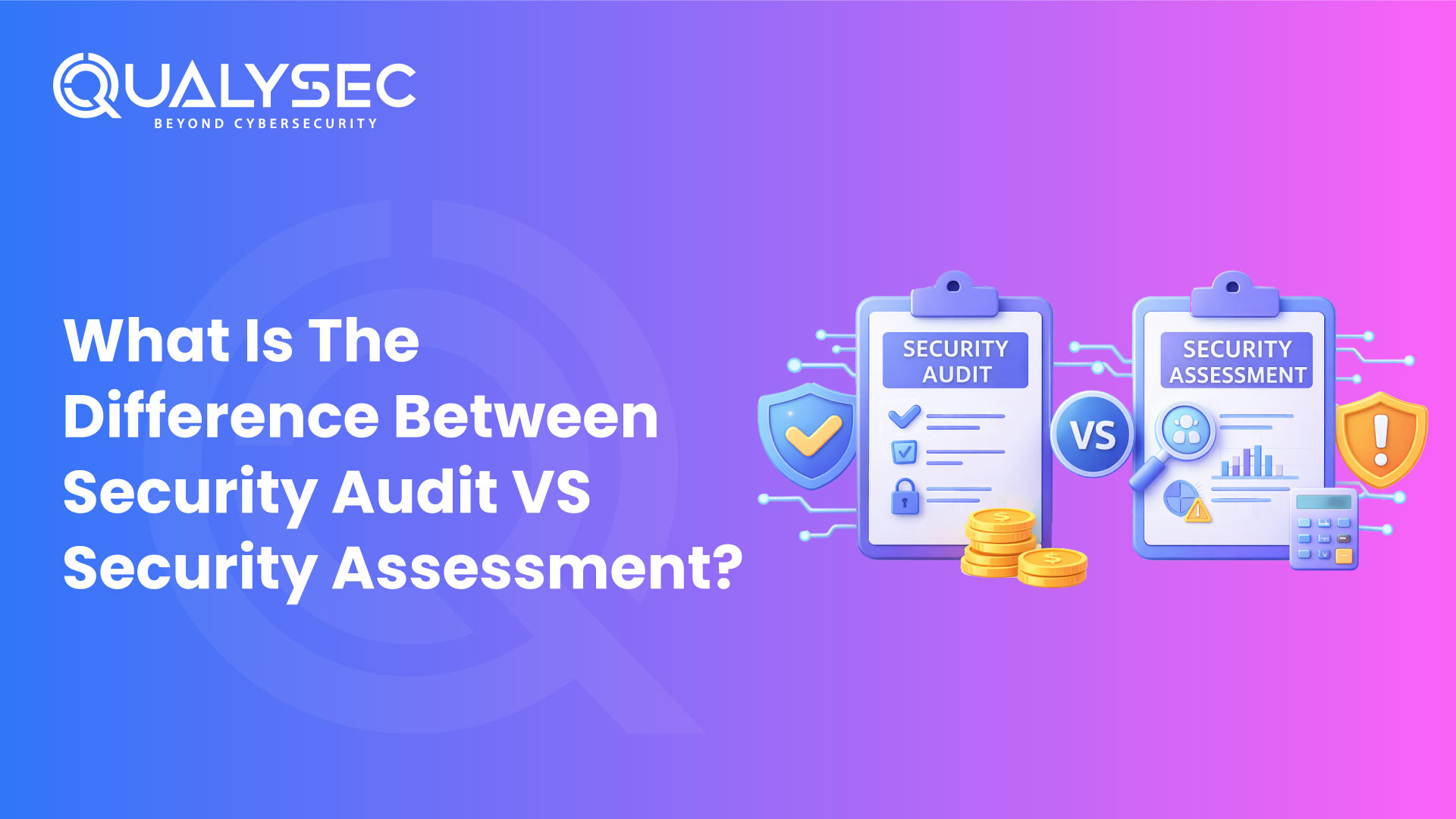
Organizations are under ongoing pressure to protect sensitive data, preserve operational continuity, and meet legal rules as cyber threats become more widespread, complex, and frequent. Financial losses, reputational damage, and legal consequences may all come from security breaches, ranging from ransomware attacks and data leaks to cloud misconfigurations and software flaws. Organizations use defined cybersecurity evaluation procedures to control these threats. Among the most often used but also the most misinterpreted methods in the Security Audit vs Security Assessment discussion are security evaluations and audits. Though they both aim to enhance security, they vary greatly in purpose, technique, extent, and results.
Choosing the best approach at the right time depends on understanding the distinction between a security audit vs security assessment. This blog offers a thorough, point-to-point analysis to support companies in making wise decisions about their cybersecurity posture.
Understanding Cybersecurity Evaluation at a High Level
Cybersecurity assessment is not a one-size-fits-all effort. Different sectors of operation, varying levels of sensitive data handled, and distinct threat environments define organizations. Cybersecurity assessments are thus intended to address certain queries. At a broad level, a cybersecurity assessment covers three main spheres:
1. Compliance and governance: Necessary security policies, controls, and procedures exist and are being observed?
2. Risk analysis and identification: How likely are the existing risks and vulnerabilities to hurt?
3. Technical security attitude: How well do infrastructure, applications, and systems resist attacks?
While security risk assessments concentrate on risk identification and technical security stance, security audits mostly target compliance and governance. A complete security risk assessment cybersecurity plan must include both of these aspects.
What Is a Security Audit?
A security audit refers to a structured overview of the security practices of a firm. This aids in monitoring their adherence to the given standards and regulations or company policies. Typically, it is performed on already existing frameworks such as ISO 27001, SOC 2, PCI DSS, HIPAA, or other regulatory standards. This is because the primary purpose of a security audit is verification rather than discovery. It makes sure that there are recorded controls, which are operating as intended.
Key Features of a Security Audit
Below are the key characteristics of a security audit. Let’s discuss them in detail:
1. Compliance-Driven Nature
A security audit evaluates an organization’s security posture against pre-set policies, conventions, or contractual responsibilities. The objective is to verify the existence of the necessary controls rather than to discover every possible vulnerability.
2. Formal and Structured Process
Audits for security adhere to a strict procedure. Auditors employ predetermined audit criteria, fixed reporting forms, and organized checklists. This guarantees consistency and repeatability throughout audit cycles.
3. Evidence-Based Evaluation
Auditors depend mostly on evidence, including:
- Policies and processes for security
- Access control rosters
- Records of monitoring and system logs
- Record of Incident Response
- Training and awareness logs
A control is regarded as non-compliant in the absence of evidence, even if it is informally present.
4. Objective and Independent Review
To guarantee objectivity, an external third party frequently conducts a Cyber Security Audit. External audits give stakeholders, clients, and regulators credibility and certainty.
Types of Security Audits

Below are different types of security audits:
1. Internal Security Audit
The audit or security team inside an organization performs internal security audits. Before an external audit, its goal is to evaluate internal compliance with corporate rules and spot gaps.
2. External Security Audit
Frequently required for certifications or regulatory compliance, these are conducted by independent auditors. Frequently shared with outside parties, these audits have significant weight.
3. Compliance Audit
A compliance audit aims at meeting particular legal requirements, including HIPAA for healthcare data or PCI DSS for payment data.
4. IT and Cyber Security Audit
This audit assesses technical controls, administrative procedures, and physical security measures over IT networks and infrastructure security.
What Are the Typical Outcomes of a Security Audit
The primary outcome of a security audit is a final compliance score that characterizes the infrastructure as compliant, non-compliant, or partially compliant to a set of standards, e.g., ISO 27001 or SOC2.
In addition to the simple grade, the report offers a detailed review of the gaps identified, specifying particular technical controls, flaws, or the lack of documentation.
The audit demanded corrective measures and strict remediation timelines to help close these gaps, therefore guaranteeing responsibility. These outputs provide the required contractual guarantee and regulatory evidence required to satisfy stakeholders, auditors, and legal needs—not just internal checklists.
What Is a Security Assessment?
A security assessment is designed to pinpoint flaws that cyber threats might exploit. It is a risk-based methodology of examining how well a company is secured in general. In contrast to compliance-based audits, a security assessment looks beyond the rules and documentation to analyze the performance of networks, applications, systems, and procedures in the context of actual threat situations. It assists in determining the actual location of risks through researching the potential threats, existing vulnerabilities, and the effectiveness of existing security systems.
Typically, the activities involve vulnerability scanning, security vulnerability assessment, configuration audits, and, under some situations, penetration testing. Such operations expose vulnerabilities, such as misconfigurations, outdated systems, weak access controls, and other loopholes that may expose the company to operational disruption or data breaches.
Finally, a security assessment provides the all-important question: How secure is the organization in practice? It provides actionable information that helps the firms to become more resilient to cyber attacks as a whole, reduce exposure, and strengthen the defense by prioritizing the risks based on likelihood and business impact.
Key Characteristics of a Security Assessment
Below are the key features of a security assessment:
1. Risk-Focused Approach
Rather than conformity, security evaluations give top priority to risks. They assess how vulnerabilities might be used and what effect such use would have on corporate activity.
2. Flexible and Adaptive Scope
Unlike audits, security evaluations are not constrained by fixed criteria. The scope can be changed depending on company requirements, threat intelligence, or recent events.
3. Threat and Attack-Oriented
Assessments consider the hacker’s point of view, among other factors, into account:
- External threat agents
- Insiders represent a threat
- Risks in the supply chain
- Misconfigurations and human error
4. Actionable Insights
The outcome of a cybersecurity assessment is practical guidance. Findings are ranked by severity, which helps companies set priorities for remediation initiatives.
Common Types of Security Assessments

Below are the common types of security assessments:
1. Security Risk Assessment
An analysis of security risk helps to determine risk levels by locating assets, threats, vulnerabilities, and effects. It enables companies to see where security expenditures will most benefit them.
2. Risk Assessment Cybersecurity
This evaluation helps inform executive-level decision-making by connecting cyber threats to company goals, financial effects, and operational disturbance.
3. Vulnerability Assessment
Using automated methods and manual verification, a vulnerability assessment finds technological flaws. It sometimes involves a vulnerability assessment to find previously discovered faults.
4. Security Vulnerability Assessment
A security vulnerability assessment contextualizes exploitability, exposure, and business relevance.
5. Vulnerability Assessment and Penetration Testing
The vulnerability assessment and penetration testing validate whether vulnerabilities can really be exploited by combining the identification of vulnerabilities with simulated attacks.
6. Web Application Security Testing
This evaluation looks at applications for security flaws like injection attacks, authentication flaws, and unsecured APIs. Learn more about Web Application Security Testing
7. Cloud Security Assessment
Utilizing a Cloud Security Assessment Checklist, a cloud security assessment examines monitoring, identity management, data protection, and cloud settings.
Typical Outcomes of a Security Assessment
A thorough Security Assessment Report is the outcome of a security analysis; this report covers:
- Vulnerabilities and risks found
- Risk probability and severity rankings
- Impact analysis for firms
- Given top priority, suggested corrective measures.
This report offers guidance for enhancing security posture.
Security Audit vs Security Assessment: Core Differences
Below are the core differences between a security audit vs security assessment:
1. Purpose
While a security assessment determines and prioritizes risk, a security audit confirms compliance. Audits concentrate on what should be in place; assessments aim at what might go wrong.
2. Methodology
Auditing depends on documentation, analysis, and organized checklists. Assessments employ threat modeling, testing tools, and analytical approaches.
3. Scope
Standards set the scope of audits. Evaluations change with the threat environment and are flexible.
4. Frequency
Usually, once a year, audits are regular. Assessments can be ongoing or triggered by system changes, events, or new deployments.
5. Outcomes
Audits generate compliance results. Assessments provide risk-based remediation strategies.
Importance of Security Audits
Security audits are formal, point-in-time assessments of a company’s compliance with specific rules or standards.
- Regulatory Compliance Assurance: Audits provide the confirmed documentation required to meet legal requirements, including PCI-DSS, GDPR, and HIPAA.
- Stakeholder and Customer Trust: Third-party security audit reports (like SOC2) act as a seal of certification, guaranteeing partners that their data is handled safely.
- Governance and Accountability: They create a clear trail of responsibility, therefore guaranteeing that the management is held responsible for maintaining established security measures intact.
- Reduced Legal and Financial Exposure: Proving due diligence helps to lower insurance premiums and thus reduces legal and financial exposure if a breach occurs through audits.
- The Restriction: It is vital to remember that audits are concerned with ticking boxes. Although an organization might be fully compliant with a standard, it is still vulnerable to a zero-day attack.
Importance of Security Assessments
Security assessments are broader and more technical, concentrating on the real efficacy of security measures. Through vulnerability scan and penetration testing, evaluations simulate how a real attack would navigate your network.
- Visibility into Real-world Scenarios: Unlike audits, which handle all non-compliance identically, evaluations prioritize problems depending on the concern of the threat and the possible effects on operations.
- Proactive Threat Mitigation: They identify hidden threats, such as misconfigured APIs or weak passwords that can be taken advantage of, if found.
- Continuous Improvement: Assessments promote an iterative approach to security, beyond static checklists, moving towards a dynamic, evolving defense.
Security Audits and Assessments in Cloud Environments
While both security audits and security assessments aim to strengthen an organization’s security posture, they differ significantly in structure and purpose. Understanding these core differences helps organizations choose the right approach based on compliance needs, risk exposure, and security maturity.
The cloud functions under a Shared Responsibility Model. The client is in charge of the data and configurations, and the security provider (AWS, Azure) secures the infrastructure.
- Audits in the cloud confirm that encryption configuration and identification access management (IAM) policies satisfy requirements.
- Assessments are essential since DevOps/CI-CD cloud settings vary quickly. Regular evaluations guarantee that, between audit cycles, a misconfigured S3 bucket or a shadow IT instance does not generate a major security flaw.
Security Assessment Report vs. Audit Report
The table below highlights major differences between a security assessment report and an audit report based on the different features.
| Feature | Audit Report | Assessment Report |
| Primary Goal | Verification & Compliance | Risk Identification & Security Posture |
| Tone | Formal, binary (Pass/Fail) | Analytical and advisory |
| Content | Evidence of controls (logs, policies) | Vulnerabilities and exploit paths |
| Audience | Board members, Regulators, Clients | IT Teams, CISOs, Security Engineers |
When to Choose Which?
- Select a Security Audit: When you need to sign a significant deal that calls for certification, have a fast-approaching regulatory deadline, or have to show evidence of due diligence to a regulatory body.
- Choose a security assessment: When you are launching a new product, have just updated your network design, or just want to find out, “How tough would it be for somebody to hack us right now?”
Do Organizations Need Both?
Definitely. Depending entirely on audits causes a compliance trap whereby you are legally secure yet technically exposed. Relying just on assessments might expose you to huge penalties and missed contracts. An effective program sets the foundation with audits and uses assessments to extend security limits.
Conclusion
In the context of Security Audit vs Security Assessment, a security assessment is a proactive, risk-based deep dive into your real defenses; a security audit is a formal, checklist-driven verification of compliance against outside criteria. Assessments guarantee that those laws really guard you from real-world attacks; audits show you are adhering to them.
Schedule a call with Qualysec to start your security assessment.









































































































0 Comments