







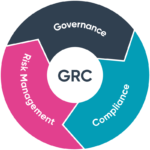
Risk, Compliance Framework, and Pillars of Governance
The pillars of the GRC framework help to understand that it is a holistic approach in the sphere of organizational governance, risk management, and compliance governance framework with policies.
Governance Pillar
- Emphasizes responsible leaders, prudent management, and decisive resolutions.
- Board’s responsibilities, rules, rule management, rule-following culture, and performance monitoring.
- Enforces responsibility, transparency, and effective communication between leaders and their followers.
Risk Management Pillar
- Involves identification of spotting risks, researching them, determining which to address initially, and monitoring them all the time.
- Plays a major role in most categories of risks, such as cyber attacks, work breakdowns, money issues, and a bad reputation.
- Engages in risk analysis and predictive analysis to combat threats using new tools such as AI risk checks and predictive analysis.
Compliance Pillar
- Make sure that the company is abiding by the laws, rules, internal checks, and industry standards.
- Involves enforcement, audit record keeping, reporting, and dealing with regulators.
- Helps companies remain adaptable when new regulations such as the EU AI Act, EU GDPR modifications, and financial adjustments occur.
Four Core Modules of the Governance, Risk, and Compliance Framework
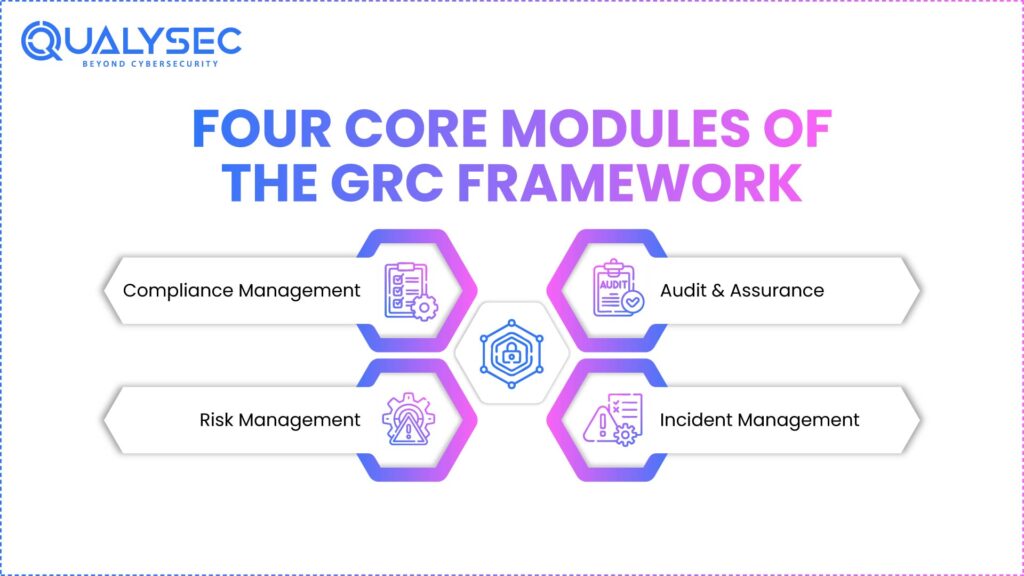
The current Governance Risk Compliance framework organizes the functionality as four fundamental modules, which balance oversight, risk control, compliance tracking, and reporting-
Compliance Management
- Establishes rules, standards, and requirements.
- Automates the process and enforcement of such controls.
Risk Management
- Identifies risks, assesses their impact, designs mitigation plans, and continuously monitors them.
- Uses real-time dashboards and alerts powered by modern technologies to provide ongoing visibility.
Audit & Assurance
- Permits internal controls, audits, and control testing, and IT security audit planning.
- Makes a record of findings and closes them.
Incident Management
- Records accidents, investigates, and identifies the source.
- Collaborates with the response teams to ensure fast repair and reporting to the regulators.
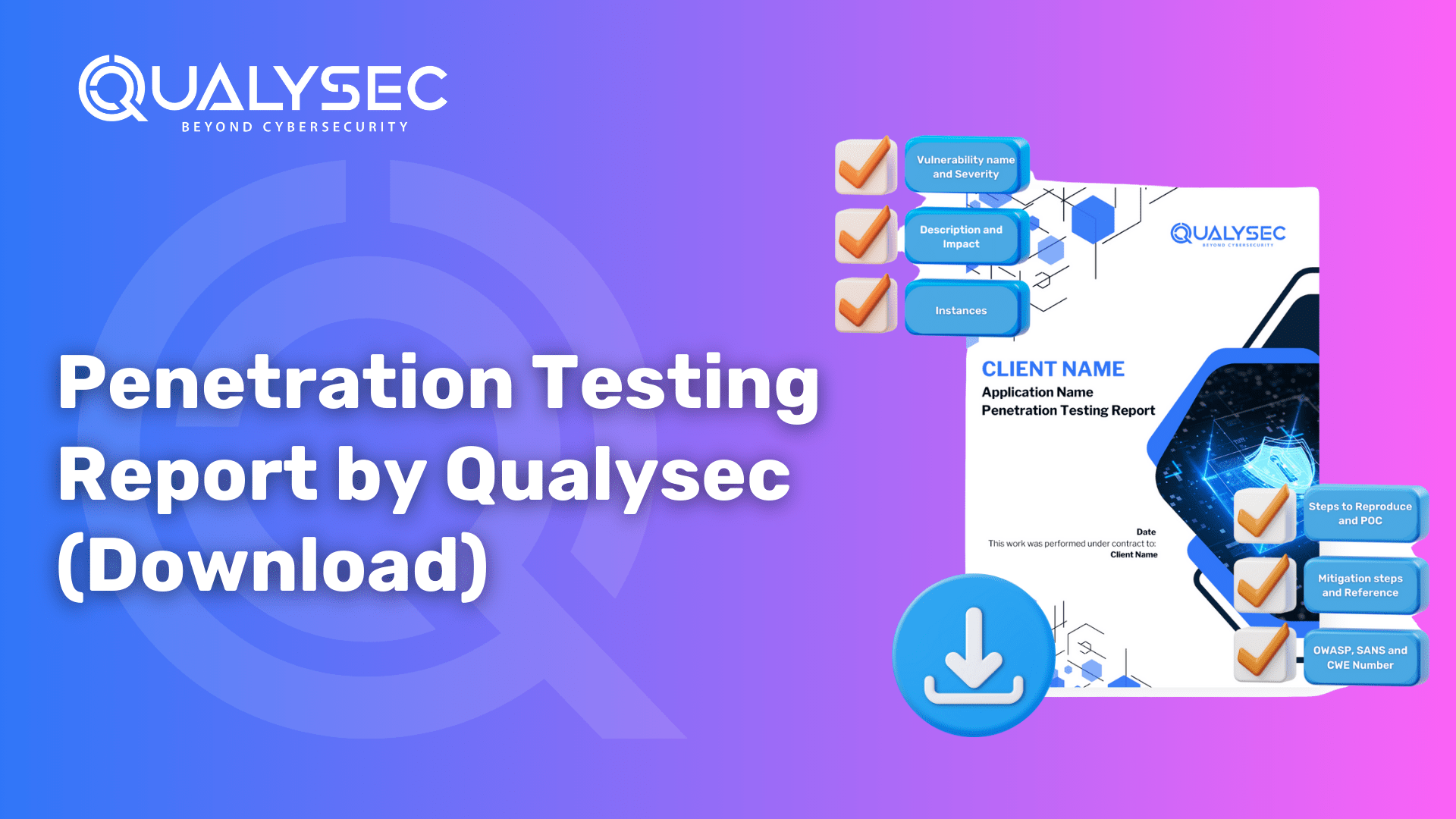
Download a sample penetration testing report to see how our Governance, Risk & Compliance Framework protects your security.
Major Characteristics of A Modern GRC Compliance Framework
To achieve the greatest utility of the GRC compliance framework today, organizations need to include –
- Systems that merge the Governance Risk and Compliance framework information to see the whole picture.
- AI and machine learning-based automation to identify abnormalities, security audit speed, and generate reports.
- Ongoing monitoring of cyber risks, third-party risks, and changes in the law.
- Effective communication and training to instill a culture of enforcement of rules among leaders the workers.
- Adaptability to the new regulations and market changes through agile policies and processes.
Future of Governance Risk and Compliance Framework in 2025
Technology is a quick mover that takes more risks and puts itself under more scrutiny by regulators, particularly in Europe. The AI, cloud, and IoT provide new avenues of attacks, but they also provide smarter means of rule-keeping. Regulations such as GDPR, DORA, AMLA, and the EU AI Act desire explicit, responsible methods of handling risks and regulations.
A well-developed Governance Risk Compliance framework –
- Reduces the frequency and damage of cyber attacks, breaking of rules, and work failures.
- Let business units, compliance teams, and risk teams collaborate.
- Makes superior decisions since all the risk and compliance information is presented simultaneously.
- Establishes trust – customers, investors, regulators, and all partners by demonstrating true concern.
- Increases operational efficiency through the elimination of repetitions and role definitions.
You might like to know more about Data Security Compliance: A Step-by-Step Guide
How Qualysec Technologies Can Assist You with GRC Framework
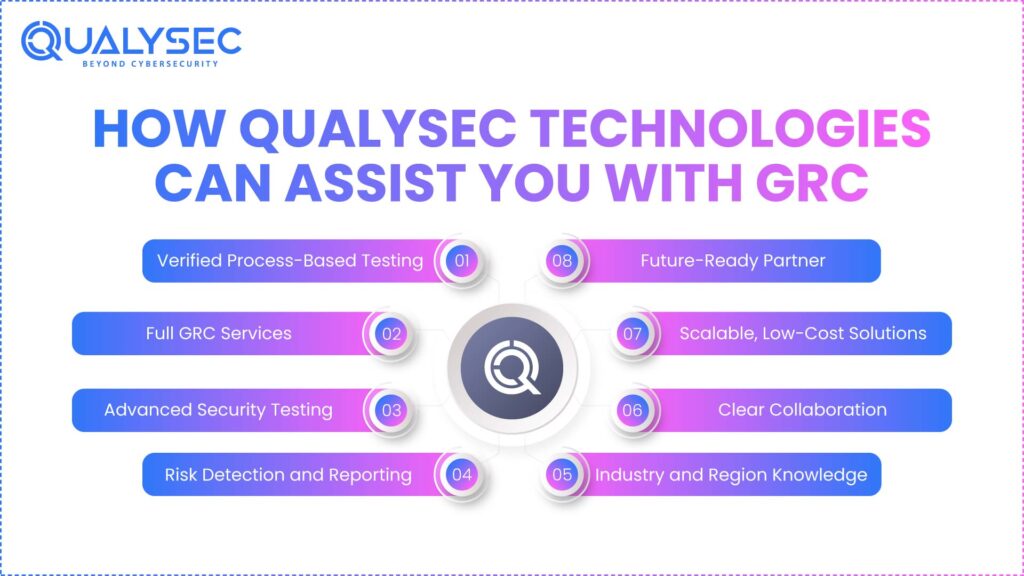
Verified Process-Based Testing
Qualysec employs an experimental process that examines all the rules, policies, and procedures in your GRC compliance framework. It ensures that you are in real compliance and not merely pretending, and discovers loopholes early enough.
Full GRC Services
Qualysec provides full GRC coverage, such as risk checks, compliance audits, continuous monitoring, policy checks, and solution of problems, which is tailored to the requirements of the rule (GDPR, DORA, PCI-DSS, HIPAA, SOC 2, and ISO 27001).
Advanced Security Testing
We also introduce modern security testing and web, API, cloud hacking tests, vulnerability checks, and DevSecOps integration to ensure that your GRC is stronger and identifies risks and corrects them as early as possible.
Risk Detection and Reporting
Our auto-detection of risks and compliance reporting in real-time with AI and machine learning reduces the number of human errors and decision time, and provides explicit recommendations on how to strengthen controls.
Industry and Region Knowledge
Our clients are in every industry, including fintech, health care, SaaS, and e-commerce, and are familiar with European regulations. That assists us in aligning local Compliance risk governance that is significant in 2025. Know more: Cybersecurity Solutions for Every Industry
Clear Collaboration
We maintain an open communication and teamwork with you in testing and validation of the software. So everyone is aware of what is going on.
Scalable, Low-Cost Solutions
We provide companies of any size with excellent GRC at affordable rates, as we are flexible and our number of tests is also increasing.
Future‑Ready Partner
We continue to refine so that your GRC continues to be in touch with new regulations and threats to safeguard your operations and reputation.
As a partner with Qualysec Technologies, your business enjoys a partner who provides strict penetration testing, professional counseling, and emerging technology to make the Governance Risk and Compliance framework more than a rule-check to a strategic benefit.
Secure your GRC future with Qualysec. Request a custom consultation and receive a verified report today!
Conclusion
In 2025, it will still be necessary to implement a powerful Governance Risk and Compliance framework due to the increasing complexity of rules, cyber threats, and more complicated operations in Europe and other countries. An effective GRC plan presents risks, ensures that you are sound, and enhances control so that you can be a confident and open runner. An effective GRC plan ensures that companies remain successful in a rapidly changing world.
Optimize your Governance Risk and Compliance framework to the ideal using the tested methods of Qualysec. Get in touch with us today and build a future for your company!



































































0 Comments