









Why Penetration Testing is Crucial for Compliance
Penetration testing is essential to ANSSI compliance because it converts theory to proof. There are policies and security tools that can guide you, but only a real data-based test of your defences in the event of a real attack will assure efficacy. ANSSI standards require that systems are secure in theory as well as in resilience.
Pen tests simulate actual hacker behaviour and gauge vulnerabilities that a scanner or audit may miss. As a process, it gives organisations clear visibility into their true risk levels. More importantly, it verifies security measures in compliance with ANSSI’s strict technical and operational requirements.
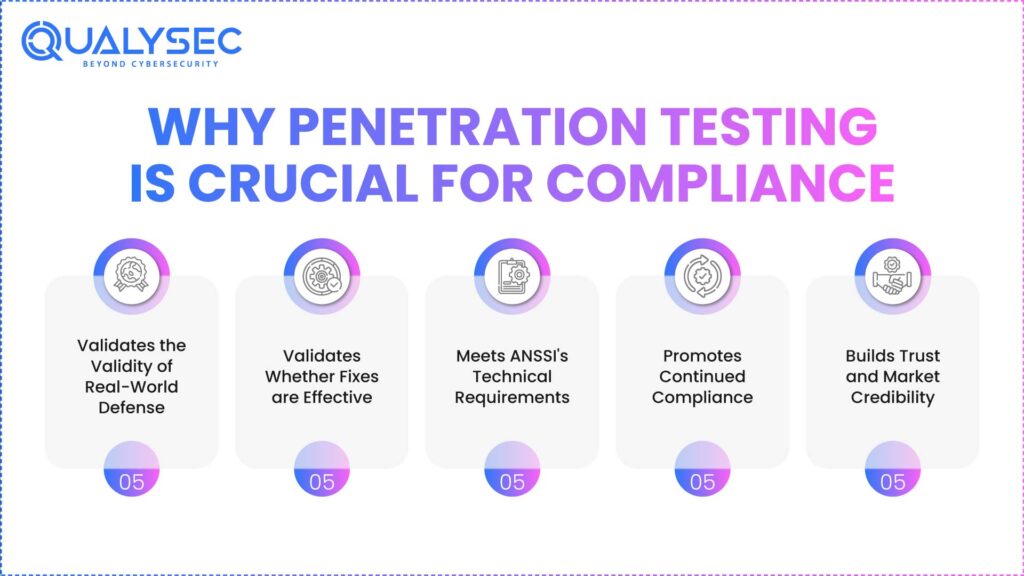
1. Validates the Validity of Real-World Defense
Penetration testing simulates real cyberattacks to see how your systems respond to real high-stress situations. A proper pen test validates the effectiveness of your firewalls, access controls, and response plans in a live setting – while assessing ingress points for an adversary in your environment. Pen testing and vulnerability assessment also demonstrate how multiple vulnerabilities working together can lead to a serious incident and offer tangible proof that your defence could hold up to a bona fide threat — precisely what ANSSI auditors look for during an assessment.
2. Validates Whether Fixes are Effective
Even after a patch or configuration change is enacted, vulnerabilities can and do exist. Penetration testing services validates the efficacy of the patch or configuration change and whether it created other vulnerabilities. This is a “trust, but verify” model — it’s vital to know every patch fixes the problem without creating a new one. For any ANSSI compliance, this is a follow-up step to show continued improvement in security efforts. If you do not verify that you patched, then your corresponding remediation efforts and security hygiene would have to remain anecdotal in the presence of an auditor.
3. Meets ANSSI’s Technical Requirements
ANSSI’s certification goes beyond mere documentation; it requires support from independent tests. Penetration tests, particularly those conducted by independent accredited third parties, are one part of the technical validation. The tests measure the system’s capacity to resist attacks illustrated in the defined attack scenarios and aid in meeting the agency’s stringent evaluation requirements. Without a recognised penetration test report, delays or potential rejections of the certification may occur. As such, ethical hacking is a straight-line solution to compliance readiness.
4. Promotes Continued Compliance
Security compliance is not an event – rather, it is an ongoing occurrence. The agency expects an organisation to meet the consistent protection requirements from updates, new deployments, and changes to the system. Regular penetration testing aids in verifying new vulnerabilities to identified weaknesses and attests that security is still strong between renewals of certification. This continuous testing process keeps your organisation audit-ready all year long while developing a mature security culture.
5. Builds Trust and Market Credibility
A solid penetration testing program instils confidence in regulators, clients, and partners. When your systems are tested and validated in a real-world attack scenario, it shows a commitment to higher cybersecurity standards. For U.S. companies dealing with European clients or public entities, this is a significant level of trust. Sharing your successful pen test results provides a helpful pathway to ANSSI certification and enhances your standing in global competitive markets.
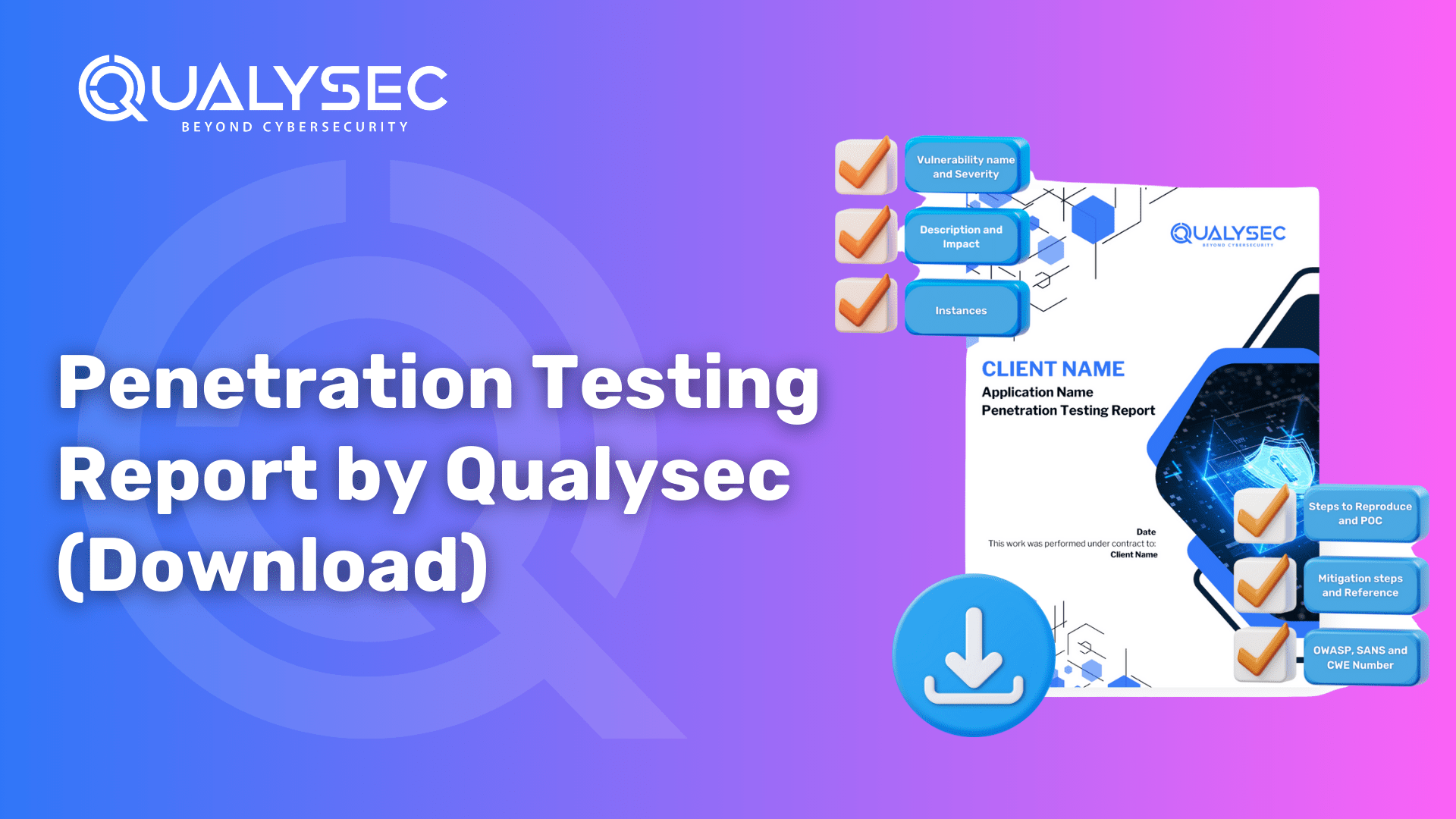
Download a Detailed Penetration Testing Sample Report to Understand Compliance Requirements.
Best Practices for Conducting Penetration Tests for ANSSI Certification
Passing ANSSI certification requirements means that you should accomplish penetration testing with precision, planning, and expertise. Penetration testing process is not solely based on identifying vulnerabilities; it is about demonstrating whether you can withstand a real cyber attack.
Following established best practices will help ensure that your penetration tests are methodical, repeatable, and audit-safe. ANSSI IT security certification requirements emphasise whether you utilised certified professionals, accepted testing methods, and completed documentation. Aligning your process and methods to these expectations will set you up to have a smoother, more reliable certification phase of the program.
Managing continuous penetration testing duties effectively safeguards the organisation against ANSSI validated exams, such as this certification, which will also bolster your overall cybersecurity maturity level.
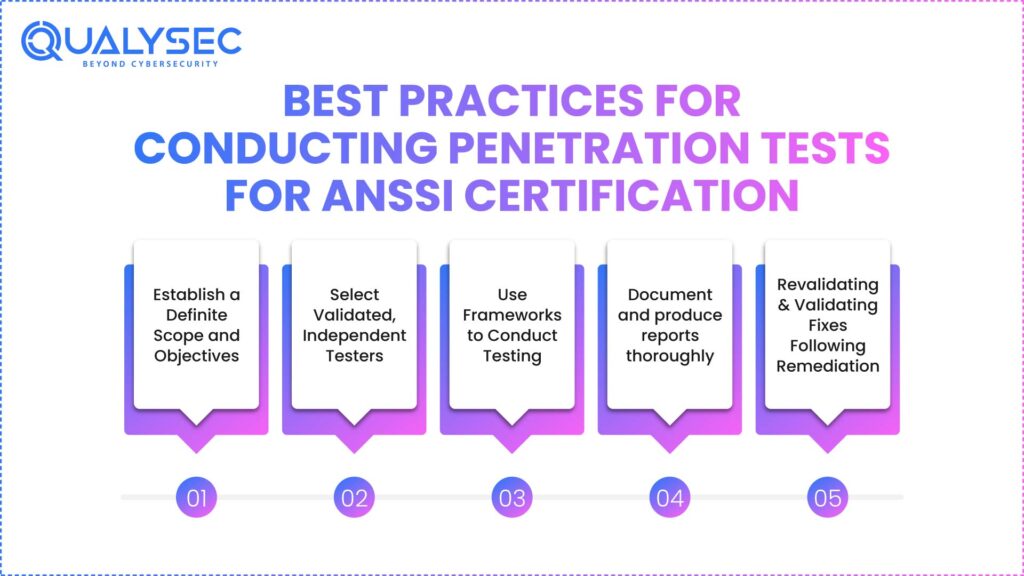
1. Establish a Definite Scope and Objectives
Initially, you will want to create a distinct scope that lists what you will test, such as networks, applications, or infrastructure, and what you won’t test. This ensures an avoidance of unintentional system disruptions and/or loss of data, which can easily occur if testing is not sufficiently defined.
When defining the scope, objectives should be aligned with ANSSI’s areas of concern, for example, data protection and access control verification. A defined scope means there will be less wasted effort throughout the testing process, and the tester will be better able to focus on the critical assets. When testing is scoped, always document the purpose, scope, and objectives before starting the cybersecurity assessment.
2. Select Validated, Independent Testers
ANSSI expects independence in the evaluation activity, such that the testers are not part of your internal team. Select a cybersecurity firm or qualified individual that holds a recognised credential such as OSCP, CREST, or CEH certification. Testers who hold formal certification demonstrate legitimate credentials related to defining the process of discovering vulnerabilities consistent with the ANSSI security framework.
Independent evaluators will also present the findings, unbiased by internal organisational factors that will be present at audit time. Partnering with an appropriate testing team provides credibility to your certification process while ensuring technical certitude.
3. Use Frameworks to Conduct Testing
You should always rely on global industry standard frameworks, such as OWASP, NIST, or PTES, to base your penetration tests. They provide a step-by-step process to ensure that standardised processes can be applied to all tests. Using standardised methodologies minimises the chance of missing important vulnerabilities.
It will also allow auditors to review your findings using a standard report format that is familiar to them. Furthermore, carbon copy documentation minimises the chance of omitting any vulnerabilities that are required in your report
4. Document and produce reports thoroughly
Documentation is probably the most important part of ANSSI compliance requirements. You will need to document every aspect, from the methodology steps you took to examine findings and remediation recommendations. Your report should allow both separate technical teams and the auditors to easily understand it while categorising findings by severity and potential impact on the blast radius.
Evidence in the form of screenshots or logs assists in supporting your results. Thorough reporting not only satisfies compliance verification but is also a useful tool to further assist with security improvements.
5. Revalidating and Validating Fixes Following Remediation
A penetration test isn’t finished until fixes have been confirmed. Once vulnerabilities have been resolved, a retest must be performed to verify that the issues are remediated and that no new issues have occurred. This substantiates an ongoing improvement to security, which is one of the main requirements in the ANSSI compliance methodology.
Revalidating fixes also helps create accountability internally, so your team understands that every fix can be measured and is working. Revalidating fixes is a great way to ensure IT security compliance over time (time period) and ensure that the same weaknesses are not repeated.
Let’s Strengthen Your Cyber Defences — Schedule a Pen Test Now!
Conclusion
ANSSI certification is more than just a seal of approval; it is evidence that your systems can withstand attacks in a rigorous testing environment. But to meet that standard, Penetration Testing as a Service (PTaaS) is essential. It is a validation of your defence mechanisms, assurance that your fixes are effective, and your best argument for the auditors.
There will be challenges (costs, scheduling, expertise, and ongoing updates), but thoughtful practices (defining a clear scope, using qualified testers, ensuring good reporting, and retesting) can take pen testing from a hurdle to a health strength.
Get Expert Guidance on Meeting ANSSI Security Standards — Talk to Our Specialists.
























































































































































































































































































































































































































































0 Comments