







Why Compliance in IT Security Is Crucial for Your Business?
Compliance in IT security is not just a matter of the Australian organisations meeting paperwork. Let us examine the reasons why the issue of IT security audit and compliance is so essential:
- Regulatory requirements: Regulations such as the Privacy Act 1988 (with its scheme of Notifiable Data Breaches) and the Cyber Security Act 2024 establish the explicit expectations related to the process of data management by businesses, the occurrence of events, and the security of the systems. Considering CPS 234 and CPS 230, the entities under the APRA regulation must have other prerequisites and must adhere to them.
- Less risk: Fraud is not only expensive in financial terms of fines, but also the lost business. The compliance standards (e.g., ISO /IEC 27001:2022) as well as the ACSC Essential Eight decrease the probability of successful cyber attacks by applying controlled and repeatable controls.
- Trust and credibility in the market: Enterprise buyers and government tenders may require a demonstration of compliance ( ISO 27001 certification, Essential Eight maturity, or otherwise).
- Board accountability: CPS 234 and CPS 230 assume the active participation of directors and executives in information security management. Lack of compliance can expose the leadership to regulatory enquiries; therefore, it is a governance issue and not an IT issue.
You might like to read about ISO 27001 Penetration Testing – A Comprehensive Guide
IT Security Compliance Standards in Australia
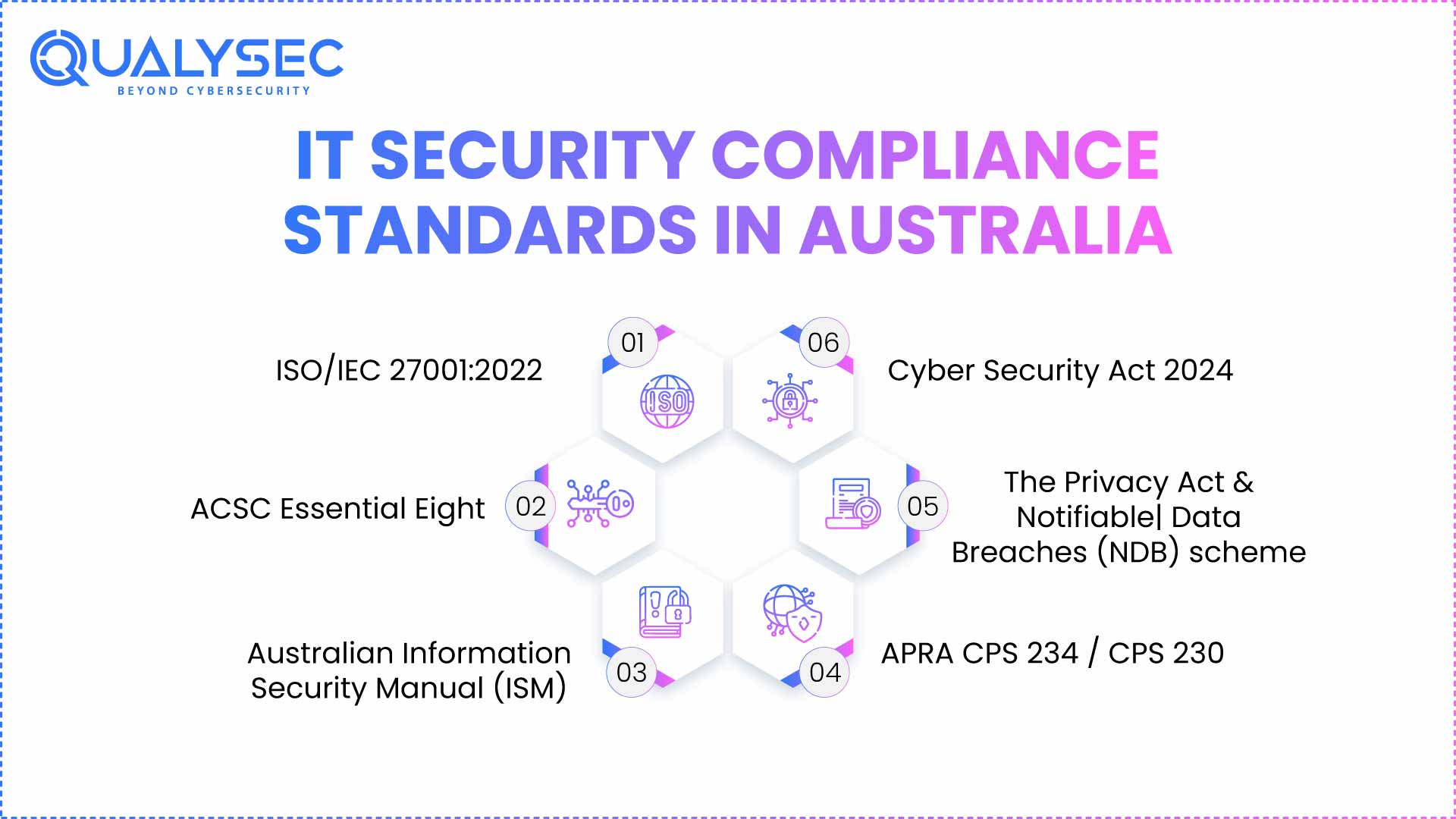
Navigating compliance means understanding which standards apply to you. Here are the most relevant it security compliance standards:
- ISO/IEC 27001:2022 – Information security compliance standards iso 27001 provides 93 controls, including vulnerability management (Annex A 8.8) and development security testing (Annex A 8.29).
- ACSC Essential Eight – This is an open source list of 8 mitigation practices (e.g., MFA, patching, application whitelisting) which are published by the Australian Cyber Security Centre
- Australian Information Security Manual (ISM) – The ISM is not only a reference used to secure the Australian government systems, but it is also regularly maintained by the Australian Signals Directorate and serves as a reference to contractors.
- APRA CPS 234 / CPS 230 – CPS 234 ensures that information security capabilities, test controls, and notification of APRA of incidents are maintained by entities that are regulated by APRA (e.g, banks, insurers, super funds) within strict time limits. The new standard CPS 230, which will be applicable in July 2025, expands the operational risk and the resilience of third parties.
- The Privacy Act & Notifiable Data Breaches (NDB) scheme – This is a requirement of all organisations that are subject to the Privacy Act, to report to the affected individuals and the Office of the Australian Information Commissioner ( OAIC ) whenever data breaches occur. The Act was changed in November 2024, and further reforms are under consideration.
- Cyber Security Act 2024 – It presented required reporting of ransomware payments, minimum security standards of smart devices, and a Cyber Incident Review Board. The pressure to become nationally cyber resilient is evident in this law.
Discover Real Results in IT Security Compliance Standards in Australia – Read Our Case Studies.
IT Security Compliance Services in Australia: The Ultimate Checklist
| Area | What to Do | Why It Matters |
| Governance & Policy Framework | Design and keep information security policies, which have been endorsed at the executive/board level and discussed on an annual basis. | Regulators require visible governance, not just IT-led efforts. |
| Risk Assessment & Treatment Plan | Determine essential resources, weaknesses, and create mitigation plans. Audit once a year or once there is a significant change. | APRA CPS 234 demands risk assessments proportional to the threat. |
| Access Controls & Identity Management | Role-based access, privileged account MFA, and periodic account reviews. | Weak access is a top breach cause; MFA is mandated in the Essential Eight. |
| Data Protection & Encryption | Encrypt sensitive data at rest and in transit, rotate keys, and test backups. | Limits consequences of breaches; complies with requirements in the Privacy Act. |
| Patch Management & Vulnerability Scans | Essential Eight has patching as fundamental ransomware protection. | Essential Eight has patching as fundamental ransomware protection. |
| Secure Development & Pre-Production Testing | Security SDLC, code reviews, and penetration tests are to be executed and integrated into the SDLC prior to release. | ISO 27001 Annex A 8.29 requires security testing during development. |
| Incident Response Planning | Maintain a documented plan, run exercises, and update after incidents. | The timely reporting of incidents/ransomware is required by the Cyber Security Act 2024. |
| Security Awareness Training | Deliver training at onboarding + annually; run phishing simulations. | The OAIC breach statistics indicate that most of the incidents are caused by human error. |
| Continuous Audit & Monitoring | Conduct internal audits, SIEM to track logs, and report to executives. | The ISO 27001 emphasizes constant improvement; the APRA wants constant affirmation. |
Start your compliance journey with Qualysec today- Contact Us to Get Started!

Best Practices for Compliance in IT Security
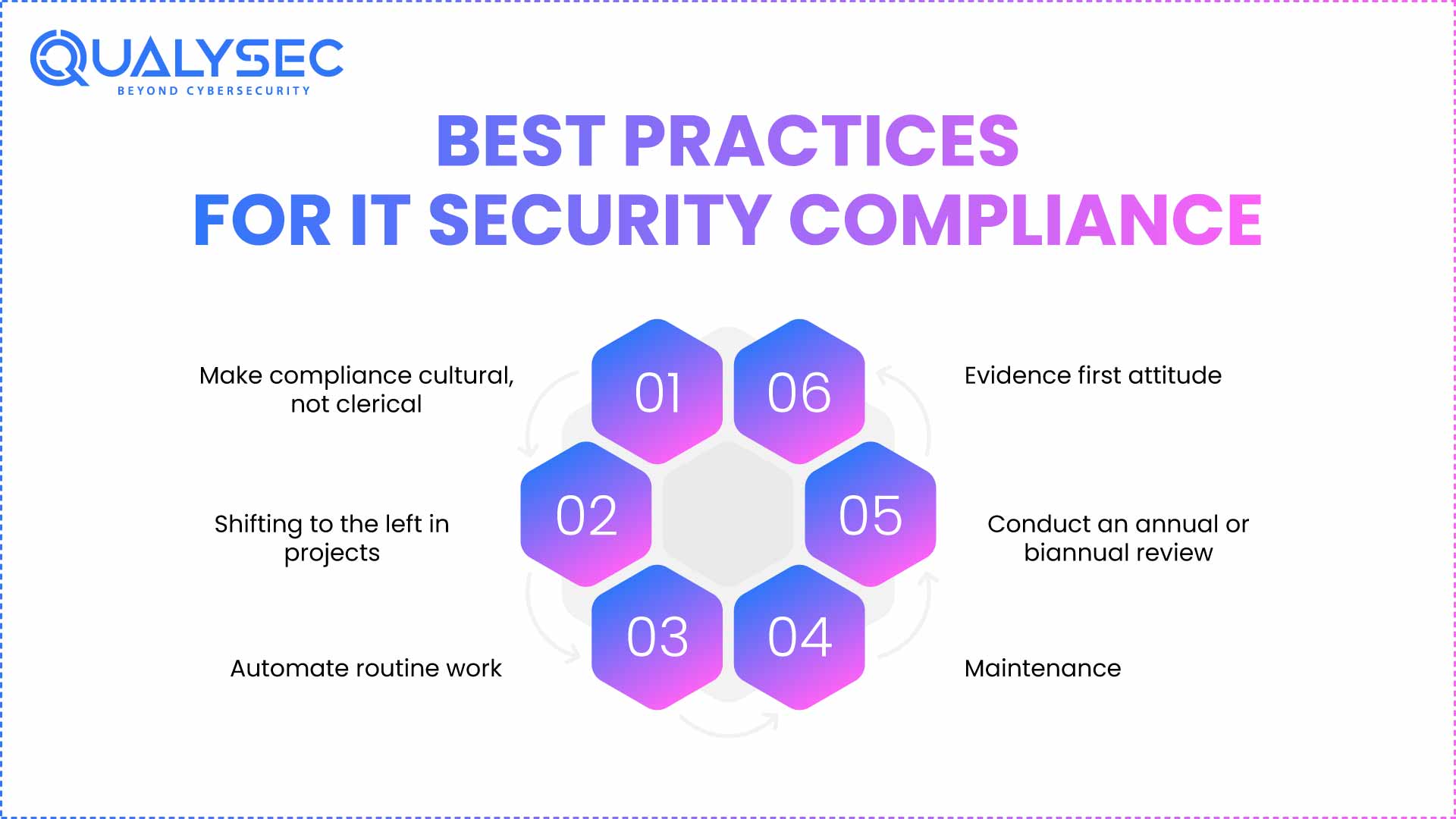
Checklists keep you compliant, but sustainable IT security requires strategy. These practices lift you above the bare minimum:
- Make compliance cultural, not clerical: When staff see security policies as part of daily work (like MFA logins or reporting suspicious emails), compliance becomes second nature. This reduces reliance on “one-off” training days.
- Shifting to the left in projects: Add compliance checks to the planning of IT projects. To illustrate, when migrating to the cloud, cross-map ISO 27001 clauses and Essential Eight to be migrated to, not afterwards.
- Automate routine work: Patch management and vulnerability scanners, and SIEM platforms will help to keep compliance at all times. Automation will minimize fatigue and guarantee uniformity in gathering evidence.
- Maintenance: The Board needs to be active, and quarterly reports need to include risk, effectiveness of controls, and compliance position. CPS 234 renders boards responsible; thus, the idea of framing security as a business risk (rather than an IT issue) will gain buy-in.
- Conduct an annual or biannual review: Legislative and standards change. The changes to the Privacy Act in 2024 and the emergence of the Cyber Security Act demonstrate how fast the requirements can change. Check the compliance security audit report every six months to keep up.
- Evidence first attitude: Question: – What would we be able to demonstrate to an auditor should he or she walk in tomorrow? This strategy integrates the daily security and preparedness of compliance.
Talk to Qualysec Experts or Chat with Our AI Bot About Compliance in IT Security!
How can Qualysec help?
Meeting IT security compliance obligations requires more than policies and checklists. It requires evidence that your controls actually work.
At Qualysec, we specialise in security testing across web, mobile, cloud, API, IoT, and network environments. Our professionals offer audit-ready reports that are in compliance with the controls on vulnerability management and security testing.
Some of the cybersecurity frameworks we assess include PCI DSS, ISO 27001, SOC 2, HIPAA, and GDPR. Among our deliverables are the detailed findings, remediation guidance, and executive summaries that have been formulated to satisfy the regulators, auditors, and boards.
Know all the information related to the Data Security Compliance: A Step-by-Step Guide
Conclusion
Compliance in IT Security is no longer optional for Australian organisations. From the Privacy Act’s breach reporting to the Cyber Security Act 2024’s ransomware rules, compliance now spans both legal obligations and industry standards.
Here is where Qualysec steps in. Our skilled experts understand the compliance that needs to be maintained. For that, we adopt a structured checklist and deliver compliance-ready reports.
Book a free compliance readiness consultation with our security experts.












































































0 Comments