








Web application vulnerabilities are the flaws in websites or apps that hackers can potentially exploit to gain access. In 2025, with new critical and high-severity flaws revealed every day, businesses in India need to keep an eye on Web Application Vulnerabilities more than ever.
An estimate indicated that roughly 31,154 new vulnerabilities appeared in 2025—around 127 new holes every day. Just avoiding it means that your app will be vulnerable, and your user will be at risk.
Why Web Application Security Matters
Web apps fuel everything today—online stores, banking applications, internal dashboards—the list goes on. Just one single breach can cause a customer data leak, damage to trust, regulatory fines, and a significant financial loss.
With the advent of AI tools in 2025 to facilitate attacks on web apps that are faster and easier than ever, web app security can no longer be considered a luxury; it must be a necessity. Without the right precautions for web application security, a small bug can escalate to major problems.
Top 10 Web Application Vulnerabilities
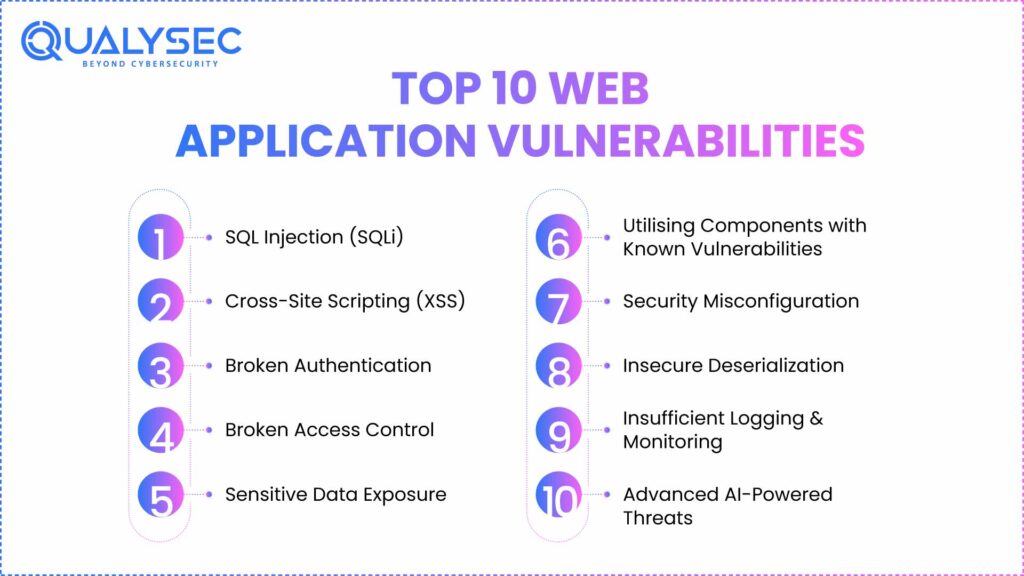
Here are the top 10 web application vulnerabilities to know.
1. SQL Injection (SQLi)
SQL Injection occurs when attackers insert malicious SQL queries into input fields or URLs. By doing so, hackers are able to view, change or delete sensitive information that is stored in databases. In many cases, attackers can reveal login credentials and customer information too. SQL Injection is one of the oldest and still one of the most dangerous vulnerabilities of web applications.
2. Cross-Site Scripting (XSS)
This occurs when a hacker injects code into a website that contains malicious commands. Once a user opens a webpage with XSS code in it, the code will run in the user’s browser and steal logins, cookies, or any personal information without the user being aware.
The hacker can manipulate the user’s browser to also send the user to a fake webpage or inject malware into the user’s browser. This affects users’ trust and puts them in danger.
3. Broken Authentication
If the login system uses faulty logic, attackers may easily bypass it. In many cases, broken authentication is caused by weak or non-existent password policies, failing to use multi-factor authentication, and/or poorly handling user sessions. Once hackers accessed the user session, they may easily impersonate the user or even impersonate the administrator. Broken authentication and impersonation can be major entry points for cybercriminals.
4. Broken Access Control
Access control is when users are given the rights only to what they are entitled to, such as allowing a visitor into a building, but only allowing them into the lobby and not into the CEO’s office.
If access control is broken, the hacker, or even a regular user, will have access to things they shouldn’t normally have access to and find a way to see things they shouldn’t see.
For example, someone with a regular account might end up being able to see admin features or secret data.
This is one of the most common and dangerous vulnerabilities to encounter on web applications during Web Application Scanning.
5. Sensitive Data Exposure
Sometimes, organisation handlers don’t protect the personal information that they have, such as passwords, credit card numbers, or health records. If the information is not stored virtually and securely locked up, hackers can steal sensitive data easily.
This hurts the users and can create serious legal issues for the organisation and a financial burden. Protecting sensitive data should be a priority for every business and should be taken seriously.
6. Utilising Components with Known Vulnerabilities
Many sites use ready-made tools, plugins, or third-party software to save the time and effort of creating their own. But if these tools are aged or not kept up-to-date, attackers can easily penetrate the system unchallenged. Just like leaving the front door wide open. Regularly maintaining and updating can easily close those doors.
Check out our article on how a Website Vulnerability Scanner helps prevent cyberattacks.
7. Security Misconfiguration
Default credentials, extras that are not required, or improperly constructed permissions are all examples of misconfiguration issues. These problems occur frequently, and attackers eat these up because it is just easy work for them. Even detailed error messages can expose underlying system information. Of the many common vulnerabilities, misconfigurations are among the easiest and most commonly found.
8. Insecure Deserialization
Insecure deserialization occurs when an application takes in untrusted and/or tampered data, thereby allowing an attacker to run arbitrary code. It may occur because an unexpected alteration was made to an object. Insecure deserialization can lead to remote code execution, denial of service, or full system compromise. Although this is technical, it can be very damaging.
9. Insufficient Logging & Monitoring
Many organisations do not see even half of the potential attacks against them because they either do not log activity or fail to do so properly. Organisations also fail to review logs once they are created. When logging and monitoring are not employed, typically the breach MAY go unnoticed for months. By the time businesses discover the breach and how it was compromised, critical data may already have been stolen. Hence, monitoring and detection are almost as important as prevention.
10. Advanced AI-Powered Threats
In 2025, cybercriminals can use AI tools to accelerate and enhance attacks. Using AI, attackers are able to scan applications in no time, develop multiple exploits, and sometimes even adjust during the attack. Traditional security practices struggle to keep up with these kinds of attacks; therefore, the combination of AI-powered defence and good security practices is required to outsmart them.
Read our article to understand the importance of Web Vulnerability Assessment.

































































































































































































































































































































































































































































































































0 Comments