







Within the framework of the analysis, it is vital to understand the distinctions between FedRAMP vs standard penetration testing, mainly when organizations cooperate with governmental clients or process federal data. Although both approaches aim to identify weak spots and strengthen security stances, they operate on entirely different platforms, with distinct needs and goals.
FedRAMP and standard pen testing is one of the most notable differences in the spectrum of cybersecurity testing. Standard penetration testing offers flexibility and customization tailored to organizational needs. In contrast, FedRAMP penetration testing is strictly standardized, with protocols formulated in a particular manner to ensure adherence by cloud service providers approached by federal agencies. This fundamental difference has had effects in terms of testing methodologies and testing results, reporting requirements, and compliance results.
Organizations should be aware of these differences to select the correct type of testing, to be regulatory compliant, and to make the best use of the money they invest to reinforce their cybersecurity. As a cloud service provider seeking to secure federal contracts or an enterprise evaluating its security posture, understanding the FedRAMP concept of standard penetration testing can inform crucial business decisions.
What Is Standard Penetration Testing?
Standard penetration testing is a series of procedures that examines computer security by acting like an aggressor to find holes in a machine, network, programs, etc. This strategy has been very flexible in terms of scope, approach, and implementation, depending on the risk appetite of the organization and organizational needs.
Key Characteristics of Standard Penetration Testing
Flexible Scope and Methodology
- Testing scope can be tailored depending on business needs, organization-wise.
- There are several methodologies at hand (OWASP, PTES, NIST SP 800-117)
- Testing may target particular assets, applications, or a segment of the network
- Staging environments are often acceptable for testing
Vendor Selection Freedom
- Organizations can choose from numerous qualified security vendors
- No mandatory accreditation requirements for testing providers
- Cost-competitive market with diverse service offerings
- Internal teams can conduct assessments with proper expertise
Reporting and Documentation
- Variable reporting formats based on client preferences
- Focus on actionable remediation guidance
- Customizable detail levels and technical depth
- Business-oriented risk assessments
Testing Frequency
- Point-in-time assessments or regular scheduled testing
- Flexibility in testing intervals based on risk appetite
- Optional retesting after remediation efforts
- No regulatory mandates for specific frequencies
Consult with Our Experts to assess your organization’s unique needs and create a tailored penetration testing strategy.
What Is FedRAMP Penetration Testing?
FedRAMP penetration testing is a specific type of security assessment procedure required by the Federal Risk and Authorization Management Program for cloud service providers serving the USA government agencies. This high-level certification process enables the provision of cloud services that can handle federal data with the necessary security and compliance.
Defining Characteristics of FedRAMP Penetration Testing
Mandatory Third-Party Assessment Organizations (3PAO)
- The 3PAOs are only accredited by FedRAMP to conduct assessments
- Independent verification protects against being opinionated and against being out of compliance
- Specialized expertise in government security requirements
- Standardized reporting to FedRAMP Program Management Office
Six Mandatory Attack Vectors
The FedRAMP pentest guidance requires comprehensive testing across specific attack vectors:
- External to Corporate (Phishing) – Social engineering attacks targeting system administrators
- External to CSP Target System – Internet-based attacks on cloud infrastructure
- Tenant to CSP Management System – Privilege escalation attempts from customer accounts
- Tenant-to-Tenant – Cross-tenant data access and isolation testing controls,
- Mobile Application to Target System – Mobile app security assessments
- Client-side Application/Agents to Target System – Testing of client-side components
Production Environment Requirements
- All testing must occur in production environments
- No staging or development environment substitutions allowed
- Real-world conditions ensure accurate security posture assessment
- Higher risk but more realistic vulnerability identification
Continuous Monitoring Integration
- Annual penetration testing requirements
- Results feed into ongoing FedRAMP continuous monitoring programs
- Tracking of remediation of vulnerabilities via Plan of Action and Milestones (POA&M)
- Frequent revisions of Security Assessment Reports (SAR)
Secure Your Cloud and Stay Compliant. Book Your FedRAMP Pentest Today.

Key Differences Between FedRAMP vs Standard Pen Testing
To clarify how to make the best decisions in adopting a cybersecurity assessment, it is necessary to learn about the inherent differences between FedRAMP vs standard penetration testing.
| Category | Standard Penetration Testing | FedRAMP Penetration Testing |
| Regulatory Framework and Compliance Requirements | Voluntary security assessment practice Follows industry best practices (e.g., SOC 2, ISO 27001, PCI-DSS) Security objectives driven by the organization |
Mandatory for federal cloud providers Based on NIST SP 800-53 controls, FedRAMP-accredited production. FedRAMP authorization integration Security goals defined by the government |
| Methodology Flexibility | Customizable based on the organization’s needs Multiple industry methodologies are accepted. |
Strict adherence to FedRAMP PT guidance Requires MITRE ATT&CK framework integration |
| Attack Vector Coverage | Tailored to threat models and risk Business priorities guide scope. |
All six FedRAMP-defined attack vectors must be tested. Comprehensive and uniform vector coverage |
| Assessor Qualifications | Can be conducted by any qualified cybersecurity vendor or internal team. Competitive pricing and services |
Only FedRAMP-accredited 3PAOs can perform testing. Vendors must meet strict expertise and accreditation requirements |
| Accreditation Requirements | Industry certifications are optional. Preferred but optional Vendor selection driven by cost and capability |
Formal 3PAO accreditation required. Assessors must be government-approved |
| Report Structure and Content | Flexible formatting and detail Risk communicated in business terms |
Follows standardized SAR format Emphasizes technical compliance |
| Evidence Requirements | Summary findings with practical remediation Moderate evidence standards |
Detailed documentation Attack narratives and technical proof are mandatory |
| Testing Environment | Can be done in dev, staging, or production. Focus on risk mitigation production. |
Must be done in production. Assesses real-world impact in live systems |
| Business Impact Considerations | Prioritizes minimal disruption Flexible scheduling around business needs |
Testing must align with compliance timelines. Potential for service disruption is accepted. |
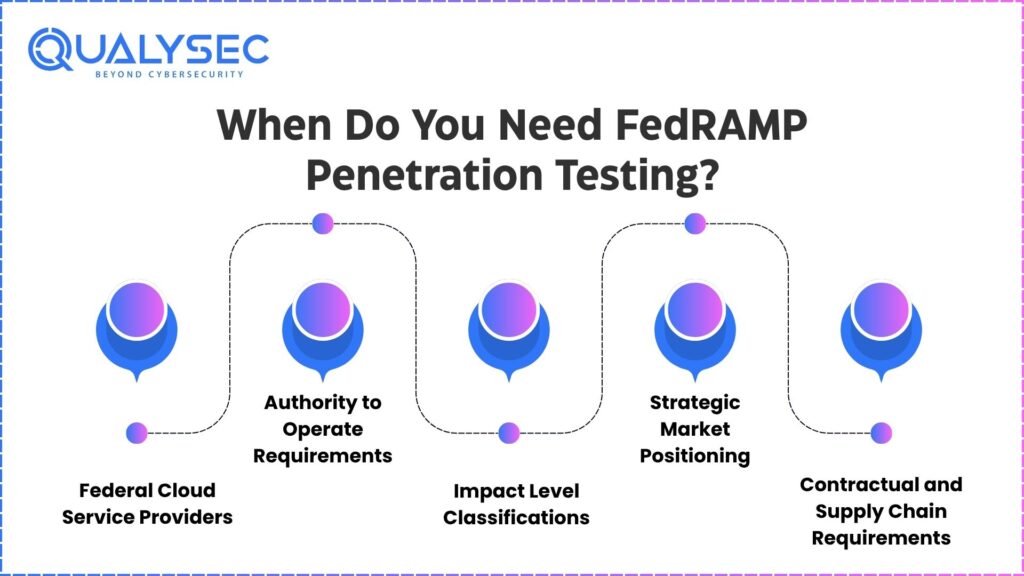
When Do You Need FedRAMP Penetration Testing?
The decision to apply to your organization for FedRAMP penetration testing or the usual penetration testing is imperative to make the better choice of a cybersecurity solution. The argument of FedRAMP vs standard penetration testing is especially of interest when organizations seek federal contracts or deal with government data. FedRAMP authorization requires the adoption of specific security evaluations that standard testing methodologies cannot replace.
Federal Cloud Service Providers
Cloud service companies with government clients at the federal level have compliance requirements that are mandatory and necessitate special assessment. In the case of your organization providing Software-as-a-Service (SaaS), Infrastructure-as-a-Service (IaaS), or Platform-as-a-Service (PaaS) service to government bodies, FedRAMP penetration testing turns out to be a necessity. The FedRAMP penetration testing guide is one that clearly says that every cloud service that deals with federal information must be thoroughly evaluated in terms of security with government-approved techniques.
The FedRAMP pentest guidance sets particular standards when agencies have to obtain this special testing. Provided that you use your business to process, store, or transmit federal information systems data, you will be required to pass through official assessments to exhibit relevance. This will apply to direct government contractors, as well as to subcontractors and third-party service providers who may come into contact with federal data indirectly as they have business relations with other people.
Authority to Operate Requirements
Federal purchase requirements have been known to raise the pressure on cloud service providers to obtain Authority to Operate (ATO) before attending to government contracts. The FedRAMP auditioning life cycle is a golden key to the federal market, and FedRAMP vulnerability scanning and overall security testing is the right way to gain entry to the federal market for an organization that approaches government business opportunities. Your organization is not allowed to take part in federal procurement activities and tap the high revenue levels in the government unless it obtains special permission.
Impact Level Classifications
The determination of levels of impact is essential in determining your FedRAMP penetration testing requirements. It has a classification system that entails:
- Low Impact Systems: Deal with publicly available data, the consequences of compromise on which are, to a limited degree, negative.
- Moderate Impact Systems: Process information in which a deterioration may have serious negative consequences on the operations.
- High Impact Systems: Handle information that the compromise of which might lead to disastrous consequences to national security.
Knowing your system impact category assists in deciding the extent and amount of security testing that will have to be completed concerning the best FedRAMP pentest tools and techniques.
Strategic Market Positioning
The consideration of the concept of market positioning may induce organizations to undergo FedRAMP penetration testing even when it is not urgently necessary. Firms that want to procure competitive advantages in government contracting understand that the preparation of compliance in its early stages places them in an advantageous position when there is an opportunity later. The FedRAMP penetration testing vs standard penetration testing choice is strategic when organizations desire to prove their reliability to the federal organizations and show they want to be secure with the federal government specifications.
Contractual and Supply Chain Requirements
Contracts you sign often require FedRAMP vulnerability scanning and security testing, whether or not your organization has direct government participation. Federal prime contractors frequently ask their subcontractors to be FedRAMP compliant before allowing them to take part in any government projects. This has a trickle-down effect where every organization within the government supply chain might have to engage in FedRAMP penetration tests to sustain their business relationship and contract eligibility.
Schedule a Free Consultation with Qualysec experts to determine if your organization needs FedRAMP penetration testing and develop a compliance roadmap.
Cost Comparison
The economic viability of FedRAMP Penetration testing vs standard penetration testing is another important decision parameter that those organizations should consider when deciding on the cybersecurity assessment options. Knowledge of such cost differences assists organizations in making sound budgetary decisions in line with long-term returns on investment for their security programs.
Standard Penetration Test Investment
There are several advantages of standard penetration testing, such as more predictable and flexible pricing structures to operationalize within an organization’s budgeting mechanisms and testing needs:
- Small Business Testing: basic security tests cost 5,000 to 15,000 dollars
- Enterprise Assessments: Full organizational testing may come in between $15,000 and $50,000
- Application-Specific Testing: Targeted testing costs between 10,000 and 30,000 dollars
- Annual Testing Programs: 20,000 to 100,000+ per year of security validation
FedRAMP Penetration Testing Price
Both penetration testing and FedRAMP are expensive, but FedRAMP penetration cost needs a lot more because it has specific needs, and even 3PAO participation is mandatory. The FedRAMP pentest guidance requires full-scale testing that usually costs between 15,000 and 40,000 USD on initial assessments. Yet, the FedRAMP authorization process imposes other costs, such as before assessment readiness assessment, expert consultation in penetration testing guide FedRAMP compliance, and regular FedRAMP vulnerability scans. Cost of total ownership can easily vary between 100K and 500K+ to authorize initially; annual maintenance fees are 50K – 150K. Such investments in the finest FedRAMP pentest tools and processes offer an entry into the federal market opportunities to make the extensive initial and recurring costs of compliance worthwhile.
Read Also: How Much Does a Penetration Test Cost on Average?
Compliance vs. Security Focus
The key difference between FedRAMP and a standard pen test is their primary focus, which is verification of compliance (required standards and frameworks approval) and enhancement of security, accordingly. The FedRAMP penetration testing will emphasize regulatory compliance and government-directed security measures, unlike the normal penetration testing that aims at practical reduction of risk and the business-based security issues. This difference facilitates the organizations to align their testing approach with their operational needs and statutory requirements.
FedRAMP Compliance-Driven Approach
The FedRAMP pentest recommendations focus on adherence to the security controls and information protection requirements of the NIST SP 800-53 and federal guidelines. Testing methodology shall show that it follows government-stipulated levels of risk tolerance and security baselines, instead of focusing on threats and vulnerabilities associated with an organization. This compliance-based system ensures consistency among cloud service providers across the Federal government, yet it might only suit standardizing on business-specific risks and industry-related security issues generally covered in a standard penetration test.
The FedRAMP authorization program involves the incorporation of continuous monitoring programs and continuous compliance verification initiatives. Security findings have to be reported in standardized forms and have to be tracked in the Plan of Action and milestones (POA&M) processes. This formal way of doing things makes it accountable and easy to trace its progress, but the method has the potential of squandering resources on more issues of security that are urgent and therefore pose the highest threat to business activities.
Standard Testing Security-First Methodology
A series of risk-based security assessment techniques prioritize vulnerabilities based on their implications for the business and the possibility of exploitation during standard penetration testing. Companies can tailor their area of test to deal with specific threat models, operational risks, and competitive security needs. The Penetration Testing Handbook FedRAMP requires complete testing against six attack vectors irrespective of their potential contribution to the actual risk in the organization, whereas traditional testing permits prioritized testing around aspects of business interest and resource limitations.
Read Also: Penetration Testing And Its Methodologies
Major Differences in Operational Differences
Vulnerability scanning and assessment efforts by FedRAMP are to be conducted by government-specified timeframes and reporting as opposed to business security enhancement periods. The differences in the operational processes are:
- Testing Schedule: Annual FedRAMP, as opposed to standard testing intervals that are flexible
- Tool Selection: Government-mandated tools vs. organizational solution Choices
- Scope Definition: Attack vectors that must be executed versus attack vectors that are customizable during the threat-based testing
- Documentation Requirements: Rigid structures of SARs worry about flexible formats of reporting.
Technology and Methodology Constraints
Government guidance prescribes the best FedRAMP pentest tools and methodologies that are not determined by their efficacy in particular organizational settings or attacks. Although this standardization makes it possible to draw parallels between the federal assessments, there is a risk that such practice does not leave room to use new security testing methods or specific tools that might prove more suitable in detecting vulnerabilities in a particular stack of technology or business model.
Balanced Security Strategy
Compliance needs and realistic security advancements have to guarantee that the organization’s approach to FedRAMP penetration testing is a minimum-security standard instead of a complete security program. The comparison of FedRAMP vs standard pen testing shows that organizations usually require both the government-mandated testing and services-oriented tests: the former can help meet government regulations mandating a specific level of security, and the latter can help organizations manage risks to their business operations. This two-front strategy will bring about both compliance and functional security capabilities.
Download our guide on security vs compliance — Download now
Which One Is Right for Your Organization?
Determining whether your organization needs FedRAMP penetration testing or standard penetration testing requires careful evaluation of your business objectives, regulatory environment, and customer requirements. The FedRAMP vs standard penetration testing decision significantly impacts your cybersecurity investment, operational procedures, and market opportunities. Organizations must consider their current and future federal government business involvement when making this strategic choice.
Mandatory FedRAMP Scenarios
Penetration testing becomes a requirement of FedRAMP for cloud service providers to agencies of or on behalf of the federal government. The federal information processes, the presence of federal contacts, or at least the ambition to get into the government marketplace make the FedRAMP authorization process a business necessity instead of an optional security upgrade. These risks are also justified by the fact that the penetration testing framework FedRAMP enforces non-negotiable rules that organizations classified under this category must adhere to, and therefore, the decision is easy considering its costs and complexity.
Strategic Business Evaluation
The organizations that do not have direct business ties with the federal government must consider the long-term strategic objectives and plan of expansion in the market. The government sector is a significant and constant revenue source, and most companies sooner or later venture into it. Preparing and investing early to undergo FedRAMP vulnerability scanning and preparing to be compliant can present competitive advantages in the event of federal opportunities coming up. Nevertheless, companies that operate only in the context of the private sector market can consider such penetration testing more convenient and more consistent with company interests.
Recommended: 52 Small Business Cyber Attack Statistics
Organizational Readiness Assessment
Your organization is impacted by the more mature technical infrastructure and advanced cybersecurity program sophistication in preparing for the FedRAMP penetration test. The most critical factors of readiness are:
- Security Program Maturity: Effective policies, procedures, and governance structures
- Technical Expertise: Trained and experienced cyber experts who have done government work before
- Documentation Capabilities: Documentation capability to keep detailed compliance documentation
- Resource Availability: Regular compliance maintenance of human resources
Organizations that have few cybersecurity assets or poorly developed security programs can harness the benefits of the standard penetration testing to develop some fundamental security capabilities before attempting government compliance.
Financial Investment Considerations
The cost factor is also a very relevant input in the FedRAMP vs standard penetration testing decision. The FedRAMP pentest guidelines involve specialized Third-Party Assessment Organizations (3PAOs) and the need to document in greater length, and thus turn out to be considerably more expensive than top-notch assessments. It will be up to the organization to consider the fact that the given federal market access might be worth the huge investment in compliance procedures and the maintenance efforts in general.
Long-Term Commitment Requirements
The FedRAMP scanning and the continuous monitoring requirements would result in a continuing operational consequence to the FedRAMP program that would go well beyond the original authorization. Organizations should measure their ability to sustain their compliance activities and help in responding to government demands and changes in the regulatory standards. Such a long-term undertaking will need specialized resources and corporate attention that not every business model or strategy can withstand.
To make the correct decision to choose between FedRAMP vs standard penetration testing, one must be sincere about the organizational competencies and goals and situate the organization in the market. To establish proper testing strategies, companies should seek expert advice from knowledgeable cybersecurity personnel on government compliance and business-oriented defensive measures to help design strategies that ensure their long-term survival.
Make a Free Consultation with Qualysec Now to discover how their FedRAMP specialization can accelerate your authorization timeline and improve your chances of achieving ATO success.






































































































































































































0 Comments