







Most enterprises already have AI running inside their businesses. Many just don’t realise how widespread it has become. It includes the growing use of shadow AI, AI tools adopted by employees without formal oversight or approval. Palo Alto Networks found that generative AI traffic across enterprise networks grew by more than 890% during 2024 after studying usage data from over 7,000 organizations worldwide. Around the same time, IBM highlighted a worrying figure. Around 38% of employees admitted to entering sensitive company information into AI tools without their employer’s approval.
This mix is creating a blind spot that security teams are finding hard to map and control. Employees are turning to public chatbots, AI browser extensions, coding assistants, transcription tools, and AI features quietly added into software the company approved years ago. In many cases, IT teams see none of this activity. No review process, logging, or understanding of where the data goes afterward. This is what enterprises now call Shadow AI. The concern is not AI itself. The concern is AI operating outside governance.
The timing matters too. AI features are appearing inside everyday business software faster than most governance programs can adapt to them. For organizations operating in Europe or handling EU customer data, the pressure increased again after the EU AI Act penalty framework started applying in August 2025. An incomplete AI inventory is no longer only a security issue. It can quickly become a compliance problem as well.
This blog looks at how Shadow AI actually spreads inside organizations, where the biggest security and compliance problems start appearing, why older Shadow IT controls are struggling to keep up, and what companies are doing now to get visibility back before the issue grows larger.
Key Takeaways
- Shadow AI refers to AI tools being used inside the workplace without formal IT approval, monitoring, or governance.
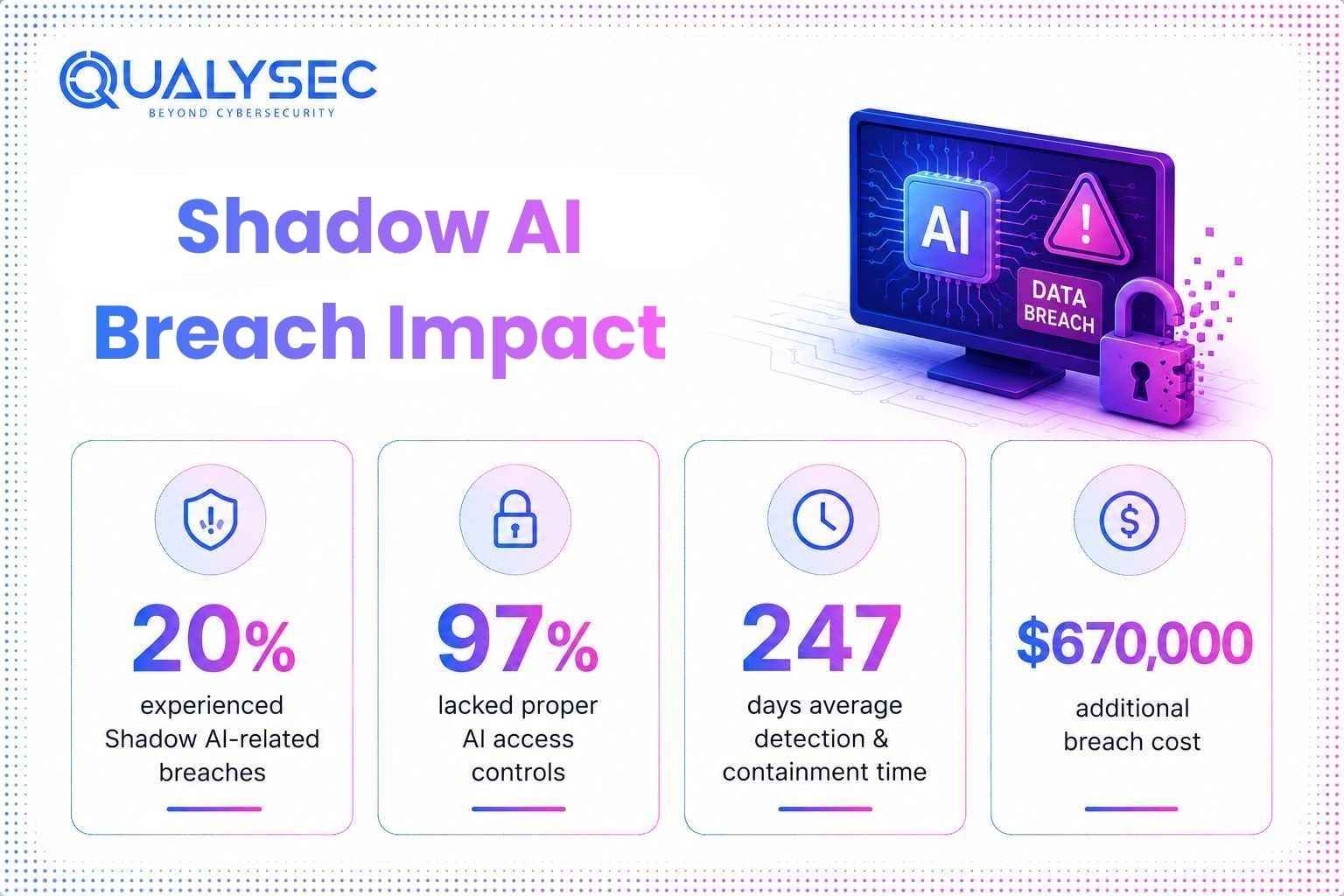
- IBM’s 2025 Cost of a Data Breach Report found that 20% of organizations studied experienced a breach connected to Shadow AI activity.
- Those incidents added an average of $670,000 in breach-related costs compared to standard cases, according to IBM.
- Nearly all organizations affected by AI-related breaches lacked proper AI access controls. IBM placed that figure at 97%.
- Gartner projected in November 2025 that more than 40% of enterprises could face Shadow AI-related security or compliance incidents by 2030.
- Most organizations cannot solve this with outright bans alone. Visibility, policy controls, approved alternatives, and continuous monitoring matter far more once AI usage becomes part of day-to-day work.
What Is Shadow AI?
Shadow AI refers to employees or teams using AI systems without formal review from IT or security departments. IBM describes it as unsanctioned AI usage happening outside approved governance processes.
That can mean public chatbot usage, but it rarely stops there anymore. AI capabilities are now built directly into workplace software that employees already use every day. Microsoft 365 Copilot, Slack AI, Gemini in Google Workspace, browser add-ons, AI writing assistants, external automation tools, and developer models running through personal API keys. In many companies, some of these tools enter production workflows long before security teams have conducted necessary AI penetration testing to evaluate their underlying models.
Some organizations discover Shadow AI through marketing automation platforms. Others find it inside customer support workflows, analytics teams, or developer environments running external models against internal data.
Common examples include:
- Employees using AI chatbots to summarize confidential documents
- AI-based data visualization tools connected to business datasets
- Machine learning models built for external analysis without approval
- Customer service teams are testing AI assistants outside of company policy
The problem is not the technology itself. The real issue starts when AI systems process company data without visibility, governance, or accountability.
Shadow AI vs. Shadow IT: What’s the Difference?
A lot of companies still treat Shadow AI like another version of Shadow IT. That is only partly true.
Traditional Shadow IT usually involves employees using software or cloud services without approval. Think personal Dropbox accounts, unmanaged Trello boards, or teams adopting collaboration apps before IT reviews them. The risk mostly sits around visibility, storage, and access control.
Shadow AI changes the equation because the system is not just storing data. It is processing it, interpreting it, and in some cases retaining prompts or inputs outside the organization’s control.
| Dimension | Shadow IT | Shadow AI |
| Definition | Unauthorized software, devices, or cloud services | AI tools, copilots, models, or plugins used without oversight |
| Data handling | Mostly stores or transfers information | Processes prompts, analyzes inputs, may retain data |
| Common examples | Personal Dropbox, unapproved Slack workspace, Trello boards | ChatGPT through personal accounts, Claude, Gemini, Midjourney |
| Risk profile | Usually predictable and infrastructure-focused | Output behavior can change and is harder to control |
| Detection | Often visible through SaaS discovery or network monitoring | Frequently hidden inside approved applications |
| Governance maturity | Most enterprises already have policies for it | Many governance programs are still catching up |
IBM describes Shadow AI as an extension of Shadow IT, but the operational risk is different. Existing governance models were built for unauthorized software usage. They were not built for systems that can absorb company data, generate new outputs from it, or expose information through prompts that employees barely think twice about entering. That difference is why many older Shadow IT controls are no longer enough on their own.
How Does Shadow AI Happen Inside an Enterprise?
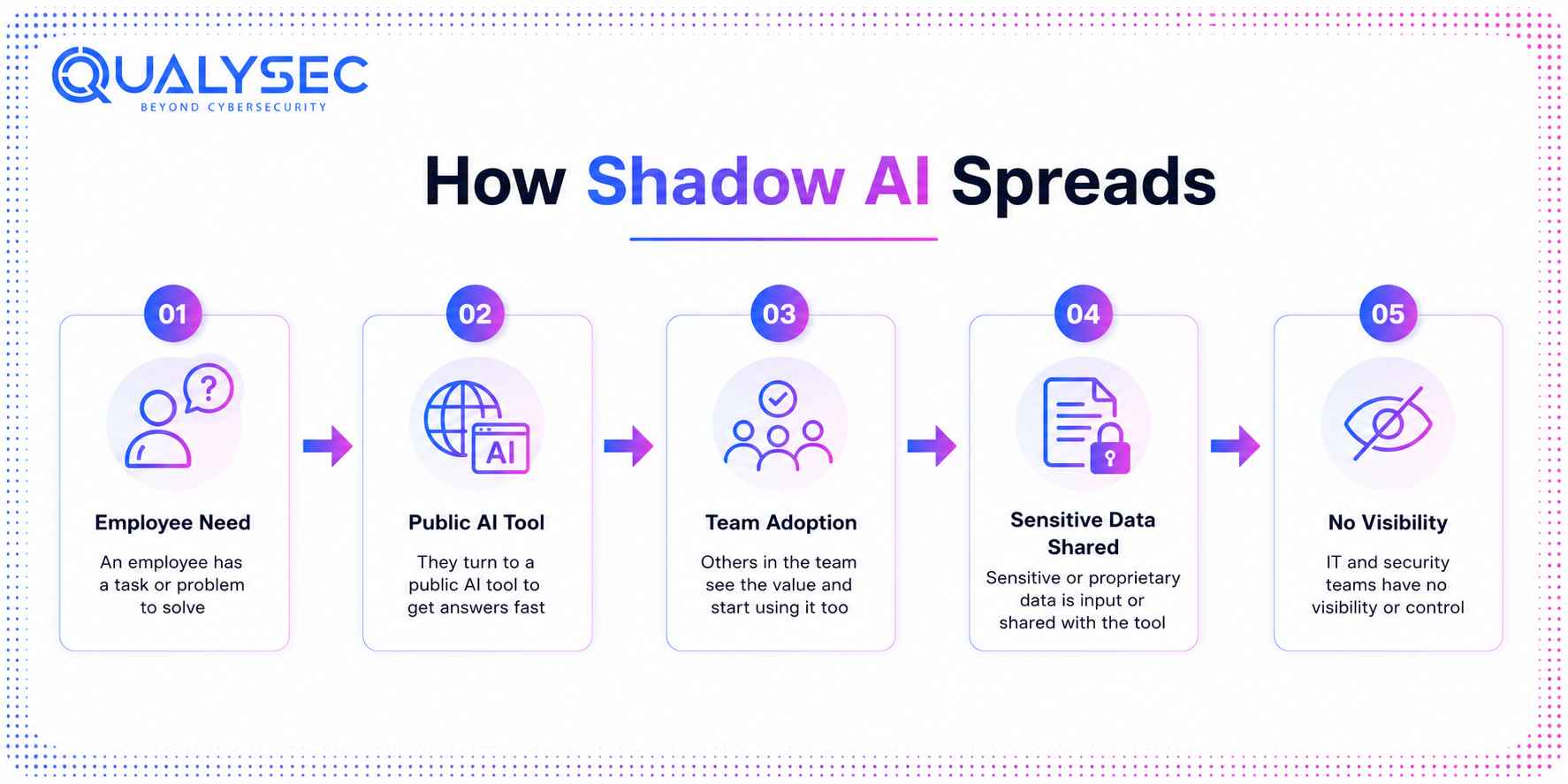
Most of the time, Shadow AI does not enter a company through a major rollout or executive decision.
It starts with smaller day-to-day actions. Someone uses ChatGPT to summarize a document before a meeting. A developer tests code through a public AI assistant. A browser extension gets installed because it saves time during repetitive work. After that, the usage spreads quietly between teams.
Several patterns show up repeatedly inside enterprises:
- employees accessing public AI chatbots through personal accounts
- browser plugins sending prompts or session data to outside AI services
- AI features appearing inside approved software after deployment
- internal tools being built with personal API keys or open-source models outside normal review processes
Samsung Semiconductor became one of the most widely discussed examples in 2023 after engineers reportedly exposed proprietary information through ChatGPT usage shortly after internal access was permitted. Reported leaks included semiconductor source code, internal meeting content, and defect detection data. The company later restricted generative AI use on corporate systems.
In many cases, the employees involved are not trying to ignore policy. They are trying to move faster, finish work sooner, or reduce repetitive tasks. That is one reason Shadow AI keeps spreading even in organizations with existing security controls already in place.
Shadow AI Risks Enterprises Cannot Ignore
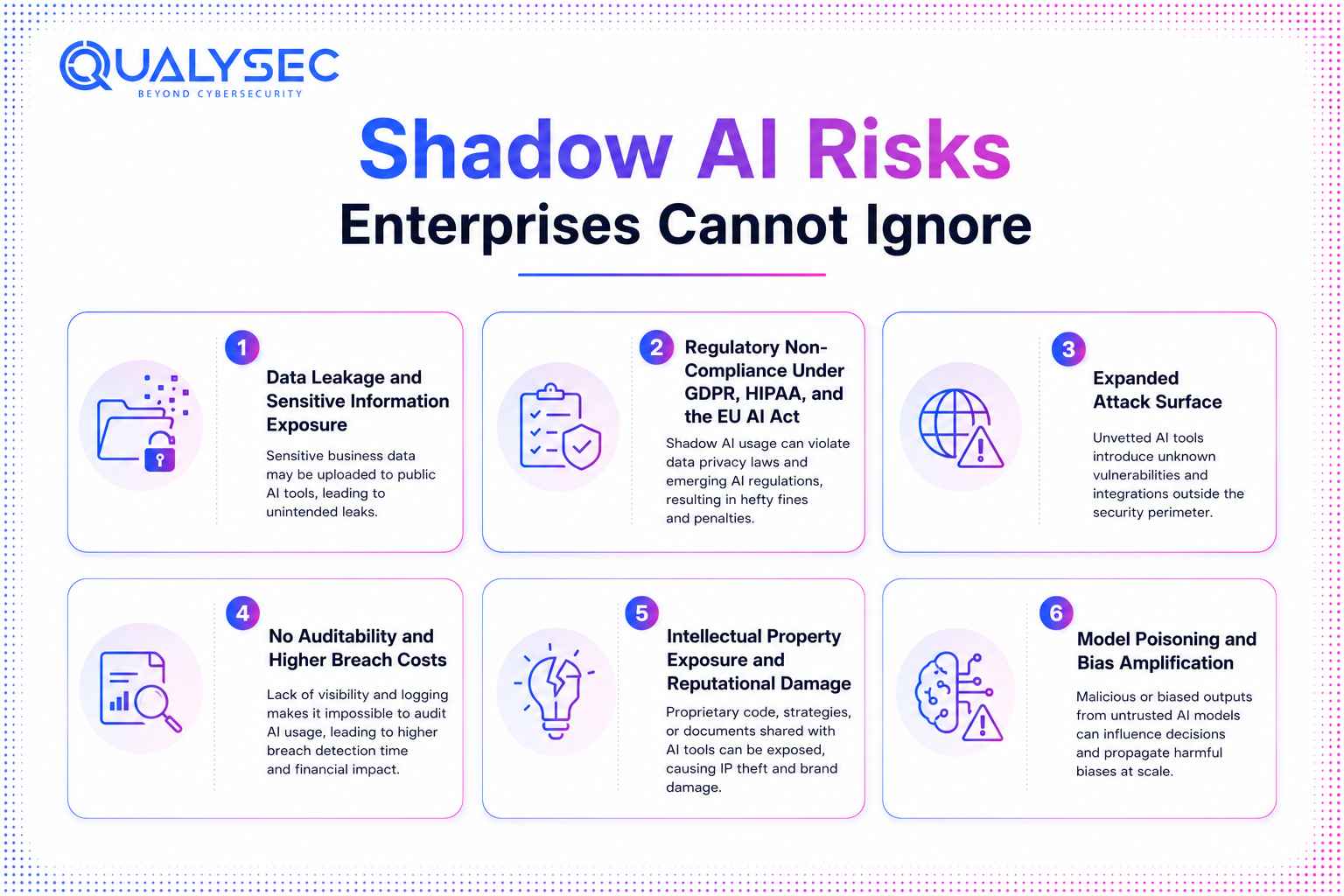
Shadow AI risks are not limited to unauthorized tool usage. The bigger concern is how quickly small gaps in visibility can turn into security, compliance, and operational problems.
1. Data Leakage and Sensitive Information Exposure
This is usually where the problem starts.
Employees paste contracts into chatbots to shorten reviews. Developers upload proprietary code snippets while debugging external models. When engineering teams expose infrastructure data without a rigorous secure source code review framework, intellectual property leaves the perimeter completely unmonitored.
IBM cited findings showing that 38% of employees admitted to sharing sensitive work information with AI tools without approval. Palo Alto Networks also reported that GenAI-related data loss prevention incidents more than doubled in 2025. Their research found that organizations were dealing with an average of 66 generative AI applications, with roughly 10% classified as high risk.
In many environments, security teams still cannot see where prompts are going or what information employees are entering into external systems.
2. Regulatory Non-Compliance Under GDPR, HIPAA, and the EU AI Act
Compliance exposure is becoming harder to separate from security exposure.
Under GDPR, major violations can lead to penalties of up to €20 million or 4% of annual global turnover, depending on the severity of the breach. The EU AI Act introduced another layer of pressure after its penalty framework started applying in August 2025. Certain prohibited AI practices can carry fines reaching €35 million or 7% of worldwide annual turnover under the regulation’s published limits.
Healthcare organizations face a different issue. If protected health information is entered into an unapproved AI platform, that can become a reportable HIPAA incident even if the disclosure was accidental.
A surprising number of companies still do not maintain a reliable inventory of AI systems touching regulated data.
3. Expanded Attack Surface
Every new AI connection introduces another layer that somebody has to secure properly.
Some tools ask for access to inboxes, internal documents, cloud storage, messaging platforms, or repositories within minutes of setup. Employees often approve those permissions quickly because they want the tool to work immediately. Later on, nobody is fully certain how much access was granted or where the information flows afterward.
The problem becomes larger when external APIs, unmanaged integrations, or poorly trained third-party models enter the picture. Employees may trust the output because it sounds polished, even when the underlying model has been manipulated, biased, or trained on unreliable data.
4. No Auditability and Higher Breach Costs
Security investigations become much harder when activity was never monitored correctly in the first place.
IBM’s Cost of a Data Breach Report 2025 found that 20% of organizations studied experienced a breach connected to Shadow AI activity. Those incidents added an average of $670,000 in extra breach costs. IBM also reported that these cases took an average of 247 days to detect and contain.
One detail from the report keeps appearing in enterprise discussions. Nearly all organizations affected by AI-related breaches lacked proper AI access controls. IBM placed the figure at 97%.
Customer records and intellectual property ranked among the most commonly exposed assets.
5. Intellectual Property Exposure and Reputational Damage
Once confidential information enters an external AI system, control over that information becomes much weaker.
Samsung’s 2023 incident drew attention for exactly that reason after engineers reportedly entered proprietary semiconductor data into ChatGPT during internal work tasks. Other organizations ran into different problems tied to AI-generated content quality and disclosure practices. IBM referenced public criticism involving AI-generated material connected to Sports Illustrated and Uber Eats, both of which faced backlash tied to transparency concerns.
Not every incident becomes a formal breach headline. Sometimes the damage shows up through customer distrust, reputational pressure, or questions around internal governance standards.
6. Model Poisoning and Bias Amplification
Not every AI model employees use has been tested properly.
Some external systems are trained on low-quality datasets. Others may contain manipulated information, hidden bias, or unreliable outputs that look convincing on the surface. That becomes dangerous when employees start using those responses inside reports, internal analysis, customer communication, or operational planning without checking the accuracy behind them.
The issue usually develops slowly. A flawed output gets trusted once, then reused again later, because nobody realizes the underlying model was already producing distorted results. Organizations should also be aware of security risks such as Model Inversion Attacks, where attackers may attempt to extract sensitive or proprietary information from an AI model by analyzing its outputs.
Consult with our cybersecurity experts
Discuss your unique security requirements and discover how we can help your business.
Why Shadow AI Is Harder to Fight Than Shadow IT
Most security teams already know how to deal with traditional Shadow IT. The tooling exists. The workflows exist. In many companies, those controls have been in place for years.
Shadow AI is different because it does not always appear as a separate application.
An employee may never visit an external AI website at all. The AI capability could already sit inside software the organization approved long ago. Microsoft 365, Slack, CRM platforms, developer environments, note-taking tools, and customer support systems. New AI functions keep appearing inside products that were previously considered low risk.
It is one of the major blind spots for enterprise security teams. AI features are often introduced quietly after procurement and deployment, sometimes without meaningful change notifications reaching IT teams. That creates a visibility problem that traditional blocklists were never designed to solve.
The scale is also moving faster than governance programs. Palo Alto Networks reported that GenAI-related DLP incidents more than doubled in 2025, while Gartner stated in late 2025 that 69% of cybersecurity leaders either had evidence or suspected employees were already using public generative AI tools at work.
At that point, the discussion stops being about banning tools. The real challenge becomes figuring out how to identify usage, reduce exposure, and build controls employees will actually follow.
How to Detect Shadow AI in Your Organization
Most companies cannot govern Shadow AI properly because they still do not know where it exists. The first step is visibility. Not policy documents. Not awareness training. Visibility.
Start with SaaS discovery tools that can identify unsanctioned AI platforms operating across the environment. That matters because employees are often using AI tools through personal accounts, unmanaged browsers, or third-party integrations that never enter the normal approval process.
Several areas usually expose activity faster than others:
- outbound traffic connecting to public AI APIs
- browser extensions sending prompts or session data externally
- AI plugins added into approved SaaS platforms after deployment
- unusual permission requests tied to automation tools or copilots
- developers using personal API keys inside internal projects
Endpoint monitoring and CASB platforms can help security teams trace connections to known AI services. Identity and access mapping adds another layer by showing who is using specific tools and what level of access those systems received.
ISACA also advised in its 2025 guidance that internal audit programs should include AI discovery procedures, policy verification reviews, and checks around data classification exposure tied to AI usage.
One detail from Palo Alto Networks highlights the scale of the issue. Enterprises are now managing an average of 66 generative AI applications, with around 10% categorized as high risk. A surprising number of organizations still have no structured process for tracking them consistently.
Another mistake companies make is treating approved software as permanently safe. AI features change quickly. Tools approved six months ago may now include embedded copilots, automated prompt systems, or external model integrations that were not part of the original review.
Solutions: How Enterprises Can Manage Shadow AI
Most organizations are past the stage where blocking AI entirely is realistic, which makes visibility, governance, and controlled adoption far more important than blanket restrictions.
Build Visibility Before Anything Else
A company cannot control AI usage that it cannot see clearly.
That sounds obvious, but many organizations still do not maintain a dependable inventory of AI systems operating across departments. The problem goes beyond standalone tools. Security teams also need visibility into AI functions added inside approved SaaS products after deployment. This is one of the biggest operational gaps enterprises are dealing with right now.
Without visibility, governance turns into guesswork very quickly.
Develop an AI Governance Policy That Employees Will Actually Use
Policies fail when they read like legal documents nobody opens again.
Employees need practical guidance. Which AI tools are approved? What data cannot be entered into public models? Which teams require additional review before using external AI systems? What happens if customer information, source code, or regulated records are involved?
IBM reported that only 57% of organizations currently maintain an AI acceptable use policy. That number is lower than many executives expect. Training matters too, although most employees do not need technical lectures. They need realistic examples tied to the work they already do every day.
Use Role-Based Access Controls
Different teams create different levels of exposure. Legal departments handle contracts. Developers work with source code. Finance teams deal with forecasting data and internal reporting. Treating all AI access the same across the company usually creates unnecessary risk.
Some employees may only need approved internal copilots for low-risk tasks. Others may require tighter restrictions because the data they handle carries regulatory or intellectual property concerns.
This also tends to work better operationally. When access rules match actual job responsibilities, employees are less likely to look for outside workarounds. Ensuring these permissions are correctly insulated across your architecture requires routine cloud penetration testing to verify that user roles cannot be bypassed to access sensitive enterprise data environments.
Create a Simple Approval Process
If approval takes three months, employees will find another route.
That is one reason Shadow AI spreads so easily inside large organizations. Staff often adopt tools because existing procurement and security review processes move too slowly for operational demands.
A lighter intake process usually works better:
- basic risk review
- data handling assessment
- access evaluation
- approval or restriction decision within a reasonable timeframe
The goal is not to approve everything. The goal is to bring usage into the open before it becomes invisible again.
Blanket Bans Usually Push the Problem Further Underground
Many organizations reacted to public AI adoption by blocking tools immediately. The problem did not disappear. It just became harder to see.
Employees still use personal devices, browser-based accounts, or external plugins when they believe the tool saves time. Microsoft research in the UK found that 71% of employees admitted to using AI systems without formal approval from IT teams.
That is why prohibition alone tends to fail after a certain point. The safer approach is controlled usage with visibility attached to it.
For many enterprises, the harder part is figuring out where exposure already exists. Policies help, but they do not reveal hidden integrations, unmanaged AI tools, or weak controls sitting quietly inside approved platforms.
Qualysec addresses this through a layered assessment model combining automated scanning, AI-assisted analysis, and manual validation by security specialists. The idea is simple enough: some risks are easy for tools to catch, others are not. Human review still matters, especially when AI systems are involved.
Gen AI vs. Shadow AI: Are They the Same?
No, and mixing the two creates confusion pretty quickly.
Generative AI is a technology category. Text generators, coding assistants, image tools, and AI search systems all fall under Gen AI. The term describes what the system does. Shadow AI describes how the technology is being used inside a company.
An employee using a public chatbot with company data through a personal account is a Shadow AI issue. A reviewed internal AI deployment with security controls in place is not. Same underlying technology, completely different governance situation. That distinction matters because many enterprise risks come from unapproved usage, not from AI adoption itself.
Conclusion
Shadow AI is already inside most enterprises. In many cases, it arrived long before governance discussions caught up.
IBM’s 2025 breach data showed that 1 in 5 organizations studied had already dealt with a Shadow AI-related breach. Gartner projected in late 2025 that more than 40% of enterprises could face security or compliance incidents connected to Shadow AI by 2030. The direction is fairly clear now. AI adoption inside businesses is moving faster than traditional oversight models were designed to handle.
Most companies will not solve this by blocking every tool employees want to use. That usually creates less visibility, not more.
The organizations handling this better are focusing on governance, monitoring, controlled access, and realistic internal processes that employees will actually follow. Companies that want to test how resilient their AI security posture really is also have the option to work with specialists such as Qualysec that assess exposure across automated, AI-assisted, and human-led security layers.
Contact our security team today to schedule a comprehensive Shadow AI exposure assessment.
Talk to our Cybersecurity Expert to discuss your specific needs and how we can help your business.

Frequently Asked Questions
1. What is the difference between Gen AI and Shadow AI?
Generative AI is the technology itself. Shadow AI starts when employees use those tools without company review, approval, or monitoring. The same chatbot can be fully approved in one environment and considered Shadow AI in another, depending on governance.
2. How to protect against Shadow AI?
Most companies begin by identifying what employees are already using. After that comes policy, access control, monitoring, and employee guidance around sensitive data. Fast approval workflows matter too. Otherwise, people usually bypass restrictions instead of waiting for formal review.
3. What are the risks of Shadow AI?
The biggest Shadow AI risks are data exposure, compliance violations, IP leakage, insecure integrations, and weak audit visibility during investigations. IBM’s 2025 Cost of a Data Breach Report found Shadow AI incidents added an average of $670,000 to breach-related costs.
4. What is the difference between Shadow AI and Shadow IT?
Shadow IT covers unauthorized apps, devices, or cloud platforms broadly. Shadow AI is narrower, but riskier in some ways, because the systems actively process prompts, generate outputs, and may retain company data outside organizational visibility or control.
5. How can companies detect Shadow AI?
Security teams usually start with SaaS discovery tools, outbound traffic monitoring, browser extension audits, and access reviews inside approved software platforms. Regular audits matter because many AI features appear inside existing workplace tools long after the original approval process ended.










































































































0 Comments