








Cyber threats are changing more quickly than conventional security systems can handle. To break networks, endpoints, and cloud settings, hackers now employ automation, AI-driven tools, and advanced evasion methods. Companies are using machine learning cybersecurity, deep learning security, and other cutting-edge AI-driven solutions to counteract this. Modern cyber defense’s central pillar has become machine learning (ML), which supports quicker detection, better prevention, and more flexible response mechanisms.
This blog examines how cybersecurity and machine learning work to improve digital infrastructure, lower risk, and work for the future of cyber defense.
Why ML Matters for Modern Cyber Defense
As cyber threats are no longer basic, foreseeable occurrences, machine learning has become absolutely vital. Dynamic, automatic, and frequently polymorphic in nature, signatures change quickly and avoid conventional defenses. They are dynamic.
Tools powered by machine learning can:
- Always learn from large datasets.
- Accurately identify strange behavior.
- Automate danger detection and response.
- Modern corporate contexts call for scales matched.
With sophisticated ML-driven testing, safeguard your company against modern threats.
Work with Qualysec, your reliable expert on compliance and cyber security evaluation.
Core Benefits of Machine Learning Cybersecurity
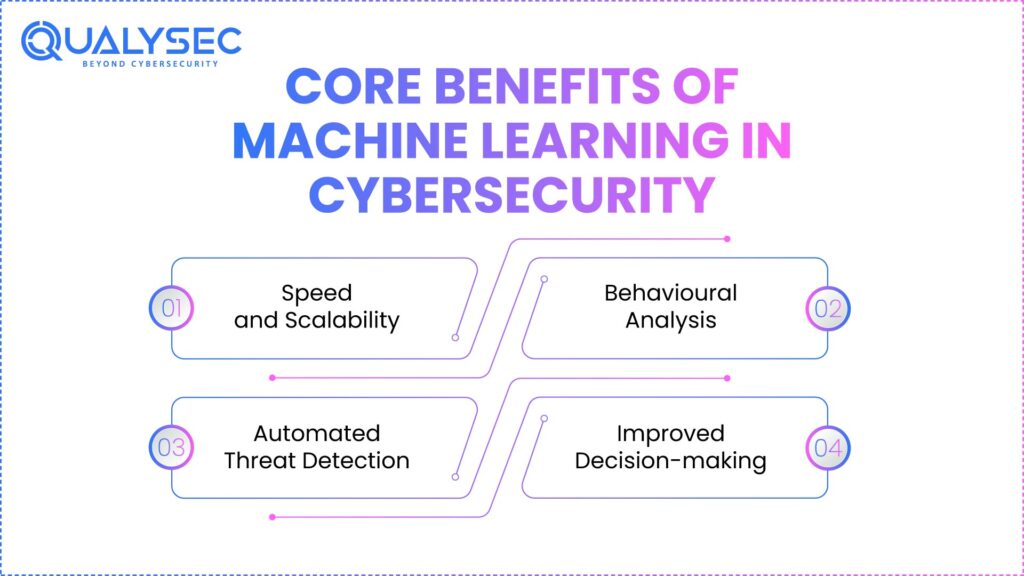
Machine learning gives cybersecurity teams many special benefits, especially in areas where conventional tools and human analysts fall short.
1. Speed and Scalability
Real-time analysis of billions of data points by ML models makes them perfect for complicated cloud environments, IoT ecosystems, and major businesses. Where device numbers increase exponentially, this is especially helpful in machine learning, IoT security, and network security.
2. Behavioural Analysis
ML assesses patterns and anomalies rather than only depending on signatures. This lessens reliance on signature-based detection and manual updates.
3. Automated Threat Detection
ML helps teams react more quickly to threats and lowers analyst workload by automatically spotting questionable activity.
4. Improved Decision-making
Deeper knowledge of security posture, adversary behavior, and system vulnerabilities helps ML to promote active defense tactics.
Download a sample penetration testing report to see how ML-driven insights identify vulnerabilities faster and more accurately.


Challenges of Using ML for Security
While machine learning (ML) has many benefits, it also has several challenges.
1. Quality and Volume of Training Data
One of the biggest challenges for ML will be how we obtain and label enough real-world attack data so that we have enough data to feed into our models. So there are no blind spots created from poor data or false positives created because of bad input.
2. Adversarial Attacks
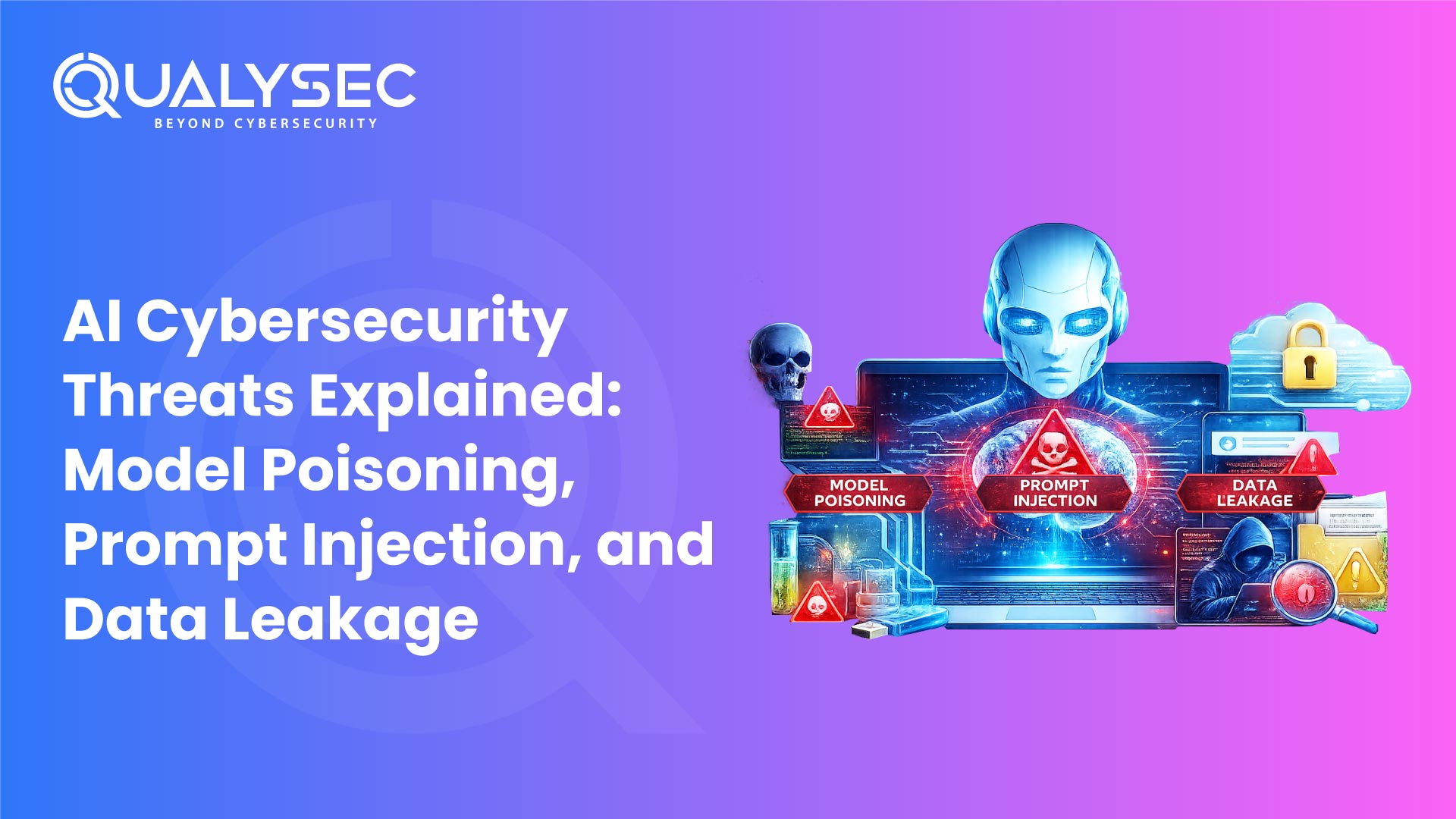
Hackers have begun using adversarial attacks to tamper with ML models by feeding them false or poisoned data that they hope will corrupt the model, so the model will then see the threats incorrectly.
3. High Costs and Complex Implementation
Implementing and developing an ML-based cybersecurity model will require much more time and expertise relative to developing a traditional cybersecurity model. In addition, integration of ML-generated outputs into traditional Security Operations Centers (SOC) can also be difficult.
4. Model Drift
Unless someone is constantly retraining the ML model with new data, the model will likely become obsolete over time because new risks and threats continue to emerge at a rapid pace.
Finally, hackers have been modifying the way they target organizations for a while now; therefore, it is imperative to constantly retrain ML models as new zero-day attacks continue to be created.
Consult Qualysec’s expert cybersecurity advisors to help you overcome ML security issues.
Best Practices for Leveraging ML in Cyber Defense
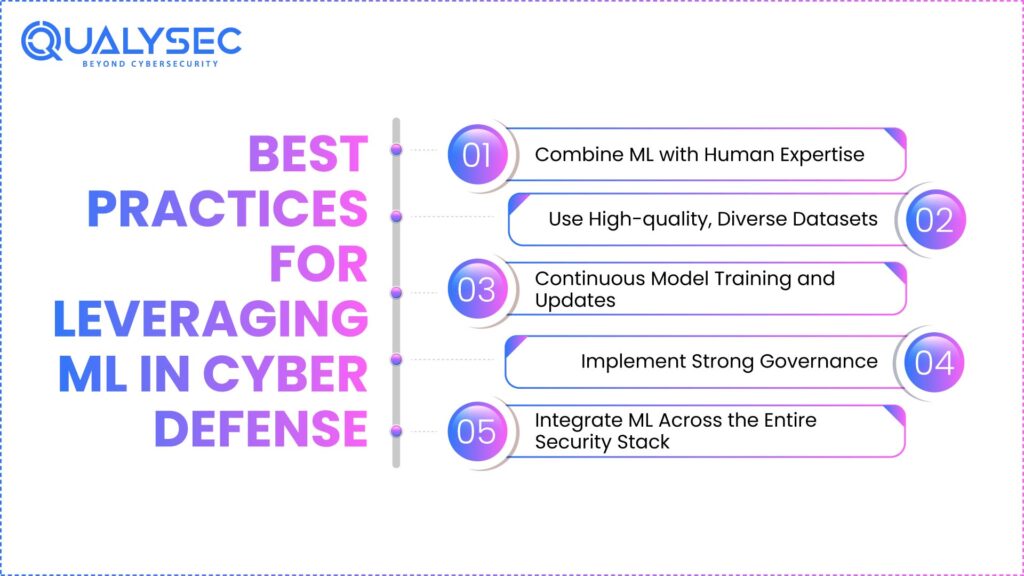
To fully benefit from ML cybersecurity measures, companies must follow several cybersecurity best practices:
1. Combine ML with Human Expertise
The purpose of machine Learning (ML) tools is to assist analysts rather than replace them. An analyst’s oversight ensures that ML-based analyses are accurate and provide the necessary context to make sense of complex results. The combination of both provides a feedback mechanism for continuous improvement and reduces false positives.
2. Use High-quality, Diverse Datasets
The quality and quantity of the dataset used to train the model dictate the model’s performance. Thus, you must procure high-quality training data, which includes properly labeled, anonymized, and reflective of normal and malicious behaviours to mitigate against bias.
3. Continuous Model Training and Updates
Machine Learning (ML) models must be updated frequently due to the fast-changing landscape of cyber threats. Regular re-training using the latest threat intelligence is essential for successfully identifying new attack types, including zero-day attacks.
4. Implement Strong Governance
Having clear governance policies in place that define how ML models are built, measured, maintained, and used is critical. For instance, having a transparent process for determining the risk associated with ML models, complying with legal requirements, and establishing trust in the model’s operations. Know more about LLM security.
5. Integrate ML Across the Entire Security Stack
Machine Learning-driven insights can be utilized across all security layers, including endpoints, networks, cloud applications, and IoT devices. Having insights available throughout the entire architecture enables companies to build a single, proactive defense strategy through the sharing of alerts and contextual information across multiple platforms.
Hoping to deploy scalable ML-driven security? Through expert testing and advisory services, Qualysec enables businesses to reach strong cyber protection.
Future of Machine Learning in Cybersecurity
With developments like these, ML cybersecurity future looks bright:
1. Autonomous Security Operations: Soon, AI-driven SOCs may identify, classify, and help to reduce events free of human interference.
2. Deeper Integration with IoT Security: ML will be critical in machine learning IoT security for anomaly detection throughout billions of devices as IoT grows.
3. Advanced Deep Learning Models: Deep neural networks will assist in detecting subtle attack patterns and developing threats.
4. Increased Use of Generative AI for Defense: Although hackers employ generative AI, defenders will also use it to simulate threats, enhance detection, and automatically respond.
Conclusion
Machine learning has changed the cybersecurity environment. ML enables companies to remain resilient against ever-changing threats, from quicker threat detection to predictive defense and lower false positives. AI and ML in cyber security will continue to be a crucial support of modern cybersecurity as companies embrace digital, cloud, and IoT-driven settings.
Using machine learning security, Deep learning security, and other AI-driven models, companies can better protect their systems, data, and consumers.
Qualysec’s modern and future-proof cybersecurity solutions let you get ahead of the next cyber threats.














































































































































































































































































































































































































































































































































































0 Comments