








Experts predict that cybercrime will cost the world $10.5 trillion a year by 2025 . That figure—much greater than the combined GDP of many major countries- reveals the severity of the digital threat terrain. Cybersecurity Statistics show that if not adequately protected, every email we open, online transaction we complete, and password we enter can be a path for hackers.
Faster, more complicated, and more difficult to spot than ever before are attacks aimed at both businesses and people. The appeal of ransomware, phishing attacks, and identity theft scams demonstrates that attacks are not becoming more numerous but also more complex. Organized, well-financed, and treating cybercrime as a worldwide enterprise, hackers are no longer solo wolves.
Learning the most recent cybersecurity statistics requires more than memorizing the data in a table. These figures state which actions should receive top priority, where the dangers lie, and which defenses are ineffective. Financial bankruptcy, reputational harm, or permanent data loss results for companies that disregard them.
Worried about how these numbers could impact your business? Talk to our experts to identify gaps before attackers do!
Why Cybersecurity Statistics Matter
Cybersecurity is fundamentally important for the survival of a company; it’s not merely a technical element. Leaders who grasp the statistics of cybersecurity have a more precise view of the risks they confront and may make better judgments about finances, education, and technology. These figures illuminate the hidden hazards lurking behind regular activities.
1. Track yearly increases in cybercrime
Follow annual growth in cybercrime. Attacks are increasing annually according to data. Companies that see cybercrime as unusual “bad luck” miss the truth. Cybersecurity breaches are unavoidable without preparation. The rising trend emphasizes why every plan has to include proactive initiatives.
2. Identify the most vulnerable industries
Determine the most fragile sectors. Statistics reveal which sectors, ranging from healthcare to finance, are the most actively targeted. This helps companies test their categorization as high-risk and rank them appropriately.
3. Understand fast-growing attack types
Know the kinds of rapidly expanding attacks. Statistics state that zero-day vulnerabilities, ransomware, and phishing are quickly escalating. Knowing which attacks are expanding the fastest helps teams change their defenses.
4. Build resilience strategies
Construct strategies for resilience. These ideas help guide employee training, information technology budgeting, and investments in monitoring systems. Businesses can plan ahead rather than respond after a breach.
Don’t just read about the risks—turn insights into action. Connect with our experts to find security gaps before attackers do!
Global Cybercrime Statistics in 2025
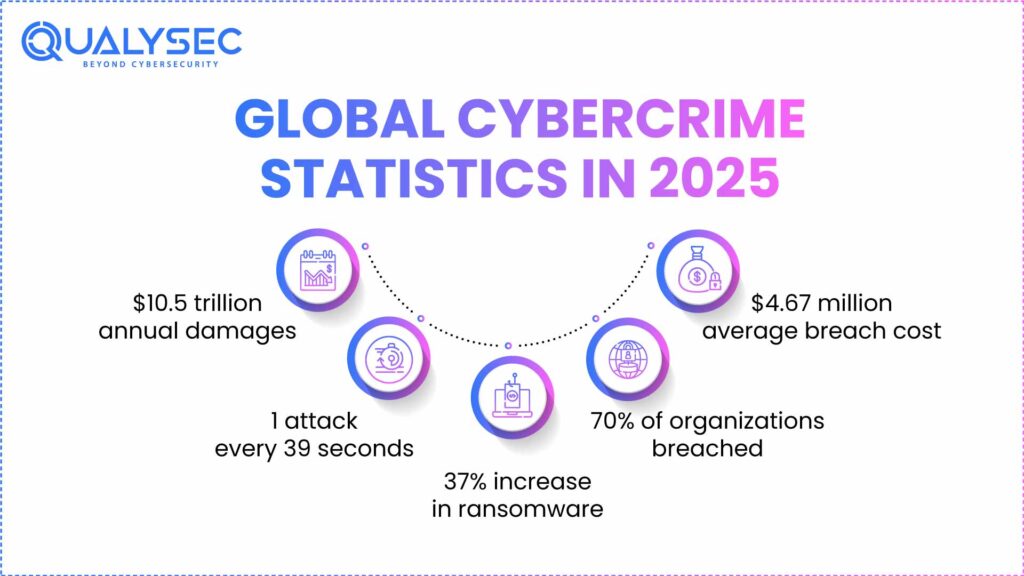
A transnational and cross-industrial worldwide pandemic is cybercrime. The 2025 cybersecurity stats show a sharp increase in both size and significance.
a) $10.5 trillion annual damages: Experts forecast that cybercrime damage will reach an astounding $10.5 trillion annually by 2025. (Cybersecurity Ventures)
b) 1 attack every 39 seconds: Cybercrime has become more lucrative than the world trade in unlawful drugs, thanks to this statistic (University of Maryland study). With one attack every 39 seconds, hackers seek breaches all across the globe at this pace.
c) 37% increase in ransomware: As attackers target corporate and public infrastructure, ransomware has exploded in 2024. The increase shows how attackers are increasingly targeting high-value targets that are unable to bear downtime.
d) 70% of organizations breached: Organizational breaches accounted for 70%. Seven out of ten businesses had at least one breach in the last year; thus, size and sector are no longer relevant. Breaches are becoming commonplace.
e) $4.67 million average breach cost: $4.67 million average breach cost; this is according to the IBM Cost of a Data Breach Report for 2024.
These statistics prove that cybercrime has become institutionalized rather than sporadic. The sheer volume of attacks implies that every company has to suppose it already is under attack.
Cybersecurity Breaches: Important Trends
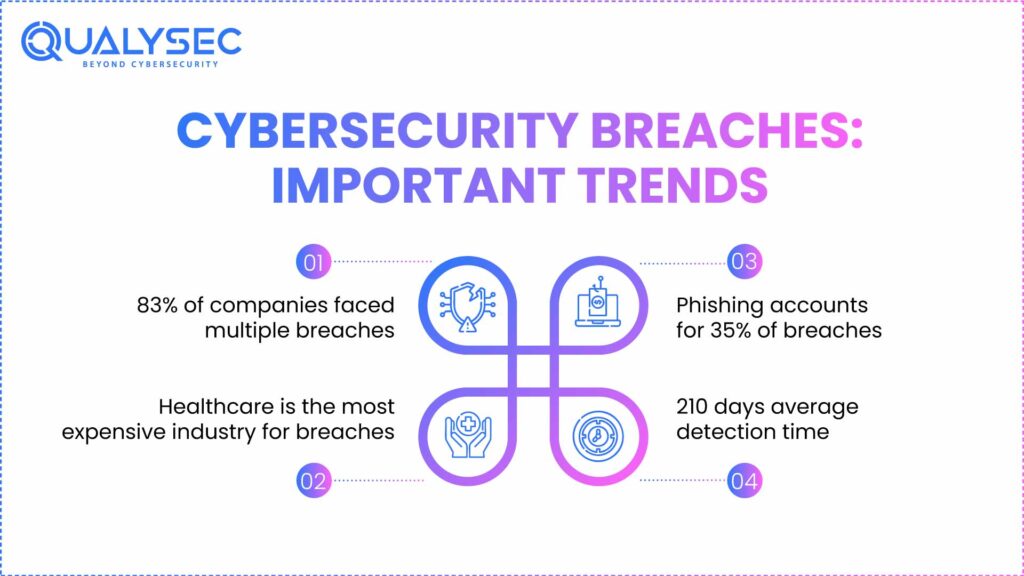
Breaches are not only rising in number in 2025 but also in seriousness. The scope of damage has reached beyond financial costs to include regulatory inspections and reputational damage. Many hits on companies spanning several sectors prove that once attackers discover a flaw, they seldom stop after the first try.
The trends emphasize how cybersecurity breaches now last longer and cost more to fix. Companies are being compelled to make security their main survival plan rather than a technological advancement because financial information, patient records, and intellectual property are at risk. These figures show that no industry is immune and that only forward lies in aggressive defense.
i) 83% of companies faced multiple breaches: According to the IBM report, 83% of businesses suffered from several breaches. (IBM Report) shows that recurring violations are now the standard. Attackers come back to known vulnerabilities until they are effectively patched. This loop makes routine audits and patch management essential.
ii) Healthcare is the most expensive industry for breaches: The costliest sector for violations is healthcare—with an average of $11 million per incident (HIPAA Journal). One of the most often attacked sectors is healthcare. For fraud, patient information has long-term worth; hence, it is a valuable asset for hackers.
iii) Phishing accounts for 35% of breaches: Phishing causes 35% of breaches. Phishing persists even after security awareness training. Attackers gain admission and extract credentials by means of human urgency and interest. To lessen exposure, simulated phishing exercises are still absolutely necessary.
iv) 210 days average detection time: 210 days. Businesses take almost seven months to identify and contain a breach. Attackers can covertly remove large amounts of data using this window; thus, early warning systems are crucial.
If you’re unsure how long attackers might linger in your systems, invest in continuous monitoring and penetration testing before it’s too late!
Case Illustration: Healthcare Violation 2025
A sophisticated ransomware attack crippled a global healthcare network in 2025, exposing more than 20 million patient records. These records included social security numbers, insurance information, and medical histories. For patients, this was an infringement of trust and privacy, not only a data loss.
The financial consequences were astounding. Including ransom demands, penalties, and IT restoration, recovery expenses totaled more than $2 billion. For smaller companies, such an effect would spell total financial disaster. The strain on resources, even for a large network, is serious.
Equally damaging was the harm to reputation. Many patients looked for other options because they no longer believed the provider would safeguard their information. Trust is essential in healthcare. Decades can pass once broken before it can be rebuilt.
This 2025 healthcare breach demonstrates that cybersecurity is as vital as hiring personnel or purchasing medical equipment. Leading universities risk losing everything without robust defenses.
Computer Security Statistics: The Individual Risk
Cybersecurity threats target people more and more, not corporate boundaries. Users now hold a major role in the more extensive threat landscape as attackers turn their attention to personal devices and online behavior. The personal risk is increasing from spyware-infected phones to stolen identities.
According to the data, many people expose themselves without realizing it. Simple errors like password reuse across accounts or clicking dangerous links offer attackers a straightforward entry point. Because professional and personal devices are frequently linked, one compromised laptop or phone might also act as a portal into corporate networks.
- 1 in 5 people are victims of identity theft: (Identity Theft Resource Center) reports a steep increase. Opening bogus accounts or engaging in financial crimes helps attackers profit from stolen identities.
- 60% of online users click malicious links: 60% of online users click dangerous links; social engineering operations depend on urgency and deceit. Malware installs silently once clicked and impairs devices.
- 50%+ reuse passwords across accounts: Across accounts, users reuse 50% or more of their passwords. Password reuse makes credential-stuffing attacks possible. One leaked password exacerbates damage by opening several sites.
- Personal devices are spyware targets: Personal gadgets, including smartphones, laptops, and IoT devices, are frequently targeted by spyware. Spyware lets hackers track microphones, cameras, and keystrokes.
Cyberattacks Affect Most Businesses
Though all industries have some level of risk, particular sectors are prime targets because of the sensitivity of the data they contain. Attackers carefully select their targets, picking those least able to cope with interruption or loss of income.
Healthcare, financial, and manufacturing companies feel heavy knocks in 2025. Every industry has particular weaknesses that attackers skillfully use. From shutting down industrial systems to stealing credit card information, the expense of weak defenses is now counted in the billions.
Healthcare: Healthcare on the dark web; patient data is invaluable. Because hospitals cannot tolerate downtime, they are easily ransom targets.
Financial Services: Fintechs and banks are always under phishing and ransom assaults. Attackers view them as high-value targets because they handle money directly.
Education: This year, attacks against institutions of higher learning and schools increased by 20%. Large stores of personal data and ancient systems expose them to vulnerabilities.
Manufacturing: Manufacturing experiences cyber-physical hazards from industrial control systems. Attacks lead to manufacturing stoppages and supply chain disruptions.
Retail and e-commerce: Retail and e-commerce online payment fraud is quickly increasing. Attackers use weak checkout systems to take credit card information.
Discover the 2025 Small Business Cyber Attack Statistics and safeguard your business from potential threats today!
Emerging Cybersecurity Stats for 2025
The threat environment is always changing; 2025 is seeing fresh attack vectors become prevalent. Never before have attackers embraced technologies such as artificial intelligence, taken advantage of cloud settings, and weaponized zero-day defects at the scale they are.
These new statistics show that companies cannot depend solely on previous approaches. Old defenses are useless, and security expenditure without a specific strategy is not enough. Organizations must rethink their investment approach and location to stay ahead of shifting hazards.
- 45% rise in AI-powered attacks: Researchers have observed a 45 percent increase in attacks powered by artificial intelligence. Hackers use artificial intelligence to design customized phishing attacks, develop adaptive malware, and avoid conventional protections nowadays.
- 25% of breaches caused by cloud misconfigurations: Cloud misconfigurations cause 25% of breaches. Small configuration mistakes expose large datasets as businesses race to adopt the cloud.
- Zero-day vulnerabilities have doubled since 2023: Since 2023, zero-day vulnerabilities have multiplied. Attackers take advantage of weaknesses before providers release patches; hence, businesses have limited protection.
- $215 billion in cybersecurity spending: Spending $215 billion on cybersecurity alone will not stop breaches, even in light of all-time high spending, without planning and prioritization.
Read our Cybersecurity Report to protect your business from emerging threats!
Comparing Past and Present: Increase in Cybersecurity
Examining the development of cybercrime over the last several years reveals a sharp and merciless curve. Rising breach expenses have coincided with a ransomware eruption as attackers’ preferred weapon. According to these figures, cybercrime compounds, with each year being more destructive than the last; it does not merely rise.
The trendline shows that companies cannot afford to consider cybersecurity as optional. Attackers are changing quickly; dropping even a little behind might become the next headline. Companies that study these statistics can use them as an early warning system to bolster defenses before it’s too late.
| Year | Average Breach Cost | % of Companies Breached | Ransomware Growth |
| 2022 | $4.24 million | 65% | +25% |
| 2023 | $4.45 million | 68% | +30% |
| 2024 | $4.53 million | 70% | +33% |
| 2025 | $4.67 million | 83% | +37% |
How Businesses Can Use Cybersecurity Statistics
Data only becomes strong when someone uses it. Cybersecurity statistics offer a roadmap for companies to improve security rather than merely warning them. Companies that use this data can develop plans consistent with the challenges they confront.
The first step in the plan of action is comparing risks against industry norms. Leaders may give priority to investment and concentrate on the most important domains by knowing where their company stands. These techniques—training staff, embracing Zero Trust, and safeguarding cloud environments—are survival mechanisms rather than best practices now.
Benchmark risk—Test your defenses in relation to industry benchmarks.
Prioritize investments – Give investments priority. Concentrate financial allocations on phishing, ransomware, and password theft—the main causes of breaches.
Train employees – Training to train personnel provides the most affordable protection since human mistakes account for 80% of violations.
Embrace Zero Trust— until proven, treat every device and user as distrustful.
Harden cloud security – Securing configurations is essential given the growing number of cloud breaches.
How Qualysec Can Help
The growing cybercrime figures confirm what every company already worries about: threats are real, unrelenting, and expanding. One step is understanding the hazards; defending against them, but, calls for tools, knowledge, and tactics. Qualysec enters here.
We assist businesses in spotting flaws before hackers do. Our aim is to expose blind spots before someone takes advantage of them, ranging from red team simulations to penetration testing. Beyond testing, we help with compliance frameworks, including GDPR, HIPAA, and PCI DSS, to make sure your company exceeds requirements rather than merely satisfies them.
Our answers transcend fixed solutions. Through constant monitoring, industry-specific plans, and active consulting, we guarantee businesses are ready to confront future challenges. Qualysec guarantees that you are ready to confront cybersecurity head-on, making it no longer discretionary.
Don’t wait for a breach to test your defenses. Contact Qualysec today and start building resilience!
Conclusion
The cybersecurity statistics of 2025 data show a grim scene: assaults are becoming more regular, costlier, and widespread across every facet of society. Businesses that disregard these figures are playing with their data, clients, and reputations.
Forward-looking businesses see these figures as a playbook. They protect their cloud infrastructure, use Zero Trust, educate staff, and invest in prevention. With correct planning, companies can not only live but also flourish in the face of growing challenges.
Cybercrime is accelerating, but preparation makes the difference. Contact Qualysec today and take the first step toward stronger protection!
FAQs
1. What are the latest cybersecurity statistics for 2025?
Experts expect cybercrime damage worldwide to top $10.5 trillion. Up 37% from last year; ransomware affects 83% of businesses that report having several breaches.
2. Why are cybersecurity statistics important for businesses?
They identify actual dangers, show which assault techniques are increasing, and assist businesses in ranking defenses where they are most needed.
3. What industries are most affected?
The sensitive and high-value data they handle expose healthcare, finance, education, manufacturing, and retail to the greatest hazards.
4. How have attacks changed over the years?
While ransomware rose 37% in one year, breach expenses increased from $4.24 million in 2022 to $4.67 million in 2023.
5. What threats are most common today?
Phishing, ransomware, zero-day vulnerabilities, and cloud misconfigurations are among the most frequent dangers.














































































































0 Comments