








The digital economy of India has grown rapidly recently, but with expansion comes increased risk. Among the top five nations struck by cyberattacks in 2024 was India, whose average cost of a single data breach was over ₹17.5 crore. IBM’s Cost of a Data Breach Report These are not only economic losses. A breach causes consumer mistrust, operational disturbance, government penalties, and occasionally unrecoverable brand damage.
This has changed security compliance for Indian businesses from something to simply a check. Whether you handle healthcare records, banking information, or e-commerce transactions, regulators want proof your systems can survive actual cyberattacks. This is when penetration testing is really useful since it provides actual proof of your defenses rather than theoretical documentation.
Here we will cover what security compliance actually means in the Indian context, why penetration testing has evolved into a compliance must, and what laws. And frameworks ask how your company could remain one step ahead. Read on if you want to go above bare minimum compliance and create actual client trust.
If you want to explore our in-depth breakdown of the Digital Personal Data Protection Act, check Qualysec’s blog on DPDP compliance!
What is Security Compliance in India?
The act of matching data procedures, IT systems, and business activities with the regulations and standards set by authorities is known as security compliance. Because it covers several sectors and legislation, this terrain is difficult in India.
- Information security compliance under ISO 27001: Many Indian companies adopt ISO 27001 compliance in information security worldwide. Companies need to implement regular risk management, audits, and data security systems.
- Financial compliance according to RBI rules: Banks, NBFCs, and fintech businesses have to follow strict RBI regulations, including cybersecurity frameworks covering penetration testing, incident reporting, and resilience planning, which helps in financial compliance.
- Data privacy compliance under DPDP Act (2023): Under the Digital Personal Data Protection Act (2023), India’s most comprehensive privacy law to date, data privacy compliance is governed. It demands businesses use reasonable security measures, hence precisely carrying out activities such as penetration testing to demonstrate care.
- Sector-specific regulations: Under IRDAI (Insurance Regulatory and Development Authority of India), healthcare, telecom, and insurance, among other industries, have their own frameworks. CERT-In (Computer Emergency Response Team of India).
Businesses are not just abiding by regulations when they use these frameworks. In a more digital India, they are developing resilience and protecting consumer trust.
Why Penetration Testing Counts Toward Compliance
Many businesses incorrectly believe compliance is satisfied simply by a firewall, antivirus programs, or intrusion detection systems deployed. Although these resources are essential, officials would like to see proof of resilience against actual cyberattacks. That is exactly what penetration testing is intended to do.
A controlled, simulated cyberattack on your programs, networks, or systems, penetration testing (or pen testing) goes beyond just listing vulnerabilities; it tries to exploit them. the manner hackers would behave; regulators view it as crucial because:
- It confirms that security measures really function: Compliance systems need more than just checklists. Pen tests show if attackers are truly protected against firewalls, encryption, and access limitations.
- It shows proactive compliance: Through regular penetration testing, companies show to auditors and regulators that they are aggressively searching for problems and fixing them rather than expecting a breach.
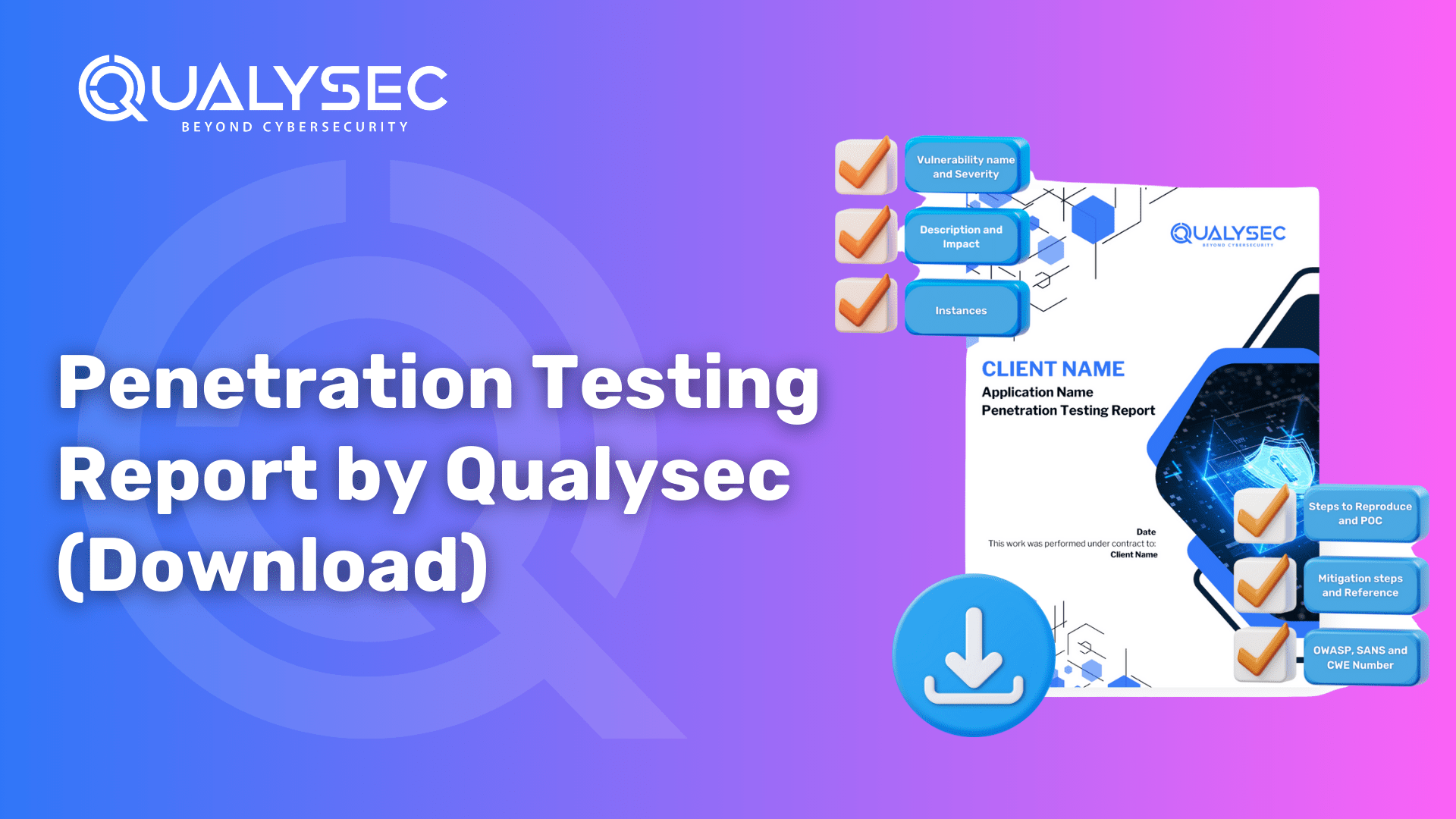
- It provides important documentation: Reports from penetration testing in compliance audits or investigations offer strong proof that due diligence was done.
Security compliance is unfinished without penetration testing. Although you might appear compliant on paper, you fall when attackers strike.
Check our blog on Vulnerability Assessment vs. Pen Testing to understand why pen testing goes beyond automated scans!
Security Compliance Frameworks in India That Require Penetration Testing
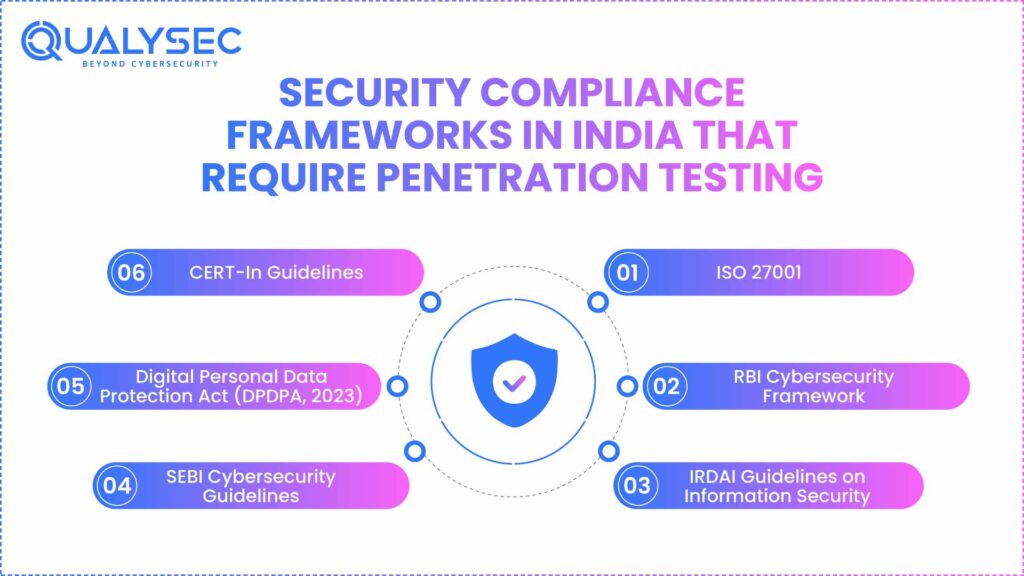
In India, penetration testing is no longer discretionary. Several authorities and systems have either required it directly or made it unavoidable as part of a more general process. security requirements. Here is how several compliance systems approach it:
1. ISO 27001
Organizations must conduct regular vulnerability assessments and penetration tests in order to satisfy this international criterion for information security management. The goal is to detect vulnerabilities before the attackers do. Since ISO 27001 covers all industries, companies from healthcare to information technology use penetration testing as part of their continuous risk management and certification initiative.
2. RBI Cybersecurity Framework
Penetration testing is mandated by the Reserve Bank of India for financial organizations, NBFCs, and payment service providers. Resilience of these entities’ systems against cyberattacks requires regular testing. RBI might punish, limit operations, or even take away permissions from financial firms that fail to meet testing criteria. Non-compliance is severe.
3. IRDAI Guidelines on Information Security
Under investigation as well are insurance providers. Insurers must undertake both vulnerability assessments and penetration testing under the Indian Insurance Regulatory and Development Authority (IRDAI). More especially, test results must be recorded and sent to the regulator at regular periods, therefore transforming pen testing from just a best practice into a compliance checkpoint.
4. SEBI Cybersecurity Guidelines
For participants in the capital market, the Securities and Exchange Board of India (SEBI) imposes stringent requirements. To protect their trading infrastructure, brokers, trading systems, and stock exchanges need to carry out penetration testing. Because financial transactions are so valuable and sensitive, SEBI views frequent testing as a barrier against systematic risks.
5. Digital Personal Data Protection Act (DPDPA, 2023)
Though it does not exactly use the term “penetration testing,” the law calls on companies dealing with personal information to have “reasonable security measures.” In reality, authorities and auditors regard penetration testing as the most efficient approach to show that those protections are in place. For businesses gathering or processing client data, pen testing is increasingly becoming the default compliance strategy.
6. CERT-In Guidelines
The Indian Computer Emergency Response Team (CERT-In) gives guidelines for important infrastructure and digital service providers. These ideas strongly advise penetration testing to uncover faults in government, telecommunications, and IT infrastructure. Presented as a recommendation, it acts like an expectation in many areas—particularly when national security is involved.
Penetration testing has become a “must-have” rather than just a “good-to-have” across banking, insurance, capital markets, and even general businesses handling personal data. It shows authorities that a company is proactively protecting its systems and client data, therefore serving as solid evidence of adherence.
Pros and Cons of Penetration Testing for Compliance
Pros
- Meets compliance requirements: Regular penetration testing helps businesses to clearly prove compliance and so circumvent legal penalties.
- Develops consumer confidence: Organizations that visibly prioritize Indian data protection laws are more likely to be engaged with by their clients. One good trust signal might be a penetration testing certificate or report.
- Reduces breach costs: Early detection and correction of flaws helps to avoid financial and reputational harm brought on by breaches, hence lowering breach expenditures.
- Strengthens overall security posture: Beyond conformance, penetration testing helps companies strengthen their general security posture by enhancing their capacity for resilience over applications, networks, and cloud infrastructure.
Cons
- Cost Aspects: Pen testing calls for knowledgeable specialists and tools that might be more costly than basic vulnerability scans. The expense, though, is much less than that of a breach.
- Temporary disruption: With appropriate planning, testing may need downtime or produce system stress, but disruptions may be reduced.
- Constant dedication: One-time tests are not adequate. Both attackers and regulators anticipate companies to test on a regular basis.
Penetration Testing vs. Vulnerability Scanning
Usually, companies mistake penetration testing for vulnerability scanning, yet they are not the same.
- Purpose: Automatic detection of known defects by vulnerability scanning. Penetration testing tries to take advantage of those defects by means of real-world attack simulations.
- Depth: While pen testing examines how flaws might be strung together for greater exploitation, scans offer surface-level observations.
- Output: The scanning produces a weak list. Pen testing offers thorough exploit reports, business influence analysis, and repair advice.
- Compliance Value: Just scanning is not adequate. Regulators clearly see penetration testing as an obedience exercise.
- Frequency: While penetration tests are usually annual, semi-annual, or conducted after significant system modifications, scans are frequently weekly or monthly.
Regulators want proof of penetration testing rather than just scan reports for compliance.
Talk to our experts and discover how Qualysec can strengthen your security compliance!















































































































































































































































































































































0 Comments