







In the current online environment, cybersecurity for small business is no longer an alternative. Since 2023, 73% of small and medium-sized businesses have faced data breaches or cyberattacks; securing your company’s digital resources is key to survival. Small businesses in the UK face unique challenges when it comes to cybersecurity solutions due to a lack of resources and expertise compared to larger firms.
The UK’s small firms have enormous opportunities due to the digital transformation. Nevertheless, it has subjected them to advanced cyber threats. The most common mistake that many business owners make is assuming that cybercriminals do not target large corporations. This myth exposes small businesses to attacks that have the potential to cost them financially, damage their reputation, and even lead to the closure of their business.
Data security for small businesses should be based on a comprehensive solution that incorporates technologies, employee education, and a strategic plan. Knowledge of the threat and the ensuing security measures may be the difference between a business’s success and downfall.
Why Are UK Small Businesses Prime Targets for Cyber Threats?
Small businesses often present attractive targets for cybercriminals due to several factors. UK small businesses often lack dedicated teams of IT security experts, making them easier targets for cyberattacks. The problem of cyber threats to small businesses is constantly evolving, and attackers are particularly focused on companies with weaker security measures.
The notion that small businesses lack valuable data is flawed. Small companies often store customer data, financial information, and intellectual property that are of interest to criminals. Additionally, businesses often serve as a launchpad for larger companies in supply chains.
Common Vulnerabilities in Small Business Operations
UK small businesses face several common security weaknesses:
- Outdated software and systems that lack current security patches
- Weak password policies that make accounts easy to compromise
- Limited employee training on recognizing security threats
- Inadequate backup systems that leave data vulnerable to ransomware
- Unsecured remote access that creates entry points for attackers
- Third-party vendor risks that extend the attack surface
Remote working has also increased the complexity of security. There are other vulnerabilities because employees using business systems through home networks, personal devices, and public Wi-Fi networks can make them vulnerable, and this should be carefully managed.
IT security for small businesses must address a wide range of risk factors using a layered security strategy. This involves the deployment of several security controls that work in tandem to defend against different attack vectors.
Recommended: 52 Small Business Cyber Attack Statistics for 2025
Essential Cybersecurity Measures for UK Small Businesses
Essential Cybersecurity Measures for UK Small Businesses
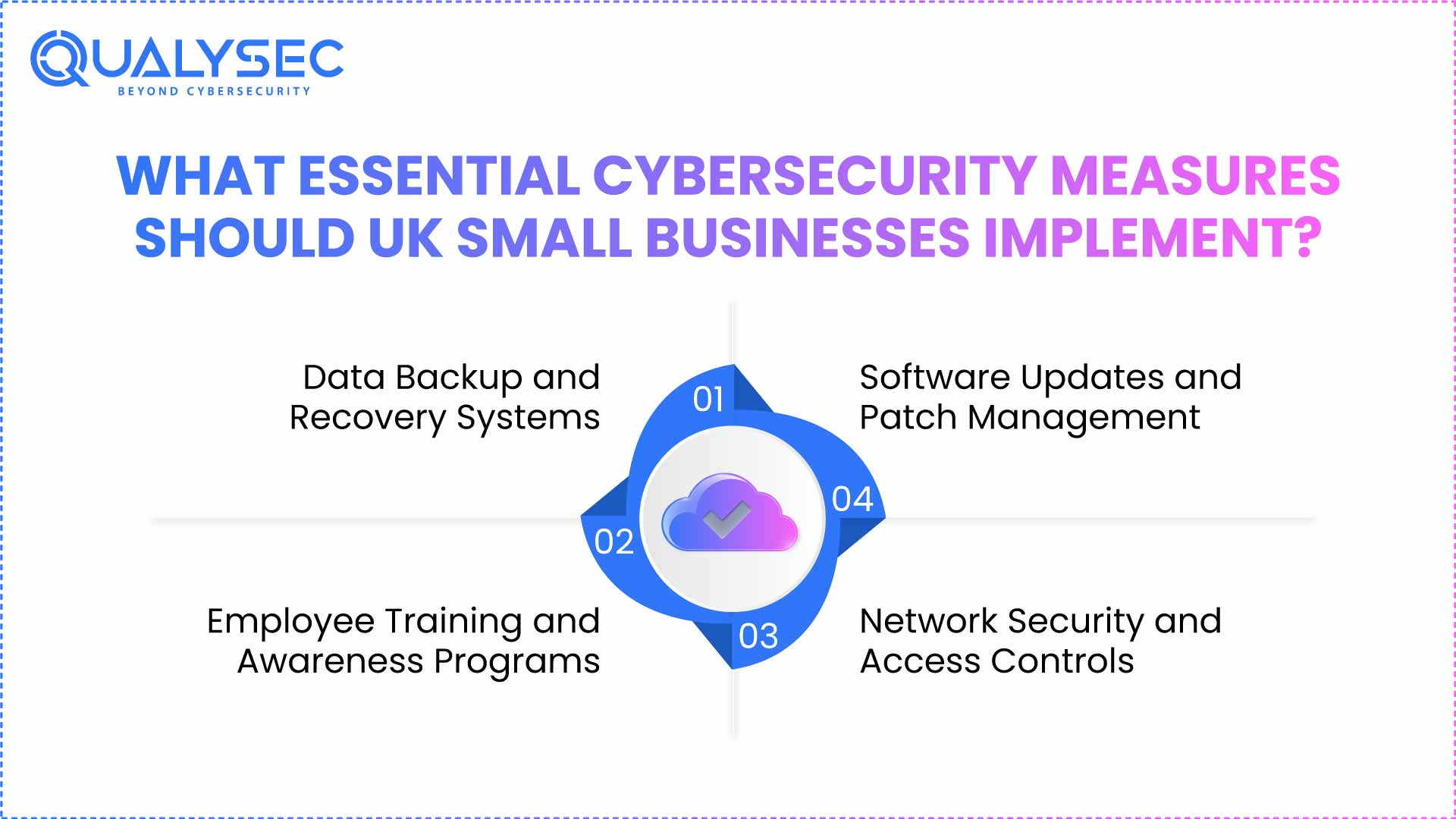
Proper cybersecurity for businesses means implementing basic security measures that provide holistic protection. These are the foundation of a solid security posture that can effectively mitigate most typical attacks.
Data Backup and Recovery Systems
Backing up data regularly is the final solution to ransomware and data loss cases. Small businesses in the UK must utilize automated backup systems that store copies in both local systems and secure clouds. The gold standard is the 3-2-1 backup rule, which recommends having three copies of valuable data stored on two dissimilar types of media and keeping one of the copies off-site.
Backup systems should be tested on an ongoing basis to ensure they are available when needed. It is only after an incident has affected many businesses that they find that their backups are corrupted or incomplete.
Read Also: What is Cloud Data Security? Key Benefits and Top Solutions

Employee Training and Awareness Programs
A major proportion of the security breaches is a result of human error. Extensive security awareness training can help employees recognize and respond to threats. Training should cover:
- Phishing email identification and reporting procedures
- Password security best practices and multi-factor authentication
- Social engineering tactics and how to verify requests
- Safe internet browsing and download practices
- Mobile device security for business use
- Incident reporting procedures and escalation paths
Security awareness is regularly updated through ongoing training. Simulated phishing exercises and other interactive training techniques will provide a realistic experience in detecting actual threats.
Network Security and Access Controls
The protection of network infrastructure helps prevent unauthorized access to business systems and information. Firewalls, intrusion detection systems, and network monitoring tools should be considered as cybersecurity solutions for small businesses.
| Security Control | Purpose | Implementation |
| Firewall | Block unauthorized network traffic | Hardware/software solutions |
| VPN | Secure remote access | Cloud-based or on-premise |
| Wi-Fi Security | Protect wireless networks | WPA3 encryption, guest networks |
| Access Controls | Limit user permissions | Role-based access systems |
| Network Monitoring | Detect suspicious activity | Automated monitoring tools |
Multi-factor authentication is a crucial verification method for passwords. The technology can go a long way in mitigating the risk of account compromise even when the passwords are stolen or guessed.
Read also: Network Security Testing: Techniques, Tools, and Benefits
Software Updates and Patch Management
Maintaining software ensures that it is up to date with vulnerabilities that hackers often use. Automation of update systems reduces the load on internal administration while ensuring the timely application of important security patches.
Software audits are conducted regularly to identify unused applications and remove them, thereby minimizing the attack surface. With an inventory of all software, it is easy to keep track of any update needs and ensure license compliance.
Contact Qualysec for a comprehensive security assessment to identify vulnerabilities in your current systems and develop an improvement plan.

Cybersecurity for Small Business: Choosing the Right Solution
When selecting the right cybersecurity for businesses, it is essential to consider both the business’s needs, the available budget, and its growth strategies. The solutions available to UK small businesses should be assessed based on their effectiveness, ease of use, and scalability.
Understanding Different Types of Security Solutions
Security software capabilities range from basic antivirus services to comprehensive managed security services. What businesses need to know are the differences:
Endpoint Protection: Protects individual devices from malware, ransomware, and other threats. The technologies employed by modern solutions identify threats that have never been identified before through the use of artificial intelligence and the examination of behavior.
Email Security: Filters malicious email, prevents phishing attacks, and secures communications. State-of-the-art solutions offer integration of real-time threat intelligence and user training.
Network Security: Monitors network traffic, identifies intrusions, and prevents unauthorized access. The solutions include basic firewalls and advanced security information and event management (SIEM) systems.
Cloud Security: Protects data and applications in cloud environments. This encompasses access controls, encryption, and cloud-specific monitoring services.
Strengthen your business with the right security solutions. Get a tailored cybersecurity assessment today!
Managed Security Services vs. In-House Solutions
UK small businesses face a crossroads in deciding whether to address security issues in-house or outsource to professional services. Every method has its own merits and factors.
Managed Security Services provide access to specialized expertise and high-tech tools without the costs associated with maintaining an internal security team. These services include 24/7 monitoring, incident response, and routine security assessments.
In-house solutions are more controllable and customized, but they demand a great investment in personnel, training, and technology. This strategy is most effective when the business has robust IT capabilities and resources.
Most smaller companies can leverage hybrid options, which combine in-house expertise and external experience to deliver specialized services, such as penetration testing and incident response.
Book an appointment to discuss the best strategy that fits your business needs and budget.
Cost Considerations and ROI
Data security for small businesses represents an investment in business continuity and customer trust. While cyber security solutions require upfront costs, the expense of recovering from a successful attack typically far exceeds the costs of prevention.
Consider both direct and indirect costs when evaluating security investments:
- Direct costs include software licenses, hardware, and professional services
- Indirect costs include employee time, training, and ongoing maintenance
- Risk reduction value quantifies the potential losses prevented by security measures
- Compliance benefits may reduce insurance premiums and meet regulatory requirements
Discover cost-effective cybersecurity solutions for small business – see pricing details.
Why Choose Qualysec as Your Best Cybersecurity Partner in the UK?
Qualysec is the leading provider of cyber security services, offering the best possible option for fully securing cybersecurity for small businesses in the UK. Qualysec focuses on providing custom-made cybersecurity solutions for small businesses that respond to the specific issues affecting UK businesses.
Qualysec’s approach to IT security for small business combines cutting-edge technology with deep industry expertise. Their team recognizes that small business owners in need of security require solutions that are both secure and affordable, given the budget and resources available to them.
Comprehensive Security Services
Qualysec offers a complete range of security services designed specifically for small business needs:
Penetration Testing: Qualysec conducts extensive security evaluations to detect vulnerabilities that attackers are unable to exploit. Their approach to penetration testing aligns with international best practices and provides practical advice on how to enhance the security posture.
Vulnerability Assessments: Regular vulnerability scanning helps maintain awareness of potential security weaknesses across all business systems. Qualysec’s assessments cover networks, applications, and cloud environments.
Security Consulting: This involves providing skilled advice to businesses on how to develop and implement effective security measures. Qualysec consultants collaborate with business leaders to ensure that security investments align with business priorities.
Compliance Support: Small businesses often struggle to navigate complex governance requirements. Qualysec guides businesses on GDPR and ISO 27001, among other standards that affect the UK.
Incident Response: Security Incidents When security events are involved, responding promptly will reduce impact and recovery time. The incident response team of Qualysec offers 24/7 services to enable businesses to respond adequately to threats.
Why Qualysec Leads in Small Business Cybersecurity
The needs of small businesses are emphasized in Qualysec, which distinguishes them from generic security providers. They recognize that cyber security for business must be realistic, cost-effective, and scalable. Their solutions are tailored to your business, so that as your business expands, you remain secure.
The fact that the company has a presence in the UK implies that it is aware of local regulatory requirements and is conducting business. This local knowledge provides that security recommendations are in line with the legal and industry requirements of the UK.
Transparent pricing and flexible service plans at Qualysec enable small businesses to achieve enterprise-level security. They have both project-based and continuous support offerings that can suit various business models and budgets.
Make a free consultation with Qualysec now to discuss your specific security needs and learn how their expertise can protect your business. Visit Qualysec’s resources page to access additional security guides and best practices.
Conclusion
Cybersecurity for small business should be a proactive initiative that incorporates technologies, training, and professional-level guidance. The dynamic threat environment is a situation that demands that small companies take security seriously and ensure they are generally protected.
Successful cyber security companies for small businesses address multiple risk factors through layered security approaches. This includes endpoint protection, network protection, staff education, and a powerful recovery mechanism. The security measures will be updated to reflect changes in new threats through periodic reviews and revisions.
Small businesses in the UK that invest in the correct IT security for small businesses protect not only the immediate functioning of the company but also its long-term sustainability. Prevention costs are always cheaper than the recovery costs of successful attacks.
The bottom line of data security for small businesses is preserving customer trust, maintaining a strong business reputation, and ensuring business continuity. Firms that prioritize security establish competitive advantages by enhancing customer trust and ensuring business continuity.
The most important tool for effective cybersecurity in businesses is collaboration with highly qualified partners who are familiar with the challenges of small businesses and have the opportunity to offer tailored solutions. Professional security providers are those with the skills and resources that most small businesses cannot sustain.
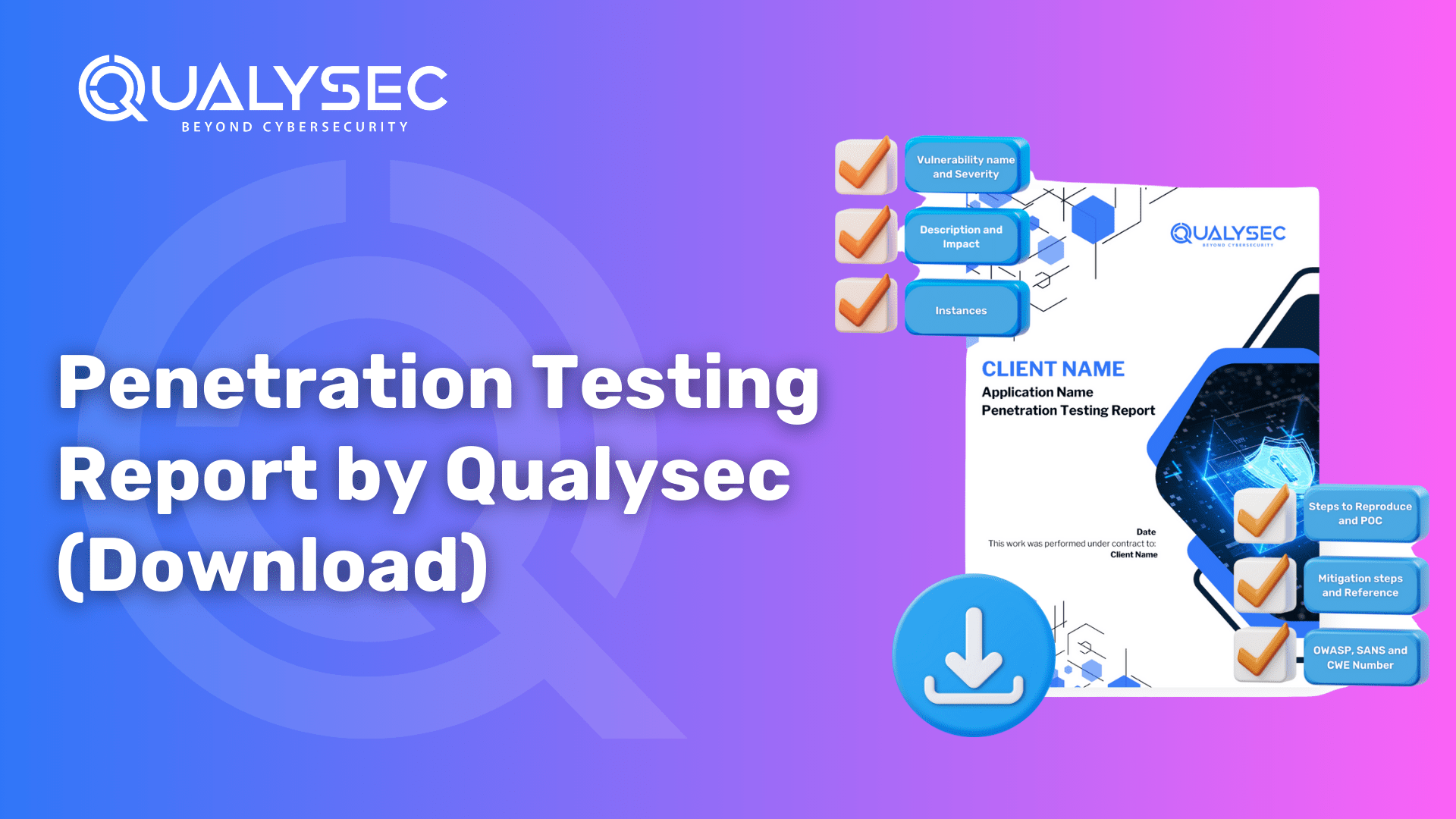
Download a sample penetration testing report and comprehensive security resources to start strengthening your business’s security posture today.





























































0 Comments