








Did you know that one-fifth of all the reported cyber attacks in India are towards financial institutions? As per the Economic Survey 2024-25, banks are a prime target, emphasizing the increasing importance of cybersecurity in banking sector.
Due to the evolving threats and increase in frequency, the Reserve Bank of India (RBI) has tightened the regulatory standards for banking and cybersecurity. Banks in India must comply with the RBI framework for overall security and protection of sensitive data.
In this environment, cyber security in banking is not just a technical aspect to maintain. It is directly involved with customer trust, meeting compliance standards, and maintaining the financial stability of the country.
In this blog, we delve into the details of cybersecurity in the banking sector, its necessity, the common threats banks face, and the solutions that can help them.
What is cybersecurity in banking sector?
Cybersecurity in banking sector refers to the different processes, tools, and security measures that protect these banks from malicious cyber attacks.
Here’s what an accurate cybersecurity strategy for banks covers:
- Infrastructure: One of the core pillars that needs immediate protection is the core banking systems, servers, and the networks.
- Payment System: The next step involves ensuring the safety and security of UPI, cards, SWIFT channels, and IMPS. Fraudulent activities in any of these areas can cause devastating consequences.
- Application Security: In this part, the online banking platforms, apps, and APIs are tested to see if they can endure malicious attacks.
- Data Privacy and Security: Testing security protocols for sensitive information. It is also important to assess people who have access controls.
- Compliance Agreement: Banks must meet RBI guidelines in India. Other global frameworks include PCI DSS, ISO 27001, etc.
- Response Plan: Knowing the fixes isn’t enough; there must be a recovery plan for banking and cybersecurity ready in case an attack occurs.
Read related article on Cybersecurity for Financial Services
Why do banks need cybersecurity?
The financial backbone of the country lies in the hands of banks. That is why these financial institutions have extra responsibility when it comes to maintaining the overall security.
Here is why cybersecurity has become non-negotiable for the banking sector:
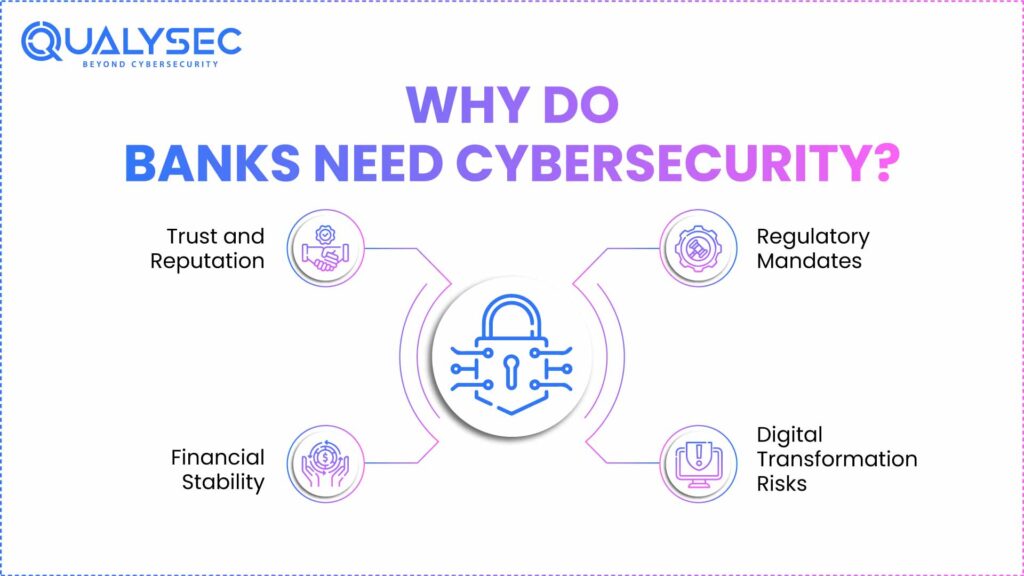
1. Trust and Reputation
Banking is built on public trust. A single breach can undermine decades of credibility. Customers expect their money and personal data to be secure in CRM systems in banking – once that expectation is broken, recovery is slow and expensive.
2. Financial Stability
The digital payments infrastructure of India is vast, with billions of transactions being done every month. Slight attacks on any of these systems can have a dangerous impact on the economy. Cybersecurity is a must for these platforms.
3. Regulatory Mandates
The RBI, or the Reserve Bank of India, has tightened regulations owing to increasing cyber attacks. Frameworks such as the Cyber Security Framework for Banks of 2016 and the Master Direction on IT Governance, Risk, Controls, and Assurance of 2023 are notable. Not complying with these frameworks can result in heavy penalties and more restrictions.
4. Digital Transformation Risks
With increasing mobile usage, banks need to focus on robust security for APIs, mobile apps, and any third-party services used. The increase in attack surface warrants the need to implement stronger it security in banking sector.
Explore more about on Cybersecurity in Fintech
Common cybersecurity threats for the banking sector
High-value and sensitive data coupled with financial assets make banks a prime target for cyber attackers.
Take a look at these common Cybersecurity in Banking threats:
- Phishing and AI-Enhanced Scams
Attackers now use AI-driven tools to create realistic phishing emails, voice scams, and Business Email Compromise (BEC) schemes. Indian banks have reported a surge in UPI and IMPS fraud through social engineering. - Ransomware and Malware
Malware targeting ATMs, card systems, and payment gateways has caused significant breaches. The 2016 Indian debit card breach compromised 3.2 million cards through malware injected into payment systems. - Insider Threats and Mule Accounts
Fraud often involves internal collusion. Recent police reports in India uncovered networks of mule accounts used to launder funds with the help of compromised staff. - Denial-of-Service (DoS) Attacks
Attackers constantly target banking portals and mobile apps to obtain sensitive data. They also disrupt customer services and erode enhanced IT trust between customers and banks, highlighting the need for better it security in banking sector.
Explore more about on cybersecurity threats!

Compliance needs to be followed by banks.
In India, cybersecurity in banking is taken very seriously. It is strictly mandated and enforced by regulators.
Here are the key compliance requirements for banks in India:
The RBI Cyber Security Framework for Banks (2016)
- It offers basic guidelines that emphasize continuous monitoring, incident reporting, and regular security audits.
RBI Master Direction on IT Governance, Risk, Controls, and Assurance (2023)
- The main focus is to ensure stronger IT governance, third-party oversight, and structured assurance frameworks.
- Emphasises risk ownership at the board and senior management level.
RBI Directions on Outsourcing of IT Services (2023)
- Addresses vendor and cloud service risks.
- Banks remain accountable even when IT functions are outsourced.
Payment Industry Compliance
- PCI DSS: Mandatory for banks and payment processors handling cardholder data.
- SWIFT CSCF (Customer Security Controls Framework): Required for banks using SWIFT for cross-border transactions.
Global Standards for BFSI
- ISO 27001, SOC 2: For global transactions, ensuring compliance with frameworks like ISO 27001 and SOC 2 is extremely important.
5 cybersecurity solutions for banks
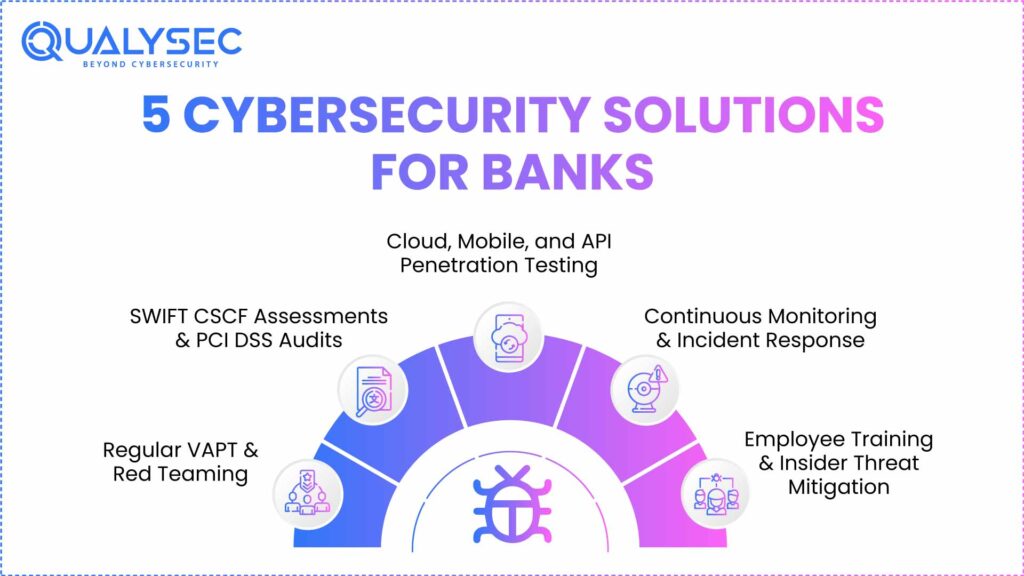
To move beyond compliance checkboxes and truly reduce risk, banks need proactive cybersecurity strategies. Here are five practical Cybersecurity solutions:
1. Regular VAPT & Red Teaming
- Performing pen testing and vulnerability assessment at regular intervals to maintain cyber security in banking.
- Opt for read teaming to simulate real-world attacks. That is the only way to test the strength of the security system.
2. SWIFT CSCF Assessments & PCI DSS Audits
- Conduct SWIFT reviews to ensure there are no fraudulent transfers.
- Check compliance with PCI DSS to maintain card data security and avoid hefty fines.
3. Cloud, Mobile, and API Penetration Testing
- As Indian banks shift core workloads to the cloud and adopt open APIs, security testing must expand to these ecosystems.
- Mobile-first testing is critical given India’s reliance on smartphone banking.
Read more on API Penetration Testing
4. Continuous Monitoring & Incident Response
- Deploy SIEM, threat detection, and fraud-monitoring systems.
- Maintain an updated incident response playbook to handle breaches quickly and minimise impact.
5. Employee Training & Insider Threat Mitigation
- Train staff to recognise phishing attempts, social engineering, and suspicious activity to maintain cyber security in banking.
- Use access controls, monitoring tools, and zero-trust principles to minimise insider misuse.
How Qualysec Helps the Banking Sector
As a leading pen testing service provider, Qualysec offers exceptional security assessments and testing. We ensure deep expertise rather than surface-level scanning.
Our expert team ensures compliance with global interbank security controls. We cover the most common vectors of Cybersecurity in Banking. All our reports are mapped to RBI frameworks, PCI DSS, and ISO 27001 requirements.
We offer proof-of-concept evidence and a detailed remediation plan for our clients. Combining manual techniques with automated scanning helps us provide accurate assessments.
With 1000+ security assessments across 30+ countries, Qualysec has supported BFSI clients in strengthening cybersecurity in banking industry while meeting regulatory requirements.






































































































































































































































0 Comments