









Cybersecurity Risk Mitigation Strategies
Knowing your risks, then deciding how to manage them. This is called risk mitigation. Simply put, prevention is avoiding the opportunity to fail or minimizing the consequences of failure.
Some key strategies:
- Secure password, multi-factor authentication — Prevents hackers even if they crack your password.
- Get routine updates — Portions provider plugs security cracks before hackers…
- Training programs for employees so that they know how to avoid clicking on bad links or opening dangerous files.
- Firewalls and antivirus —Prevent a lot of attacks in advance.
- Backups: Allow you to restore your data if something is deleted or lost.
- Network monitoring — Intelligent alerting with detailed context for action.
Know Also: What Is Ethical Hacking? Pros And Cons of It
Information Security Risk Management – The Real World
Example:
A mid-sized retailer stored card payment data on its computers. When they conducted a cybersecurity risk assessment, they discovered that the payment system was using no encryption. Basically, if hackers were able to break in, they could see the data.
Here’s what they did:
- Encrypted the data so even if the information reaches a third-party, it would just look like scrambled data and not plain text.
- Restricted access, so only the payment team had visibility into this data.
- Taught the team how to protect payment information
- The store nearly eliminated any stolen payment data and heavily increased the credibility of the customers.
Common Challenges Businesses Face
Cybersecurity risk management is difficult for many businesses for the following reasons:
- They have no skilled IT staff.
- They believe they are small enough not to get attacked.
- They worry about the cost.
- They fail to secure their systems after they change them.
With due planning and the right tools and expert help, these problems can be taken care of.
Struggling with these cybersecurity challenges? Let our experts help you identify gaps and build a stronger defense. Schedule a consultant with cybersecurity expert.
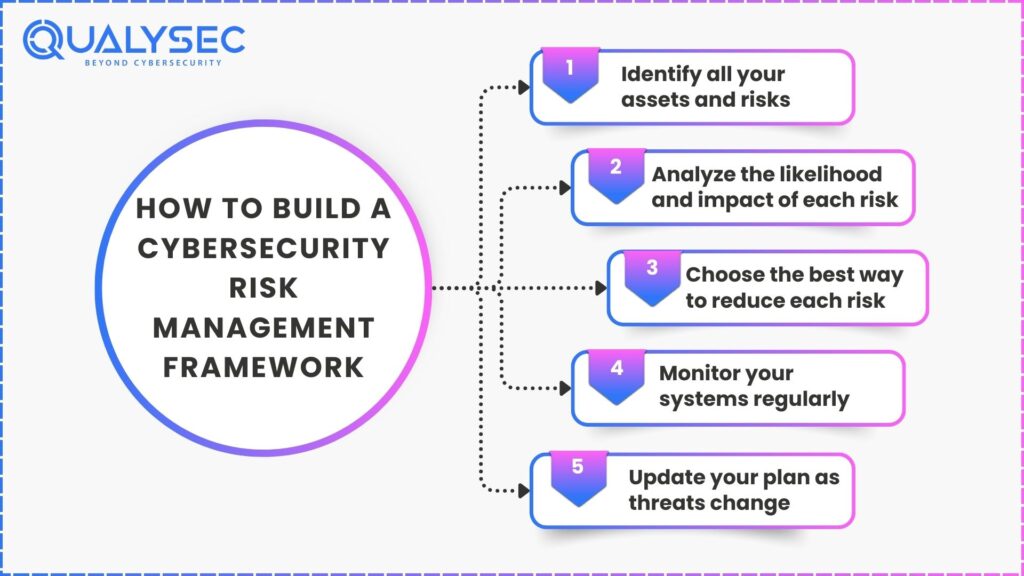
How to Build a Cybersecurity Risk Management Framework
Here’s a simple 5-step framework:
| Step | What to Do |
| 1 | Identify all your assets and risks |
| 2 | Analyze the likelihood and impact of each risk |
| 3 | Choose the best way to reduce each risk |
| 4 | Monitor your systems regularly |
| 5 | Update your plan as threats change |
Following these steps regularly helps you stay ahead of hackers.
Tools That Help in Cybersecurity Risk Management Process
Many tools make risk management easier:
- Firewalls – Block unwanted network traffic.
- Antivirus software – Finds and removes harmful files.
- Vulnerability scanners – Look for weak spots in your systems.
- SIEM tools – Collect and analyze security data.
While some tools cost money, they are much cheaper than recovering from an attack.
Making Risk Management a Routine
Cybersecurity is not an “Install and forget” task. It needs regular attention.
Every month:
- Check your security settings.
- Update all software.
- Retire access lists and separate unauthorized people.
- Test backups.
- Every few months:
- Train employees again.
- Review your risk assessment.
- And change anything in your plan if necessary.
- The sooner you can do this, the better off and safer your business will be.
Read Also: Effective Threat Vulnerability Management for Cybersecurity
Understanding Threats Beyond Hackers
The term “cyber threat” to many people is still a guy in a dark room with a hoodie. But the threats are wide-ranging:
- Human errors — Employee sends the wrong file to the wrong person.
- Lost devices — a few stolen laptops can contain thousands of customer records.
- Bothersome, frustrating, and dangerous: Software bugs — Gas leak holes in programs.
- Act of God — Natural events such as floods, fires, or storms that wreak havoc on servers.
This is one of the many reasons why cybersecurity risk management process is more than a numbers game — or just keeping bad actors out. You are securing your data from the threats that want to rip off your data.
The Hidden Cost of Downtime
Even the smallest amount of time where an attack or system failure stops your business can face thousands in damages. You might lose:
- Sales and income.
- Customer trust.
- Company time wasted on repairing the harm. Concerns grow about PR.
A single cyber incident can take companies months to recover from. Risk management reduces odds by allowing you to react quickly and mitigate the impact.
Don’t let downtime drain your business—discover hidden risks and protect your operations. Contact us!

The Proverbial Droplet Causing Ripple Effect
The most expensive is not always the best to secure your IT system. Less challenging are small changes that can make a big impact, like these:
- Moving from weak passwords to strong passphrases.
- Adding two-factor authentication for accounts.
- Limiting access to sensitive files.
Regularly updating systems.
These are cheap, yet effective countermeasures useful for preventing a myriad of commonly seen attacks.
The Role of Continuous Monitoring
You simply cannot have cybersecurity like health, i.e., a “one check per year” statement. You are looking for the ability to monitor it all and see problems early. Continuous monitoring tools can:
- Notify you if there are any suspicious login attempts
- Have not reported any excessive spikes in network traffic.
- Warn you about outdated software.
- The earlier you detect an issue, the quicker you halt it.
Read also: Cyber Security Penetration Testing For Secure Business
Incident Response: Prepared Before It Hits
Security will never be perfect — there will always be a tiny gap in the defenses. This is why an incident response plan is a must. It is the guide your team will stick to in case of a problem. It should include:
Who to contact.
- How to End the Problem Quickly
- Preservation of evidence for investigation
- A few strategies on when to alert the customer if you have.
- Running this plan every few months makes sure everyone will be able to act as quickly as possible in a dangerous situation.
You may also like to read: Cybersecurity Assessment : Uncover Hidden Threats
Establishing a Security Culture Within Your Business
Sure, technology can build you an endless mountain of automated customer relationship marketing platforms, but people are every bit as important. It is much more difficult to attack a business that has security-aware employees. How do you create this culture?
- Mention cybersecurity at team meetings.
- Incentivizing employees who adhere to proper security conventions.
- Bragging about actual cyber incidents so employees are more aware of the potential risks.
- When everyone participates in security measures, the entire organization is stronger.
- Change your risk plan for when business changes.
That risk profile evolves every time your business changes (e.g., new product, office, cloud provider). As such, this is a good time to always review your risk management plan. Individual efforts that solved the problem previously may now be insufficient.
Combining Human Skills with Technology
Even the best tool will not protect you from all types of dangers, not to mention all. The best approach is a mix:
- Employ technologies such as firewalls and antivirus software with quicker detection.
- Ultimately, trust human expertise to make smarter choices.
- But automated tools can miss patterns or problems that experts recognize.
Strengthen cybersecurity risk management with the perfect blend of expert insight and advanced technology. Talk to our expert.
How Risk Management Leads to Other Benefits in Building Customer Confidence
Two-thirds of consumers are fully aware that there has been a data breach. And they select companies with whom they trust their data. Follow best risk management practices and demonstrate to customers that you are serious about security — do this right, and you will differentiate yourself in the market and earn trust.
The Long-Term View
The future is one for which cybersecurity risk management is needed. Threats will evolve, but a sound framework will keep your business well-positioned to respond. The cost of goods and payroll is a no-brainer, as it will have to be paid either way — although overtime brings the dangers associated with sleep deprivation. The investment in security now will lead to fewer incidents down the road, easier operations, and better brand value overall.
Read also: What Is A Cybersecurity Threat Assessment And How To Manage Risk
How QualySec Can Help
Qualysec works with businesses, ensuring they stay safe from online threats. It is composed of a group of cybersecurity experts. They follow up their tips with a complete walkthrough.
First, they will go through your systems to see where the loopholes and weaknesses are that a hacker might want to exploit. Then they assist you in correcting those issues, whether that is adding encryption, establishing firewalls, or enhancing password guidelines.
Qualysec also understands that people might be the weakest link. This is why they provide training so your employees can recognize shady emails, steer clear of scams, and respond promptly when things do go wrong.
They also do systematic inspections. The nature of cyber threats changes quickly, so QualySec ensures keeping your systems up to date and in compliance with industry standards.
Getting support from QualySec means you are never alone in securing your business. They provide you with the tools, training, and support that you need to make cybersecurity integral to your business-as-usual operations.
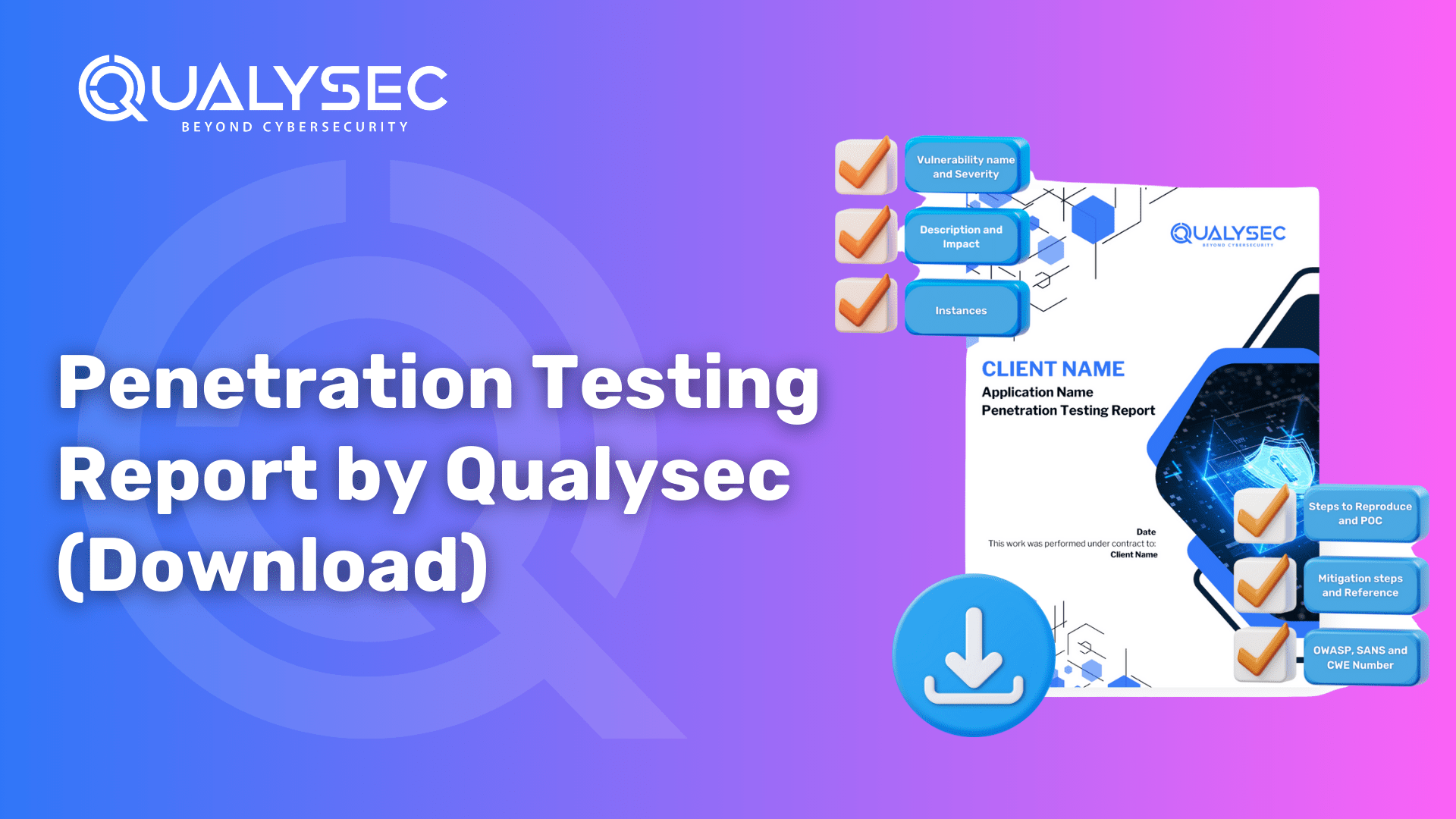
See the difference for yourself. Download a free sample report from QualySec and discover how our security testing delivers clear, actionable results.






























































0 Comments