








In today’s digital-first world, cybersecurity is not only an IT issue. It’s a business issue. However, many organisations mix up risk assessment vs vulnerability assessment. While both are similar, they are also very different.
Understanding the difference allows organisations to better identify threats and make better decisions regarding protecting their data, systems, and people. In this blog, we will look at what each assessment entails, how they work, and where they fit in a solid cybersecurity plan.
What Is Risk Assessment?
Risk Assessment – This is a top level strategy. The process involves identifying your vulnerabilities and threats, assessing the likelihood of these vulnerabilities being exploited and the threat occuring, as well as determining potential harm that could be caused. These threats range from cyber and system threats to third-party threats, to even human error. It aggregates an enterprise perspective that goes beyond technical vulnerabilities to include legal and financial dimensions, regulatory ramifications and operational repercussions. Risk assessments serve to inform decision makes what risks are most critical to their organisation and, in turn, enables them to make risk responses (such as mitigation, acceptance or transference (i.e. cyber insurance).
Worried about unseen vulnerabilities? Go to Qualysec: There are any vulnerabilities on your web application, let us find and fix them first!
What Is Vulnerability Assessment?
The Vulnerability Assessment: more of a techie vulnerability assessment. In simplest of terms, it is a process to scan your systems, networks, and applications looking for known vulnerabilities or weaknesses (e.g. unpatched software, misconfigurations) that an attacker can exploit. A Vulnerability Assessment is often carried out using automated tools, vulnerability scanners and manual testing methodologies. It will automatically prioritize results of the Vulnerability Assessment according to severity for IT teams to take immediate decisions. A VA does not asses BI or the likelihood of exploitation, only points out where you are vulnerable, and it does so fast.
Discover more: Vulnerability Assessment and Penetration Testing (VAPT)
Risk Assessment vs Vulnerability Assessment: Key Differences
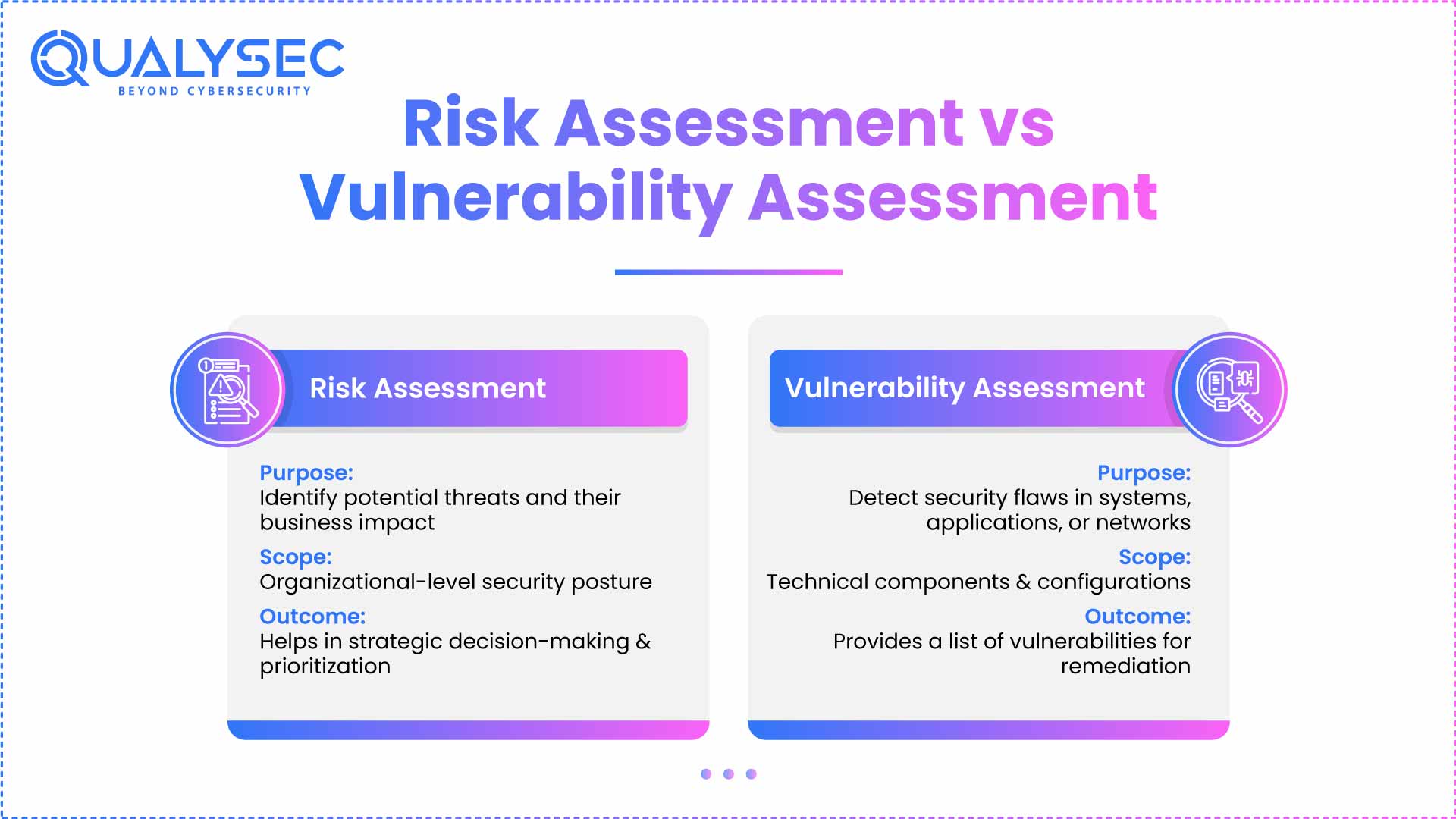
Risk assessment vs vulnerability assessment are frequently mistaken for each other, so often in the cybersecurity world, and they are NOT the same thing. They are related goals, but they each aim to serve a different purpose in protecting your systems. Here are the main differences, how do they help and how this will enhance your security strategy.
| Criteria | Risk Assessment | Vulnerability Assessment |
| Purpose | Identify, assess, and prioritize risks to the organization. | Identify and document security vulnerabilities or technical weaknesses. |
| Scope | Business-wide; encompasses assets, people, policies, third-party vendors, and compliance. | Technical environments, i.e., servers, networks, databases, apps. |
| Focus | Business impact, threat likelihood, and overall risk exposure. | Specific vulnerabilities and organizational concerns. |
| Approach | Strategic and often qualitative or semi-quantitative. | Strategic and often qualitative or semi-quantitative. |
| Tools Used | Risk matrices, interviews, threat modeling, risk scoring frameworks. | Vulnerability scanners, manual tests, CVSS scoring. |
| Frequency | Conducted an annual, bi-annual, or changing at the convenience of the business. | Performed regularly, monthly, quarterly, or continuously. |
| Performed By | Risk managers, compliance officers, and executive leadership teams. | Security analysts, engineers, and IT teams. |
| Outcome | A list of prioritized risks with business context and recommendations. | A report of vulnerabilities found and rated for severity. |
| Decision-Making Level | Executive-level decision on risk treatment plans and budget decisions. | Operational-level fixes, patches, and remediation plans. |
| Relationship to Each Other | Uses data from vulnerability assessment as an input. | It is a part of or input in risk assessment. |
























































































































































































































































































































































































































0 Comments