








SAST vs DAST: Key Differences
The similarities between SAST and DAST end at their aim to identify vulnerabilities in the application. Understanding the difference between static and dynamic application security testing is essential.
Comparison Table: sast vs dast
| Feature | SAST | DAST |
| Testing Stage | During development | During runtime |
| Access to Source Code | Required | Not required |
| Test Environment | Does not need running app | Needs a fully deployed and running app |
| Commonly Found Issues | Code-level flaws, insecure logic | Misconfigurations, runtime behavior, logic bypass |
| False Positives | Higher | Lower |
| Primary Users | Developers, DevSecOps | QA Engineers, Security Teams |
| Compliance Utility | Supports secure SDLC practices | Helps demonstrate attack-surface testing |
When to Use SAST vs DAST
Knowing the difference between SAST and DAST is helpful; there is no doubt about that. However, it is essential to understand when to use each one, as application security starts becoming strategic. Understand that both play distinct roles at different stages of the software development lifecycle.
Use SAST During Development
SAST is best applicable in the early stages of the software development lifecycle (SDLC). It is mainly used during coding, code review, or build phases. By scanning the codebase directly, SAST helps developers identify logic flaws, insecure patterns, etc. It also helps in revealing bad coding practices before the application ever reaches testing or staging.
Use DAST During Staging and Post-Deployment
DAST is the best option when the application is fully deployed, be it in a staging or a production environment. It tests how the app behaves during runtime, mimicking external threats and simulating attack scenarios.
That makes DAST ideal for identifying flaws that don’t exist in the code itself. These flaws generally arise from misconfigurations, broken logic flows, or deployment gaps.
DAST is especially useful just before product releases or after major updates. It helps validate that the application, in its live state, doesn’t expose user data or create exploit paths.
When to Use Both SAST and DAST?
Relying on just one method can cause missing real red flags in application security. Using only SAST may cause you to miss vulnerabilities that appear after the app is deployed, while relying solely on DAST overlooks insecure code. The smartest approach is to use both – strategically placed within your SDLC.
SAST acts as the early warning system, preventing vulnerable code from progressing too far. DAST acts as the late-stage defence, catching anything that slips through or emerges from real-world interactions. Using both ensures that the application is secure from all sides.
Book a free security consultation with Qualysec experts today!
SAST and DAST Tools: What the Industry Uses
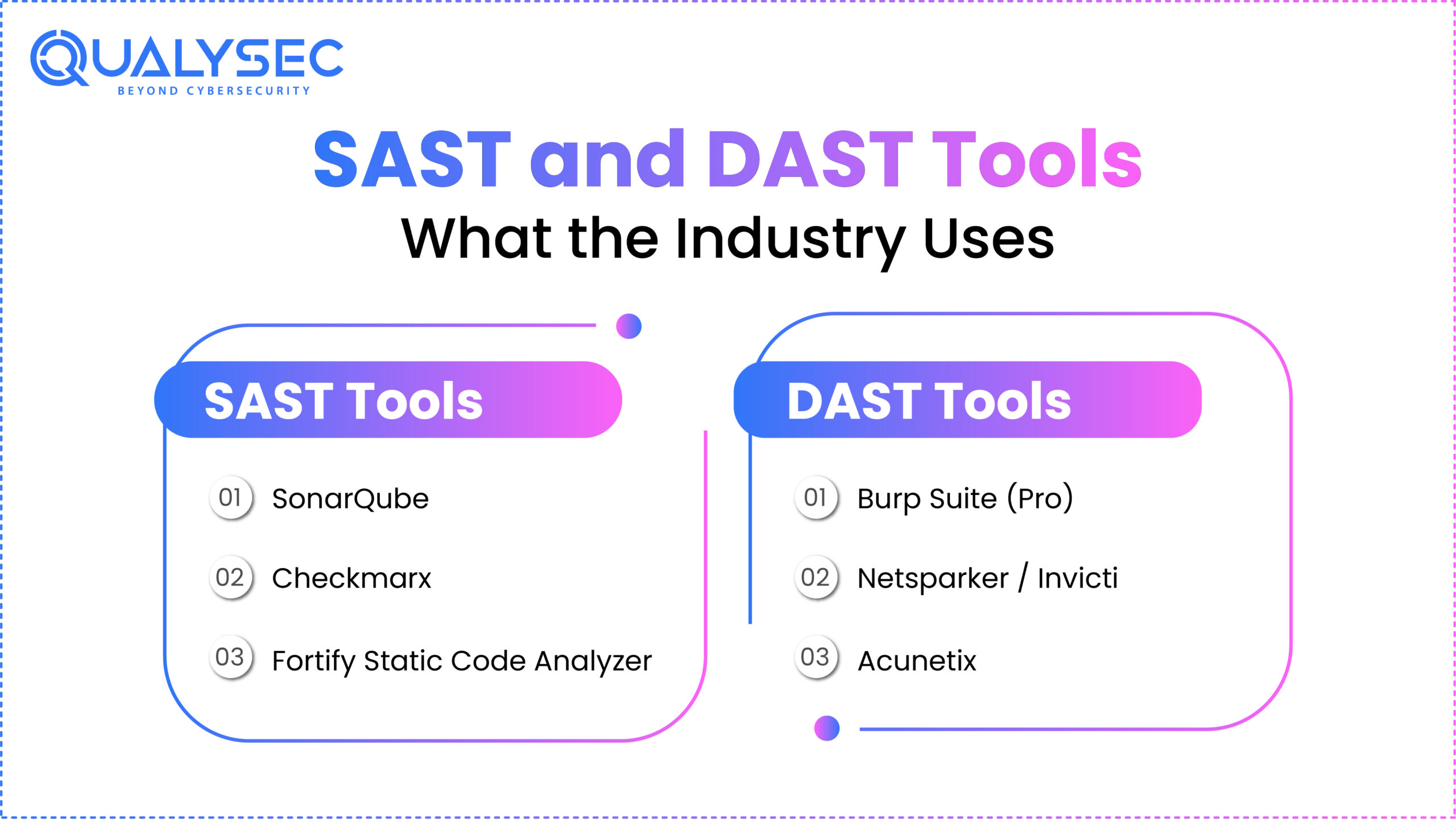
The cybersecurity market is flooded with tools that claim to cover everything from code analysis to live attack simulation. But not all tools are built the same, and choosing the right SAST and DAST tools can make all the difference.
SAST Tools
SAST tools are integrated early in the development process. They typically scan source code, bytecode, or binaries to identify potential vulnerabilities.
Let’s take a look at some of them:
- SonarQube – Perfect for analysing code quality in multiple languages.
- Checkmarx – Offers deep code analysis and customizable rulesets.
- Fortify Static Code Analyzer – If you want comprehensive language support and detailed reporting, this is the ideal tool.
DAST Tools
DAST tools test your running application in real time. They simulate attacks, check responses, and attempt to exploit vulnerabilities from an outsider’s perspective.
Take a look at these DAST tools:
- Burp Suite (Pro) – An industry standard for manual and semi-automated web application testing.
- Netsparker / Invicti – Offers automation with accurate scanning and minimal false positives.
- Acunetix – Known for its fast scanning engine and ease of integration into CI/CD workflows.
Discover How To Conduct DAST Scanning Automation?
Conclusion
SAST and DAST aren’t competing testing methods – in fact, these are complementary once you get a better understanding of the functionalities. In today’s landscape of growing cyber risks and tightening compliance demands, choosing between SAST vs DAST isn’t a choice at all. Implementing both is the key to ensuring maximum security.
At Qualysec, we help organisations of all sizes secure their applications. Our experts offer manual-first testing, tool-assisted validation, and tailored strategies built around your development workflow.



























































































































































































































































































































0 Comments