









How DORA Empowers the Digital Finance Strategy
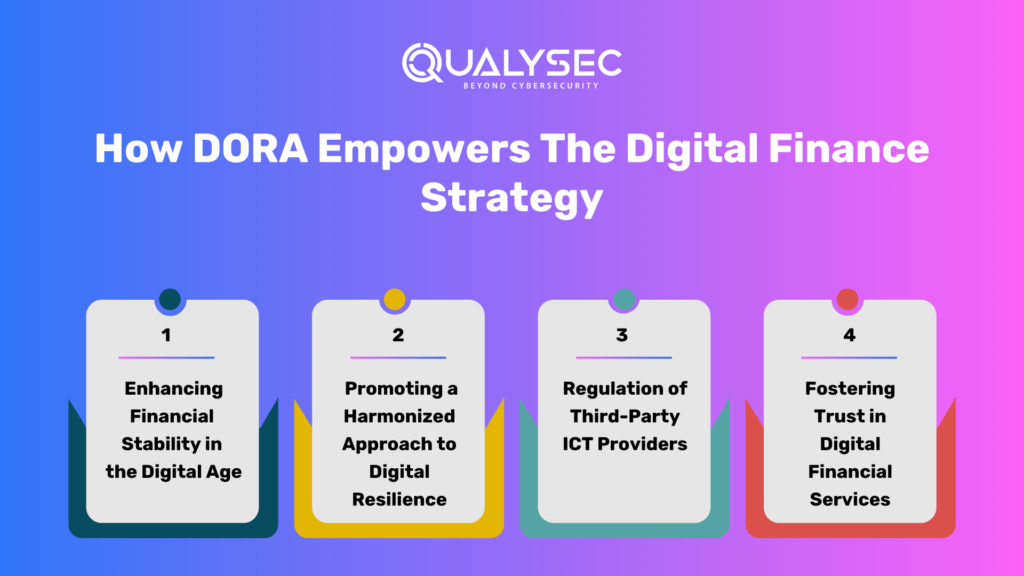
1. Enhancing Financial Stability in the Digital Age
Since banks are becoming more digital in their services, they expose themselves to increased cyber vulnerabilities. DORA requires risk management and resiliency planning to be part of the operational models of such banks, reducing the risk of financial instability driven by the cyber environment.
2. Promoting a Harmonised Approach to Digital Resilience
EU member states previously had diverse national requirements for the financial sector’s cybersecurity. DORA unifies regional resilience measures to promote uniformity in managing risk and compliance.
3. Regulation of Third-Party ICT Providers
The majority of financial institutions rely on third-party ICT providers to supply cloud computing, data analytics, and cyber security services. DORA establishes oversight mechanisms to oversee and monitor these providers and ensure they meet security best practices.
4. Fostering Trust in Digital Financial Services
Consumer confidence is of utmost significance in the financial sector. DORA’s compliance mechanism makes sure that institutions are well prepared to handle cyber attacks properly. It also prevents data breaches and financial fraud, thereby boosting confidence in online finance.
You might like to know more about Achieving DORA Compliance in the Financial Sector
Key Requirements for DORA Compliance in Europe
Five major pillars are needed by financial institutions to meet DORA compliance in Europe:
- ICT Risk Management – Set up governance structures for IT risk identification, assessment, and management.
- Incident Reporting – Have a standard process for reporting, identifying, and reacting to cyber incidents.
- Operational Resilience Testing – Periodic penetration testing and threat evaluation for vulnerability testing of systems.
- Third-Party Risk Management – Ensuring ICT vendors are compliant and there is no security risk.
- Information Sharing – Facilitating the sharing of threat intelligence on the cyber side to improve overall industry preparedness.
Read our case studies to know about DORA compliance penetration testing.
Challenges in the Implementation of DORA
Though having advantages, banks and financial institutions also have some challenges to fully comply with DORA compliance in Europe:
1. Unreasonably Excessive Costs of Implementation: Advanced cybersecurity infrastructure, employee training, and compliance can be out of the question. The majority of financial institutions, particularly smaller ones, will not be able to fund upgrades. Compliance involves paying to install advanced security products, regulators’ inspections, and employee training workshops to ensure they comply with the guidelines in DORA.
2. IT System Sophistication: Large financial institutions with ageing systems may struggle to absorb new models of resilience. IT ageing systems are inflexible and do not allow for the adoption of new cybersecurity shields, since that is their natural inclination to resist innovations. Regulation is slow and arduous in this case. Institutions must undertake full-scale system overhauls or employ the use of middleware to bridge the gap between old and new technology. Learn about what cybersecurity is for Financial Services.
3. Third-Party Dependencies: Vendor compliance is difficult to control since ICT service providers must also comply with DORA regulations. Banks are reliant on third-party technology companies for cloud, cybersecurity solutions, and digital payment systems. They must make their external partners conform to DORA standards through strict contractual conditions, regular audits, and continuous risk monitoring.
4. Changing Cyber Threat Landscape: Banks are forced to continuously reinvent themselves as a result of new and state-of-the-art cyber attacks. Cybercriminals continue to evolve sophisticated, advanced attack methods such as ransomware, phishing, and AI-based cracking strategies. Businesses are required to remain compliant by remaining attuned to threats through dynamic cybersecurity processes, ongoing vulnerability checks, and an ongoing improvement culture of the organisation.
Speak with our cybersecurity specialists to ensure full DORA compliance. Contact us today.
The Future of Digital Finance under DORA
The future of digital finance within the EU is about to change completely with the DORA. The effects are:
Enhanced Market Resilience: A more resilient financial sector with diminished cyber threats and business losses. Through implementing stringent cybersecurity measures, DORA enables financial institutions to enhance their operational resilience. So they can better cope with absorbing and bounce back from cyber-attacks, hence minimising economic and reputational loss.
Increased Adoption of New Technologies: Promoting the use of AI-based security measures, blockchain-based financial transactions, and real-time fraud detection platforms. As institutions strive to gain compliance, they will consequently employ new technologies that improve security, automate processes, and enhance customer experience.
Increased Global Competitiveness: EU leadership of global regulation of digital finance will set a global standard, and the same policy will be followed throughout the globe. By creating far-reaching standards on cybersecurity and resilience, DORA makes the EU a global rule-maker in the regulation of digital finance, poised to inspire other regions to do the same.
Increased Consumer Confidence: With secure cybersecurity, consumers will feel more confident in using online banking, payment, and investment portals. The confidence in effective operating resilience will minimise breaches of data as well as fraud issues, enhancing further confidence in the online financial environment.
Explore more about: Penetration Testing For Financial And Banking Industry
Conclusion
DORA is a foundation of the EU Digital Finance Strategy to allow financial institutions to operate in a safe, resilient, and regulated digital environment. By aligning its mission with the strategy, DORA supports financial stability, aligns resilience levels, and inspires trust in digital financial services.
While there are obstacles, such as high implementation expenses, complexity in IT systems, and emerging cyber threats, the long-term benefits of compliance outweigh these barriers. The banks that successfully implement DORA’s guidance will be able to gain an edge, showing their commitment to cybersecurity and operational resilience.
As digital finance continues to progress, DORA Compliance in Europe will continue to be an important framework in ensuring the financial system is protected against more sophisticated cyber threats. It promotes innovation while security remains secure, allowing the financial system of the EU to be solid, resilient, and forward-looking.
Schedule a meeting with our cybersecurity experts to understand exactly how your organisation can achieve full DORA compliance and improve operational resilience.























































































































































































































































































































































0 Comments