







Cybersecurity in fintech is an urgent issue now that companies providing financial technology transform the way we pay and manage our finances, as well as gain access to financial services. Given that over 75% of all customers worldwide use at least one fintech application, the widespread adoption of such apps has made them prime targets for cybercriminals seeking valuable personal and financial data. The facets of cybersecurity in fintech go beyond the security standards of banks and require the implementation of new strategies to deter a greater variety of threats due to the vulnerability of mobile apps, APIs, and the disclosure of sensitive customer information.
As fintech firms continually revolutionize the banking sector through innovative technologies like contactless payments, mobile banking, and micro-investing, they encounter unique security challenges that appear to have a lesser impact on their counterparts in the financial sector. Blistering speed in growth and the questionable digital-first business model of fintech firms can neglect the importance of establishing expansive security systems, leaving the door open to attacks by hackers who will gladly take advantage.
Fintech security matters more than ever. Talk to our experts to secure your app and APIs today.
What Is The Importance of Cybersecurity in Fintech?
Fintech cybersecurity plays a vital role in helping businesses survive, particularly from the perspective of customers. Unlike traditional banks, which are subject to strict regulations, most fintech startups operate with fewer regulations, making them more flexible but also creating security loopholes.
The role of excellent cybersecurity in fintech is made clear by examining the ramifications that security breaches have:
Business Impact
- Destruction of customer confidence: The loss of customer confidence can lead to a fintech company going out of business permanently.
- Financial Impact: Data breaches may incur heavy financial losses due to fraud and recovery expenses
- Legal consequences: Unlawful conduct under the GDPR and regulatory infringements may result in substantial penalties
- Operational disruption: Service availability may be destroyed by cyberattacks that can temporarily shut down the business operations
Customer Impact
- Identity theft: This could result in identity theft due to the loss of personal details
- Financial fraud: Unauthorised access to accounts may be associated with loss of funds
- Breach of privacy: Exposure to sensitive financial information has personal, long-term repercussions
- Compromised credentials: Access to other systems and services: Compromised credentials may be utilized to access other systems and services
The overlay structure of most fintech companies, acting as mediators between customers and the traditional banking system, raises other security considerations. Such companies need to not only protect their systems but also integrate with the legacy banking infrastructure in a secure fashion.
Read more: Why Fintech Companies Choose Qualysec for Cybersecurity?

Top Cybersecurity Risks in Fintech
It is critical to recognize the main threats of fintech firms to plan proper security options. The landscape of fintech cybersecurity threats is ever-changing, with cybercriminals continually developing highly advanced attack tools.
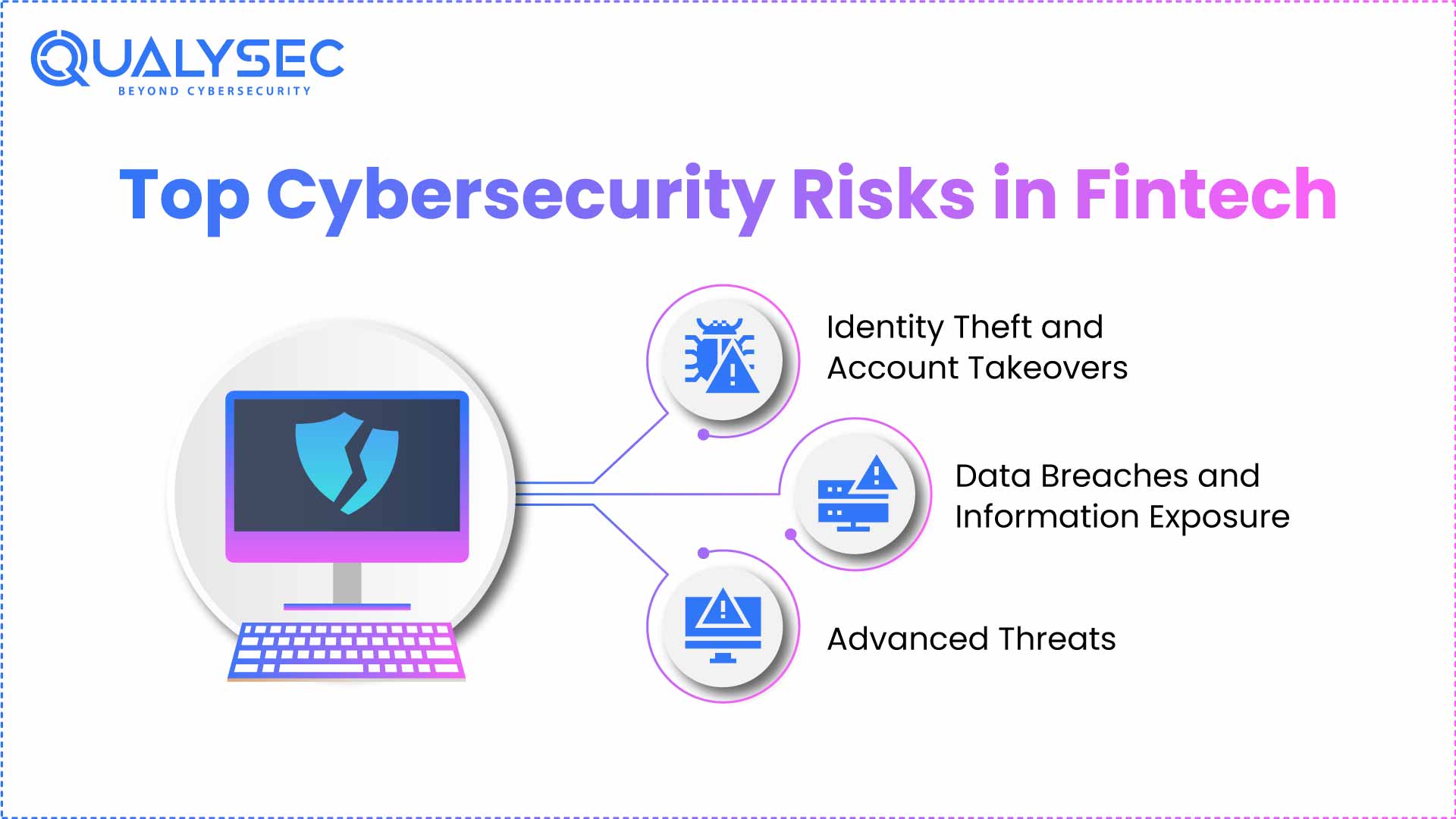
1. Identity Theft and Account Takeovers
The most devastating threats in fintech cybersecurity continue to be identity theft, an act that has seen an upsurge in attempted account takeovers by 82% in 2020 compared to 2019. With modern attacks, there is an increased use of API to obtain authentication tokens and session management concerns. Credential stuffing attacks utilize computerized technologies to target millions of previously compromised usernames and passwords across numerous systems. Social engineering has become more focused on users of fintech since attackers have begun pretending to be customer service representatives or financial advisors. SIM swapping is a type of attack, still in the stages of development, in which criminals can circumvent the effectiveness of SMS-based two-factor authentication by persuading mobile carriers to reroute the phone number of victims to their own intentionally compromised devices.
2. Data Breaches and Information Exposure
Data breaches are the apocalyptic circumstances of fintech firms due to the never-before-seen sensitive data stored on such platforms. The most risky vulnerabilities are business logic flaws, which attackers can exploit to access unauthorized data through legitimate application functionality. Such defects involve manual fintech security testing issues that can be successfully detected and eliminated. Unsecured API endpoints remain major vectors of data loss, especially once firms adopt APIs at hastened scales to implement new functionalities without thorough security checks.
3. Advanced Threats
The situation with DDoS attacks suggests new requirements regarding fintech applications because they are characterized by their time-sensitive nature and the need to be constantly available to customers. Machine learning is being used by AI-powered attacks to automatically discover vulnerabilities at a scale never seen before and can test thousands of potential attack vectors very quickly. Recent phishing attacks are highly technical and prone to psychological manipulation, with spear phishing involving in-depth reconnaissance, voice phishing with spoofed numbers, and business email compromise against the finance department. Malicious insiders and negligent employees, through unintentional vulnerability creation, are responsible for 60% of security breaches in financial services.
Worried About Your Fintech App Security? Get a Free Risk Assessment
Compliance Requirements for Fintech Companies
Fintech cybersecurity must align with the evolving regulatory requirements that have been introduced to mitigate risks in digital finance services.
1. PCI DSS (Payment Card Industry Data Security Standard)
PCI DSS compliances apply to fintech organizations that deal with credit cards. The standard contains twelve key requirements to cover network security, data protection, vulnerability management, access controls, monitoring, and security policies. It must be implemented with strong network security, including appropriately tuned firewalls, the encryption of cardholder data with strong keys, and tight vulnerability management with routine penetration testing for fintech apps. Additionally, it should limit access to network resources based on need-to-know business principles and maintain thorough record-keeping of all network resource access. The pressures that non-compliance may give rise to include substantial fines and withdrawal of payment processing options.
2. SOC 2 and ISO/IEC 27001
SOC compliance refers to the reliability of handling customer data within the five premises of trust, which encompass security, availability, processing integrity, confidentiality, and privacy. The ISO/IEC 27001 is a globally accepted framework (concerning information security management systems) that mandates risk-based approaches, exhaustive security rationalizations, and continuous management improvement. Both standards reiterate that fintech security testing must be conducted regularly with the fintech. Cofense asserts that data protection is ongoing because it is continuously monitored, as shown in their independent audit.
3. GDPR and CCPA
Fintech companies that process the personal data of EU residents must be GDPR compliant, and this sets several stringent requirements, such as data minimization, consent by the user, the notification of a breach within 72 hours, and the principles of privacy by design. CCPA offers the following rights to California consumers: to know, delete, opt out, and non-discrimination concerning the personal data. Both of them carry enormous fines and punishment in case of non-compliance, such that cybersecurity in fintech programs requires compliance.
Explore more in our recent article on Data Security Compliance.
How to Strengthen Cybersecurity in Fintech Apps
Comprehensive security can be implemented through multi-level, strategic approaches to security, which are redundant in terms of technology, process, and humans.
Secure-by-Design and Shift-Left Security
By pursuing a secure-by-design approach, security considerations are integrated at all phases of development lifecycles, from conceptualization to execution, maintenance, and sustenance. The given approach entails defining security requirements in addition to functional requirements, threat modelling throughout design and development, and automation of security testing in CI/CD pipelines. The shift-left approach focuses on introducing security early in the development process, where NIST estimates indicate a 30% cost savings once vulnerabilities have been identified early. They must include developer training that provides for input validation, authentication, and safe coding practices that may be needed to meet fintech cybersecurity standards.
Read also: Fintech Industry Case Study
Comprehensive API Security
APIs promote the use of fintech applications that necessitate excellent security environments with coverage on authentication, authorization, data protection, and monitoring. Strong authentication mechanisms based on OAuth 2.0 and JWT tokens comprise industry-standard best practices that provide maximum security to an API. Authorizations of fine-grained policies on role-based and attribute-based access policies are enforced by taking into consideration context-related factors, which include location and risk assessment. Output encoding and input validation will ensure that the system prevents the injection and exposure of information and can monitor the entire spectrum of usage data, thereby granting companies the opportunity for immediate identification of unauthorized activities. The penetration testing for fintech must include testing the bypass vulnerability of authentication.
Read also: What is API Security Testing: A Simple Guide & Rules.
Advanced Authentication and Data Protection
Risk-based authentication Multi-factor authentication relies on risk to avoid comparing the authenticating and validating process of the device, location [geolocation], and behavioral patterns to give a higher level of authentication. Relatively convenient and secure techniques of authenticating users include hardware security keys, mobile authenticators, and biometric authentication. The authentication systems based on risk will monitor patterns of behavior and contextual details to identify the amount of risk involved in authentication attempts. Data in transit, at rest, and in use are covered by end-to-end encryption, database encryption, and state-of-the-art key management using either hardware security modules or cloud-based services.
Continuous Monitoring and Response
An efficient fintech cybersecurity solution should be able to monitor and respond to threats 24/7 with real-time threat identification and containment. SIEM solutions collect data about log events within application ecosystems and can use logic rules (correlation) as well as machine learning to recognize security events. Behavioral analytics set a user- and system-wide baseline, which allows anomalies to be identified and detected to identify account compromise or insider threats. Regular testing of incident response planning facilities ensures they respond effectively, and vulnerability management programs integrate regular vulnerability scanning with fintech security testing to detect and mitigate vulnerabilities before they are exploited.
Your fintech data deserves the Best Protection – Reach out to our cybersecurity expert.
Why Do Fintechs Need Penetration Testing?
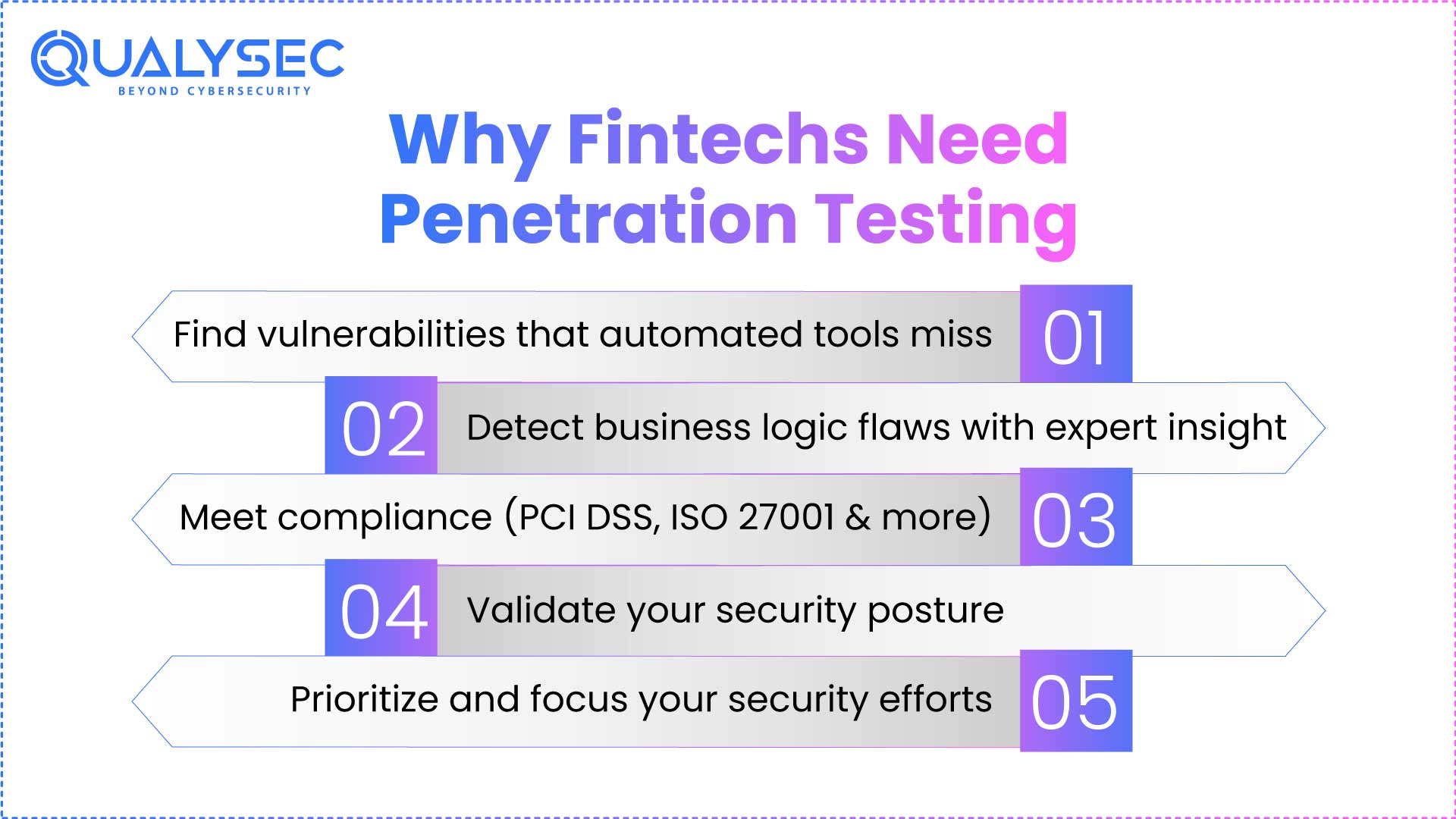
Fintech companies require penetration testing to identify vulnerabilities that malicious users might otherwise exploit. In contrast to automated security scans, where results are easily missed, penetration testing is a service that offers human skills to identify compounded security vulnerabilities that automated tools are likely to overlook.
Benefits of Penetration Testing
- Realistic simulation of an attack on the behaviour of attackers
- Business logic bug detection that can be identified only manually by automated scans
- The attainment of compliance requirements of different standards in the industry
- Confidence in the administered measures that they are well in place, and Security posture validation
- The prioritisation of risks assists in the focus of security investments
Types of Penetration Testing for Fintech
- Web and mobile application penetration testing
- API penetration testing, looking at API integrations and endpoints
- Systematic penetration of the network to test the security of the infrastructure
- Social engineering testing based on human security factors
- Office and data center Word mill physical security testing
Explore all penetration testing services here.
Penetration Testing Frequency
There should be regular fintech security testing:
- Quarterly assessments for high-risk applications
- After major updates or system changes
- Before product launches or new feature releases
- Following security incidents to validate remediation efforts
- Annual comprehensive testing covering all systems and processes
Download our Sample Penetration Testing Report to understand how vulnerabilities are reported and mitigated.








































































































0 Comments