







Medical Device Cyber Risk Assessment shows that one vulnerable medical device can do better than data exposure. Thus, able to interfere with treatment, change clinical decision-making, or become a point of attack in a whole hospital system. The risk is no longer theoretical as healthcare systems are getting more interconnected. It is operational.
Infusion pumps and imaging systems belong to the digital ecosystem of modern medical devices, among other things. Though this connectivity enhances efficiency and patient outcomes. It also brings an increasing set of cyber threats, which traditional safety checks fail to deal with.
The point is that medical device cyber risk assessment is paramount. It offers a systematic means to find vulnerabilities and determine the possible effect. Further ensures that the devices are secure, reliable, and safe in a real-world setting.
In this guide, we are going to dissect what a medical device cyber risk assessment consists of, such as
- The frameworks
- What other risks are most frequent in connected medical devices
- How healthcare establishments may introduce effective security strategies
What is a Medical Device Cyber Risk Assessment?
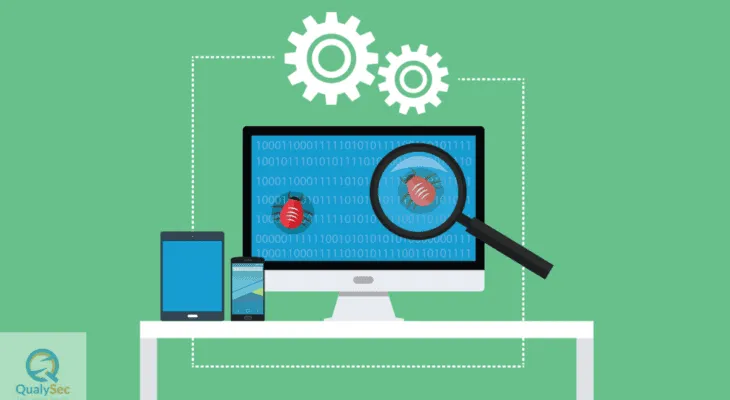
A medical device cyber risk assessment is a methodical procedure for identifying cybersecurity risks in medical equipment. It examines the weaknesses, threats that may occur, and their effect on patient safety, device performance, and data security, and assists organizations in prioritizing and reducing risks.
The evaluation usually extends to the whole device ecosystem, such as hardware, software, firmware, communication interfaces, APIs, and integrations with hospital networks or cloud platforms.
Cyber risk assessment prioritized normal penetration testing. It not only points to the weak areas but also assesses their probability and possible effect to enable organizations to make informed judgments.
It is not only to identify any technical flaws, but to learn how these flaws might influence the clinical outcome, reliability, and operational continuity in healthcare settings.
Why is Cybersecurity Risk Assessment Critical for Healthcare Devices?
Due to the digitization of healthcare systems, cybersecurity is no longer an IT issue. It closely connects to the patient’s safety, the availability of devices, and the continuity of operations.
- Influence on the safety of patients: In most cases, the medical devices are important to the diagnosis and treatment. Cybersecurity vulnerability may result in inappropriate outputs, sluggishness in responses, and even malfunctions in devices, which may have a direct impact on patient outcomes.
- Increasing cyber attacks in healthcare: Healthcare is one of the highest-attack industries. The interconnected devices present numerous points of vulnerability to attackers, and a healthcare cybersecurity risk assessment helps detect these risks and overcome them at an earlier stage.
- Data security of sensitive patient information: Medical equipment often manages sensitive health information. Vulnerabilities may result in data breaches, violations of compliance, and loss of trust unless assessed properly.
- Operational and financial risks: cyber attacks may interrupt the functioning of the hospital, postpone treatment, and lead to losses. The ransomware attacks, in particular, have demonstrated the vulnerability of the healthcare systems.
- Compliance and regulatory pressure: Regulators are also putting increased pressure on manufacturers and healthcare providers to prove that they have identified and addressed cybersecurity risks. Risk assessments aid in achieving these expectations to facilitate smoother approvals.
Assessment of cybersecurity risk is essential to healthcare devices since it aids in avoiding malfunction of the devices, data loss, and cyberattacks that may disrupt the operation of the hospital and the safety of the patients. It helps organizations to discover weaknesses, risk management, and secure and reliable performance of devices.
Common Cyber Risks in Connected Medical Devices
Unauthorized access, data interception, firmware vulnerabilities, insecure APIs, ransomware attacks, and misconfigurations are the common cyber risks in connected medical devices. These risks may affect patient safety, data integrity, and the reliability of the system, and it is necessary to conduct periodic risk assessments of cybersecurity.
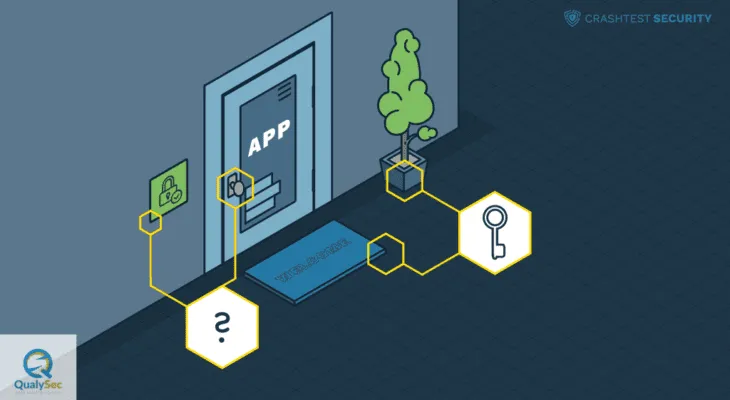
- Unauthorized access and poor authentication: Attackers can easily access devices that have weak login and default credentials. This may cause unauthorized control, data exposure, or misuse of device capability.
- Data interception and unsecured communication: Attackers may intercept or alter sensitive patient data when it fails to encrypt between devices, servers, or applications.
- Firmware and software vulnerabilities: Old firmware and software that lack patches or secured by updates can bring potential holes. This set of vulnerabilities may enable attackers to have persistent access or modify device behavior.
- API and integration risks: Medical devices interconnect and usually use APIs and third-party integrations. The whole system can be vulnerable even in the case when the device is unbroken, but the API security or access controls are weak.
- Attacks based on the network: A device that is attached to a hospital network can provied to get access to ransomware attacks. After gaining access, the attackers are able to propagate throughout systems, derailing functions and essential care.
- Misconfigurations and deployment problems: Any wrong configuration when installing or deploying may leave devices vulnerable. Open ports, unneeded services, or ineffective network settings are typical problems.
These connected medical device security risks underscore the reason why risk assessment and ongoing monitoring are important in contemporary healthcare settings.
Key Components of Medical Device Cyber Risk Assessment
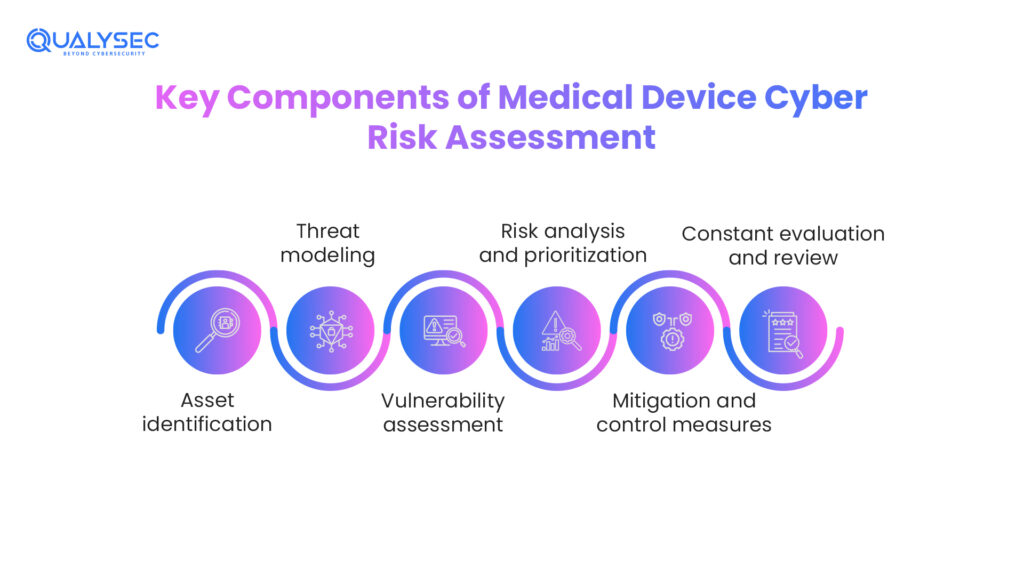
One is not a one-time event of a comprehensive cyber risk assessment. It is a well-organized and consists of various components that collaborate to detect, analyze, and prevent risks successfully.
- Asset identification: The first step is to list all assets involved in it, such as medical devices, software, firmware, communication interfaces, and linked systems. This assists in establishing the extent of the protection that should be complete.
- Threat modeling: This is the process of identifying threats that may attack the device or its ecosystem. It involves knowing how attackers act, potential attack patterns, and the way the vulnerabilities may be abused.
- Vulnerability assessment: This is a step where vulnerabilities in both the environment and the device are determined. Vulnerability assessment comprises firmware, API, network settings, and authentication problems.
- Risk analysis and prioritization: This is because not all vulnerabilities are equally risky. The step will assess the risk of exploitation and the possible harm to the safety of the patient, the security of the data, and the functionality of the system.
- Mitigation and control measures: When the risks are detected, the correct controls are applied to mitigate or eliminate the risks. This can involve fixes to vulnerabilities, better encryption, access control, or redesigning vulnerable parts.
- Constant evaluation and review: Cyber risk assessment is not a single exercise. The devices need to be monitored constantly, and risks also need to be re-evaluated, particularly following updates or environmental changes.
These elements are the basis of the medical device risk management cybersecurity that will be able to identify potential risks early on and address them properly across the device lifecycle.
Frameworks Used for Medical Device Cyber Risk Analysis
Medical device cyber risk evaluation usually follows the premises of established frameworks to have consistency, reliability, and regulatory alignment. Such frameworks are systematic approaches to the identification, evaluation, and management of risks.
- Risk management ISO 14971: ISO 14971 is the most common standard of risk management of medical devices. It offers a methodical procedure for determining hazards, estimating risks, and controls through the device lifecycle. When used in the context of cybersecurity, it helps to conduct a structured ISO 14971 cybersecurity risk assessment in accordance with patient safety.
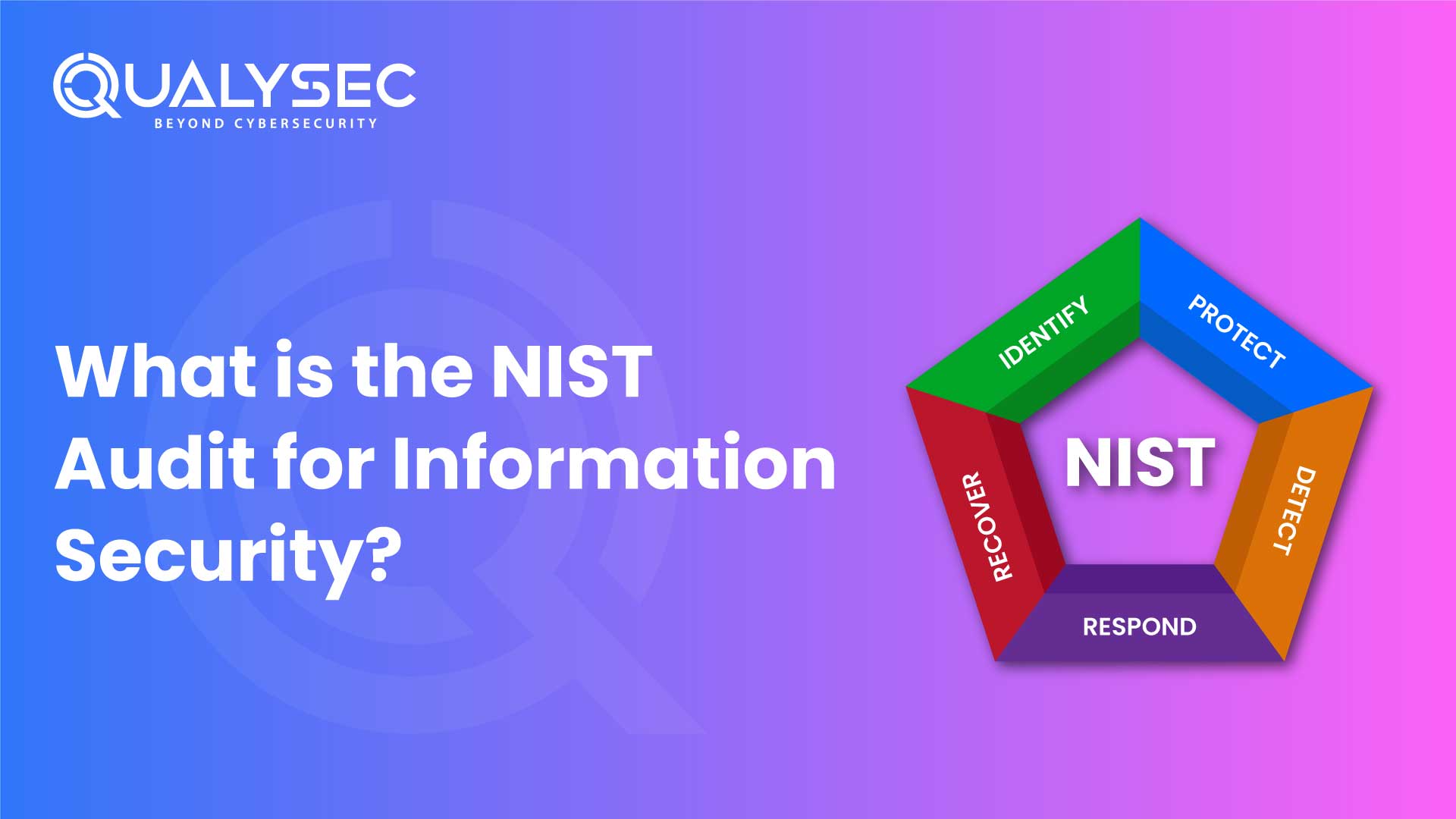
- NIST Cybersecurity Framework: The NIST framework assists organizations in dealing with cybersecurity risks by the use of five core functions that include: identify, protect, detect, respond, and recover. It comes in handy, especially with healthcare settings that have complicated device networks.
- FDA cybersecurity guidance: FDA guidelines are fairly specific to the US, but they typically apply as reference points in other parts of the world. These are secure design, risk-based evaluation, and ongoing monitoring of medical equipment.
- OWASP on application and API security: OWASP offers well-known recommendations on how to detect software and API vulnerabilities. This is especially applicable to related medical equipment based on web or cloud elements.
- Combined approach: In practice, organizations may use a number of frameworks in combination. For example, risk management uses ISO 14971, whereas technical evaluation on cybersecurity relies on NIST and OWASP.
The frameworks also make sure that cyber risk assessments are not made on impulse, but they are organized, repetitive, and in line with the best practices of the world.
Step-by-Step Process for Conducting Cyber Risk Assessment
A systematic methodology ensures that cyber risk analysis remains complete, repeatable, and consistent with healthcare needs. The process aims at managing risks at a young stage and handling them.
- Define scope and system boundaries: Begin by defining what must be evaluated. This comprises the medical device, the related software, firmware, interfaces with communications, and environments connected to the medical device software, like hospital networks or cloud systems.
- Find assets and data flows: Visualize all important elements and the flow of the data. The way data flows helps you to note the location of sensitive information stored, processed, or transferred.
- Conduct threat modelling: Analyze threat potentials by evaluating the way attackers can use the system. This involves determining the attack vectors, attack actors, and potential entry points.
- Perform vulnerability assessment: Assess the security vulnerability of the system of devices, applications, APIs, and networks. This stage gives the identification of technical loopholes that may exploit.
- Determine risk impact and likelihood: Risk assessment of every vulnerability in terms of its probability of exploitation and the likelihood of an adverse effect on patient safety, data integrity, and system availability.
- Give precedence and take mitigation actions: Mitigate high-risk vulnerabilities first. Implement effective measures like patching, encryption, access control, and secure settings to limit vulnerability.
- Test and document findings: Test and validate mitigation measures. Record all findings, risk level, and compliance measures to be used in the future.
- Ongoing review and evaluation: Cyber threats keep on changing. Relies on continuous evaluation, particularly following updates in the system or changes in the system, to maintain security and compliance.
How Often Should Cyber Risk Assessments Be Performed?
Medical devices should have cyber risk assessments conducted in their development and prior to deployment. Also needed to conduct after updates, periodically during operation, or as a result of a security incident. Routine evaluations can be used to detect:
- Emerging vulnerabilities
- Keep in line with the requirements
- Protect patient data
- Device functionality consistently.
- Development and design stage: Risk analysis is to be initiated at the early stages of the development lifecycle. Uncovering weaknesses at this level assists in designing safe-by-design medical equipment and incurs fewer expensive repair issues in the future.
- Prior to deployment or market release: A complete evaluation must occur before the device enters a clinical setting, or regulatory approval can be submitted. This will make sure that the significant dangers are identified and addressed.
- Following updates or system changes: System integration can create new vulnerabilities after any software change, firmware upgrade, or update. There is a need to re-analyze to ensure that security is not compromised.
- Regular evaluation of the operating conditions: Evaluations are to be made frequently, even when significant alterations are not made. This assists in detecting emerging threats in healthcare systems that have close interdependence, particularly with networking.
- Following security incidents or alerts: In case an abnormality, breach, or unusual activity occurs, a risk assessment must be performed immediately to assess the impact and avoid additional damage.
Such practices guarantee that hospital device security assessment is continuous and adaptive rather than reactive.
Hospital Device Security Assessment: Real-World Considerations
Cyber risk assessment is not limited to individual devices in the real healthcare setting. Hospitals have complex ecosystems involving various devices, systems, and networks, which interrelate to provide special security challenges.
- Multifaceted and networked settings: Hospitals have numerous devices of various manufacturers, linked to common networks. This enhances the possibility of lateral movement, where a compromised device can impact many systems.
- Obsolete systems and old equipment: Numerous healthcare institutions continue to use old equipment did not anticipated to be cyberattacked in the present. These systems are not updated, encrypted, or secured in a basic way; therefore, they are high-risk.
- Exposure on the network level: Medical devices are commonly attached to the IT network of hospitals, which can also be connected to the administrative systems or the internet. Attackers have easy access between systems without proper segmentation.
- Third-party and vendor dependencies: Devices usually rely on external vendors to update software, maintain it, or use cloud services. The third-party systems could have weaknesses that bring risks to the hospital environment.
- Poor visibility and asset control: Hospitals might not necessarily have a full inventory of interconnected devices. This invisibility complicates the process of tracking the risks, as well as addressing the threats efficiently.
- Limitations in the operational setting of healthcare facilities: Medical equipment cannot always be offline to have tests or updates, as compared to other industries, because of patients and their care needs. This complicates the management of security.
This is why the evaluation of the security of hospital devices is an urgent and ongoing procedure that will demand both technical and operational knowledge.
Challenges in Medical Device Cyber Risk Assessment
As much as cyber risk assessment is necessary, its application in a healthcare device setting has a number of challenges. Such issues are usually caused by the intricacy of medical systems and the dynamic character of cyber threats.
Ecosystems of complex devices
Medical devices are not isolated. They work in interdependent settings that entail software, networks, cloud platforms, and third-party systems. It may be challenging and time-consuming to assess the risk in this whole ecosystem.
Poor visibility and tracking of assets
It is not uncommon to find that most healthcare organizations keep incomplete and out-of-date inventories of associated devices. It is much more difficult to define and rank risks without full visibility.
Shifting threat environment
The cyber threats are dynamic. New vulnerabilities, attack methods, and exploits arise frequently, and it is difficult to maintain risk assessment at the latest level.
Striking a balance between security and clinical operation
Medical equipment is a key component of patient care that can not be regularly put offline to be tested or updated. This poses a problem in conducting the assessments without interfering with healthcare services.
Obsolete technologies and systems
Systems and devices that are older tend not to have advanced security and might not be capable of updates and patches. In spite of the vulnerability, such systems are still popular in the healthcare environment.
Complexity of regulations and compliance
There are various standards and regulatory expectations to which healthcare organizations must align. This is complicated to ensure that the risk assessments meet the security compliance requirements.
Limitations in resources and expertise
Resource and expertise limitations affect effective cyber risk assessment. It is possible that many organizations do not have the necessary expertise in-house, and it will be challenging to make comprehensive assessments.
Nevertheless, a well-organized strategy and the utilization of professional assistance will allow enhancing the efficiency of medical device cyber risk evaluation considerably despite these issues.
Request FDA Compliance Assessment Today!
Best Practices for Effective Cyber Risk Assessment
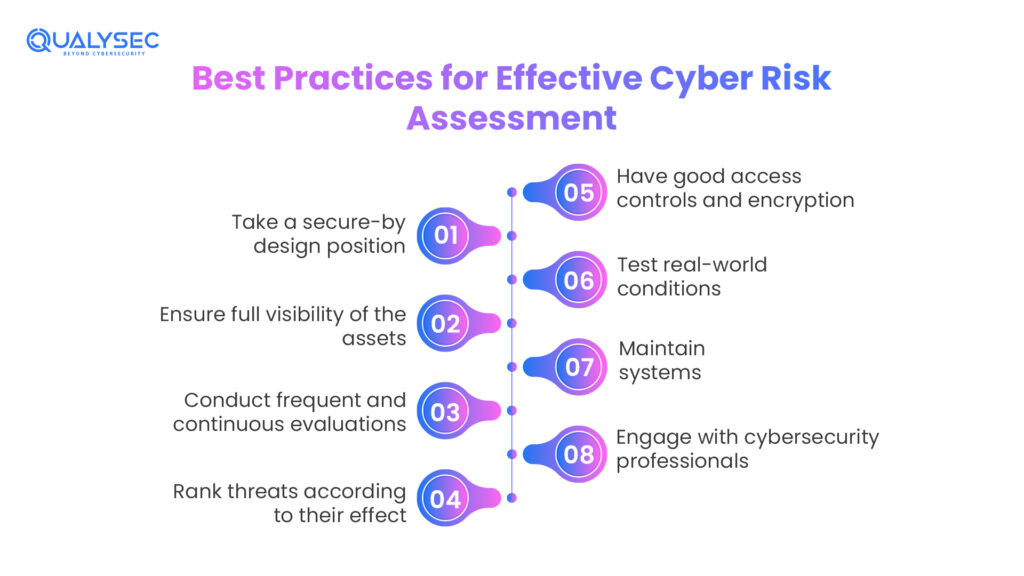
In order to have a cyber risk assessment really effective, healthcare organizations and manufacturers must enlarge past single-time assessment and work proactively and organized.
- Take a secure-by-design position: Security must be designed into the device during the initial design phase and not be added afterwards. This minimizes the vulnerabilities and makes cybersecurity a part of the full development process.
- Ensure full visibility of the assets: It is necessary to have a proper inventory of all the related medical devices. It assists in determining which systems require reviewing and does not allow leaving any device neglected.
- Conduct frequent and continuous evaluations: Cyber risk assessment ought to be an ongoing process and not periodic. Real-time monitoring will prevent new vulnerabilities and counter new threats in a timely manner.
- Rank threats according to their effect: Not every vulnerability is serious. Pay attention to the risks that may directly impact patient safety, equipment functionality, or confidential data.
- Have good access controls and encryption: Implement strong authentication and secure communication protocols to ensure that data access and interception cannot occur without authorization.
- Test real-world conditions: Simulate real attack conditions to get an understanding of the behavior of devices under attack. This gives a more insightful perception as compared to theoretical analysis.
- Maintain systems: Updates and patch management help eliminate known vulnerabilities and improve the overall security of devices.
- Engage with cybersecurity professionals: Engaging professional cybersecurity professionals will help make sure that the assessments are comprehensive, meet the standards of the industry, and can serve to deal with the complex medical setting.
Through these best practices, organizations are able to establish a resilient security posture and keep medical devices safe, consistent, and compliant with an ever-changing threat environment.
Why Choose Qualysec for Medical Device Cyber Risk Assessment?
To perform a successful medical device cyber risk assessment, vulnerability identification is not the only key requirement. It entails the knowledge of healthcare settings, regulatory requirements, and practical attack contexts. Here, Qualysec provides a definite benefit.
Cybersecurity experience in healthcare
Qualysec has specialized in healthcare cybersecurity and has a good understanding of the functioning of medical devices in a clinical setting. This makes sure that risk assessment is in line with patient safety as well as the operational realities.
Assessment of device ecosystems
Qualysec analyses the complete ecosystem, including device firmware and software, APIs, network, and cloud integrations. This assists in the discovery of the hidden risks that cannot be seen in isolated testing.
Conformity to international principles and standards
Qualysec conforms to organized approaches in line with such standards as ISO 14971, NIST, and OWASP. This will make risk assessments uniform, acceptable, and able to meet compliance needs.
Pay attention to the actual risk impact
In addition to identifying vulnerabilities, Qualysec prioritizes risks based on their potential impact on patient safety, data security, and system functionality. This aids in making organizations concentrate on what is most important.
Actionable and clear reporting
Risk assessment reports are well-organized, easy to read, and include detailed risk levels, impact analysis, and remediation measures. This assists in quicker decision-making and execution.
Compliance and regulatory preparedness support
Qualysec helps organizations match their cybersecurity position with regulatory demands, and approvals are conducted; it becomes significantly simpler to prove that an organization is security-ready.
More timely risk reduction and better security positioning
With the ability to recognize and rank risks effectively, Qualysec allows for reducing exposure to risks faster, thereby enhancing the security position of overall devices.
The selection of Qualysec does not only imply the performance of an assessment. It is regarding the development of a secure, compliant, and robust medical device ecosystem.
Conclusion
With the increasing interconnection in healthcare systems, the risks posed by medical devices are no longer restricted to functionality. Cyber threats can now affect patient safety, disorient clinical activities, and interfere with sensitive data. This preconditions the fact that medical device cyber risk assessment is a vital aspect of modern healthcare security.
Since it involves identifying vulnerabilities and their real-world impact, organizations can use a systematic risk assessment process to stay ahead of dynamic threats. It also helps in compliance, enhancing the reliability of devices, and developing trust in healthcare ecosystems.
Nevertheless, risk assessment cannot be done effectively without more than tools. It entails the appropriate expertise, frameworks, and an appropriate knowledge of the working of medical devices in actual settings.
This is where Qualysec is involved. Having a profound understanding of healthcare cybersecurity, extensive risk evaluation strategies, and concentrating on practical information, Qualysec assists organizations in better enhancing security and reducing exposure to risk.
In case you are seeking to protect your medical devices and make them resistant to the current cyber threats, it is high time to take action.
Get in touch with Qualysec to conduct a comprehensive medical device cyber risk assessment and strengthen your healthcare security posture.
























































































































































































































































































































0 Comments