







Is ChatGPT an Agentic AI?
ChatGPT is not considered an agentic AI because:
- It generates responses to user prompts
- Does not independently execute actions
- Access systems of the enterprise.
However, when connected to plugins, APIs, automation tools, or external memory systems, it becomes part of a broader agentic system.
| System Type | Autonomous Action | External Tool Access | Risk Level |
| Standard LLM Chat | No | No | Low |
| LLM with Plugins | Limited | Limited | Medium |
| Fully Agentic AI | Yes | Extensive | High |
Why is Security critical for Agentic AI Systems?
The growing adoption of agentic AI is changing how organisations automate decision-making and operational tasks. Unlike traditional software, these systems can interact with internal databases, APIs, and enterprise applications. External services help to complete workflows with minimal human supervision. This level of autonomy makes agentic AI powerful, but it also introduces significant security challenges.
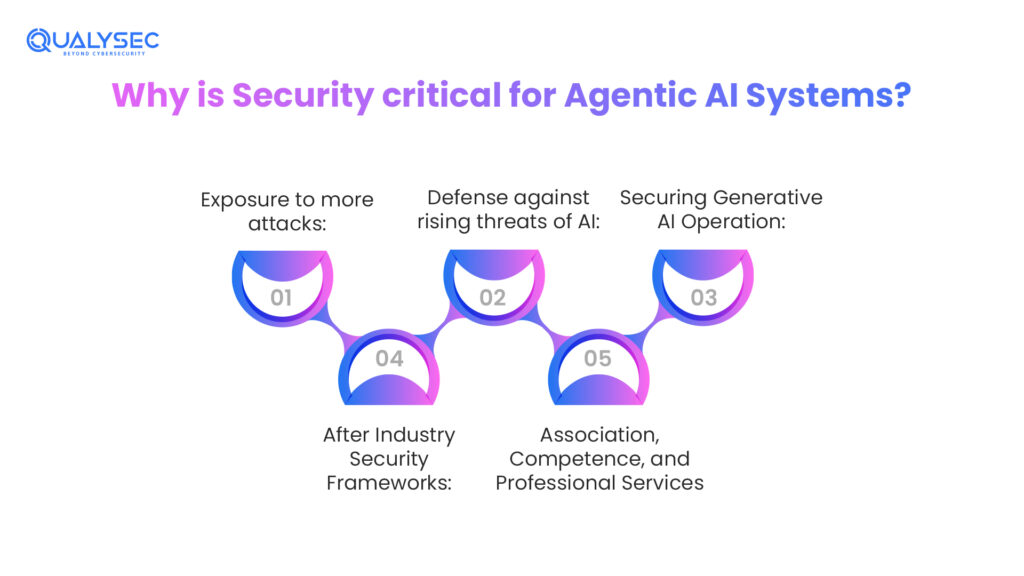
- Exposure to more attacks: AI communicates with APIs, databases, tools, and external environments, putting a huge number of potential vulnerabilities at risk. Carrying out Agentic AI threat modeling enables organizations to be aware of the way that attackers may abuse immediate injection, abuse of tools, or manipulation of information in the agent workflow.
- Defense against rising threats of AI: New types of cyberattacks are a threat to autonomous AIs. AI threat assessment should be continuous to identify threats. Including advisory prompts, memory pollution, and data leak, which may undermine the integrity of the system and decision-making process.
- Securing Generative AI Operation: Since agentic systems are based on generative models, good GenAI security practices are necessary. These comprise timely validation, output filtering, as well as handling of sensitive data. In order to avoid hallucinations, exposure of sensitive data, and unsafe automated behavior.
- After Industry Security Frameworks: Security frameworks like OWASP Agentic AI security guidance assist organizations in determining the frequent risks and applying best practices. The frameworks suggest such controls as the control of agent reasoning process, the monitoring of tool accessibility, and the secure coordination of multi-agent systems.
- Association, Competence, and Professional Services: Agentic AI security assessment and implementation of security controls are commonly noted within organizations. Also, AI compliance consulting enables agentic systems to comply with regulators, be transparent, and ease the responsible implementation of AI.
What are the main threats to Agentic AI?
- Instant Injection attacks: AI instructions can be manipulated by malicious inputs, so Agent Security is important, as well as continuous threat evaluation of AI.
- Unauthorized Tool Access: Mishandled integrations enable agents to abuse APIs or systems, which could be detected by using Agentic AI threat modeling.
- Sensitive Data Disclosure: The data may be disclosed due to weak security measures, which means that robust GenAI security measures are necessary.
- Memory Poisoning: Intruders may inject malicious data into the agent’s memory, and it is essential to perform regular agentic AI security evaluation.
- Autonomous Action Exploitation: It is possible that agents will perform unintentional actions when safeguards are weak, and this can be addressed by OWASP Agentic AI security guidance.
- Governance and Compliance Risks: Agentic AI compliance consulting and AI security companies are frequently used by organizations to make sure they are in compliance with the regulations and safe deployment.
Who is responsible for agentic AI security?
Agentic AI security is a shared responsibility across technical, security, and executive leadership. It is not one person’s job. Because these systems can autonomously execute actions just like humans, accountability is holistic. Particularly:
- AI development teams are responsible for secure design, guardrails, and safe API integrations.
- Security teams and the CISO oversee threat modelling, monitoring, and incident response aligned with guidance from OWASP.
- Risk and compliance teams ensure governance, documentation, and alignment with ISO/IEC 42001 requirements.
- Executive leadership is accountable for AI risk appetite, budget allocation, and overall governance oversight. Therefore, they play a critical role in ensuring responsible AI management.
- Third-party AI vendors are responsible for secure infrastructure, model integrity, and transparent security controls.
What is the outcome of an Agentic AI Security assessment?
An agent-based AI Security assessment evaluates autonomous AI systems to identify vulnerabilities, security gaps, and compliance risks; therefore, it helps prevent attackers from exploiting them.
The outcome of the Agentic AI security assessment is a report that identifies vulnerabilities, quantifies their business impact, and prioritises remediation actions. It provides technical findings for engineering and compliance teams to remove and strengthen security controls. It includes:
- A detailed report covering prompt injection, goal hijacking, API abuse, and memory risks
- Risk severity scoring on the basis of likelihood and business impact
- Architecture-level security gaps across agent workflows and integrations
- Evidence of control effectiveness or breakdown
- Compliance mapping against AI governance frameworks
- Recommended technical and policy remediation steps
- Residual risk evaluation after mitigation planning
How can Qualysec help?
Qualysec Technologies is a dedicated cybersecurity firm that aims at enhancing the security posture of organisations through vulnerability assessments, penetration tests, risk tests, and professional remediation support. It provides:
- Penetration Testing and vulnerability assessment.: Qualysec also provides deep penetration testing of web applications, mobile applications, APIs, cloud systems, Internet of Things, and intelligent systems.
- Intelligent System Security: Qualysec performs security testing on AI-controlled applications and AI/ML components. Discovers vulnerabilities such as data poisoning, model extraction, and API abuses.
- Reporting and Remediation Advice: Qualysec aids development and security teams in comprehending risk and executing repairs. Also assists in enhancing defenses against new threats using extensive, prioritized reporting and specialist consultation.
- Compliance and Governance Support: Since Qualysec has experience with compliance-based controls and evaluations, it helps its clients fulfill security and regulatory requirements, including ISO 27001, SOC 2, GDPR, and other industry needs that underlie wider AI governance models such as the ISO/IEC 42001.
- Experience in a wide range of industries: Qualysec has clients in the fintech, health care, SaaS, e-commerce, enterprise IT, and other sectors all over the world.
Through collaboration with Qualysec, organizations that implement agentic AI and other autonomous systems receive a more robust security base, less exposure to sophisticated attacks, and receive an ideal risk mitigation report according to the current best practices in cybersecurity.
Conclusion
The agentic AI is a major transition of passive generative systems into active agentic systems performing actions in the real-world context. Risks such as goal hijacking, prompt injection, API abuse, and memory poisoning require specialised agentic AI threat modelling and systematic Agentic AI security assessment. The conventional controls are insufficient. Organizations should carry out a combination of runtime monitoring, least-privilege access, red-team validation, and secure memory governance to minimize system-level impact.















































































0 Comments