







As more and more companies begin to use cloud computing (with more than 90% of companies now using cloud computing) and have shifted or plan to shift some portion of their IT operations to it, the urgency to discover how to secure cloud data, applications, and infrastructure has peaked. To address these concerns, businesses are increasingly turning to cloud security solutions.
Although there are some notable benefits to using cloud computing, including flexibility, cost efficiency, and resiliency, several additional risks have emerged, such as misconfigurations, unauthorised access, data compliance issues, and many more. It has now become clear that traditional security tools are inadequate for protecting your digital assets as the pace of cloud usage continues to accelerate.
This is a great opportunity to introduce cloud based security solutions that exist to protect your cloud environment from emerging threats as they evolve, and to allow you to stay compliant with applicable industry regulations.
In this blog, we’ll discuss the challenges of cloud security, the recent cloud security trends, and best practices to help you secure your organisation’s data and keep your systems up and running smoothly.
What Are Cloud Security Solutions?
Cloud security solutions are types of protection for your data on the cloud, apps, and systems. They can protect you from a data leak, hacks, or bad configuration.
They can cover all the types of cloud environments in which your data or applications may reside, be it public, private, or hybrid cloud, possibly, user access, traffic mediation, and threat prevention.
Whether you are using AWS, Azure or Google Cloud, it helps you remain safe while meeting compliance requirements if you can use the correct security tool.
Discover More About our Cloud Security Services.

Why Cloud Security Is So Important
Strong cloud security is essential because cloud environments are more vulnerable and dynamic than standard IT environments. With constantly moving data and users accessing all locations from anywhere within their company, the probability of attacks, data leaks, and misconfigurations is increasingly high.
Businesses also don’t fully control the infrastructure as they share security responsibility with cloud providers. Through weak security, business-critical data is exposed, compliance can be risked, and business operations can cease. Strong cloud security gives businesses confidence in their security posture, that they are compliant with industry, and builds customers’ trust.
Learn more about cloud penetration testing services offered by Qualysec.
Schedule a discovery calls with Qualysec to define the scope of your cloud penetration test and turn insights into action.
Major Challenges in Cloud Security Solutions
The cloud has many benefits, but it also has a unique set of security problems. Businesses have to face complicated environments, shifting threat landscapes, and a shared responsibility model to protect their data.
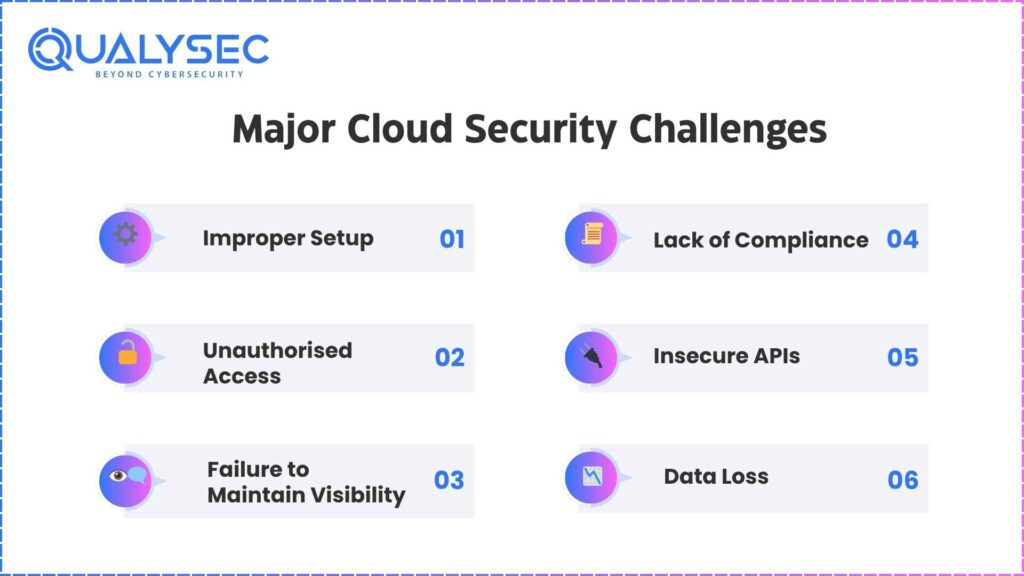
1. Improper Setup
Inadequate configurations of clouds—such as public access to storage buckets—can lead to the release of personally identifiable information. Such little mistakes are a primary reason for cloud breaches and can go unnoticed until it is too late.
2. Unauthorised Access
Weak passwords, no multi-factor authentication (MFA), and poor access management can allow attackers to gain entry without restriction. Once inside, they can move around and do damage.
3. Failure to Maintain Visibility
Cloud-based systems evolve quickly. The lack of visibility into who is doing what, and the ability to detect unusual activity promptly when monitoring tools or behaviour analytics are missing, makes it difficult to manage.
4. Lack of Compliance
Industries regulated by legislation such as HIPAA, PCI-DSS, or GDPR, among others, need to ensure security and audit processes meet these compliance regulations. Failing to do so can lead to fines and customers no longer wanting to work with you.
Also Read: Compliance security audit services.
5. Insecure APIs
APIs are the connections to services that are hosted in the cloud. For that reason, APIs can represent the Achilles’ heel when exposed, as adversaries use APIs to gain access. Behind every insecure API is a vulnerability that can be exploited to allow an attacker access to the entire environment.
6. Data Loss or Data Leakage
Data can be lost by accidents relating to data deletion (often accidental), backups failing with age, or insider threats. Without proper stewardship of data and laws protecting it, sensitive data can make its way to people who may leak it.
Take a look at Qualysec’s ratings and reviews on Clutch to see how we help businesses secure their cloud infrastructure. Book a free live consultation to learn more.
Emerging Trends in Cloud Security Solutions
Cloud security is evolving fast. Here’s what’s trending right now:
1. Zero Trust Security Models
Trust no one, verify everything. Zero trust mandates strict identity verification and restricts lateral movement within networks.
2. AI & Automation
AI is enabling quicker threat detection and response automation, reserving manual work solely for security teams.
3. CNAPP (Cloud-Native Application Protection Platforms)
Combines a plethora of tools, including CSPM and CWPP, into a single platform to protect cloud-native applications from code to runtime.
4. DevSecOps
Security is no longer an afterthought—it is incorporated into the development process from the beginning and uses automated scans and policy enforcement through the CI/CD process.
5. Multi-Cloud and Hybrid Cloud Management
Most enterprises are using multiple clouds to do business. Security tools are evolving to allow users to manage security across AWS, Azure, GCP and on-prem at the same time.
Also Explore: Trusted cloud security companies in 2025.
Conclusion
Cloud security isn’t a “set it and forget it” affair. It’s ongoing, with the key ingredient being the right combination of people, processes, and tools and reliable cloud security solutions. It’s also required that your defenses change and grow as threats become more advanced.
Start by understanding what you’re responsible for in your cloud deployment, and then layer in the right solutions (CASB, CSPM, CWPP) to cover all your bases. Finally, maintain best practices, remain attuned to trends, and consistently enhance your cloud protection progress.
Have any questions? Feel free to ask now—our cybersecurity experts are here to help.
FAQ’s
1. What are cloud application security solutions?
Cloud application security solutions are comprehensive protection strategies designed to safeguard cloud-based applications from ever-evolving cyber threats, including data breaches, hacks, or bad configurations.
2. What are the biggest cloud security problems today?
The same items come up primarily: people access when they shouldn’t, poor setup mistakes, and lack of knowledge. Many companies have issues adhering to security policies or protecting interactions between systems.
3. What can you do to protect your cloud systems?
Use complex passwords, use two-factor authentication (like sending a code to your mobile), keep your data locked up, and watch it regularly for issues. Cloud based security solutions with automated monitoring tools can also help notify you when there is an issue or abnormal behaviour.
4. What’s new in cloud security?
Some newer, better ways to secure include vetting every user, not just once when they start their role, smart tools that can respond to threats quicker, and building security in your work from day one. The objective is to outsmart the threat.
5. How do these tools prevent data from being compromised?
They monitor your systems around the clock, disrupt unwarranted behaviour along the way, and notify you quickly if a problem occurs or if an abnormality is observed. They will also assist with identification and automated remediation before damage can occur.
6. What security tools are common for most organisations?
Organisations employ a combination of security tools that monitor their environments, stop attacks, help them comply with regulations, and protect remote employees. These types of tools largely help organisations find suspicious activity and maintain security without having to monitor or protect everything manually.
More:

































































































0 Comments