






Qualysec

BLOG

Cybersecurity in Premarket Approval (PMA) Applications and PMA Supplements

Pabitra Kumar Sahoo

Pabitra Kumar Sahoo

Published On: April 13, 2026

chandan

Chandan Kumar Sahoo

August 29, 2024

Cybersecurity in Premarket Approval (PMA) Applications and PMA Supplements
Table of Contents

Introduction

You can do everything right on the clinical side and still watch your PMA get blocked before review even begins. That is exactly what is happening to teams that treat cybersecurity as a secondary requirement.


At the Premarket Approval level, the FDA does not just evaluate whether your device works. It looks at whether your entire system can stay secure in real-world conditions. An FDA PMA Supplement guidance raises the same scrutiny when changes introduce new risks.


With FDA Section 524B, this is no longer flexible. Submissions must now include vulnerability management plans, secure design processes, and clear software transparency, or they risk refusal before review.


Most teams are still not building for that level. So, where exactly do PMA submissions fail, and how do you avoid them?

Key Takeaways

  • Cybersecurity is now part of the core evaluation in PMA submissions and directly influences approval decisions
  • PMAs require a clear explanation of how cybersecurity risks impact patient safety and clinical outcomes
  • FDA Section 524B requires SBOM, vulnerability management plans, and ongoing security processes across the device lifecycle
  • The FDA reviews how the entire system manages risk, not just individual vulnerabilities or scan results
  • Changes in cybersecurity, even if small, can require a PMA supplement depending on their impact

FDA Cybersecurity Guidance You Must Align With 

The FDA Cybersecurity in Medical Devices Guidance now plays a direct role in how your submission is judged. With the 2025 update, it aligns with Section 524B of the FD&C Act, which means cybersecurity is no longer treated separately from safety and effectiveness. It is part of the core evaluation.


The update also introduces Section VII, focused on cyber devices. This is where the FDA makes its expectations clear. If your device includes software and connects to a network, it will likely fall under this scope, which covers most modern devices. 


Because of this, your submission needs to show how security is handled beyond the design stage. You are expected to explain how vulnerabilities will be tracked and fixed over time, how secure development practices are followed, and provide a complete Software Bill of Materials.

The implication is simple. If cybersecurity is not clearly demonstrated as part of your device lifecycle, your submission will not meet FDA expectations.

What Makes PMA Cybersecurity Different from 510(k)

The difference starts with how each pathway is evaluated. A 510(k) is built on comparison. You show your device is substantially equivalent to one already on the market. A PMA takes a completely different route. You need to prove safety and effectiveness with your own data, often supported by clinical evidence.


In a 510(k), cybersecurity usually appears as structured documentation. You outline controls, testing, and risk management. If nothing introduces new concerns compared to the predicate, it generally fits within the review. But in PMA, cybersecurity has to be explained as part of how the device actually behaves in real conditions. 


The FDA looks for a clear chain:

  • How a threat exists
  • How it can be exploited
  • What it does to the device
  • How does that lead to patient harm
  • How do your controls reduce that risk

This is where things get stricter. In PMA, cybersecurity is not just a technical detail. It becomes part of the benefit-risk discussion. If that connection to clinical impact is not clearly shown, the submission starts to fall apart.

Cybersecurity Requirements for PMA Submissions

Secure Product Development Framework (SPDF)

At the PMA level, cybersecurity is judged by how your team actually builds the product over time. The FDA looks for a Secure Product Development Framework, but not as a document you attach. It should show up in your decisions, your design flow, and how you handle risk as the device evolves. 


What matters is whether security is part of the process from the beginning and continues after release. Your submission should reflect:

  • Threat modeling influences early design, not added later
  • Secure coding practices were followed during development
  • Risk management continues after the device is in use

This is where many teams fall short. They show a secure product. The FDA is looking at something deeper. Whether the way you build can consistently produce secure outcomes.

Cybersecurity Risk Management File

This section should read like a clear explanation of how your device handles real risk, not a collection of disconnected inputs.


You are showing how an attack could actually happen, how serious it is, and what you have done to reduce that risk. That starts with realistic threat scenarios based on how your device operates in practice. From there, you bring in exploitability scoring such as CVSS to show how feasible those scenarios are, and then connect that to patient impact, not just system behavior.


A technical issue on its own is not enough. What matters is what it leads to in a clinical setting. The structure behind all of this should stay tight:

  • Each risk links to a specific control
  • Each control connects to validation or test evidence

The FDA looks for this traceability. Risk, control, and verification should follow a clear path without gaps. If that connection feels broken or unclear, the analysis becomes difficult to rely on.

Software Bill of Materials SBOM

SBOM is no longer something you add for completeness. Under FDA Section 524B, it is a required part of your submission for any cyber device. SBOM is a full inventory of the software inside your device. Not just what you built, but everything it depends on.


That includes:

  • Open source components
  • Third-party libraries
  • Off-the-shelf software
  • All of it tracked at the version level, not just names

The 2025 update tightened this further. SBOMs now need to be provided in a machine-readable format such as SPDX or CycloneDX, so reviewers can actually analyze the data instead of reading static files.

Security Architecture Documentation

The flow of data should be easy to follow from entry to exit, including how it passes through different components and systems. When data moves between internal and external parts, those points need attention because that is where control shifts and risk tends to increase.


Access points also need to be visible. APIs, interfaces, and any external connections should not be buried or assumed. If something can be reached, it needs to be obvious.


The important part is how this ties back to security. If there is a path an attacker could take, the documentation needs to make it clear where that path is stopped. The protection should sit right at the point of risk, so it is easy to understand.


Many submissions describe the system. The stronger ones make it easier to see how that system handles real threats.

Security Testing Evidence

Testing should reflect how the device holds up under different conditions. Penetration testing shows how an attacker could approach it in practice. Fuzz testing pushes the system with unexpected inputs to see how it reacts. Static and dynamic analysis help uncover issues in code and during execution.

What you include matters more than what you say.

  • Detailed test reports, not summaries
  • Proof of successful exploitation where it exists
  • Clear validation that identified issues were fixed

If the evidence feels incomplete or too high-level, it raises questions about how deeply the device was tested and whether risks were fully understood.


Latest Penetration Testing Report
Penetration testing report

Patch and Vulnerability Management Plan

Your plan should explain how you deal with vulnerabilities once the device is in use. Start with how issues are received and handled.


Provide a clear way to log, review it, and decide what to do when someone reports a vulnerability. This should not depend on ad hoc decisions. Define timelines clearly. Fix more serious issues faster, while lower-risk ones can follow a different schedule. Think through that difference.


You also need a basic process for coordinated disclosure. If an external researcher reports something, there should be a way to communicate, fix the issue, and share information responsibly.


Under Section 524B, this is part of the process. The FDA wants to see that you can monitor issues and release updates when needed, not just at launch but throughout the device lifecycle.

Labeling and User Documentation

Users should know how to set the device up without putting it at risk. Explain Basic things like configuration and access settings in a way that leaves no confusion.


Updates also need a clear explanation. If something installs automatically, say that. The user has to take action; make that obvious. If there are any known security limitations, mention them. Hiding them or softening the language only creates problems later. This part is checked during review, so it needs to be clear and complete.

Cybersecurity Risk and Clinical Impact Mapping

Cybersecurity risks need to be translated into patient impact. Without that link, the analysis stays technical and does not carry weight in a PMA.


A few examples make this clear:

  • Ransomware can block access to the device, leading to delayed therapy
  • Data manipulation can result in incorrect diagnosis or treatment

The FDA looks for a structured explanation for each risk. That includes:

  • How serious the clinical outcome is
  • How likely the scenario is to occur
  • Define what risk remains after controls are applied, and explain why it is acceptable.

This approach aligns with ISO 14971, where severity and probability drive the overall risk decision.

Cybersecurity in PMA Supplements (When Changes Trigger Re-Approval)

Not every update needs a new submission, but some changes do cross that line. In the context of cybersecurity, a PMA supplement comes into play when a modification can affect how the device handles risk or impacts safety and effectiveness. It is not about small fixes. It is about changes that alter how the system behaves.


Common situations where this happens include adding new connectivity, such as WiFi or cloud features, updating encryption methods, or redesigning parts of the software architecture. These changes can introduce new attack paths or shift existing risk, which is why they get closer scrutiny.


The 2025 update provides more clarity on what teams need to document when they make these changes. The FDA now expects a clearer explanation of what changed, how it affects risk, and how teams control those risks.


A simple way to think about it:

Change TypeLikely FDA View
Minor patchNo supplement
Security enhancementCase by case
Architecture changeSupplement required

The key is not the size of the change, but its impact on risk and system behavior.

Why PMA Applications Fail Due to Cybersecurity 

Weak threat modeling

A lot of submissions mention threats, but they don’t go far enough. The FDA often flags this when teams do not evaluate risk across the full system or miss real attack paths.

No link to patient impact

Some teams stop at technical risk. That’s not enough. If it’s not clear what happens to the patient, the analysis feels incomplete.

Incomplete SBOM

Missing components create doubt. It suggests parts of the software are not fully tracked, which also means hidden risks.

No plan beyond release

Teams often treat security like a one-time activity. The FDA looks at how it will handle the device is in use, not just before submission.

Poor structure

Even solid work can fall apart if the information is scattered. Reviewers expect things to connect without digging.

Too much reliance on tools

Scan results are useful, but they don’t explain real-world behaviour. The FDA looks at how risks actually play out, not just what a tool reports. Most of these problems come down to one thing. The story is not clear enough.


Avoid costly PMA cybersecurity mistakes before submission. Contact our complete readiness assessment with our Qualysec experts.

Step-by-Step PMA Cybersecurity Submission Strategy
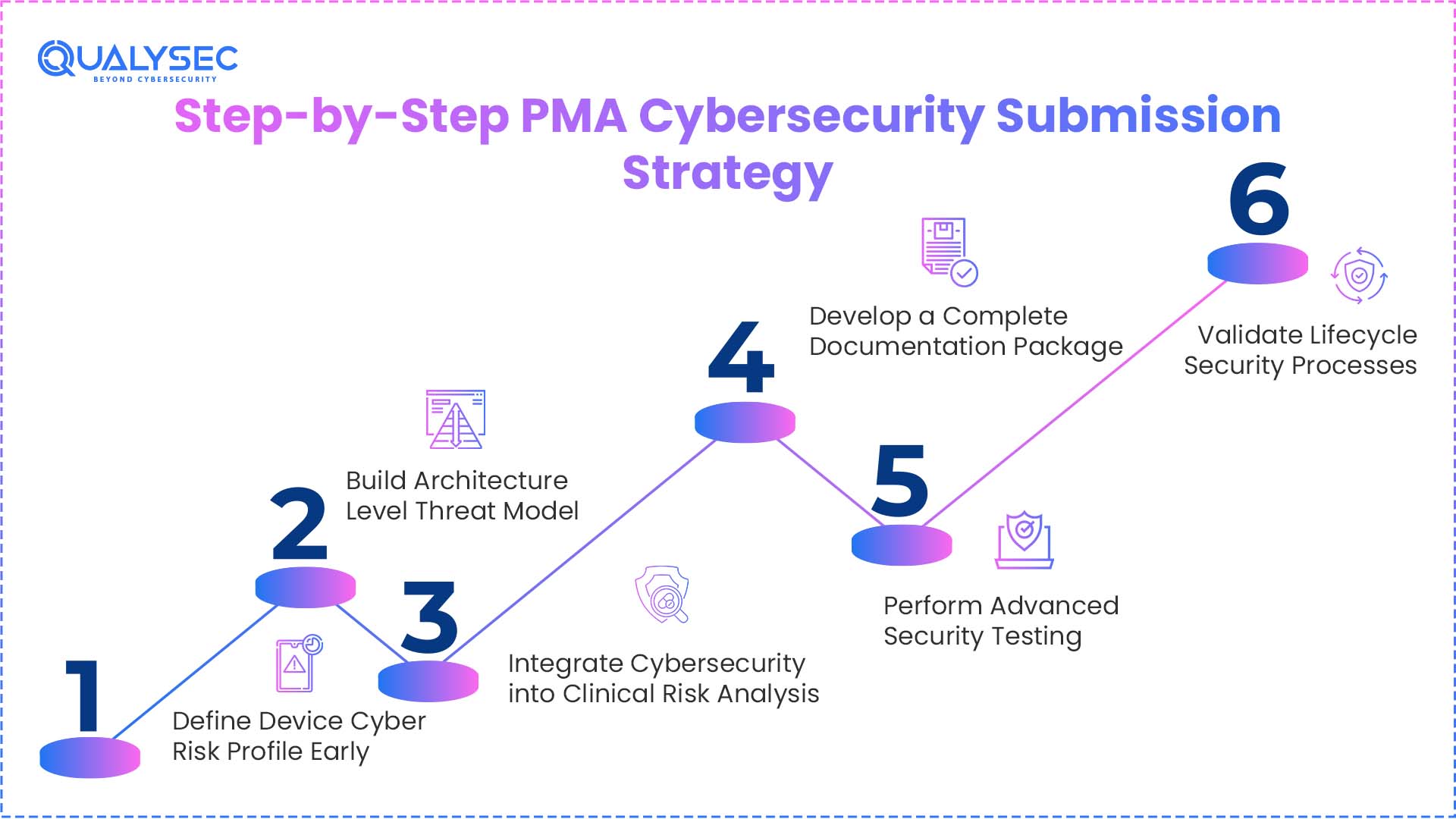
Step-by-Step PMA Cybersecurity Submission Strategy

Step 1: Define Device Cyber Risk Profile Early

Start by understanding the basics of your device. Look at connectivity, data sensitivity, and where users can access it. If it connects to networks or handles patient data, it already falls under stricter scrutiny as a cyber device.

Step 2: Build Architecture Level Threat Model

Think in terms of real attackers. Identify who might target the device and how they could move through it. Map trust boundaries and entry points so you know where risk actually exists.

Step 3: Integrate Cybersecurity into Clinical Risk Analysis

Do not keep cybersecurity separate. If something fails due to a cyber issue, what happens to the patient? That connection needs to be part of your safety and effectiveness argument.

Step 4: Develop a Complete Documentation Package

Keep everything structured and connected. Risk analysis, testing, and controls should not sit in separate places. The reviewer should not have to search for how things link.

Step 5: Perform Advanced Security Testing

Use both manual and automated security testing. Tools can find issues, but manual testing shows how attackers can actually use those issues in real scenarios.

Step 6: Validate Lifecycle Security Processes

Show how you will handle vulnerabilities after release. This includes patching, monitoring, and coordinated disclosure. These are required under Section 524B.

Real World Challenges in PMA Cybersecurity Industry Insights

  • Documentation depth is often underestimated
    Teams do the work, but the level of detail required in submissions is higher than expected. FDA guidance asks for structured, connected evidence across all sections, not summaries.
  • Linking cyber risk to patient impact is difficult
    It is easy to describe a vulnerability. It is harder to explain what it means for patient safety. This gap shows up frequently.
  • SBOM management gets complicated fast
    Devices rely on multiple third-party and open source components. Keeping track of all dependencies and versions becomes difficult, especially as software changes over time.
  • Coordination across teams is not smooth
    Engineering, security, and regulatory teams work on different parts. When they do not align, gaps appear in risk analysis, documentation, and final submission.

Future Trends in PMA Cybersecurity

AI and ML introduce new types of risk

AI-driven devices bring problems that did not exist before. Attacks like data poisoning can corrupt training data, while model drift can change how the device behaves over time. Both can directly affect clinical decisions if not monitored.

Zero Trust is moving into medical devices

Traditional perimeter-based security is not enough anymore. Devices are becoming more connected, which means access needs to be verified at every step, not assumed. This shift is already happening in connected healthcare systems.

More focus on third-party software and cloud

Devices now rely heavily on external components and cloud services. Regulators are paying closer attention to these dependencies because they expand the attack surface and introduce risks outside the manufacturer’s direct control.

Continuous validation is replacing one-time checks

The expectation is changing. It is no longer enough to submit documentation once. The FDA is moving toward a lifecycle approach where teams continuously monitor performance, security, and risks after deployment.

How Qualysec Supports PMA Cybersecurity Readiness
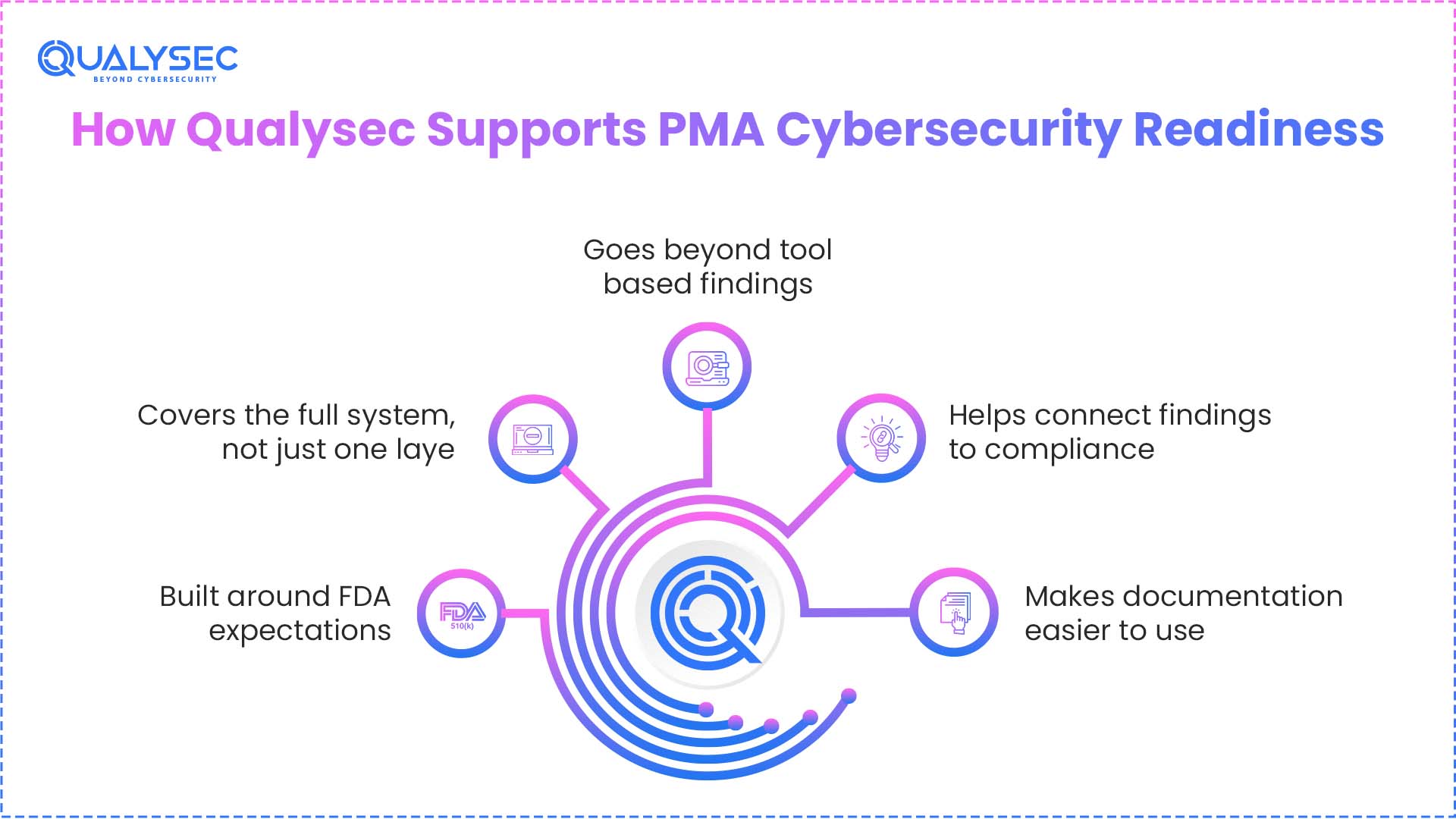
How Qualysec Supports PMA Cybersecurity Readiness

By the time teams reach PMA, they already know their system. The hard part is explaining it clearly enough for someone else to evaluate it.


  • Built around FDA expectations: Qualysec does not treat testing as a standalone activity. The focus stays on how teams will use the results in a submission, so the work aligns with FDA expectations from the start.
  • Covers the full system, not just one layer: Devices today are not isolated. APIs, cloud, mobile apps, and backend systems all connect. Testing is done across these areas so nothing important gets missed.
  • Goes beyond tool-based findings; Automated scans can generate noise. Manual testing helps filter that and shows what actually matters in a real scenario, especially when proving exploitability.
  • Helps connect findings to compliance: Technical issues are mapped to standards like FDA guidance, OWASP, NIST, and ISO 27001. This makes it easier to explain why something matters, not just that it exists.
  • Makes documentation easier to use: Instead of raw reports, the output is structured so it can be used directly in submissions. That saves time and avoids rewriting everything later.

In practice, the value is simple. You get testing that already fits into how PMA submissions are reviewed, instead of trying to adjust it later.

Conclusion

Getting through an FDA PMA Supplement guidance is no longer just about proving your device works. It also requires you to prove that you can trust it.


Cybersecurity now sits at the centre of that decision.

It shapes how your design system, how you understand risks, and how you manage those risks over time. A submission that treats it as a set of documents often feels incomplete. One that builds it into engineering and regulatory thinking holds together much better.


What stands out is not how much you include, but how clearly everything connects. Clinical impact, system behavior, and long-term risk handling need to make sense as one picture.


As devices continue to connect, integrate, and rely on software, this will only become more important. Cybersecurity will shape not just approvals, but whether users feel confident relying on the device in the first place.


Ready to implement your PMA cybersecurity strategy? Schedule a call with our experts.

Talk to our Cybersecurity Expert to discuss your specific needs and how we can help your business.
FAQs

What cybersecurity requirements apply to Premarket Approval Applications PMAs and PMA supplements

For PMA and PMA supplements, cybersecurity directly ties to safety and effectiveness. You need to include secure development practices, risk management, SBOM, security testing evidence, and a plan for handling vulnerabilities after release. These requirements come under FDA Section 524B.
Is penetration testing mandatory for Premarket Approval Applications PMAs

Penetration testing is not listed as a single mandatory item, but in practice, it is expected. The FDA looks for real-world testing evidence that shows how vulnerabilities can be exploited and how they are fixed.

What cybersecurity documentation is required for PMA supplements

For supplements, documentation depends on the change. You may need updated risk analysis, revised architecture details, testing results, and impact assessment showing how the modification affects security and patient risk.

How often should cybersecurity testing be updated for PMA supplements

Update testing whenever changes affect the system. This includes new features, connectivity changes, or updates that introduce new risks. It is not time-based; it is change-driven.
What are the common cybersecurity challenges in Premarket Approval Applications PMAs

Most teams struggle with linking cyber risks to patient impact, managing SBOM complexity, and organizing documentation in a way that clearly connects risk, control, and evidence.

Qualysec Pentest is built by the team of experts that helped secure Mircosoft, Adobe, Facebook, and Buffer

Pabitra Kumar Sahoo

Pabitra Kumar Sahoo

CEO and Founder

Pabitra Sahoo is a cybersecurity expert and researcher, specializing in penetration testing. He is also an excellent content creator and has published many informative content based on cybersecurity. His content has been appreciated and shared on various platforms including social media and news forums. He is also an influencer and motivator for following the latest cybersecurity practices. Currently, Pabitra is focused on enhancing and educating the security of IoT and AI/ML products and services.

Leave a Reply

Your email address will not be published.

Save my name, email, and website in this browser for the next time I comment.

0 Comments

No comments yet.

Chandan Kumar Sahoo

CEO and Founder

Chandan is the driving force behind Qualysec, bringing over 8 years of hands-on experience in the cybersecurity field to the table. As the founder and CEO of Qualysec, Chandan has steered our company to become a leader in penetration testing. His keen eye for quality and his innovative approach have set us apart in a competitive industry. Chandan's vision goes beyond just running a successful business - he's on a mission to put Qualysec, and India, on the global cybersecurity map.

3 Comments

emurmur

John Smith

Posted on 31st May 2024

Lorem ipsum dolor sit amet, consectetur adipiscing elit. Ut et massa mi. Aliquam in hendrerit urna. Pellentesque sit amet sapien fringilla, mattis ligula consectetur, ultrices mauris. Maecenas vitae mattis tellus. Nullam quis imperdiet augue.

    Pentesting Buying Guide, Perfect pentesting guide

    Subscribe to Newsletter

    Scroll to Top
    Pabitra Kumar Sahoo

    Pabitra Kumar Sahoo

    COO & Cybersecurity Expert

    “By filling out this form, you can take the first step towards securing your business, During the call, we will discuss your specific security needs and whether our services are a good fit for your business”

    Get a quote

    For Free Consultation

    Pabitra Kumar Sahoo

    Pabitra Kumar Sahoo

    COO & Cybersecurity Expert