







Introduction
In 2026, payment systems are in constant hunt for cybercriminals. They leak 18 million U.S. cards every year, and they inflict damage in the tune of approximately $6.2 million per attack. Fifty percent of the businesses fail PCI DSS examinations and may be fined up to 100,000 dollars monthly. Analysts caution that the next increase in PCI attacks will be by 25 per cent due to unpatched issues. With this PCI DSS 4.0.1 compliant pentest checklist, you will have a clear guideline on how to secure cardholder data. Adhere to it to prevent attacks, pass audits, and get customer trust, particularly among the U.S. merchants.
Want to secure your systems? Get the PCI DSS 4.0.1 compliant pentest checklist with Qualysec Technologies today!
How to Determine the PCI DSS Pentest Scope?
What Enters the PCI DSS Pentest Scope?
- CDE perimeters
- Internal networks
- External‑facing apps
- Segmentation boundaries
- Poetic systems such as authentication servers and logs.
Why Validate Segmentation in PCI DSS Pentest Scope?
The firewall rules and VLANs are tested every six months to ensure that the CDE remains isolated. In the event of failed tests, the scope may increase to 30%. PCI DSS 4.0.1 requires evidence that unauthorised paths do not exist.
Provide an accurate list of your PCI DSS pentest scope:
- Web applications and external IPs dealing with payments.
- Card data processing servers
- Domestic servers that receive payment information
- Shared environment cloud assets.
- Wireless networks in the CDE.
- Data flow integrations by third parties.
PCI DSS 4.0.1 Compliant Pentest Checklist – 2026
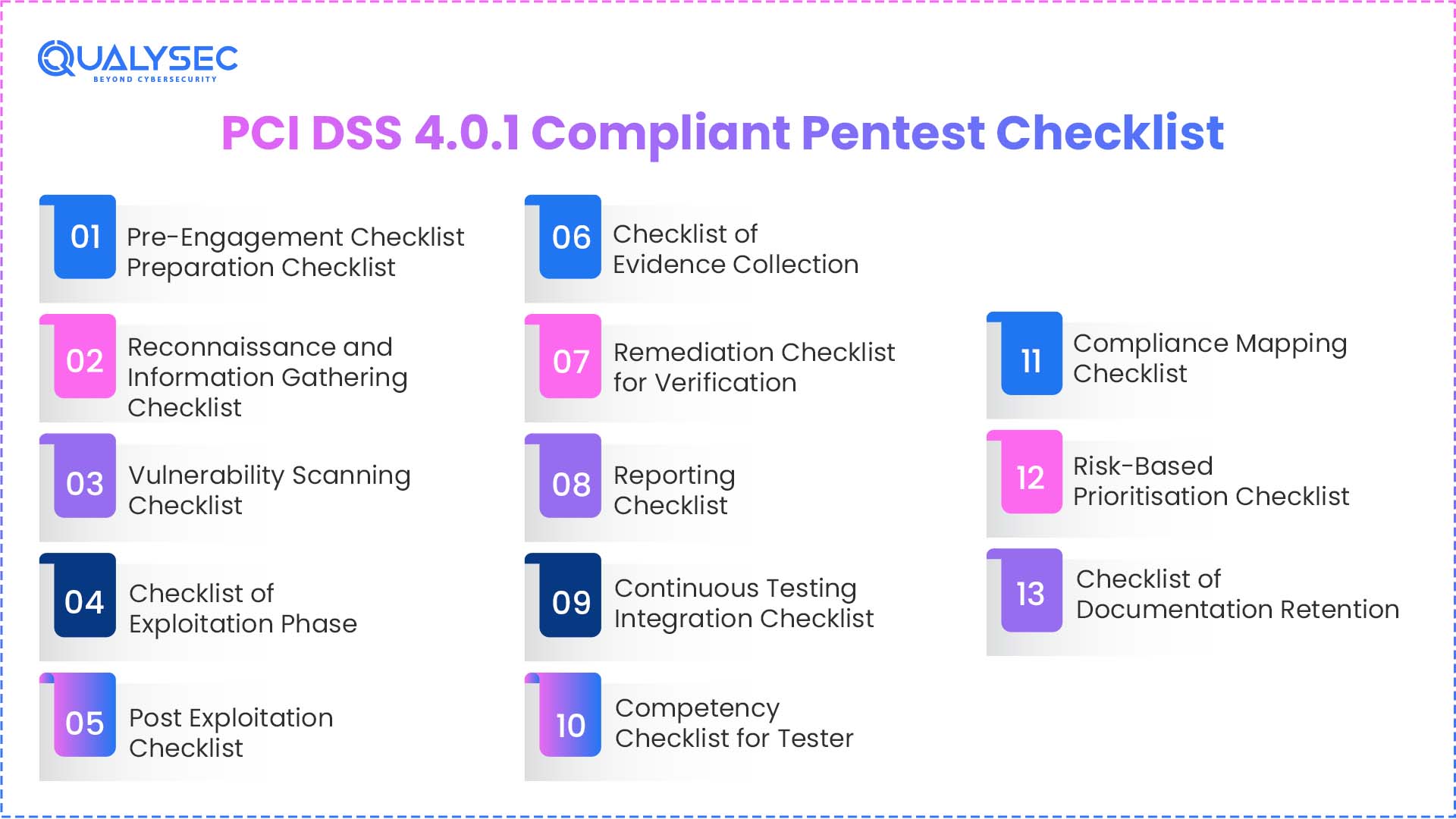
1. Pre-Engagement Checklist Preparation Checklist
Define Testing Objectives:
The teams must find out the test coverage of the PCI DSS rules (11.3 and 11.4). They have to make choices to audit both internal and external systems and guarantee that the objectives safeguard the cardholder information.
Assemble Testing Team:
Hire PCI DSS QPTM certified pick penetration testing. Ensure that the testers do not share with the development or operations personnel. Create distinct roles of the lead tester, report writer and the coordinator of fixes.
Gather Documentation:
Network diagrams and device lists should be reviewed by the teams. Gather firewall policies, access control lists, and information on the network partitioning. Obtain the data flow and application architecture diagrams.
Effect Change Rules of Engagement:
The teams have to define when they test and the times when they cannot test. Instructions on how to terminate tests in case of necessity and emergency personnel. Describe the procedure with sensitive findings.
2. Reconnaissance and Information Gathering Checklist
External Reconnaissance:
All the public IP addresses and domain names should be discovered by the teams. They are required to locate running services, ports, and live hosts. Trace out domain names, subdomains and DNS records.
Internal Reconnaissance:
Workstations with compromised workstations have a list of internal hosts, user accounts, shared folders and network services. They are required to observe trust relationships and domain structure.
Application Reconnaissance:
Web applications and frameworks are fingerprinted by the teams. They find administration pages, user interfaces, and API interfaces. Record third-party parts and libraries.
3. Vulnerability Scanning Checklist
Automated Scanning:
Carry out authenticated and unauthenticated scans. Address high-scoring issues on CVSS. Confirm any suspicious results by hand so as to eliminate false positives.
Targeted Scanning:
Scan payment gateway, authentication servers and logging systems. Encryption of the test and certificate validity. PCI DSS Audit rogue access point wireless networks.
4. Checklist of Exploitation Phase
External Competitor Exploitation Attempts:
Attempt SQL injection or XSS breakage of websites. Attempt to disable authentication on JN portal websites. Apply remote and buffer overflow attacks.
Internal Exploitation Techniques:
Lateral movement by pass-the-hash or Kerberos attacks. Using services or binaries that are not configured correctly can result in escalating the privileges. Since the initial foothold, attempt to access the cardholder data environment.
Exploitation of Segmentation Testing:
Launch an attack through out-of-scope segments and attempt to access the CDE. Effort to circumvent firewall policies and access control lists. Model the movement of data over the boundaries of the segmentation.
5. Post‑Exploitation Checklist
Privilege Maintenance:
Set up ways to keep access. Erase credentials from memory and registries. Trace out all access in the network using the positions obtained.
Data Access Simulation:
Identify the storage and logging areas of cardholder data. Make attempts to read or change unauthorised data. Ensure that there is a prevention of data exfiltration.
Cleanup Procedures:
Erase evidence, backdoors, system modifications. Reset the accounts and settings. Note down all the actions in the audit trails.
6. Checklist of Evidence Collection
Capture Exploitation Proof:
Screenshot all the successful exploit steps. Video record major attack chains. Record all the outputs of the command and record network traffic.
Document Findings:
Categorise risks and effects of the risk group. Issues follow step-by-step reproduction instructions. Mark down the assets that are affected and how it affects business.
7. Remediation Checklist for Verification
Fix Implementation Review:
Authentic patches and configurations were made by developers. Check code reviews and correct bugs in the application. Revised segmentation controls.
Retest High‑Risk Findings:
Re-exploit the fixed problems. To ensure that there are no access paths available. Complete clean reports of production.
8. Reporting Checklist
Executive Summary Section:
Point out the most critical vulnerabilities and general risks. Overview of gaps of PCI DSS 4.0.1 compliance. Recommend priority fixes.
Technical Findings Section:
Enumerate severity-rated vulnerabilities. Explain how they were both exploited. Provide remedial advice and schedules.
Appendices:
Include complete scan traces and packet captures. Provide network diagrams with attack paths. Give a dictionary of definitions and references to methodology.
9. Continuous Testing Integration Checklist
Schedule Recurring Tests:
Arrange internal and external penetration tests once a year. Test the system following significant system changes. Associate with quarterly scans of ASV.
Automate Baseline Checks:
Employ perpetual surveillance devices. Include pentest results on SIEM rules. Create notifications of regularly occurring problems.
10. Competency Checklist for Tester
Qualifications Verification:
PCI DSS QPTM or equivalent certificates are held by certified testers. Test their experience in the payment industry. Check on recent training on the latest attack tactics.
Tool Proficiency:
Demonstrate proficiency with Burp Suite, Nmap and Metasploit. Show individual scripting. One has to be acquainted with cloud-native testing platforms.
11. Compliance Mapping Checklist
Requirement 11.3 Alignment:
Confirm automated scans are at the necessary frequency. Retain quarterly scan results for the necessary time. Test remediation schedules of scan results.
Requirement 11.4 Alignment:
Requirement 11.6 Alignment:
Vulcanise web apps on the OWASP Top 10. Exploitation validation of secure coding. Ensure the process of change-control is resistant to attacks.
12. Risk-Based Prioritisation Checklist
Impact Assessment:
Assess the potential exposed cardholder data. Think of the harm of privilege escalation. Consider the impact of business continuity.
Likelihood Evaluation:
Determine the ease with which an attack can be successful in reality. Examine attacker motivation and ability. Examine the level of effectiveness of compensating controls.
13. Checklist of Documentation Retention
Retain Test Artefacts:
Store raw scan data for a year. Safely keep exploitation evidence. Further retain methodology documentation.
Update Compliance Records:
PCI records the date and results of log tests. Monitor the status of track remediation up to closure. Read the records to be examined by the QSA.
This PCI DSS 4.0.1 compliant penetration testing checklist will help your team to perform a comprehensive and defensible testing that will comply with PCI DSS 4.0.1 penetration testing requirements. These steps are to be followed closely in order to identify actual risks, demonstrate that controls are working, and maintain compliance. Construct and maintain evidence that is audit-ready and enhance the PCI compliance security testing by means of structured and repeatable processes.
What Tools and Methodologies Could Fulfil the PCI DSS 4.0.1 Penetration Testing Provisions?
You can use both automatic scanning of SQL injections, XSS misconfigurations, and manual scanning for PCI compliance security testing. Popular tools that are used by leadership groups are OWASP ZAP, Burp Suite, and Nmap, modified according to PCI guidelines.
Fortify your defences today – reach out to Qualysec Technologies for tailored PCI DSS 4.0.1 compliant pentest solutions!

How Qualysec Technologies Help
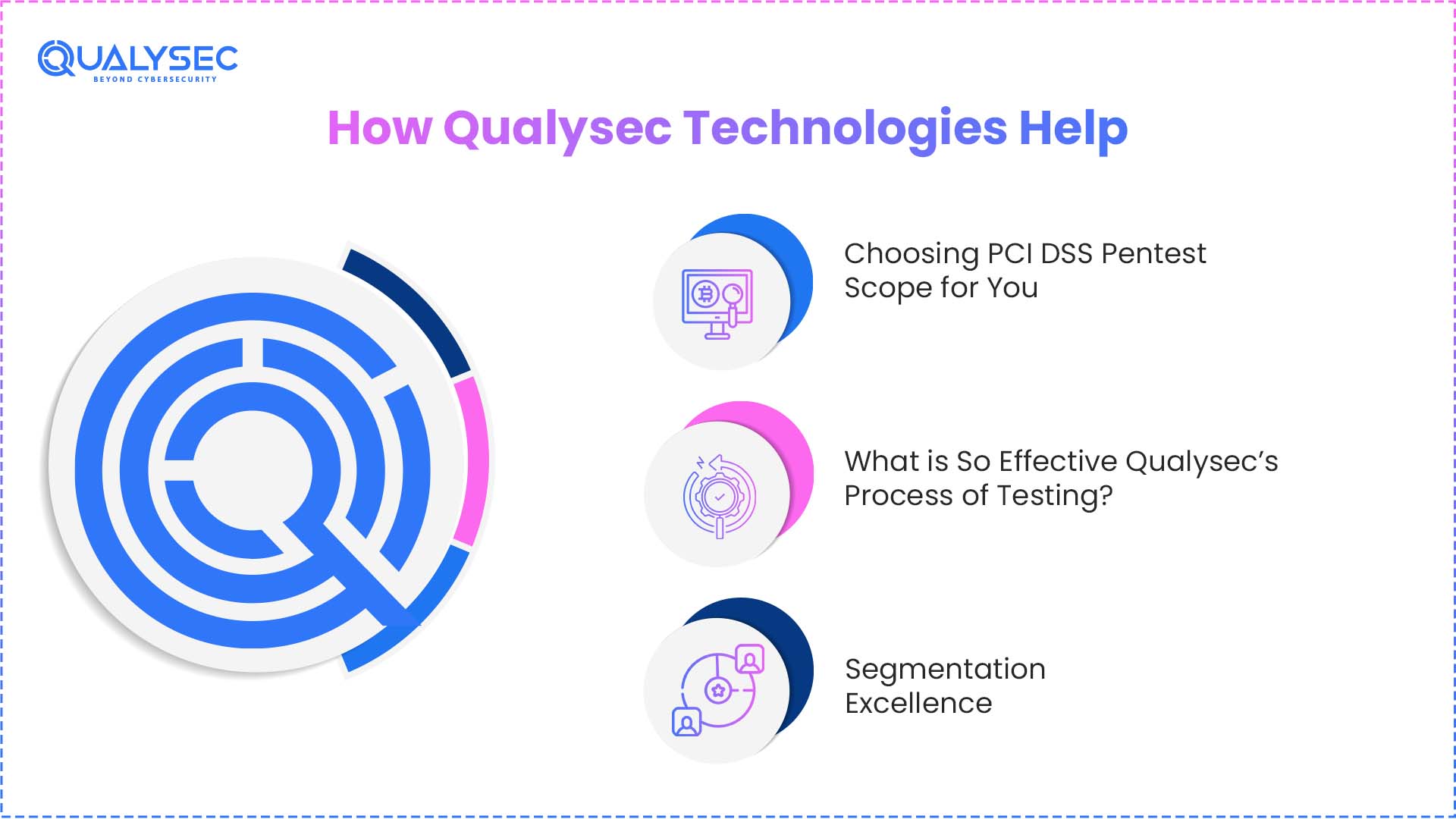
Choosing PCI DSS Pentest Scope for You
You define the very level of your PCI test using our hyper-detailed discovery process. The experts automate the mapping of cardholder information regions, internal networks, cloud assets, and separation lines through automated tools and those by hand. They simulate attacker access points, hence you ensure external applications, APIs, and wireless vulnerabilities. Everything is listed in the scope and reduces audit work for the PCI DSS 4.0.1 compliant pentest checklist.
What is So Effective Qualysec’s Process of Testing?
Qualysec’s testing is special since the testers apply our step-by-step approach based on 2026 threat data. The experts begin with the external scans with Nmap and Burp Suite, then attempt internal attacks such as pass-the-hash and privilege escalation. A real-time dashboard displays live tests to protect cardholder information. This detects more issues than standard scanning and satisfies PCI DSS 4.0.1 penetration testing requirements.
Segmentation Excellence
PCI DSS Segmentation Testing, the testers verify the movement of attackers and the way the data could escape. They firewall rules to test twice a year and demonstrate that card data has not been accessed unauthorised. You can also rerun up to 30 days to ensure fixes are effective, and get CVSS scores, screenshots, and code fixes of the PCI DSS 4.0.1 compliant pentest checklist.
Why Qualysec’s Reports Are Compactable for PCI DSS Pentest Report
You receive executive summaries, issues of priority, and a course of action to rectify them in QSA-ready format. You get reports of attacks and re-test results that will increase your compliance score immediately.
Schedule your PCI DSS 4.0.1 compliant pentest Checklist with Qualysec today – Contact us now!
































































































































































































































































































0 Comments