With the Vulnerability Dashboard, managers, testers, clients, and developers collaborate seamlessly to identify, track, and fix security vulnerabilities in real time.
Discover the blueprint for how mature security organisations, including those partnered with QualySec, invest in offensive strategies to safeguard their operations
The issue of remote access security has been a global concern for organisations. Besides, it is necessary to protect systems against unauthorised access. As a matter of fact, the threats to businesses are rising each day. Thus, installation of secure remote access solutions is now not an option. Moreover, the environment of cyber threats is developing very fast. Therefore, organisations have to change their security strategies. Moreover, remote work has increased the area of attack considerably.
The modern cyber world requires full-scale security. On the same note, the companies must strike a balance between security and efficiency in their operations. Consequently, the conventional security practices are no longer adequate. Later, new methods such as the use of zero-trust remote access are being prominently featured. Furthermore, the problem of remote workforce security should be thoroughly updated at all times. Moreover, regulatory frameworks are increasingly becoming tough across the world.
The 2026 challenges and opportunities present themselves. Organisations should therefore be ready to face threats in the future. Moreover, VPN security best practices have not been understood yet. This guide, therefore, offers practical information on strong defence. We also discuss contemporary security models and plans. Finally, securing your remote access infrastructure will ensure business continuity.
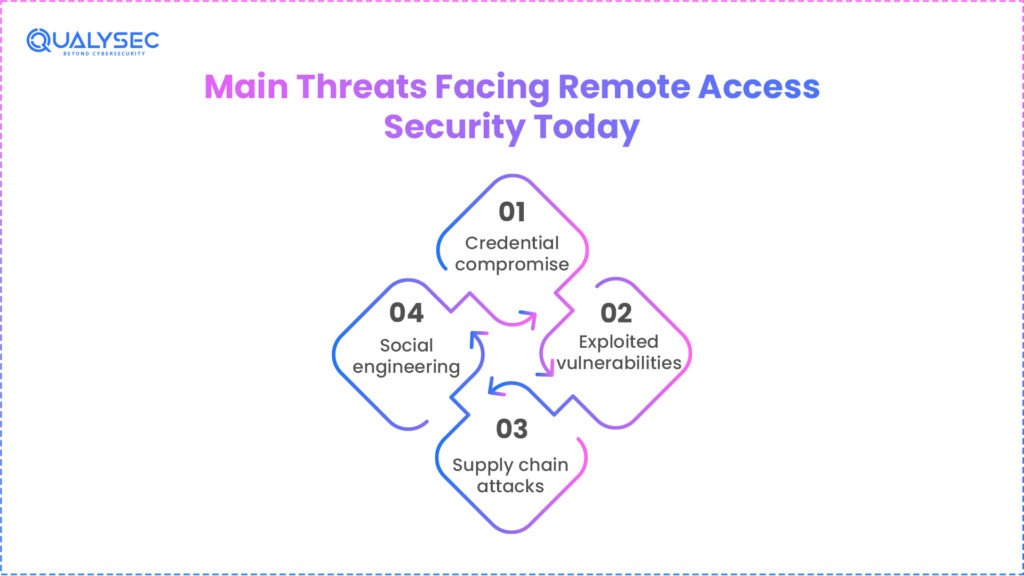
What Are the Main Threats Facing Remote Access Security Today?
The risks of cyber threats to remote access security have become extremely sharp. In fact, the number of attacks designed by harmful actors is constantly growing. Besides, living off the land (LOTL) attacks are growing in number. These attacks are made with the help of honest tools to pass unnoticed. They are, therefore, frequently not detected by the conventional security systems.
The remote access software can be very useful to organisations. It, however, also poses serious security threats when compromised. Moreover, hackers use such resources to achieve unauthorised network access. Further, remote monitoring and management software are often abused by ransomware groups. As such, it is important to be aware of such dangers to defend against.
Common Attack Vectors
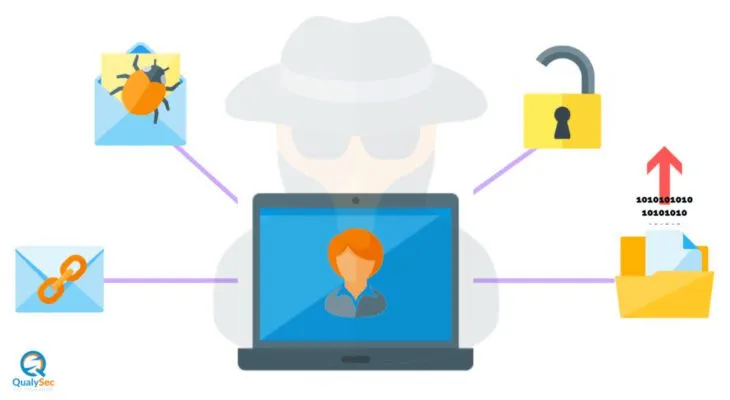
Credential compromise: Hackers steal or even guess weak passwords without any problem. Then they obtain a legal entry without making a commotion.
Exploited vulnerabilities: There are unpatched systems that are easily accessible. Besides, the risk multiplies with the use of outdated software.
Supply chain attacks: Hackers turn into the backdoor to compromised vendors. Further, organisations are attacked using trusted relations.
Social engineering: Phishing attacks are used to deceive users in order to install malicious software. Moreover, such attacks do not observe technical controls at all.
The economic consequences of such attacks are dismal to the world in general. Notwithstanding, enterprises are losing billions of dollars due to breaches of remote access. In addition, the damages incurred tend to be less than the recovery costs. Hence, prevention is much cheaper than redress. Moreover, the damage to reputation may take years after the incidents.
How Can Organisations Implement Secure Remote Access Solutions Effectively?
The use of secure remote access solutions ought to be well planned and implemented. The first step that organisations need to undertake is to evaluate their present security posture. After that, they are able to detect gaps and rank the improvement accordingly. Furthermore, a systematic strategy would provide holiness in terms of coverage in all access points.
The construction of proper security on remote access begins with the effective design of the architecture. Hence, organisations must draw a map of all access pathways remotely. Moreover, awareness of the needs of the user can be used to strike a balance between security and usability. Besides, stakeholders who represent different departments will aid in the provision of practical solutions. Therefore, adoption rates are enhanced in situations where systems address real needs.
Essential Implementation Steps
Asset inventory: Record all gadgets and systems that have to be accessed remotely. Additionally, assigns resources according to the level of criticality and sensitivity.
Access policies: Spell out clear access policies about access to what. Also, apply role-based access control in all the environments.
Authentication mechanisms: Implement multi-factor authentication for all remote connections. In addition, get rid of stagnating credentials wherever feasible as soon as possible.
Monitoring systems: Have a continuous check on the remote access activities. Next, process logs regularly and compare the logs to identify suspicious patterns or anomalies.
Regular audits: Review access permissions and configurations. Besides, eliminate outdated accounts and revise regulations promptly.
The recent secure remote access solutions use a combination of security layers at the same time. In fact, multiple controls are superior to single controls in terms of protection. Thus, integrating technologies will result in a stronger security stance. Also, automation is used to create consistency in large environments. Moreover, built-in solutions make the management much more complex. Building a 2026-ready security roadmap needs to be strategised and implemented.
Why Are VPN Security Best Practices Still Relevant in 2026?
VPN security best practices are very fundamental in the current world, even with the emerging technologies. In fact, VPNs are still being used as major remote access devices in the world. In addition, they offer necessary encryption of secure data transmission in a safe manner. Thus, it is again important to learn how to use a VPN correctly.
Nevertheless, VPNs are no longer sufficient to ensure full security of remote access. Actually, the conventional VPN designs are already limited in nature. Moreover, even properly set up VPN systems can be vulnerable. In turn, organisations need to improve VPN implementations by adding controls. Moreover, the use of VPNs together with the current security systems is really protective.
Strong authentication: All connections to the VPN must be multi-factor authenticated. This, in turn, is a way of preventing the credential-based attacks today.
Regular updates: It is always best to keep VPN software and firmware up-to-date. Besides, implement security patches upon release.
Split tunnelling control: This is a special consideration of what traffic flows over VPNs. Also, discourage unauthorised access to corporate networks through the internet.
Connection monitoring: Monitor all VPN sessions for suspicious activity at all times. Moreover, apply robotic notifications about suspicious patterns of connections.
VPN security best practices in modern times involve the combination with other security tools. Thus, endpoint protection used together with VPNs increases the overall level of security. Also, the use of network access control will offer granular network access control that is granular. Furthermore, the zero trust principles are effective when used with the conventional VPN framework. In turn, combined measures are more effective than a single design.
Important Note: VPNs are necessary but should be used in a whole-body remote access security plan. Thus, various security controls need to be implemented by the organisations. Moreover, periodic security tests can be used to find the areas of vulnerability before they are exploited by the attackers.
How Does Zero Trust Remote Access Transform Security Architecture?
Zero-trust remote access is a revolutionary change in security thinking. In particular, it does not presuppose trust of any user or device by default. In addition, all access requests are verified irrespective of origin. This, therefore, goes a long way in helping to minimise the available attack surface. Moreover, the concept of zero-trust remote access is perfectly in line with the current threat landscape.
The main type of security models used in the past was based primarily on network perimeter defences. Nevertheless, they did not work as remote work became internationalised. Also, the traditional boundaries became practically meaningless due to the adoption of the cloud. Hence, zero-trust remote access offers enhanced protection to distributed environments. Next, the organisations can acquire resources at any location successfully.
Core Zero Trust Principles of Remote Access Security
Verify explicitly: This is to verify and authenticate using available data. In addition, access decisions can be made with confidence using several signals.
Least privilege access: Only give access to the minimum required permissions. Also, get access revoked when unnecessary.
Assume breach: Design systems that will experience security failures. Moreover, reduce the blast radius by segmentation and constant monitoring.
Continuous validation: Do not believe once and forget about validation. Rather, revoke access at session lifetime boundaries continuously.
Zero-trust remote access is a complex and expensive implementation, which must be planned and deployed in phases. To begin with, organisations are to stock all resources and access requirements. They are later able to formulate proper policy frameworks systematically. In addition, a high-value ratio proves value within a short time. So, pilot programs assist in testing strategies and make improvements before expansions. Moreover, user training will make the adoption process very easy and will create a lot less friction.
Zero-trust remote access has advantages other than enhancing security. In fact, it increases access patterns and behaviour visibility. Furthermore, companies have enhanced control over the whole environment. Moreover, compliance needs also become simpler to demonstrate and uphold. As a result, numerous regulatory frameworks are currently proposing zero-trust methods. Zero trust is the focus of CISO recommendations for 2026.
Why Is Qualysec the Best Company for Remote Access Security in the USA and Global Markets?
The selection of an adequatesecurity partner is an important step towards the success of remote access security. Thus, companies require the services of seasoned providers with an awareness of complicated needs. Qualysec is a successful cybersecurity firm in the world. In addition, they specialise in end-to-end security services to businesses. Moreover, they are now the most competent when it comes to the security of the remote workforce.
Qualysec provides services relating to the provision of end-to-end security to companies. To begin with, they have a team that carries out comprehensive vulnerability tests. They then give specific remediation instructions and steps of implementation. In addition, it is a specialised company in the business of secure remote access, which is a speciality of Qualysec. Thus, they are aware of the challenges that are peculiar to organisations nowadays.
Their comprehensive service portfolio includes several critical capabilities:
Penetration testing: Coax the vulnerabilities to be detected before the systematic exploitation by the attackers. In addition, be provided with detailed reports and prioritised remediation recommendations.
Security architecture review: Review the existing designs based on best practices. Moreover, get strategic advice on improvement efforts.
Compliance consulting: Navigate complex regulatory requirements confidently and efficiently. Furthermore, ensure continuous compliance through ongoing support programs.
Security training: Educate teams on security best practices and threats to VPN. Later on, develop internal security awareness and capabilities systematically.
Incident response: Get expert support when security incidents occur rapidly. Moreover, minimise damage through quick and effective response actions.
Zero trust implementation: Gradually go to zero-trust remote access architectures. As well, get practical assistance during implementation stages.
Qualysec has an international presence, allowing it to have local expertise and international standards. In fact, they provide clients in the USA and globally effectively. In addition, they have a team that is aware of the compliance needs and cultures in the regions. Hence, the solutions are feasible and culturally suitable in both markets. Moreover, 24/7 support is provided so that assistance can be given at any time.
The firm has a promise of zero-trust remote access, which makes it stand out. In particular, they assist the organisations in the process of transferring traditional security models to the new ones. Besides, Qualysec offers on-the-job implementation assistance during projects. Moreover, they provide constant monitoring and optimisation for them. As a result, security posture is enhanced gradually in a systemic manner.
Why Choose Qualysec?
Key Services:
Comprehensive penetration testing and vulnerability assessments
Remote access security architecture design and implementation
Secure remote access solutions deployment and management
Regulatory compliance consulting and audit support
24/7 security monitoring and incident response
Unique Value Propositions:
Industry-leading expertise in remote workforce security
Proven track record across multiple industries globally
Tailored solutions for organizations of all sizes
Commitment to practical, implementable security strategies
Ongoing support and partnership approach
Ready to strengthen your remote access security? Qualysec offers free initial consultations to assess your needs. Visit Qualysec to learn more. Additionally, their team can demonstrate how secure remote access solutions protect your organisation effectively.
The testimonials of the clients always point to the high level of professionalism and experience of Qualysec. In fact, institutions flaunt their comprehensive nature and articulateness. In addition, the projects are completed on time and within budget reliably. Thus, companies rely on Qualysec when their most important security requirements are considered. Moreover, long-term associations show value provision in the long run.
Remote access security will continue to be a very high priority up to 2026 and beyond. In fact, threats are constantly changing, and remote working is growing all over the world. Hence, companies need to institute total defence measures at the moment. In addition, the integration of various security methods offers optimal security. Also, scheduled tests serve to detect and deal with emerging weaknesses.
The deployment of safe remote access systems is an activity that needs consistent resources and dedication. The price of not doing so is by far better than protection. Moreover, modern frameworks have to be added to the best practices in VPN security. Afterward, the basis of future security is zero trust remote access. Besides, the security of remote workforces requires enhancement and constant attention.
Companies must move to fortify their security stance to take the initiative. Hence, the initial step is carrying out thorough security tests. Moreover, the collaboration with such providers as Qualysec helps speed up the process. In addition, technical controls are augmented by training and awareness programs on the part of the employees. Finally, remote access infrastructure protection will guarantee business continuity and growth.
The process of achieving a holistic security of remote access starts with one step. As such, act now to secure the future of your organization. Moreover, the use of professional advice of such firms as Qualysec is the guarantee of successful execution. This will then put your organisation in a good position to handle the challenges of 2026. In addition to this, proactive security investments are providing quantifiable returns in terms of the reduction of risk. Lastly, keep in mind that security is not a final location, but it is an ongoing process.
Frequently Asked Questions (FAQ)
1. What are the best practices for securing remote access?
The best practices are to apply multi-factor authentication and constant monitoring. Besides, zero-trust remote access principles and frequent security audits should be applied in organizations.
2. Is VPN still secure for remote access in 2026?
VPNs are safe when correctly configured using the best practices of VPN security. Nevertheless, they are to be integrated with other security levels in order to be fully protected.
3. What is zero trust network access (ZTNA)?
Zero-trust remote access is a cybersecurity system that does not trust users by default. Rather, it authenticates each access request according to the identity and context on a continuous basis.
4. How do you prevent remote access attacks?
The first step towards prevention is the use of safe remote access systems that have high levels of authentication and surveillance. Also, companies should have updated systems and perform frequent security testing.
Qualysec Pentest is built by the team of experts that helped secure Mircosoft, Adobe, Facebook, and Buffer
Pabitra Sahoo is a cybersecurity expert and researcher, specializing in penetration testing. He is also an excellent content creator and has published many informative content based on cybersecurity. His content has been appreciated and shared on various platforms including social media and news forums. He is also an influencer and motivator for following the latest cybersecurity practices. Currently, Pabitra is focused on enhancing and educating the security of IoT and AI/ML products and services.
Chandan is the driving force behind Qualysec, bringing over 8 years of hands-on experience in the cybersecurity field to the table. As the founder and CEO of Qualysec, Chandan has steered our company to become a leader in penetration testing. His keen eye for quality and his innovative approach have set us apart in a competitive industry. Chandan's vision goes beyond just running a successful business - he's on a mission to put Qualysec, and India, on the global cybersecurity map.
Lorem ipsum dolor sit amet, consectetur adipiscing elit. Ut et massa mi. Aliquam in hendrerit urna. Pellentesque sit amet sapien fringilla, mattis ligula consectetur, ultrices mauris. Maecenas vitae mattis tellus. Nullam quis imperdiet augue.
Table of Contents In an increasingly digital world, an organization’s...
Chandan Sahoo
August 29, 2024
Table of Contents In an increasingly digital world, an organization’s...
Chandan Sahoo
August 29, 2024
Table of Contents In an increasingly digital world, an organization’s...
Chandan Sahoo
August 29, 2024
Subscribe to Newsletter
Scroll to Top
Pabitra Kumar Sahoo
COO & Cybersecurity Expert
“By filling out this form, you can take the first step towards securing your business, During the call, we will discuss your specific security needs and whether our services are a good fit for your business”

































































































0 Comments