







Telecom security testing has emerged as a pressing need in the contemporary digital environment. As recent reports indicate, telecommunications has been the most targeted industry, with 38 per cent of all known cyberattacks being conducted in the year 2023. As such, there is a need to undertake comprehensive security of the telecommunications networks and APIs. In addition, telecom security testing assists organisations in determining vulnerabilities before unscrupulous parties can use them. Also, the 5 G network deployment and the growth of the API integrations have increased the area of attack significantly. Therefore, effective telecom security testing strategies should be implemented to ensure the safety of important infrastructure and vital customer information throughout the United States and the whole world.
What Are the Primary Vulnerabilities in Telecom Infrastructure?
The complexity of telecommunications networks and their importance to the global infrastructure pose a wide range of security challenges to the networks. In addition, the vulnerabilities open doors to cyber-criminals to attack sensitive systems.
Critical Attack Vectors in Telecom Systems
The results of the telecom security testing indicate that there are a number of crucial areas of vulnerability that must be addressed by experts. First, the interception and manipulation attacks on legacy signalling protocols such as SS7 and Diameter are still vulnerable. Moreover, these protocols control such basic functions as call routing and messaging services. On top of this, attackers are able to use such weaknesses to intercept communications or maliciously redirect traffic.
Secondly, API security for telecoms has gained more significance due to the fact that APIs have become a significant source of B2B integrations in organisations. Nonetheless, APIs are frequently the targets of:
- Data scraping attempts that extract sensitive information
- Credential stuffing attacks using stolen login details
- Unauthorised access through poorly configured authentication
- Rate-limiting bypass techniques
- SQL injection and cross-site scripting vulnerabilities
- Man-in-the-middle attacks on API communications
Third, the growth of the 5G network security demands new challenges. In particular, 5G infrastructure will have an increased number of devices connected and the ability to slice the network. Thus, the network slices should be secured by separate controls to avoid the lateral movement between virtual networks.
Secure Your Telecommunication Infrastructure Through Penetration Testing.
The Growing Threat Landscape
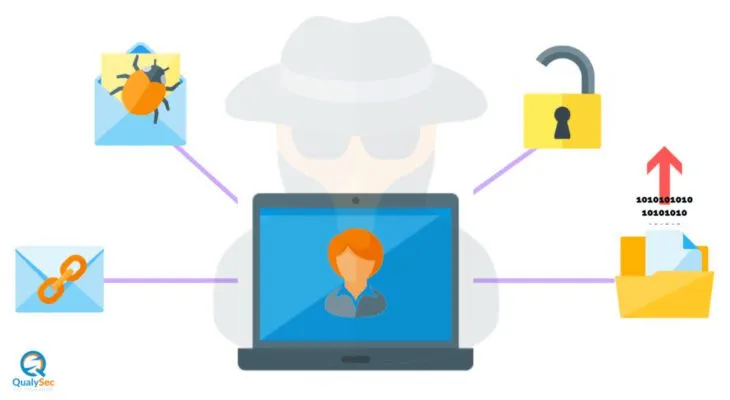
Advanced Persistent Threats (APTs) have always been pointed out as significant issues for telecommunications providers by telecom penetration testing. It is worth noting that some groups of APTs, such as Salt Typhoon and Volt Typhoon, specifically attack telecom infrastructure. Indeed, these advanced hackers apply underhanded methods to stay longer without being detected.
An example of this is Salt Typhoon, which had a long history of accessing the American telecommunication systems. On the same note, they used firewall loopholes to collect credentials and spy on network traffic. In the meantime, Volt Typhoon applies the methods of living off the land by exploiting the built-in system tools, such as PowerShell. Thus, such techniques can assist attackers in staying unnoticed, but with the presence of continuous access.
| Threat Type | Attack Method | Primary Target | Impact Level |
| APT Groups | Long-term infiltration | Network infrastructure | Critical |
| DDoS Attacks | Service disruption | Core network services | High |
| Insider Threats | Credential abuse | Internal systems | High |
| Supply Chain | Third-party vulnerabilities | Vendor connections | Critical |
| IoT Exploits | Device compromise | Connected endpoints | Medium-High |
| API Abuse | Data extraction | Business integrations | High |
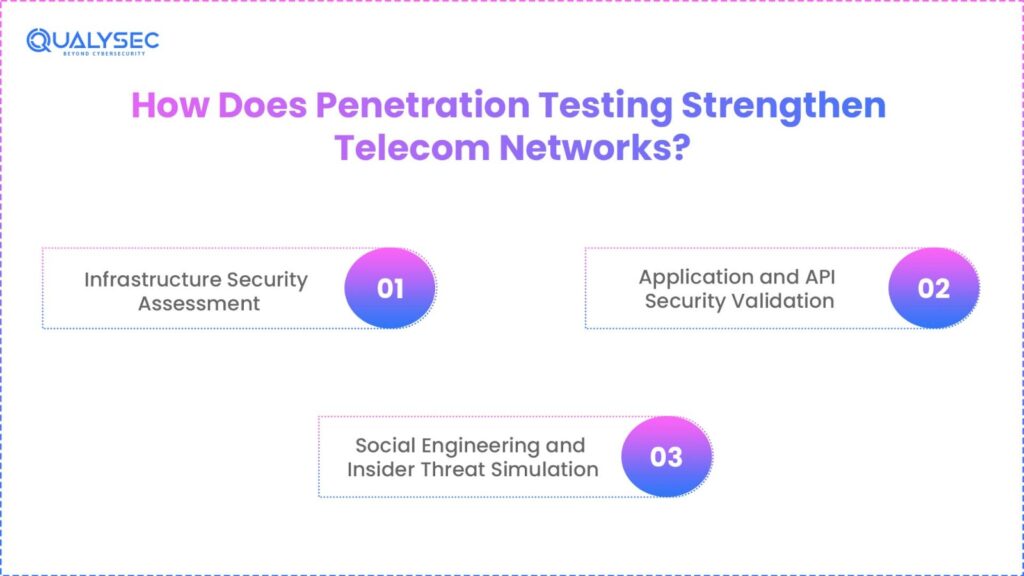
How Does Penetration Testing Strengthen Telecom Networks?
Telecom penetration testing can be used as a proactive measure of identifying and resolving security vulnerabilities. In addition, it emulates an attack situation in the real world under controlled conditions. Thus, organisations will be able to learn about weaknesses before they are exploited by malware agents.
Infrastructure Security Assessment
Telecom security testing is performed to test important network components based on extensive infrastructure testing. The first step taken by testers is to scan routers, switches, DNS settings and DHCP settings to identify vulnerabilities. Besides, internal and external testing approaches give full insight into the security posture.
Besides, infrastructure testing deals specifically with the issues of 5G network security. This leaves organisations in a position to determine network slicing, edge computing, and virtualised network functions vulnerabilities. These understandings are then used to help teams put in place relevant segmentation and access control.
Application and API Security Validation
The API security for telecoms needs a specialised testing methodology to secure the business-critical integrations. Security professionals, therefore, evaluate customer portals, mobile applications and API endpoints in relation to vulnerabilities. Moreover, testing exposes such problems as broken authentication, excessive data exposure, and a lack of rate limiting.
Additionally, testers simulate various attack scenarios, including:
- Authentication bypass attempts
- Authorisation flaws in API access controls
- Input validation testing for injection attacks
- Business logic abuse scenarios
- Session management vulnerabilities
- API endpoint enumeration techniques
Social Engineering and Insider Threat Simulation
Telecom penetration testing involves human-based testing to assess the organisational resilience. In particular, testers can run phishing and pretexting operations that simulate the work of an APT. In the meantime, such simulations are effective in revealing training deficiencies and weak points in policies.
Besides that, the simulations of insider threats are evaluated to determine the effectiveness of compromised employee credentials. Thus, organisations know how bypassers could proceed in the network after acquiring initial access. This can then be used to drive the application of zero-trust security principles.
Learn more about comprehensive Security Vulnerability Testing.
Why Is Compliance Essential for Telecom Security?
Telecom cybersecurity compliance highlights compliance by the organisations with the requirements of regulations while still retaining high standards of security. Additionally, compliance frameworks offer systematic ways of safeguarding confidential information and essential coding.
Key Regulatory Requirements
The Federal Communications Commission (FCC) seven-day rule mandates that telecommunications providers report data breaches within seven days after they have been discovered. As such, organisations need to adopt detection and response capabilities which will enable them to detect breaches quickly. Besides, adherence to industry requirements such as ISO 27001 and NIST models enhances the general security status.
Moreover, the compliance of telecom cybersecurity requires frequent security evaluations and records. Therefore, organisations have to undertake regular vulnerability assessment and telecom penetration testing drills. In addition, it would also be necessary to keep good audit trails and security records as a means to prove compliance.
Building a Compliance Framework
Telecom security testing is essential to ensure that there is adherence to various fields. To begin with, organisations need to undertake a thorough risk assessment to establish the possible threats and weaknesses. These evaluations are then used to inform the decisions made in security control implementation and resource allocation.
Second, vendor management programs make sure that the third-party partners have sufficient levels of security. Thus, organisations should review the security practices of their vendors and require data protection. There are also periodic assessments of vendors to ensure that they comply with security requirements.
Third, business continuity planning proves the organisational strength and adherence to regulations. In particular, disaster recovery processes, as well as operational resilience, will maintain continuity of the services in the case of security incidents. In addition, the routine testing will confirm these plans and show the areas of improvement.
Continuous Monitoring and Improvement
Ongoing monitoring and continuous improvement should be done in telecom cybersecurity compliance. Thus, organisations use real-time detectors in the form of security information and event management (SIEM) systems. Moreover, there are automated compliance monitoring tools that monitor compliance with security policies and regulatory requirements.
Moreover, the routine telecom security testing is used to reveal emerging vulnerabilities and confirm the corrective actions. As a result, organisations are up to date with their security posture because threats change with time. Besides, this loop of feedback can allow the implementation of proactive security enhancements instead of reactive ones.
How Can Organisations Implement Effective Security Testing Programs?
The deployment of the program of thorough telecom security testing needs to be strategically planned and budgeted. In addition, organisations have to strike a balance between the security requirements, the operational requirements and the business objectives.
Developing a Testing Strategy
The telecom penetration testing programs must be conducted in a systematic way that is oriented towards business risks. First, organisations need to establish appropriate testing goals that incorporate threat intelligence and regulatory requirements. Also, all essential assets should be tested, such as network infrastructure, applications, and APIs.
More so, organisations must create a periodic testing schedule that is both comprehensive and not disruptive. In particular, the comprehensive assessment that is conducted on an annual basis and quarterly focused tests are enough to cover the area. In the meantime, the in-between periodical penetration testing is complemented by continuous vulnerability scanning.
Choosing Between Testing Methodologies
The various testing methods have different purposes in an extensive telecom security testing program. That is why organisations should be aware of the time when particular methodologies should be utilised.
Penetration testing is aimed at the discovery of particular technical weaknesses within a certain scope. Testers therefore test systems in a systematic way that systematically assesses the weaknesses of the systems, such as misconfigurations, unpatched programs and insecure protocols. Actionable remediation recommendations to identified problems are then given in detailed reports.
Red team exercises represent advanced adversarial behaviours to evaluate the detection and response capabilities. Particularly, there are various attack vectors employed in red teams, and these are social engineering, physical security bypasses, and advanced technical exploits. Thus, the exercises assess the effectiveness of the security programs as a whole and not the security of the individual components.
Threat-informed testing focuses on testing which is prioritised on real adversary tactics and techniques. Besides, this methodology employs models such as MITRE ATT&CK to align testing cases to actual threat behaviours. As a result, organisations justify defences against threat-specific attacks as opposed to generic attacks.
Integrating Security Testing with Operations
Telecom security testing should be part and parcel of operational processes in order to maximise effectiveness. That is why the organisations must have proper channels of communication between the staff and the security departments. Also, the testing schedules must take into consideration business-critical and maintenance windows.
Besides, 5G network security testing demands multiple domains of technical coordination. In particular, radio access networks, core networks, and edge computing infrastructure are to be tested at the same time. As a result, cross-functional teamwork is necessary to perform a complete security validation.
Schedule a consultation with security experts.
Why Is Qualysec the Leading Provider for Telecom Security Testing in the USA and Globally?
In terms of holistic telecom security testing, Qualysec is the top company that an organisation would want to take to ensure that it is well safeguarded against the arising cyber threats. Besides, they are specialised in telecommunications security, and hence they are the only people who can respond to the industry-related issues.
Unmatched Expertise in Telecom Security
The staff at Qualysec has extensive experience in long-term telecom penetration testing across various network designs and technologies. Moreover, their security experts are aware of the special needs of telecommunications infrastructure, such as the legacy infrastructure and the new 5G network security architecture. They also keep abreast with the new information on emerging threats and attack methodologies against the telecom industry.
An insight into the technical skills and knowledge, and a solid business grasp, can be seen in the way that the company dealt with API security for telecoms. Therefore, their evaluations find technical weaknesses as well as weaknesses in business logic that might undermine sensitive processes. In addition, the testers at Qualysec model the real-life attacks to replicate the real threat actor behaviour.
Comprehensive Service Offerings
Qualysec also offers a complete telecom security testing service covering every area of telecommunications infrastructure:
- Infrastructure penetration testing covering network equipment, servers, and cloud environments
- Application security assessments for customer portals, billing systems, and administrative interfaces
- API security testing specialised for telecommunications integrations and B2B connections
- 5G network security evaluations, including network slicing and edge computing assessments
- Wireless security testing for cellular networks and Wi-Fi infrastructure
- IoT device security assessments for connected telecommunications equipment
- Social engineering simulations test employee awareness and organisational resilience
Moreover, their telecom cybersecurity compliance services to organisations assist them in satisfying regulatory obligations as well as establishing effective security programs. As such, clients get both technical security upgrades, as well as compliance documentation required to make regulatory reporting.
Global Presence with Local Expertise
Qualysec is a US-based company that serves telecommunication customers across the world. As a result, they are aware of the regional regulatory standards as well as international security standards. Also, their dispersed group allows them to test in various time zones and geographic locations.
In addition, the experience of Qualysec covers big telecommunications markets such as North America, Europe, Asia-Pacific and emerging markets. Hence, they carry cross-regional threat intelligence and best practices on all engagements. Thereafter, customers are given the advantage of international security experience that is translated into their unique business environment.
Proven Methodology and Deliverables
The telecom security testing methodology by Qualysec is a mixture of industry-standard testing frameworks with proprietary testing methods that were created with telecommunications settings in mind. First, they are consultative, which makes testing objectives consistent with business priorities and risk management goals. Moreover, extensive planning reduces operational inconvenience and ensures the highest value of security.
Deliverables comprise the detailed and prioritised technical reports with actionable guidelines to remediate the technical problems. What is more, executive summaries give an effective communication of the security posture to business leaders and the board. Additionally, Qualysec is an ongoing provider of support in the process of remediation to achieve the successful elimination of vulnerabilities.
Continuous Innovation and Threat Intelligence
Qualysec has a vigorous threat intelligence initiative, which guides its telecommunication penetration testing practices. In turn, test scenarios are representative of the modern attacker approaches and the new threat vectors. Also, their research team is constantly creating new types of testing of emerging technologies, such as 5G network security and software-defined networking.
Moreover, Qualysec is a member of industry working groups, as well as standards organisations, which influence the practice of telecommunications security. Thus, clients will enjoy proactive security advice that helps them look into the future. In addition, this thought leadership keeps the testing programs up to date with the changing technology and threats.
Client-Centric Approach and Support
Qualysec does not limit its dedication to the success of its clients to the test engagements. In particular, they offer security training solutions, which develop internal capacities in client organisations. Their advisory services also assist telecommunications providers in the creation of a long-term security strategy and roadmap.
Moreover, flexible engagement models fit a wide range of organisational requirements and budgets. Thus, regardless of the needs of organisations in individual security tests or ongoing security partnerships, Qualysec offers corresponding services. In addition, open communication and cooperation will keep the clients informed during the testing.
Make a free consultation with Qualysec now to discuss your telecom security testing requirements and discover how their expertise can strengthen your security posture. Also, their team will collaborate with you to come up with customised testing programs which meet your particular infrastructure, applications, and business goals. Contact Qualysec today to have your consultation and be on the first steps to complete telecommunications security.
Conclusion
The telecom security testing has become inevitable in securing the critical telecommunications infrastructure against the changing cyber threats. In this article, we have discussed the way in which the penetration testing of telecom helps in the identification of vulnerabilities prior to the malicious actors exploiting them. In addition, 5G network security, API security for telecoms and telecom cybersecurity compliance requirements are all met by extensive security programs.
Besides, the telecommunications sector has advanced competitors, such as Advanced Persistent Threat teams that attack the network infrastructure continuously. Thus, organisations are required to put into practice proactive security measures which encompass frequent testing, ongoing monitoring, and integrating threat intelligence. Moreover, the selection of skilled security partners such as Qualysec is an assurance that telecommunications operators get specialised skills that would meet industry-specific challenges.
Finally, telecom security testing is not only a way to defend organisational resources but also the trust of its customers and business survival. As a result, telecommunications companies that focus on security stand themselves to have long-term success in a world that is getting smaller.
Talk with our security experts today to begin strengthening your telecommunications security posture and protecting your networks from emerging cyber threats.
FAQs
1. Why do telecom providers need regular security testing?
The telecommunications providers should undergo periodic telecom security testing since they handle important infrastructure that is vulnerable to advanced cyberattacks. Additionally, ongoing testing determines new vulnerabilities as networks are developing, and the threats also advance with time.
2. What are the major cyber threats facing telecom companies?
Advanced Persistent Threats such as Salt Typhoon and Volt Typhoon, which specifically attack the 5G network security infrastructure, are major cyber threats. Also, API security of telecoms is under threat due to credential stuffing, data scraping, and unauthorised access attempts regularly.
3. How does penetration testing secure telecom APIs and networks?
Telecom penetration testing is the simulation of real attacks in order to identify vulnerabilities, prior to them being used in systematic manners by malicious actors. Moreover, API security, when it comes to telecoms, can be tested to ensure that authentication, authorisation and data protection controls are considered holistically.
4. How to ensure 5G network security in telecom operations?
To guarantee the security of the 5G network, network slicing isolation, edge computing protection, and wholesome telecom security testing programs should be put in place. Moreover, organisations will be required to ensure compliance with the industry requirements regarding telecom cybersecurity and perform the security testing regularly.















































































































































































































0 Comments