








The average cost of a data breach in the US crossed USD 4.45 million in 2025. According to IBM’s Cost of a Data Breach Report, this statistic reflects not only the loss of data but also disrupted operations, regulatory fines, legal exposure, and the erosion of customer trust.
The situation is even worse than before, as 51% of incidents in this process now involve assets placed in the cloud, with hybrid work, SaaS acceptance, and complicated supply chains as the major contributing factors.
If proper action is taken, data breach prevention is possible. A company’s ability to combine strong cyber hygiene, continuous testing, and proactive incident readiness will, in turn, reduce the attack impact significantly.
In this blog, we break down how modern businesses can prevent cyber data breaches by implementing best practices.
Data breach: What is it?
In simple words, a data breach refers to the unauthorized access, copying, transmission, and even use of confidential and sensitive data.
Common causes are personally identifiable information (PII), financial statements, intellectual property, and logins. When stolen, such data is sold in dark web markets or may be used to make second attacks like identity theft, ransomware, or fraud. In that case, knowing how to prevent data breaches is highly essential.
Choosing the best data breach protection services can help a great deal. Discover the top cybersecurity solutions.
Causes of data breach
Data breaches rarely happen because of a single failure. They occur when small weaknesses overlap technical gaps, human mistakes, and third-party exposure combine to create the perfect entry point.
Take a look at these common causes of data breaches:
1. Phishing and Social Engineering
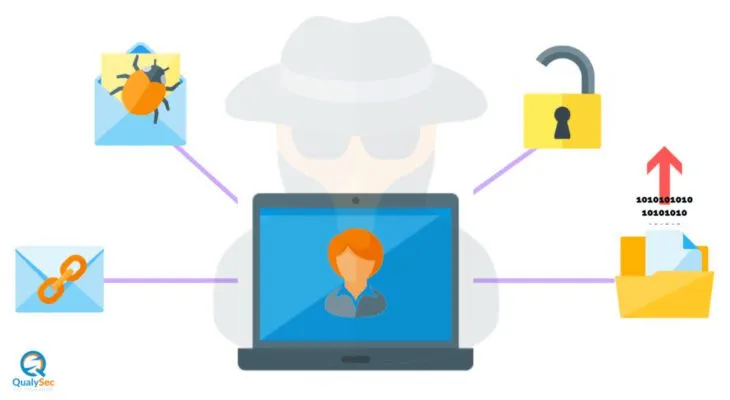
Verizon’s 2024 Data Breach Investigations Report states that human error or social engineering accounts for 68% of all breaches. Attackers deceive employees into giving up their credentials or installing malware using tactics like spoof emails, look-alike login pages, and urgency as a nudge.
2. Weak or Reused Passwords
Attackers will easily bypass security controls using simple or reused passwords. After they access one system, they tend to go sideways through various platforms using the same credentials.
3. Unpatched Vulnerabilities
Software vulnerabilities that are not patented are considered one of the most used vectors. The list of applications that have been decommissioned and operating systems that are not updated routinely is provided by CISA as one of the enabling factors of ransomware and data exfiltration attacks.
4. Insider Threats and Negligence
Insiders, whether it’s careless or malicious, account for nearly one-third of reported breaches. Be it accidental data sharing or the malicious intent of an employee, the data loss has consequences for the business.
Get a free data breach risk assessment tool.
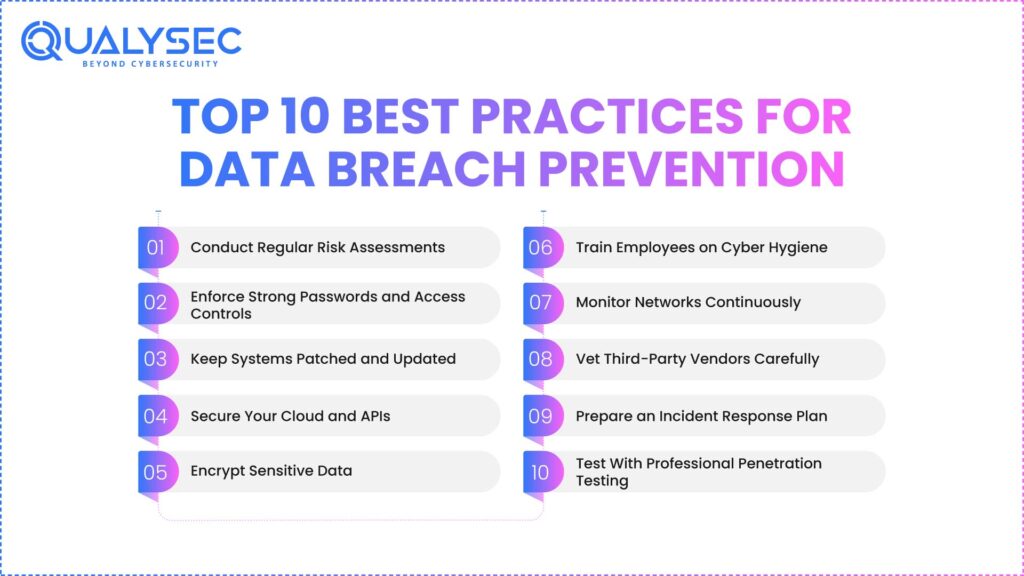
Data breach prevention: Top 10 best practices
Still relying on antivirus software or firewalls to prevent a data breach? That won’t work in 2025. Now, an active and layered approach is the best solution. Take a look at these ten best practices:
1. Conduct Regular Risk Assessments
Visibility is crucial for preventing data breaches. Begin with a thorough security assessment of data assets, encompassing servers, endpoints, SaaS platforms, and data flows. It is important to opt for vulnerability tests and internal audits at least once every three months. Document all risks, allocate accountability, and monitor the progress of their removal.
2. Enforce Strong Passwords and Access Controls
The first level of defense is the access control. Multi-factor authentication (MFA) should be implemented on all of the most important systems, passwords must have a minimum length and rotation, and role-based access control (RBAC) should be used to ensure that employees can only access what they actually require.
Check dormant accounts on a regular basis. Integrate identity and access management (IAM) systems with logging to identify log sign-ins at a tender age. Organizations need strong cybersecurity risk management for effective data breach prevention.
3. Keep Systems Patched and Updated
Un-patented vulnerabilities are all weak points. Regularly complete the Patch-Management cycle and give extra attention to critical CVEs (Common Vulnerabilities and Exposures).
4. Secure Your Cloud and APIs
Wondering about how to prevent data breaches? Secure your APIs & Cloud. One of the most common ways that companies worldwide experience data breaches is cloud misconfigurations. This means you should instantly review IAM roles and permissions for storage buckets and ensure encryption is enabled. Ensure the principle of deny by default is implemented using robust cybersecurity software that only allows access when it is explicitly required.
Take authentication tokens, HTTPS/TLS, rate-limiting, and input validation as your means of guarding APIs from abuse for data breach prevention. Also, have a CSPM tool working to automatically detect and notify insecure settings.
5. Encrypt Sensitive Data
Encryption neutralizes theft. The AES-256 encryption algorithm is used to safeguard the data that is not being used, while TLS 1.3 is applied to secure data that is being communicated. However, separate your encryption keys from the data they are protecting. Use different changes often and keep them in separate offline setups in hardened HSMs.
In mobile devices and removable media, opt for full-disk encryption and the ability to do a remote wipe. Do remember that encryption will not prevent a breach. However, what it does is make the stolen data useless.
6. Train Employees on Cyber Hygiene
Your employees are your greatest weak point and your greatest strength. It is due to this that security-awareness programs, which cover phishing simulation, safe-browsing habits, and reporting procedures, have to be carried out.
Training content should be updated every quarter to include new scam and attack trends. Consciousness turns unintentionally subversive people into intentional protectors.
7. Monitor Networks Continuously
Damage is dependent on the speed of detection. Implement intrusion-detection/prevention systems (IDS/IPS), SIEM systems, and endpoint-detection and response (EDR) systems, which include real-time visibility.
Ensure the configuration of alerts for abnormal outbound traffic, escalation of privileges, and huge data transfers. Develop surveillance 24/7. This may be both in-house and outsourced, hence incidents are detected within minutes as opposed to months. Reaction is changed into prevention by continuous monitoring.
8. Vet Third-Party Vendors Carefully
As strong as your security chain can be, it is as weak as the weakest link in your chain. Prior to using vendors, their security credentials (SOC 2, ISO 27001, GDPR compliance) should be reviewed.
Periodic audits or attestation reports are also to be done and also to uphold continuous compliance. Risk management of the third party should be on the permanent agenda, rather than a post-hoc consideration.
Learn: Compliance Security Audit: A Comprehensive Guide
9. Prepare an Incident Response Plan
An incident response and recovery plan is a documented and tested plan so that chaos does not succeed the compromise. Elements of clear roles and escalation paths are vital. Who isolates systems, who internally communicates, and who controls the public disclosure need to be detailed in the incident response and recovery.
The most appropriate solution would be to conduct tabletop exercises every six months to prove the effectiveness and timing. Have hard copies of emergency contacts and playbooks, not digital, so that you have access to worst-case scenarios.
10. Test With Professional Penetration Testing
Even the most perfect defenses must be justified. Penetration testing replicates the actual attacks to reveal the concealed vulnerabilities before the threat agents. Results (compliance mapping) and step-by-step advice towards remediation should be offered. The best data breach protection services can help fortify your business.













































































































































































































































































0 Comments