







Vanta compliance is an emerging accessory among companies that want to automate their process of gaining security certifications. Nevertheless, using Vanta compliance alone presents a potentially harmful vulnerability to your cybersecurity defence plan. Although automated compliance solutions, such as Vanta, can assist organisations in effectively achieving minimum security standards, they cannot substitute for the valuable information found in human-conducted penetration testing. Additionally, in the United States, where cyber threats are on the rise and data breaches are costing companies an average of $4.45 million based on research conducted by IBM, organisations require more than checkbox compliance to keep their assets safe. As such, it is important to know the Vanta limitations cybersecurity experts to create an actually secure infrastructure. Additionally, understanding the distinction between security testing and compliance automation can enable you to make informed decisions about your security policy.
What Are the Critical Gaps in Vanta’s Automated Compliance Approach?
Vanta compliance automates numerous security controls and monitoring actions, and companies can more easily get certifications such as SOC 2 and ISO 27001. However, automation has shortcomings, which can expose organisations to advanced attacks.
The Nature of Automated Compliance Tools
An automated compliance tools security gap is needed to check whether or not controls are there, and not whether or not the controls can effectively resist an actual attack. As a result, Vanta does not know whether your implementation has exploitable weaknesses, but it can verify that you have encryption turned on. Moreover, compliance frameworks are essentially reactive in nature, formalising lessons learned in previous events and developing minimum standards based on familiar threat patterns. Consequently, they find it difficult to deal with new threats that are actively being taken advantage of by the attackers.
Key Limitations Include:
- Surface-Level Validation: Vanta will check that security controls exist, but not whether they are effective against advanced attack methods.
- No Business Logic Testing: Automated tools are sensitive and fail to identify critical vulnerabilities in application processes, and require human intuition to detect.
- Limited Scope: Contemporary threat actors actively explore gaps between regulations and take advantage of new methods before any standards organisation can react.
- False Sense of Security: Organizations can feel safe just because they successfully pass compliance tests.
- Lack of Attack Simulation: You cannot determine the performance of your defences in a real attack scenario without simulating the behaviour of an adversary.
- Missing Context: Automated scans have no comprehension of your business-specific context and prioritise risks accordingly.
Explore: Penetration Testing Compliance: Simple Step-by-Step Guide
Real-World Attack Vectors Compliance Misses
A compliance framework may require encryption at rest, but it will not always detect a serious attack in a third-party integration. Moreover, complex attack chains and social engineering vulnerabilities are also commonly used by the attackers to take advantage of business logic errors and the complex nature of the attack chains that cannot be covered by the compliance frameworks. Thus, companies must have Vanta compliance penetration testing to collaborate on developing overall security coverage.
| Security Aspect | Vanta Compliance | Penetration Testing |
| Control Verification | ✓ Automated | ✓ Manual + Automated |
| Real Attack Simulation | ✗ Limited | ✓ Comprehensive |
| Business Logic Testing | ✗ Not Available | ✓ Expert Analysis |
| Zero-Day Detection | ✗ Cannot Detect | ✓ Possible Discovery |
| Prioritized Remediation | ○ Basic Guidance | ✓ Risk-Based Priority |
| Continuous Validation | ✓ Ongoing Monitoring | ○ Periodic Testing |
How Does Penetration Testing Reveal What Automated Tools Cannot?
Security testing vs compliance automation is a radically different way of testing cybersecurity. As Vanta certifies that you have controls in place and that they are operating as intended, as documented, the penetration testing will confirm that your controls stand against determined adversaries.
The Human Element in Security Testing
Penetration testing consists of ethical hackers with experience simulating real-life cyber attacks in order to test business logic bugs, sophisticated attack paths, and situations that are not accurately reflected in standard checklists. What is more, there are skilled penetration testers who think like an attacker and will explore innovative methods of evading whatever protection you can offer, which automated tools cannot imagine. As a result, they find the weak points that lie in the distinctive set of your systems, configurations, and business processes.
Learn: Penetration Testing Process: A Step-by-Step Breakdown
What Penetration Testing Discovers:
- Chain Vulnerabilities: Multiple minor issues that become critical when combined
- Configuration Weaknesses: Secure components deployed insecurely
- Access Control Bypasses: Ways to circumvent authentication and authorisation
- Data Exposure Points: Unintended information disclosure through various channels
- Third-Party Integration Risks: Vulnerabilities introduced through external services
- Privilege Escalation Paths: Routes from limited access to administrative control
The Business Impact
Companies that invest in penetration testing usually discover the vulnerability before it leads to a major incident, to avoid operational interruptions and save their reputation. Moreover, active security facilitates business responsiveness so that organisations can embrace new technology and venture into new markets without fear. Hence, penetration testing must be considered an investment, not a compliance cost.
Talk with Our Experts at Qualysec to understand how penetration testing can complement your Vanta compliance strategy.
Why Do Leading U.S. Organisations Combine Vanta Compliance with Regular Penetration Testing?
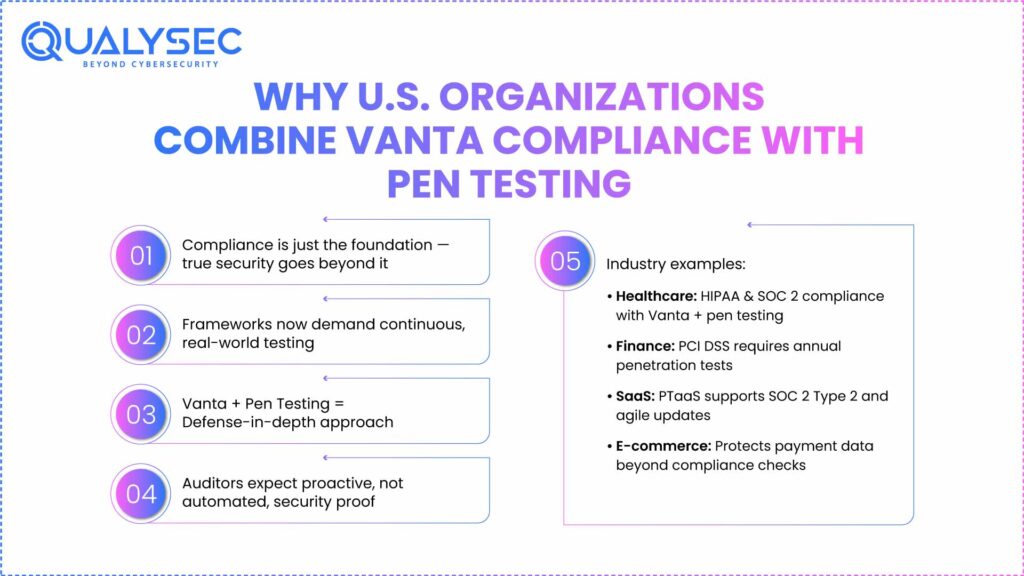
The strongest organisations consider compliance as a starting point rather than an endpoint, and they use frameworks as a scaffolding to construct extensive security programs that go far beyond regulatory mandates. Also, there is a growing regulatory pressure in the United States, and the frameworks are shifting towards continuous testing requirements.
The Evolving Compliance Landscape
A greater numbers of compliance frameworks are beginning to require ongoing penetration testing to address the current always-on threat environment. Namely, companies within highly regulated sectors are becoming more scrutinised by auditors seeking to see signs of proactive security steps beyond automated compliance checks. Thus, when Vanta compliance penetration testing is combined it forms a defence-in-depth approach to meet the minimum requirements as well as the higher security requirements.
Industry-Specific Requirements
Various industries have different penetration testing requirements depending on their threat profiles and regulations:
- Healthcare Organisations: Should safeguard PHI in accordance with HIPAA and be SOC 2 compliant using Vanta. The Security Rule of HIPAA mandates that reasonably expected threats be identified and mitigated, and both penetration testing and vulnerability testing can be used to fulfil these mandates..
- Financial Services: These attacks are advanced against customer financial information and payment systems. Moreover, these organisations many times require PCI DSS compliance that involves conducting annual penetration testing on Level 1 merchants with more than six million transactions per year.
- SaaS Companies: Must demonstrate security to the enterprise customers and still maintain rapid development times. In addition, the SOC 2 Type 2 report continuously watches over controls for at least 3 months, and penetration testing as a service (PTaaS) offers quarterly testing to help fulfil this need.
- E-commerce Platforms: Handle sensitive payment information requiring both compliance validation and practical security testing.
The Cost of Inadequate Security
When breaches happen, they lead to major financial and reputational impacts on U.S. organisations. The average cost of a security breach globally amounted to 4.45 million, an increase of 15 per cent in three years. In addition, 68 per cent of breaches involved vulnerabilities that were known and not patched, proving that awareness of compliance requirements is not the same as validation.
Schedule a Free Consultation to assess your current security posture and identify gaps in your Vanta compliance strategy.
Why is Qualysec the Best Partner for Comprehensive Penetration Testing in the USA?
Although Vanta compliance is the cornerstone of your security program, Qualysec offers professional penetration testing that can expose actual vulnerabilities before they can be used by attackers. Headquartered in the United States and with profound knowledge of the regulatory requirements and threat environment in the United States, Qualysec focuses on facilitating the alignment between compliance and security in an organisation.
What Makes Qualysec Different?
Qualysec offers technical skills and a business-oriented approach that makes security testing relevant to your organisational objectives. In contrast to automated compliance tools, the team of certified ethical hackers at Qualysec conducts thorough manual testing, revealing the complex vulnerabilities that automated scans fail to address. In addition, they are aware of the unique issues confronting U.S. organisations, such as SEC cybersecurity disclosure mandates and industry-based compliance mandates.
Qualysec’s Comprehensive Services Include:
- Application Security Testing: Deep analysis of web applications, mobile apps, and APIs for business logic flaws and security vulnerabilities
- Cloud Infrastructure Testing: Comprehensive assessment of AWS, Azure, and Google Cloud environments to identify misconfigurations and access control issues
- Network Penetration Testing: Internal and external network testing to discover exploit paths and privilege escalation opportunities
- Compliance-Focused Testing: Specialised assessments aligned with SOC 2, ISO 27001, PCI DSS, HIPAA, and other regulatory frameworks
- Red Team Operations: Advanced attack simulations that test your entire security program, including technical controls, detection capabilities, and response procedures
- Continuous Testing Programs: Ongoing security validation through quarterly or monthly testing cycles that complement your Vanta monitoring
Discover all advanced penetration testing services here!
Key Differentiators:
- Expert-Led Testing: Each engagement is performed by trained experts who have years of experience in real-world security usage, not automated scanners posing as penetration testers.
- Clear, Actionable Reports: Qualysec provides focused remediation recommendations in the form of clear and actionable reports that can be put to immediate use by your development teams. Also, their reports meet the auditor’s needs and are also to be read by technical personnel.
- Collaborative Approach: Qualysec will get involved during the testing process by collaborating with your team, responding to questions and confirming fixes instead of just releasing a report and fading away.
- U.S.-Based Expertise: Strong knowledge of regulatory needs in the United States, industry standards and threats to U.S. organisations.
- Competitive Pricing: Pro-forma engagement models enabling differentiated pricing to suit different budgets without undermining the quality or depth of testing.
- Fast Turnaround: Rapid testing methods, which provide results quickly and without compromising extensiveness, facilitate agile development cycles.
Integration with Vanta Compliance
Qualysec realises that Vanta compliance is used by many organisations as a continuous monitoring and certification management tool. As such, they design their penetration testing reports in a manner that they are complementary to the evidence collection conducted by Vanta, making it easy to show both compliance and security to auditors and customers. Moreover, their testing finds holes in the control that Vanta is tracking, but can not actually prove that they are there, which constitutes a wholesome security image.
Visit Qualysec’s website to explore their full range of penetration testing services and read detailed case studies from satisfied clients.
Make a Free Consultation with Qualysec Now to discuss how their penetration testing services can strengthen your security program beyond Vanta compliance alone.

















































































































































0 Comments