








IBM’s 2024 Cost of a Data Breach Report clearly states that the average cost of a data breach has increased to $4.88 million globally. That explains why a data security audit is no longer optional, but rather a baseline for protecting sensitive information and staying compliant.
From ransomware incidents that can bring operations to a halt to regulatory fines that can cause financial damage, the risks are real and immediate. It is important to understand that companies in finance, healthcare, and technology possess a more financial and reputational risk.
A well-structured data security audit process provides more than compliance. It builds resilience, strengthens customer trust, and uncovers risks before they become crises.
In this blog, we will cover what a data security audit involves and the checklist you can use to protect your business.
What is a Data Security Audit?
A data security audit is basically an expert evaluation of how the business gets, manages, stores, and protects data. With this audit, it becomes easy to identify gaps in the systems and networks. Businesses can use the findings of the data audit to adopt measures that help tighten the security controls.
The basic purpose of a data privacy audit is to make sure that your defenses work in real-world scenarios. Businesses in regulated sectors like healthcare, finance, and even SaaS must meet different compliance standards like HIPAA, PCI DSS, and SOC 2.
Types of Data Audits Every Organization Should Know
Data security audits are not all designed to accomplish the same. The kind of audit required by an organization will be determined by the industry, sensitivity of the organization data, regulatory exposures, and the threat profile. The knowledge of various types of data audits is essential to allow the business to make the appropriate selection of the assessment rather than adopting a one-size-fits-all strategy.
1. Data Privacy Audit
A data privacy audit is concerned with the manner in which personal and sensitive data is gathered, handled, stored and distributed. This audit is significant in organizations dealing with customer information, patient information or employee information.
It evaluates:
- The policies in data collection and management of consent.
- Access control and data storage sites.
- Conformity to privacy regulations including GDPR, HIPAA, and state privacy regulations.
Healthcare, fintech, SaaS, e-commerce organizations need this audit, particularly.
Read our latest guide on Compliance Security Audit.
2. Infrastructure and Systems Data Audit
In this audit, security is reviewed on the servers, endpoints, networks, and cloud infrastructure as regards data protection. The idea is to discover the technical vulnerabilities that may result in unauthorized access or data loss.
It covers:
- Encryption implementation
- Network security controls
- Horizontal and vertical backup and recovery.
- Cloud and hybrid environment set-ups.
This audit is most useful to organizations that are going through cloud migration or infrastructure modernization.
3. Application-Level Data Security Audit
One of the most popular data exposures is through applications. This audit measures the data treatment within web and mobile applications and API-based applications.
It focuses on:
- Handling of data input and output.
- Sensitive data storage and transmission is secure.
- Logic authentication and authorization.
- Developmental vulnerabilities that are capable of exposing data.
Such an audit is crucial to SaaS systems and applications that are made in-house.
4. Access Control and Privilege Audit
Numerous breaches are caused by uncontrolled or too much access. This audit examines the access controls of data by who and whether least-privilege guidelines are implemented.
It includes:
- Reviews of user and administration accounts.
- Role-based access control authentication.
- Privilege escalation risks
- Orphaned and dormant accounts detection.
The audit is of specific importance to businesses and controlled settings.
5. Third-Party and Vendor Data Audit
Organizations tend to disseminate information to vendors, SaaS, and service providers. The given audit evaluates the accessibility of data, processing, and protection of the organizational data by third parties.
It evaluates:
- Access control and scope of vendor access.
- Data sharing contract and data compliance.
- Integrated system security posture.
The audit assists in minimizing the risk of exposure to third-party data and compliance risk.
With the combination of these audits, it is possible to have a full visibility of data risks at the systems, application, user and external dependencies.
Explore: Third Party Security Audit: Advantages and Key Steps
10-Step Process for a Successful Data Security Audit
A reliable and efficient data security audit is not a checklist to be ticked off once. It is a structured process that aids in exposing vulnerabilities and validating the existing security controls.
Here is a 10-step process that a successful data security audit follows –
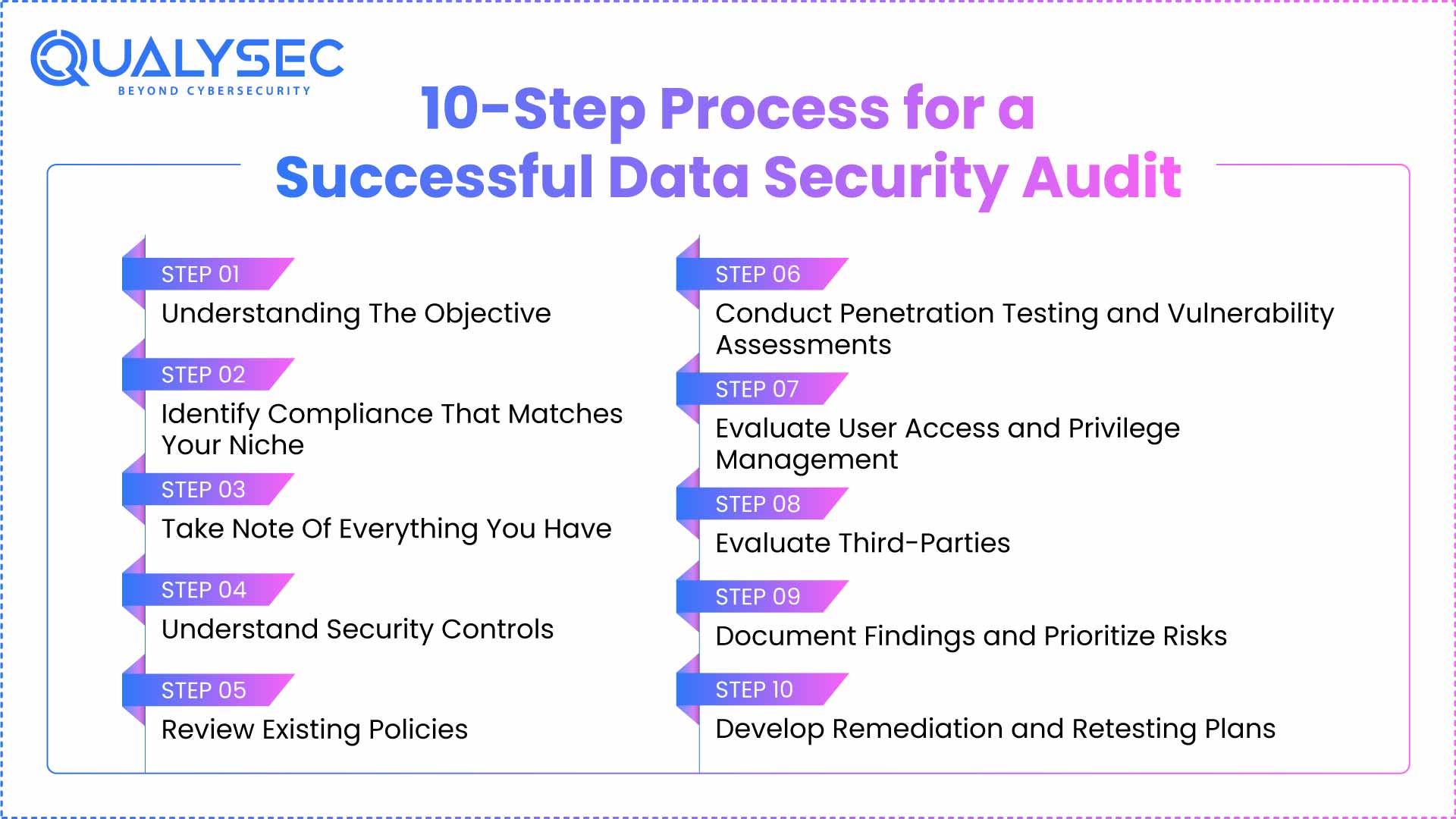
1. Understanding The Objective
The first step in this process is to get better clarity of what the audit will cover. For instance, the team needs to know what systems to cover and how to proceed.
2. Identify Compliance That Matches Your Niche
Every industry carries unique obligations. For example, healthcare providers must meet HIPAA standards, while finance companies dealing with cards need PCI DSS compliance. Identifying the relevant standards early ensures that the audit maps back to measurable obligations – not just “good practices.”
Learn more on Data Security Compliance: A Step-by-Step Guide
3. Take Note Of Everything You Have
It is critical to understand that you can only protect something if you know what to protect. That is why mapping servers, databases, endpoints, etc., is important. After that, you must document the data flows. That way, you have complete information at hand to get an accurate and reliable data security audit.
4. Understand Security Controls
Firstly, you need to understand your technical defenses. This includes firewalls, detection systems, encryption methods, etc. After that, you must ensure that these work properly. That is why testing them at regular intervals is necessary.
5. Review Existing Policies
If your security policy exists only on paper and is never actually implemented, that’s a major gap. In audits, experts check if the response plans or the recovery processes are enforced when an attack happens.
6. Conduct Penetration Testing and Vulnerability Assessments
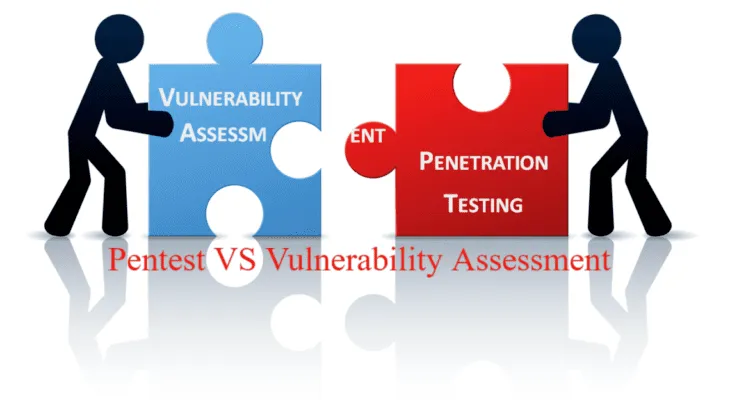
Automated scanning tools are useful for quick scanning of known weaknesses. However, to know how real attackers can exploit the system, penetration testing is essential. A mix of both of these approaches ensures you are secure from all sides.
7. Evaluate User Access and Privilege Management
One of the fastest-growing attack vectors is compromised credentials. Auditors examine who has access to sensitive data and whether “least privilege” is enforced. Too many rights on accounts or weak passwords raise an alarm right away.
8. Evaluate Third-Parties
It is critical to identify the weakest link in your security structure. Often, businesses overlook third parties that may come with risks to their system. That is why data audit includes a complete assessment of vendor contracts, integration security, and more.
9. Document Findings and Prioritize Risks
Raw technical results alone don’t help leadership make decisions. Efficient documentation ensures proper categorization of the issues based on severity and their impact on the business.
10. Develop Remediation and Retesting Plans
The last step of the audit closes with action. A proper response plan makes sure that all the gaps are covered and retesting is done to double-check that nothing is at risk anymore.
Book a consultation with Qualysec experts now!
Data Security Audit Checklist

Understanding the process helps you know how the data security audit works. However, with the Data security audit checklist, you know exactly what to look out for:
1. Define Scope and Objectives
- Decide on system boundaries and audit depth.
- Clarify goals: compliance validation, risk reduction, or both.
2. List Applicable Regulations and Standards
- Make a list of compliances that fit your niche as part of the Data security audit checklist.
- Align the audit with specific clauses from these standards.
3. Create an IT Asset and Data Flow Inventory
- Servers, endpoints, cloud apps, APIs, databases.
- Track how customer or employee data moves across the organization.
4. Data Protection Steps
- Encryption is done at all levels.
- Ensure secure backup storage along with a recovery plan.
5. Review Access Controls
- Give access only when necessary.
- Audit everything – admin accounts, logins, etc.
6. Test Incident Response and Response Plans
- Run real-world cyber attack simulations.
- Assess the time taken from detection to response.
7. Vulnerability Scans and Penetration Tests
- Use automated tools and manual processes
- Focus on cloud, mobile, and web application layers.
Explore our recent guide on Penetration Testing vs Vulnerability Scanning.
8. Document Findings with Action Plans
- Rank risks based on how critical they are.
- Create a document to note down all findings and prepare an action plan.
9. Monitoring & Retesting
- Retest at regular intervals.
- Leverage different tools to detect gaps.
Request a no-obligation audit consultation with Qualysec today.
Common Pitfalls to Avoid in Data Security Audits
Understanding the common traps helps businesses know how to avoid falling into these pitfalls in data privacy audits. Take a look at these common issues –
- Treating the Audit as a Checklist Exercise: Audits that focus only on “passing” a compliance review miss broader risks. It is important to understand that malicious attackers are always ready to exploit weaknesses.
- Ignoring Cloud and SaaS Environments: Many data audits still focus heavily on on-premise systems while overlooking the cloud. With workloads shifting rapidly to SaaS and hybrid models, ignoring these environments creates massive blind spots.
- Internal Threats: Attackers from outside are harmful to your system, but the ones with internal access are more dangerous. Failing to review privilege escalation and user monitoring leaves organizations exposed.
- Failing to Act on Findings: An audit that generates reports but no remediation plan is wasted effort. Organizations often delay fixes due to cost, complexity, or politics – giving attackers time to strike.
- Over-Relying on Tools Without Human Expertise: Automation is powerful, but tools lack context. Skilled auditors interpret results, connect patterns, and spot subtle misconfigurations that software might overlook. A balanced approach for data privacy audit is critical.
Read also: What is Cybersecurity Audit: A Complete Guide in 2025
Best Practices for Data Security Audits
Adopting best practices can help strengthen the security of your data. Here are the best practices that are worth taking a look at –
- Make Audits Continuous, Not One-Off: Security threats evolve daily. It is critical to ensure that audits are done every now and then. It is not a checklist to be dusted off when done once.
- Align Security with Business Objectives: An audit meeting only the compliance standards without satisfying business goals doesn’t make sense. Here, the best way to proceed is to map the risks to real impact on the business and how that affects the revenue.
- Leverage AI Tools: Manual audits just don’t cover everything now. The rapid rise of AI and its use by attackers has compelled businesses to use it for detecting gaps in real-time, prioritising concerns, and finding solutions.
- Involving Multiple Departments: The security of the business is not only the job of the IT department. Multiple departments in the business need to work together to ensure the policies are implemented, training is given, and that no person takes unnecessary security risks.
- Document in Business-Friendly Language: Technical reports often alienate non-technical leadership. The best way to ensure that everybody knows what’s happening is to provide layered reporting. The IT staff can access the technical part while the management can take a look at the executive summaries.
Explore our Data Security Services in Cybersecurity.
Why Choose Qualysec for Your Data Security Audit
It is equally crucial to select a suitable partner in the process of carrying out a data security audit as much as the audit itself. Qualysec is more than a one-dimensional checklist-based assessments which includes technical depth, compliance knowledge, and real-world attack simulation.
Risk-Driven Audit Approach
Qualysec narrows down on the risks that are of business interest and not mere hypothetical matters. Every audit is correlated with real attack situations and possible impact of data disclosure on business.
Manual and Automated Testing Combined
Qualysec does not use tools alone, but it combines both the automated analysis and the manual testing by skilled security experts. This methodology reveals misconfigurations and faulty logic that is absent in tools.
Compliance-Ready Reporting
Qualysec audits are compliant to regulatory and industry standards including:
Reports are designed in a way that they facilitate audits, certifications and regulatory reviews.
Clear, Actionable Remediation Guidance
Findings are presented with:
- Risk prioritization
- Business effect exposition.
- Sequential remediation instructions.
- Reproving after corrections.
This guarantees that the outcome of the audit can be measured to offer security improvement.
Industry-Specific Expertise
Qualysec is an actor that performs data security audit services to organizations in healthcare, financial technology, SaaS, e-commerce, government, and AI based on the platform. Every audit is industry-specific risk and compliance specific.
Trusted by Global Organizations
Having an excellent history of penetration testing and security testing, Qualysec assists an organization to protect sensitive data proactively, before breaches, audit failures or regulatory failures strike.
Ready to strengthen your data security posture? Get a clear understanding of your risks, compliance gaps, as well as priority of remediation through scheduling a data security audit with Qualysec.































































































0 Comments