





Qualysec

BLOG

What is Digital Payment Security? Best Practices, Threats & Compliance Requirements

Pabitra Kumar Sahoo

Pabitra Kumar Sahoo

Updated On: August 19, 2025

chandan

Chandan Kumar Sahoo

August 29, 2024

Digital Payment Security
Table of Contents

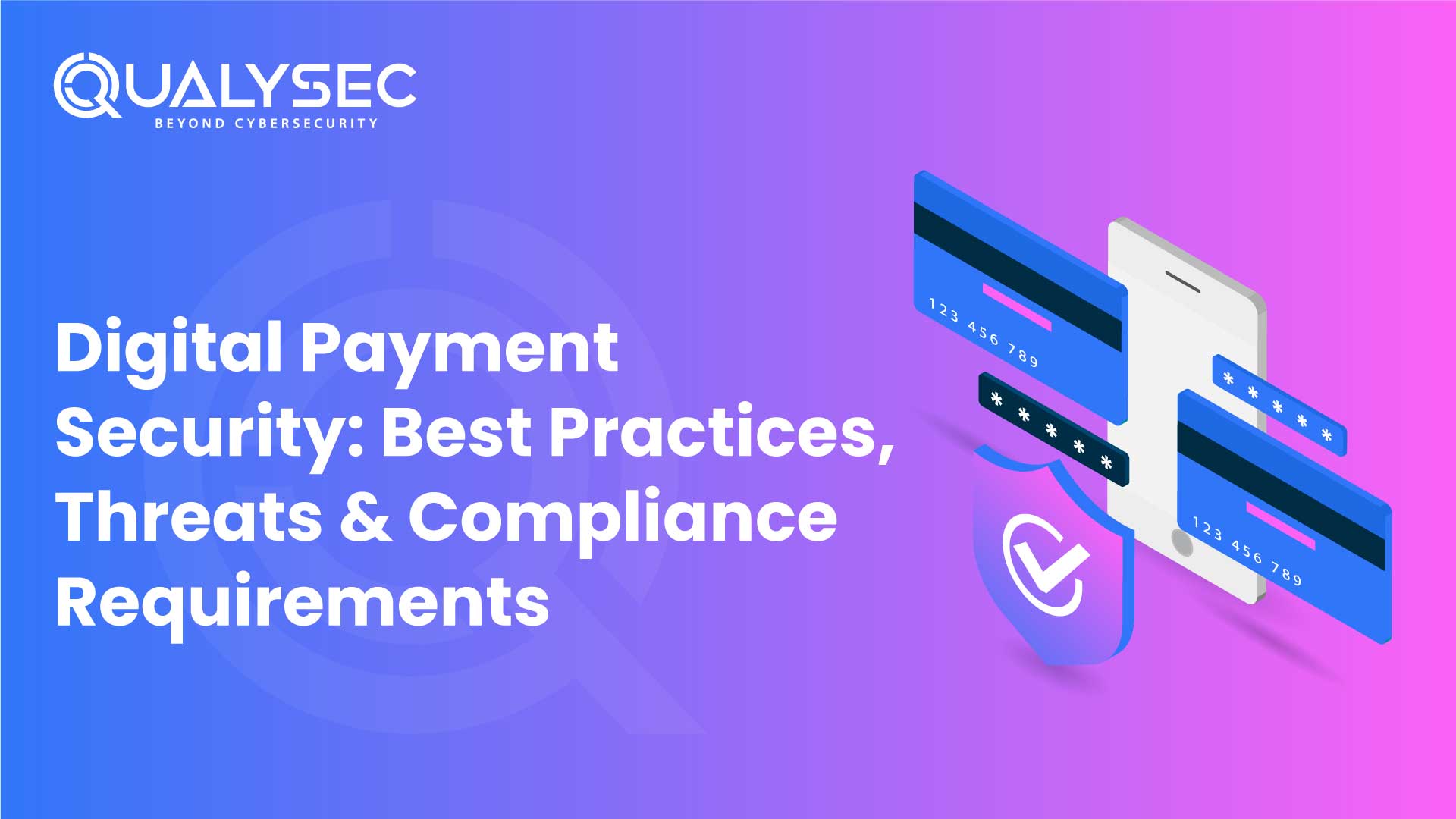
The digital payments market is predicted to reach more than US$20.09tn in 2025! The increasing percentage every year is an indication that digital payments are becoming more popular than ever. Now, digital payments are more convenient and faster, leading to exposure to various threats. That further cements the need for reliable Digital Payment Security

AI-based scams, deepfakes, phishing attempts, etc., have caused widespread alarm among customers and partners. In response, compliance bodies have tightened rules to ensure customer payment data remains safe. No matter if you are running an e-commerce store or handling a fintech problem, complying with global standards is a must. 

In this guide, we explore in detail what digital payment security is, the common threats, best practices for secure online payment methods, and how pen testing can help achieve excellent digital payment security. 

What is Digital Payment Security?

In simple terms, digital payment security is the use of different aspects like technology, processes, and controls to protect customer payment data. It is important to keep this sensitive data safe at all costs. 

Digital payment security covers four key aspects:

  • Data Confidentiality: It is important to ensure that payment details are unreadable to unauthorised parties via encryption. 
  • Authentication & Authorization: Keep in mind that verification of people having access and giving access based on role is essential. 
  • Data Integrity: It is crucial to protect transaction data from being altered or manipulated at various stages, like storage, transmission, etc.
  • Regulatory Compliance: The security process must align with compliance standards like PCI DSS or other regional standards. 

Common Threats to Digital Payment Systems

In 2025, threats to digital payment systems are no longer limited to brute-force attempts or simple malware attacks. They have become far more sophisticated, taking advantage of weaknesses in business logic, third-party integrations, and more. 

Take a look at these common threats: 
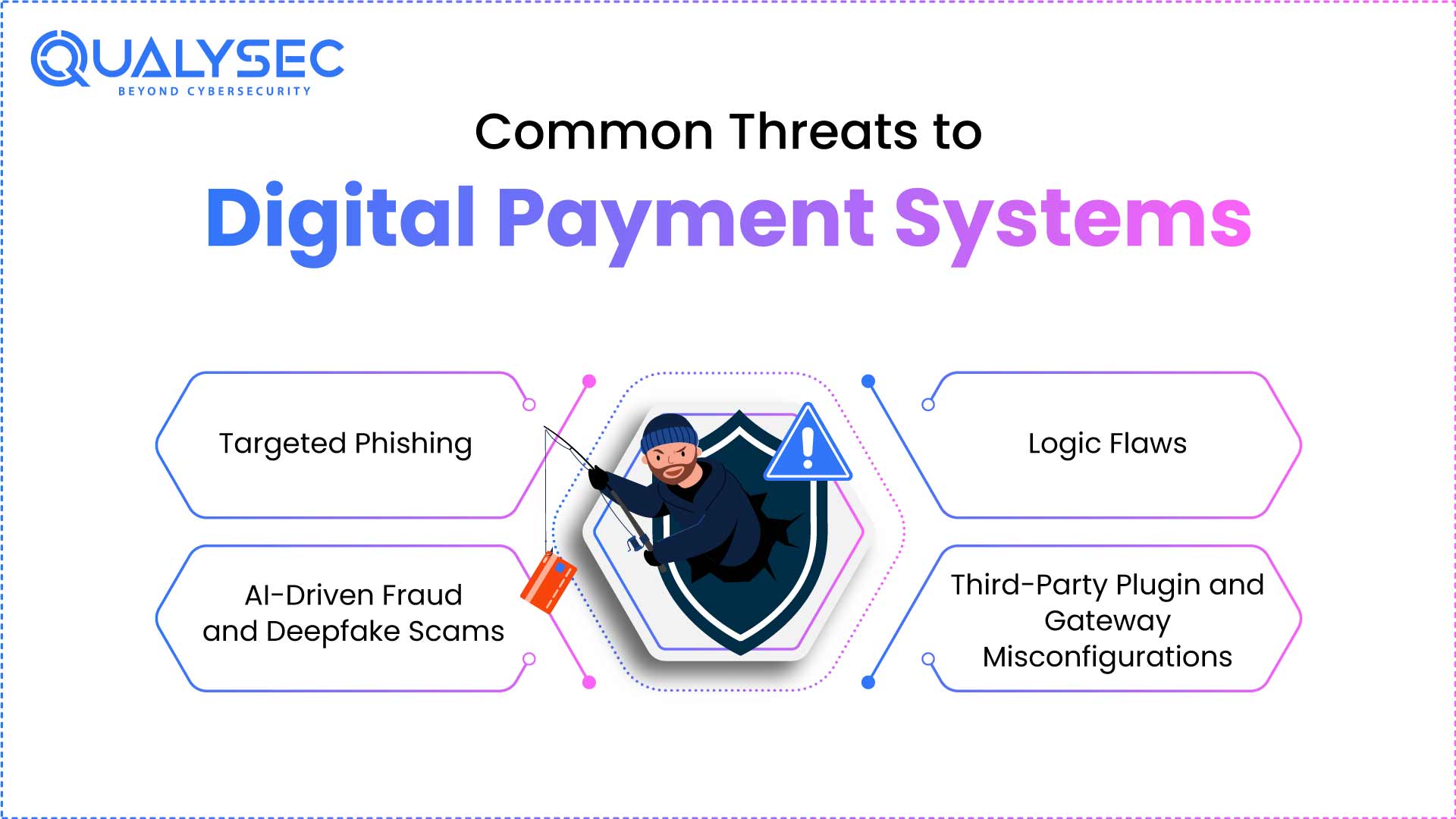
 

Common Threats to Digital Payment Systems

1. Targeted Phishing

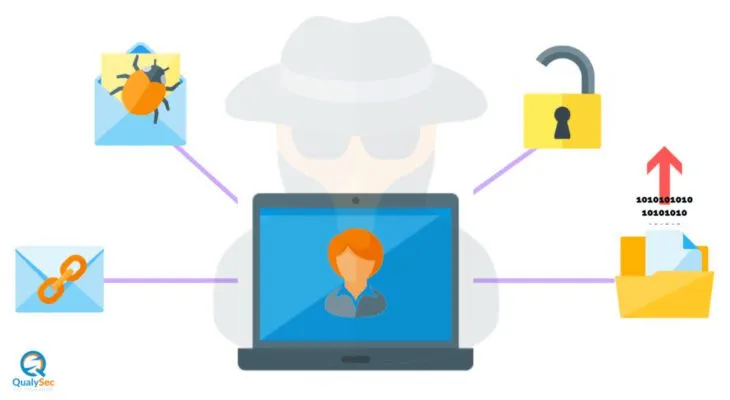
SMS-based phishing, also known as smishing, has been on the rise, targeting businesses with urgent “payment processor” messages. These campaigns trick users into entering credentials into spoofed portals, which are then used for unauthorised transactions, a major concern for e-commerce payment security.

2. AI-Driven Fraud and Deepfake Scams

Malicious attackers are now using AI to mimic legitimate payment requests, impersonate businesses, and create very realistic phishing lures. Deepfake voice and video calls have been used to authorise fraudulent transfers in e-commerce payment security

3. Logic Flaws

Missing idempotency checks or weak currency validation can lead to currency manipulation or bypassed authentication. This is a major gap in the security of digital payments

4. Third-Party Plugin and Gateway Misconfigurations

Outdated or unsafe ecommerce plugins or improperly configured gateways can often expose sensitive data. It can also help in the creation of entry points into the CDE for attackers. 


Read our guide on Ecommerce Security – How to Prevent Cyberattacks.

Best Practices for Securing Digital Payments

Understanding the threats that can expose sensitive data is crucial. However, simply knowing them is not enough. You also need to know how you can counteract them. 

Take a look at these tested-and-proven digital payment security best practices

1. End-to-End Encryption

One of the most well-known security practices for digital payments is ensuring the complete encryption of data from the point of entry to final processing. That means no data can be hacked in transit. This helps in preventing breaches during network transmission. 

2. PCI-Compliant Service Providers

It is important to maintain PCI DSS compliance for digital payments. If you are operating locally, compliance with specific local regulatory bodies is also a must. 

3. Vulnerability Management

One of the most crucial digital payment security best practices is performing constant vulnerability scans and patch cycles. That way, it becomes easy to address CVE-listed vulnerabilities and configuration weaknesses.

The Role of Penetration Testing in Digital Payment Security
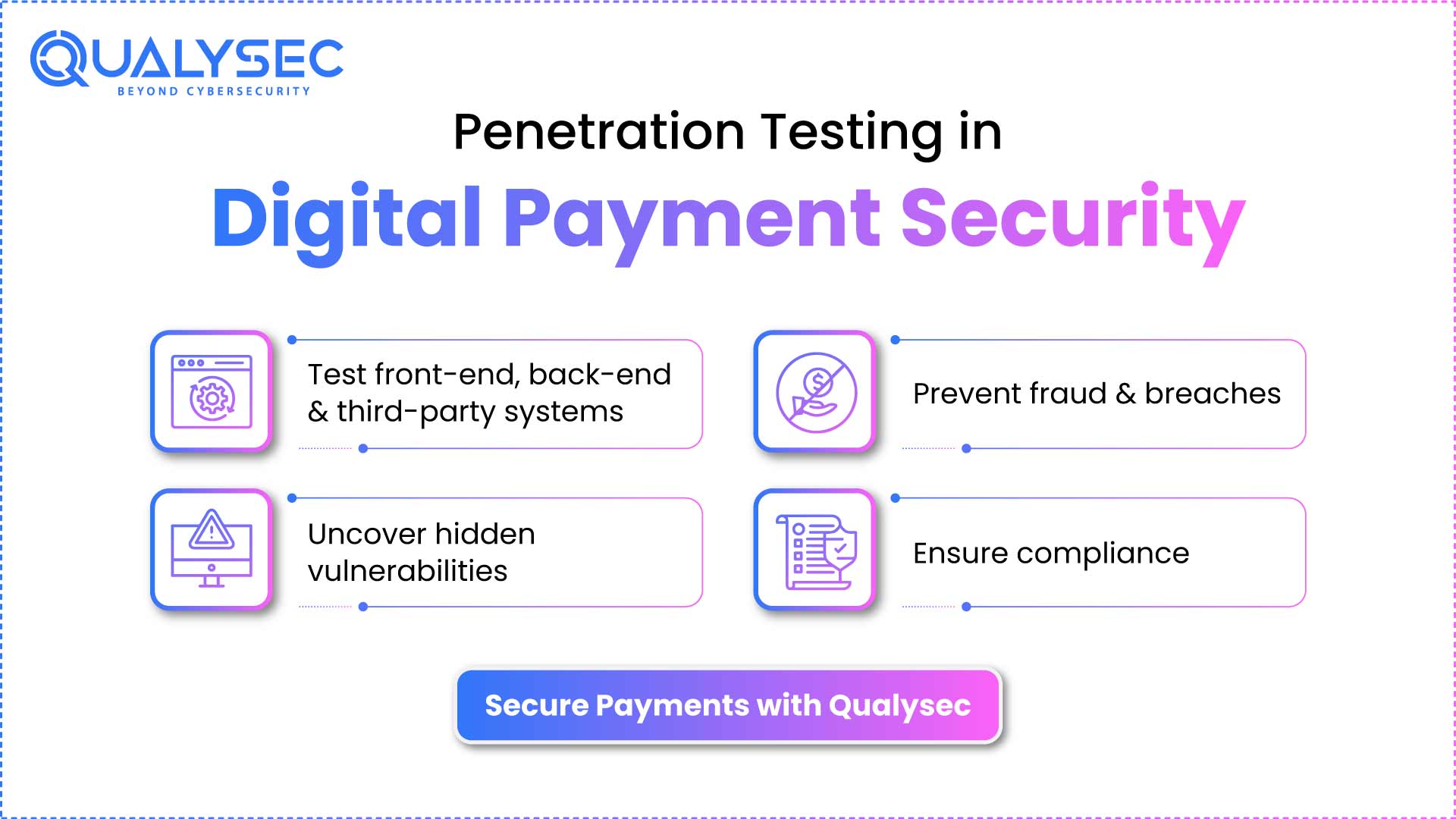
Penetration Testing in Digital Payment Security


Implementing best practices for digital payment reduces risk significantly. However, they cannot guarantee safety unless validated under realistic attack conditions. This is where penetration testing becomes critical for payment systems.

Penetration testing involves simulating targeted attacks on your payment infrastructure. That way, it becomes easy to identify exploitable weaknesses before malicious attackers do. 

To ensure complete security of digital payments, testing end-to-end payment flows is critical –

  • Front-End Components: Checkout forms, mobile apps, and embedded payment widgets.
  • Back-End Systems: Payment gateways, APIs, databases, and processing logic.
  • Third-Party Integrations: E-commerce plugins, payment SDKs, and processor connections.

At Qualysec, we follow a well-structured digital payment security pentest that includes both manual and automated testing. Our experts excel at manual testing, which is particularly vital for uncovering business logic flaws in payment gateway security testing


Discover and fix vulnerabilities in your payment system today!
 

Latest Penetration Testing Report
Pentesting Buyer Guide

Regulatory & Compliance Requirements

Payment security is not only a technical necessity; it is more of a regulatory obligation. In 2025, businesses handling digital payments must align with multiple frameworks. 

PCI DSS 4.0 (Payment Card Industry Data Security Standard)

  • This compliance standard applies globally to any organization storing, processing, or transmitting cardholder data.
  • More focus on continuous compliance compared to annual checks.
  • Extensive emphasis on multi-factor authentication, customised approaches, and targeted risk analyses.

Achieve PCI DSS compliance—Request a pentest today!
SCA (Strong Customer Authentication) – EU PSD2 Requirement

  • In this standard, multi-factor authentication is a must for secure online payment methods.
  • Influences payment UX, requiring security controls that don’t disrupt conversions.

If you are operating locally, it is critical to ensure that you follow the respective local data protection and payment regulations. 

For example, if your business is in California, you need to comply with CCPA or CPRA. Likewise, if it’s in India, then following RBI guidelines is a must. For Brazil, you will need to adhere to LGPD.


Learn more on Data Security Compliance here.

How Qualysec Secures Digital Payment Systems

Qualysec, one of the leading cybersecurity partners, is an ideal payment security testing partner. We help businesses identify and close vulnerabilities before they lead to breaches or compliance failures.

  • Scoping: Collaborate with clients to define the exact payment environment in scope — from web checkouts and mobile payment apps to API endpoints, gateways, and third-party plugins.
  • Testing: We, firstly, opt for manual penetration testing aligned to OWASP and NIST frameworks. This covers different technical gaps, logic flows, integration risks, etc. This is then accompanied by automated scanning. 
  • Reporting: After that, we delivered in-depth reports with risks outlined, evidence presented, and clear guidance about what to do next for your system.
  • Remediation Support: We help clients in addressing the issues through consultation or in any other way that might be helpful to them. 
  • Retesting: After the fixes are done, we retest to ensure that those gaps are covered and there are no new vulnerabilities present. 

Book your digital payment security test now.


Talk to our Cybersecurity Expert to discuss your specific needs and how we can help your business.

Conclusion

In 2025, Digital Payment Security is not an optional upgrade. It is much more than that – it is a core requirement that directly impacts revenue and customer trust. 

As threats become more sophisticated, it becomes more necessary to comply with the demanding compliance standards. Keep in mind that once you lose customer trust with such sensitive data, it’s the kind of nightmare you can never get out of. 

The businesses that thrive are those that combine strong preventive measures and reliable pen testing. It is absolutely essential to validate your security controls in real-world attack scenarios. 

Protect customer trust by validating every layer of your payment system with Qualysec!
FAQ –

1. What is digital payment security, and why is it important?


Digital payment security is basically how you use technologies and processes to protect the sensitive data of customers. It is important because it offers protection to consumers against fraud, helps businesses get relief from data breaches, and more. It also helps you maintain compliance with different payment standards. 

2. How do I secure my e-commerce payment gateway?


To secure your e-commerce payment gateway, you can opt for various security measures. For example, you can choose payment gateways that are compliant with PCI DSS, opt for end-to-end encryption, etc. 

3. What compliance standards apply to digital payments?


PCI DSS is the most common compliance standard applicable to almost all digital payments. However, if you are operating regionally, you will also need to comply with various payment data protection laws.

4. How often should payment systems be tested for vulnerabilities?


PCI DSS requires annual testing to ensure there are no vulnerabilities in the payment system. For external vulnerability scans, you can do it quarterly. It is also advisable to opt for pen testing at least once a year. 

5. What is the difference between encryption and tokenization in payment security?


Encryption in payment security means that only the person with the right key can read that particular data. On the other hand, tokenization means that the data is replaced with something random, so that even if the data is hacked, nothing of value can be taken.

Qualysec Pentest is built by the team of experts that helped secure Mircosoft, Adobe, Facebook, and Buffer

Pabitra Kumar Sahoo

Pabitra Kumar Sahoo

CEO and Founder

Pabitra Sahoo is a cybersecurity expert and researcher, specializing in penetration testing. He is also an excellent content creator and has published many informative content based on cybersecurity. His content has been appreciated and shared on various platforms including social media and news forums. He is also an influencer and motivator for following the latest cybersecurity practices. Currently, Pabitra is focused on enhancing and educating the security of IoT and AI/ML products and services.

Leave a Reply

Your email address will not be published.

Save my name, email, and website in this browser for the next time I comment.

0 Comments

No comments yet.

Chandan Kumar Sahoo

CEO and Founder

Chandan is the driving force behind Qualysec, bringing over 8 years of hands-on experience in the cybersecurity field to the table. As the founder and CEO of Qualysec, Chandan has steered our company to become a leader in penetration testing. His keen eye for quality and his innovative approach have set us apart in a competitive industry. Chandan's vision goes beyond just running a successful business - he's on a mission to put Qualysec, and India, on the global cybersecurity map.

3 Comments

emurmur

John Smith

Posted on 31st May 2024

Lorem ipsum dolor sit amet, consectetur adipiscing elit. Ut et massa mi. Aliquam in hendrerit urna. Pellentesque sit amet sapien fringilla, mattis ligula consectetur, ultrices mauris. Maecenas vitae mattis tellus. Nullam quis imperdiet augue.

    Pentesting Buying Guide, Perfect pentesting guide

    Subscribe to Newsletter

    Scroll to Top
    Pabitra Kumar Sahoo

    Pabitra Kumar Sahoo

    COO & Cybersecurity Expert

    “By filling out this form, you can take the first step towards securing your business, During the call, we will discuss your specific security needs and whether our services are a good fit for your business”

    Get a quote

    For Free Consultation

    Pabitra Kumar Sahoo

    Pabitra Kumar Sahoo

    COO & Cybersecurity Expert