








Google Cloud penetration testing has become essential as an increasing number of companies shift to the cloud. Businesses within the USA have turned to Google Cloud Platform (GCP) as one of their cloud providers because of its ability to scale, artificial intelligence (AI) based features, and infrastructure. However, with such an increase comes new threats, especially regarding cloud security.
Inappropriate setup, unprotected APIs, and excessively liberal access roles remain among the leading causes of breaches in the cloud. The misconfiguration of a single setting in a multi-tenant server, such as GCP, can result in devastating security breaches across entire workloads.
In 2026, organizations are expected to shift further toward security as code, compliance automation, and real-time threat detection. However, these efforts remain incomplete without rigorous Google Cloud pentesting.
GCP penetration testing assists in replicating real-life attacks to identify obscure risks that the commonly used monitoring tools fail to detect. Regardless of HIPAA or SOC 2 compliance and testing the security state of a containerized workload, GCP pentesting is a must now. It is necessary.
What Is Google Cloud Penetration Testing?
Google Cloud penetration testing is an ethical activity of simulating cyberattacks on assets that are present on the Google Cloud Platform (GCP) to discover areas of vulnerability when the same can be compromised. As compared to the traditional pen testing of the on-premise systems, GCP pentesting would require the consideration of the cloud-native factors such as IAM, Kubernetes Engine, Cloud Functions, and storage buckets.
How GCP Penetration Testing Differs from Traditional Testing
- The conventional penetration tests are aimed at physical networks, servers, and independent applications.
- GCP pentesting tests the values of virtualized resources, managed services, and Google Cloud-specific configurations.
- Penetrating testers are supposed to act within the framework of the shared responsibility model, and they should not interfere with the underlying infrastructure, which Google handles.
Google’s Policy on Penetration Testing
Google Cloud does not require prior approval for penetration testing of most GCP services, as long as:
- You are testing the resource in your own GCP environment
- The other Google Cloud customers are not affected by the testing
- The activities are consistent with Google’s Acceptable Use Policy and the Terms of Service
For reference, see the official Google Cloud policy here: GCP Acceptable Use Policy – Security Testing
Google Vulnerability Assessment vs Penetration Testing
These two terms are mostly used in interchangeable forms, although they are meant differently:
- Vulnerability assessment is an automatic task that is used to scan and recognize the known weaknesses in GCP assets. It is more general, and it is usually carried out more often.
- Penetration testing involves a manual or a hybrid technique of vulnerability exploitation by the security professionals to realize the actual vulnerability effects. It gives more insight into how the vulnerabilities may be concatenated or abused.
Both are essential, though penetration testing will provide a more realistic view of cloud security.
GCP Penetration Testing vs Traditional Cloud Pentests
Penetration testing in Google Cloud Platform (GCP) offers an opportunity to reveal some peculiar challenges as compared to the traditional clouds, such as AWS or Azure. This disparity is mainly caused by the different architecture and service model of GCP.
GCP’s Shared Responsibility Model
Google Cloud, similar to other cloud vendors, adheres to the shared responsibility model:
- The role that Google has to play is the securing of the infrastructure: hardware, network, storage, and foundational services.
- Data, workload, access controls, and configurations will be secured by customers on GCP.
It is key to know the area where your duties begin and conclude before engaging in any penetration testing exercise.
Unique Challenges in GCP Penetration Testing
There is a close integration of services offered by GCP, and as a result, configuration is quite strong and difficult:
- IAM complexity: GCP employs a resource hierarchy (Organization > Folder > Project > Resource), and this affects the inheritance or enforcement of the roles and permissions. Unhealthy IAM policies may trigger unwanted access escalations.
- Service accounts and impersonation: GCP also heavily relies on the use of service accounts, which can be used to initiate lateral movements or privilege escalation in an environment due to over-scope.
- Cloud-native services: An example of tools such as Cloud Run, Cloud functions, GKE, Pub/Sub create testing issues due to the abstraction of infrastructure layers and frequently demand modeling of attacks to use events or roles.
How GCP Pentesting Differs from AWS and Azure
- IAM Design: The IAM in GCP is more hierarchical and closely connected with its project hierarchy than that of AWS, whose IAM is flat, or that of Azure RBAC.
- Tooling Support: The majority of security tools are explicitly AWS-focused, and, therefore, it is usual to need GCP-specific tools such as Pacu, GCPBucketBrute, and GCPScanner.
- Logging and monitoring: Monitoring, such as Cloud Audit Logs and Security Command Center, is used by GCP, and this needs customized configurations to monitor the attacker simulation.
Pen testers must change their approach to fit the specific architecture and identity model of GCP, to make the test meaningful and also compliant.
Want to secure your AWS & GCP infrastructure? Start with a free consultation.
Additionally, you may want to explore our expert’s guide on AWS and Azure Penetration Testing.
Rules & Permissions: Is Google Penetration Testing Allowed?
Even without the express authorization of Google, penetration testing of GCP projects is exempted, provided that you do not violate any of the rules or policies of the GCP acceptable usage, and limited to those resources you control.
What You Can Test Without Approval
- A project, VPC network, compute resource, or service belonging to you
- Typical attack vectors like vulnerability of application logic, insecure orientation, or permission crabs
- The exploits are simulated with common tools such as Burp, Nmap, or Metasploit, so far as none other than your own resources are involved
What Is Restricted
- Testing on resources that you do not own, or those that are not your property and belong to other Google customers
- Denial-of-service or stress test beyond the range of Apigee
- Testing or phishing of Google-managed infrastructure or social engineering
When You Must Request Permission
- In case of attacking commercial Google services (including Apigee, where customers are forced to place a support ticket first)
- In cases where testing can affect production or when there is much automated traffic involved
- When your penetration plan goes beyond what you have and involves GCP system shared systems.
The policies of Google make ethical testing flexible while conserving their multi-tenant infrastructure. When you are less clear in determining whether an activity has exceeded a line, begin with a scoped plan that restricts attention to your assets.
Learn our full scope and workflow cloud pentesting guide
Scope of a Google Cloud Platform Penetration Test
The scope should be defined before any proposed Google Cloud Platform penetration testing. The disadvantage of having a clear scope is that the risk of policy violation will be minimized, the business-critical assets are going to be covered fully, and the risk of service disruption will be minimal. The multiprotocol aspect of the shared infrastructure, combined with the layered services used in the GCP system, makes scoping complicated to handle beyond what is possible in the general application environment, and more so in the dynamic workloads and microservices domain.
In-Scope Areas Typically Tested
- GKE (Google Kubernetes Engine) cluster of pod misconfigurations, container breakout pathways, and public dashboards
- Problems with input validation in Cloud Functions, unauthenticated triggers, or too many permissions
- IAM roles and policies to detect privilege escalation or identity spoofing paths
- VPC networks with improper firewalls, open ports, or insecure peering arrangements
- APIs that are served in Cloud Endpoints or API Gateway could be used to achieve authentication bypass and rate limiting.
- Compute Engine instances with weak credentials, or files open publicly, or unpatched operating system (OS) vulnerabilities.
- Publicly known or mispermissioned files using Cloud Storage buckets
Common Targets
- The use of Web applications in App Engine
- Service accounts set with unneeded privileges
- Custom APIs that are connected to Firebase or backend databases
- Cloud Run services with open-source components
Out-of-Scope or Restricted Components
- Such infrastructure governed by Google, as BigQuery internals, Cloud Spanner backends, or Google’s global network
- Any resource that is not yours or does not belong to the testing organization
- Testing that can cause denial of service, or an infrastructural impact on other tenants on shared infrastructures
- Load testing, which results in load above resource quotas, or auto-scaling above the minimum configuration capacity
Methodology: How GCP Pentesting Is Conducted
The penetration testing of the Google Cloud Platform is not a universal process. The purpose of each test is to recreate the exact behavior of an attacker in the real world under the exact situation in your cloud architecture. Whether it is external-facing assets or IAM misconfigurations, the approach takes into consideration realistic risk identification, as opposed to purely theoretical flaws.
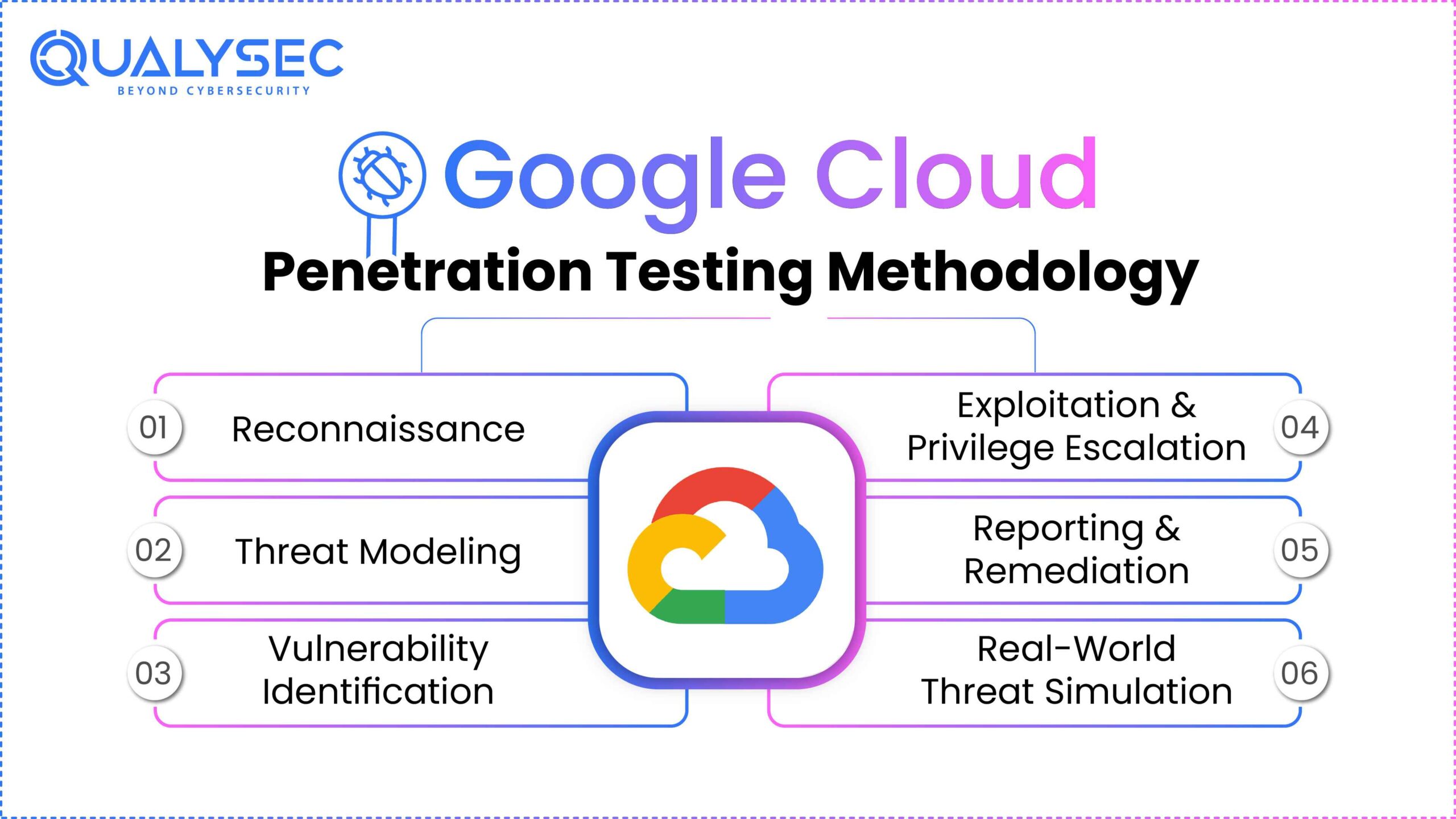
Here’s a breakdown of the key phases involved:
1. Reconnaissance
In this step, you need to gather a set of information regarding your GCP environment. Assets such as APIs, domains, storage buckets, Kubernetes endpoints, and IP ranges are mapped with tools and techniques. Open-source intelligence (OSINT) and passive scanning serve as part of creating a footprint that does not generate alerts.
2. Threat Modeling
Your architecture and the services you use are used to find the most likely attack paths by security experts. As an example, having an IAM role that is misconfigured with a Cloud Function dealing with sensitive data would report as a high-risk vector.
3. Vulnerability Identification
Code flaws are identified in the environment using automated and manual approaches to testing. These include:
- Unsafe storage rights
- Super privileged service accounts
- GCS Buckets, which contain API keys
- Cloud Functions or App Engine SSRF or RCE
4. Exploitation and Privilege Escalation
Having identified vulnerabilities, testers make attempts to exploit them in an ethical way in order to illustrate potential impact. This may include accessing the Cloud Storage data, accessing Compute Engine instances via shell, or misconfiguration in IAM.
5. Reporting and Remediation Guidance
A detailed report is prepared that outlines:
- Confirmed vulnerabilities with proof-of-concept evidence
- Risk levels and potential business impact
- Step-by-step remediation suggestions
- Compliance mapping to standards like SOC 2 or HIPAA
6. Focus on Real-World Threat Simulation
GCP pentesting simulates contemporary techniques of attacks, including lateral movement through service accounts and stealing tokens with unsecured metadata servers. The idea is to demonstrate the manner in which a real breach can happen, not in which it can.
See how our approach follows this methodology in our GCP pentesting service page.




















































































































































































































































































































0 Comments