In 2025, the average data breach in India cost organisations around INR 220 million according to
IBM’s Cost of a Data Breach Report. That figure explains why cybersecurity budgets have started moving out of the “later” category for a lot of companies. The pressure is worse in Maharashtra. Seqrite’s India Cyber Threat Report 2026 recorded 36.13 million malware detections in the state over the 12-month period ending September 2025, the highest in the country. In the context of business technology usage, the necessity of
cybersecurity companies in Pune becomes indisputable.Pune sits right inside that equation. You have global capability centres in Kharadi, SaaS firms operating from Hinjewadi, manufacturing networks near Chakan, healthcare platforms, logistics companies, and fintech startups handling payment data. Different sectors, but the attack surface overlaps more than most leadership teams expect. One exposed API, one poorly configured cloud bucket, one compromised vendor account. That is usually enough.The difficult part is choosing the right security partner when half the market sounds identical online. Some companies mainly sell security products. Some focus heavily on compliance audits. Others are built around offensive security testing and incident response. Those differences matter, especially for organisations dealing with RBI guidelines, customer data protection obligations, or enterprise procurement reviews.This list compares cybersecurity companies using actual evaluation criteria instead of marketing visibility alone, including CERT-In empanelment, penetration testing depth, certifications, managed security capability, compliance support, and delivery credibility.
Why Pune Businesses Are Prime Targets for Cybercrime in 2026
Pune doesn’t look like a high-risk city at first glance. But spend time inside its business ecosystem, and the exposure becomes obvious.The shift happened quietly. What used to be IT parks is now a dense mix of SaaS, fintech, manufacturing, and global capability centres, all running on interconnected systems.
- SaaS firms here are handling global customer data, often across multiple regions
- GCCs are not “support offices” anymore; they run finance, analytics, and even core infra
- Manufacturing clusters in Chakan and Pimpri-Chinchwad now connect shop-floor systems to cloud dashboards
- Fintech startups are processing large volumes of sensitive payment data
- Healthcare and logistics players rely heavily on third-party integrations
That overlap creates gaps. Not theoretical ones. Real, exploitable gaps. That’s the reason why
VAPT (Vulnerability Assessment and Penetration Testing) is the most common way of discovering these weaknesses before they can be deployed.Seqrite’s India Cyber Threat Report 2026 puts Maharashtra at over 36 million malware detections in a single year. Nearly a quarter of the country’s activity.The pattern is familiar:
- Phishing that slips through because someone was in a hurry
- Business email compromise leading to quiet, expensive mistakes
- Misconfigured cloud environments
- Vendor access that no one reviewed properly
And in manufacturing, one breach can stall production. Not just systems. Actual output.For SaaS and fintech, pressure shows up differently. Audits. Compliance. Clients are asking harder questions before signing anything.
How We Selected These 8 Cybersecurity Companies in Pune
This shortlist is curated from our broader analysis of the
top cybersecurity companies in India, specifically filtered for vendors with strong delivery capabilities and local expertise in the Pune market.
- CERT-In empanelment
Not mandatory for everyone, but critical in regulated setups. BFSI, government work, listed companies, anything dealing with financial or citizen data. A few names here do meet that bar.
- Service spread
One-trick firms didn’t make the cut. Real environments don’t have isolated problems. We looked for coverage across areas like:
- VAPT in some form
- cloud security, sometimes deep, sometimes limited
- incident response readiness
- compliance support that goes beyond templates
- Team credibility
Certifications came into play, but not blindly. OSCP, CISSP, CREST and similar credentials showed up across teams, which at least signals hands-on capability.
- Compliance exposure
ISO 27001, SOC 2, PCI-DSS, RBI expectations, DPDP. Most Pune businesses are already dealing with at least two of these. Vendors had to show they’ve done this before, not just pitch it.
Top 8 Cybersecurity Companies in Pune (2026): Compared
| Company | HQ / Pune Presence | Specialisation | CERT-In Empanelled | Key Certifications | Best For |
|---|
| Qualysec | Bhubaneswar HQ / Pan-India | VAPT, Pen Testing, Cloud, AI/ML Security | Yes | OSCP, CEH | SaaS, fintech, startups & enterprises |
| Quick Heal / Seqrite | Pune HQ (Viman Nagar) | Endpoint, EDR, XDR, UTM, DLP | Not required | GoDeep.AI | Endpoint & product security |
| Suma Soft | Pune HQ | VAPT, Managed SOC, Cloud, Compliance | Yes | CEH, OSCP, CMWAPT | Full-service VAPT + SOC |
| Varutra (Infoshare) | Kalyani Nagar, Pune | VAPT, SOC, Cloud, Compliance | Yes | ISO 27001:2013, CMMI Level 3 | Manufacturing, BFSI, tech |
| SecureLayer7 | USA HQ / Pune | VAPT, Red Teaming, PTaaS, Code Audit | Yes | CREST, SOC 2 Type 2 | Offensive security |
| Payatu | Viman Nagar, Pune | IoT, Red Team, Product, AI/ML Security | No | ISO-17025 Lab | IoT & product companies |
| eSec Forte | Pan-India | VAPT, Forensics, Compliance, Cloud | Yes | CMMI Level 3, PCI DSS QSA | Government & regulated sectors |
| Kratikal | Delhi HQ / Pan-India | VAPT, Compliance, v-CISO | Yes | OSCP, CEH, CISSP, CREST, CISA | Compliance-heavy firms |
Note – Public information was cross-checked against vendor websites, industry reports, certification disclosures, and publicly accessible compliance references available as of 2026.
1. Qualysec

Company Overview
Founded in 2020,
Qualysec focuses primarily on penetration testing and vulnerability assessment services across web applications, APIs, mobile applications, cloud environments, networks, AI/ML systems, blockchain infrastructure, and IoT ecosystems.The company operates with a security-testing-first approach rather than a broader IT services model. Its delivery footprint is pan-India, including Pune-based SaaS firms, fintech companies, healthcare platforms, and enterprise environments that require recurring application and infrastructure testing.Qualysec works with industries including finance, government, healthcare, insurance, AI/ML, blockchain, and IoT.
Core Security Services
Qualysec’s service portfolio includes:
- Web application VAPT
- API security testing
- Mobile application penetration testing
- Cloud security assessments
- Network penetration testing
- Source code review
- IoT security testing
- AI/ML security testing
- Blockchain security assessment
The company also offers a cloud-focused monitoring layer through its Qualysec Cloud Suite, along with a vulnerability dashboard that allows clients to track findings, remediation progress, and testing activity in real time.
Testing Approach and Technical Focus
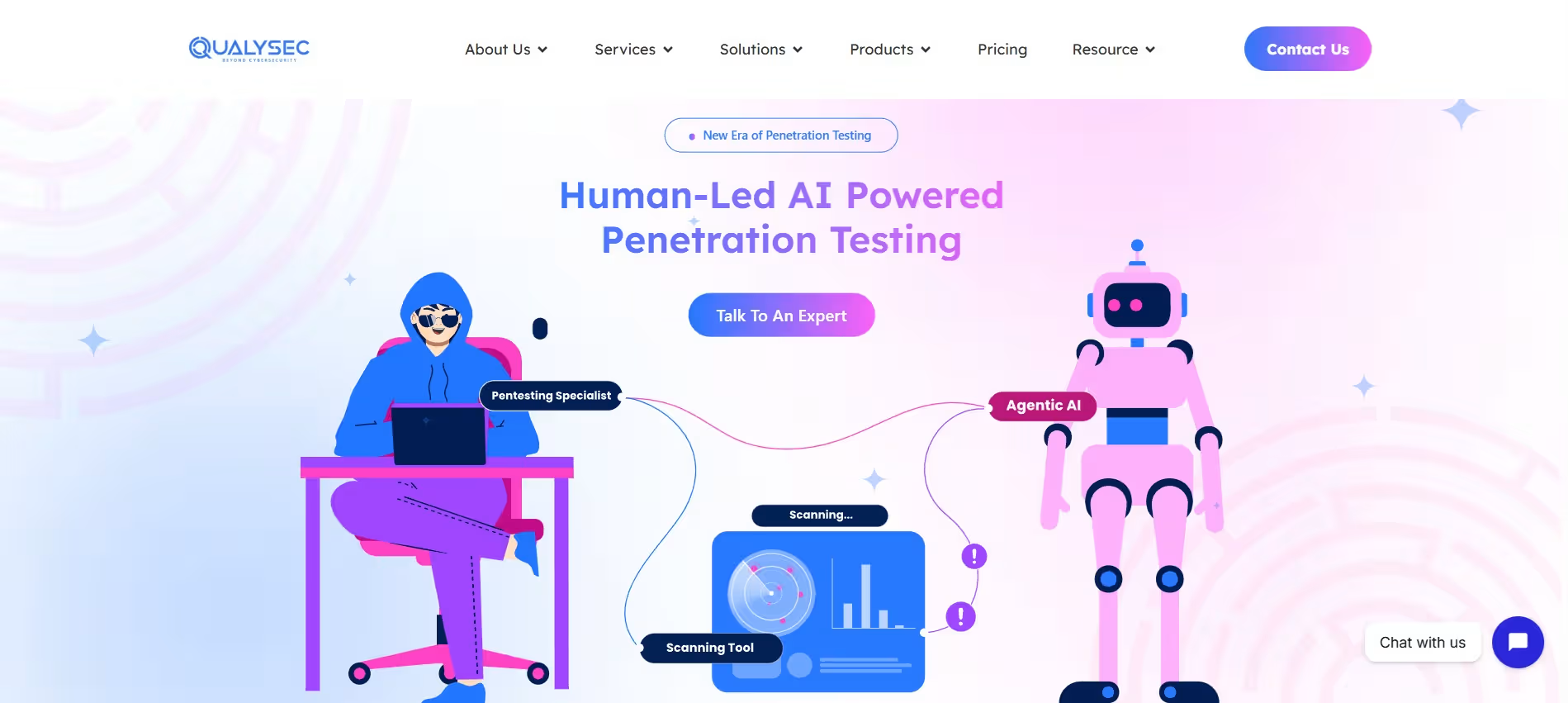
One thing that stands out with Qualysec is its three-layered defence system for testing. That model combines:
- Layer 1: Automated vulnerability scanning
- Layer 2: AI-assisted analysis
- Layer 3: Human-led validation and exploitation
The emphasis stays on “
Human-Led, AI-Powered testing”, where automated discovery is supplemented with manual verification and contextual analysis from security researchers. The practical advantage there is that false positives can be reduced while business logic vulnerabilities and chained attack paths receive more attention during assessments. Team certifications include OSCP and CEH.
Positioning
Qualysec is more focused on offensive security and deep VAPT delivery than on endpoint products or large-scale IT outsourcing. Businesses evaluating multiple vendors for application-layer testing, cloud assessments, or recurring penetration testing often shortlist the company when manual validation depth is an important requirement.
Looking for a penetration testing partner in Pune? Talk to Qualysec’s Experts.Talk to our Cybersecurity Expert to discuss your specific needs and how we can help your business.
Schedule a Call2. Quick Heal Technologies / Seqrite
Company Overview
Not many Indian cybersecurity companies can claim a three-decade run. Quick Heal can. Started in 1995 out of Pune, it spent its early years doing what most people still associate it with: antivirus software for home and small business users. Over time, the enterprise side grew into its own thing, and that’s now Seqrite.Seqrite is the B2B face of Quick Heal. Banking, healthcare, manufacturing, government bodies, IT firms, these are the kinds of organisations it typically works with. The model is product-driven, not consulting-led.
Core Security Services
Seqrite’s enterprise portfolio includes:
- Endpoint Protection (EPP)
- Extended Detection and Response (XDR)
- Endpoint Detection and Response (EDR)
- Unified Threat Management (UTM)
- Data Loss Prevention (DLP)
- Zero Trust Network Access (ZTNA)
- Mobile Device Management (MDM)
A large part of the company’s threat intelligence work is handled through Seqrite Labs, which it describes as one of India’s largest malware analysis facilities.
Technology and Security Focus
A large part of their threat research comes through Seqrite Labs, which tracks malware patterns and attack behaviour across enterprise environments. Their GoDeep.AI engine is used within products to support detection and response.
Positioning
Seqrite is generally evaluated as an enterprise security product stack, not a testing or consulting-led security firm. It fits organisations looking for endpoint protection and monitoring at scale. For
penetration testing, application security, or red team work, companies usually bring in specialised vendors alongside it.
3. Suma Soft
Company Overview
Suma Soft has been running out of Pune since 2000. That’s a long time in Indian IT, and the company has spread across a few verticals over the years. IT services, BPM, and cybersecurity all sit under the same roof.The security practice covers VAPT, managed monitoring, cloud security, and compliance work. Nothing wildly unusual for a firm of this size, but the mix is practical and covers what mid-to-large enterprises typically need on an ongoing basis.The company leans toward continuous engagement models rather than one-off assessments. For organisations that want a monitoring partner sitting alongside them month to month and not just a vendor that shows up, runs a test, and leaves, that model tends to fit better.Sectors they work with include banking, healthcare, logistics, e-commerce, and broader enterprise operations.
Core Security Services
Its cybersecurity offerings include:
- Web application and API VAPT
- Mobile application security testing
- Network security assessments
- Cloud security testing
- IoT security assessments
- Managed SOC services
- Vulnerability management
- Compliance and audit support
Suma Soft also provides
Cloud Security Posture Management support across AWS, Microsoft Azure, and Google Cloud environments.
Testing Methodology and Team Certifications
The company publicly references OWASP and OSSTMM methodologies for assessment work. Its testing process combines automated discovery with manual validation, depending on project scope and asset complexity.Visible team certifications include:
Unlike pure-play red teaming firms, Suma Soft’s approach is more operational and service-oriented. A lot of its work appears structured around long-term enterprise support rather than highly specialised exploit research.CERT-In empanelment could not be independently confirmed from official public sources during research and therefore has not been claimed here.
Positioning
Suma Soft generally fits organisations that want both security testing and ongoing monitoring under one vendor relationship. Enterprises already running internal IT operations teams sometimes evaluate the company for managed SOC support combined with recurring VAPT cycles.For businesses looking only for advanced offensive security research or standalone red teaming, more specialised firms on this list may be a closer fit.
4. Varutra Consulting (Infoshare-Varutra)
Company Overview
Varutra started in Pune in 2012, focused purely on information security from day one. No IT services on the side, no BPM, just security work. That focus held even as the company grew.In 2018, US-based Infoshare Systems acquired the company. Post-acquisition, it continued running under the Infoshare-Varutra structure, with the Pune office staying put in Kalyani Nagar. These kinds of acquisitions sometimes blur what a firm originally stood for. With Varutra, the security focus seems to have stayed intact through that transition, which is worth noting.
Core Security Services
The company’s offerings cover multiple areas:
- Web and mobile application security testing
- Cloud security assessments
- Network security testing
- Managed SOC services
- Compliance audits
- Threat intelligence support
- Mobile security testing
Varutra also developed internal tools, including:
- MASTS (Mobile Application Security Testing Suite)
- MVD (Mobile Vulnerability Database)
The company works with industries such as banking, manufacturing, retail, entertainment, and technology.
Certifications and Technical Capability
Varutra is CERT-In empanelled, which matters for regulated audits and government-linked engagements in India.Publicly visible credentials and standards include:
- ISO 27001:2013
- CMMI Level 3
The company also maintains delivery operations outside India through its association with Infoshare Systems.From a delivery standpoint, Varutra sits somewhere between compliance-heavy audit firms and purely
offensive security companies. It handles both assessment work and managed security operations.
Positioning
Varutra is usually considered by organisations that need a combination of:
- CERT-In recognised audit capability
- ongoing monitoring
- cloud security assessments
- regulatory support
It is less product-oriented than companies like Seqrite and less narrowly focused on offensive security research than firms built entirely around red teaming.
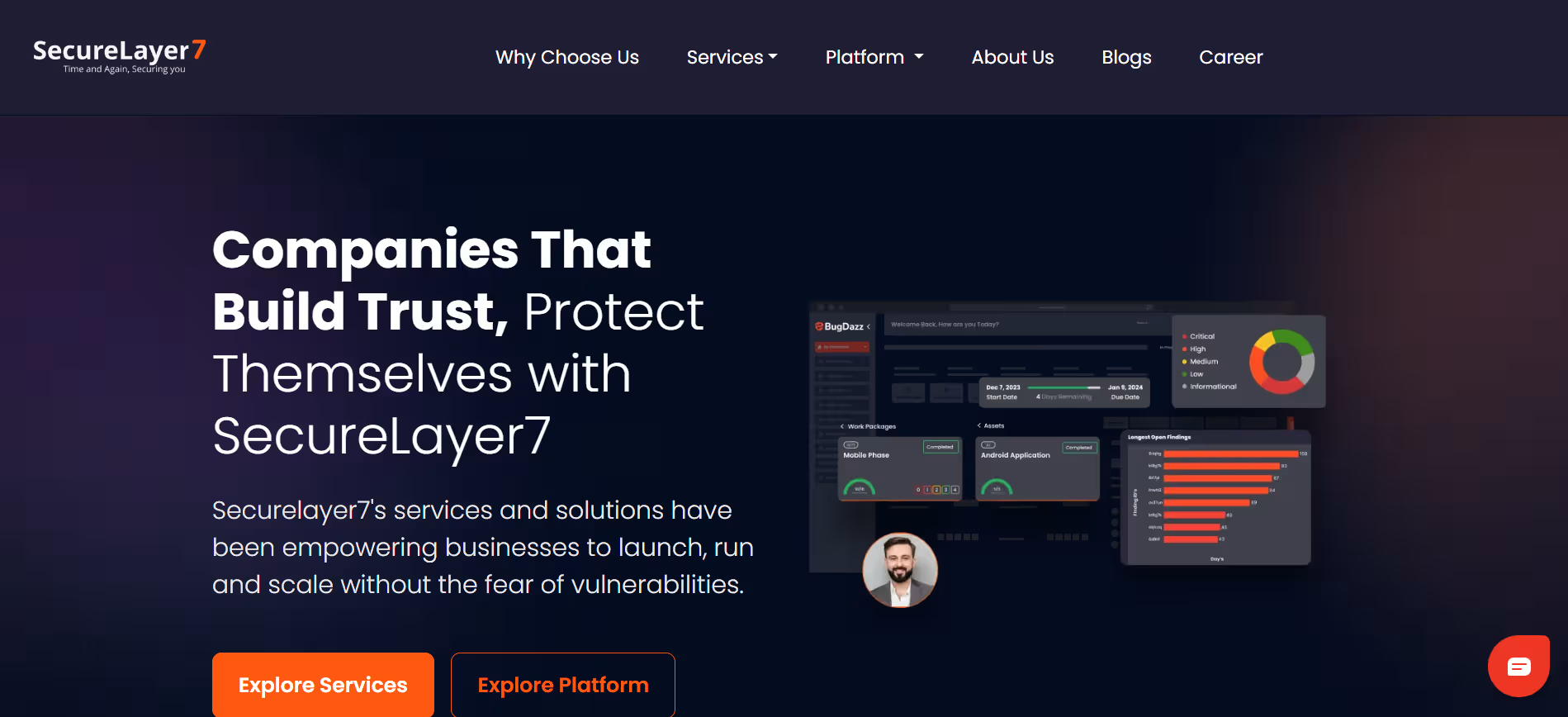
5. SecureLayer7
Company Overview
SecureLayer7 was founded in 2012 and operates with a stronger offensive security focus. The company is headquartered in Delaware in the US, though a significant part of its delivery and research operations runs from India, including Pune.A lot of their work revolves around identifying exploitable weaknesses before attackers do. Less checkbox auditing, more hands-on testing. That difference shows up in the type of services they push forward publicly.
Core Security Services
SecureLayer7 works across several testing areas:
- Web application penetration testing
- Mobile application security testing
- Internal and external network testing
- Cloud infrastructure assessments
- Wireless security testing
- Source code review
- IoT security testing
- Red team exercises
The company also runs a PTaaS platform called BugDazz, designed for ongoing collaboration, tracking, and remediation visibility during penetration testing projects.
Certifications and Technical Capability
SecureLayer7 holds CREST accreditation for penetration testing services, which is still relatively uncommon among Indian-origin security firms. It also maintains
SOC 2 Type 2 compliance.The company uses both automated tooling and manual testing during assessments. That matters because automated scans alone generally miss logic flaws, chained attack paths, and contextual vulnerabilities tied to business workflows.CERT-In empanelment was not publicly confirmed during research, so it has not been included here.
Positioning
SecureLayer7 tends to fit companies that already understand offensive security reasonably well and want deeper technical assessments rather than surface-level scanning exercises.It also appears more suited to:
- SaaS platforms
- product companies
- cloud-heavy environments
- businesses preparing for SOC 2 or enterprise security reviews
The company is not positioned as a large managed SOC provider or endpoint security vendor.
6. Payatu Technologies
Company Overview
Payatu operates from Viman Nagar in Pune and has built most of its reputation around research-heavy security testing rather than conventional IT security support. The company is especially visible in areas like IoT security, embedded systems, automotive environments, and hardware-focused testing.Their teams are also active in vulnerability research. Over the years, Payatu researchers have disclosed multiple CVEs affecting vendor technologies and connected systems.
Core Security Services
The company’s service portfolio includes:
- IoT security testing
- Product security assessments
- AI/ML security testing
- Red team exercises
- Cloud security testing
- Web application security testing
- Mobile application testing
- Source code review
- OT and critical infrastructure security
Payatu also works in environments involving connected devices, healthcare systems, industrial control technology, and automotive ecosystems.
Certifications and Technical Capability
One thing frequently associated with Payatu is its ISO/IEC 17025-accredited cybersecurity testing laboratory. That certification relates to testing competence and laboratory quality standards.The company is also known for organising technical conferences, workshops, and hands-on research discussions focused on offensive security and hardware exploitation.
Positioning
Payatu is usually considered when the environment involves:
- connected hardware
- embedded systems
- automotive technology
- industrial infrastructure
- specialised product security testing
For businesses looking mainly for endpoint deployment, large-scale SOC operations, or governance consulting, other firms on this list may align more closely with those requirements.
7. eSec Forte Technologies
Company Overview
eSec Forte is based in Gurgaon, though the work goes well beyond NCR. The company delivers across Mumbai and Bangalore too, which gives it a reasonable geographic reach for an India-focused security firm.In enterprise and government circles, eSec Forte tends to come up in conversations around audit, compliance, and structured assessments. That’s the space it’s most associated with. Organised, process-driven security engagements rather than public-facing offensive research or red team work.
Core Security Services
eSec Forte’s cybersecurity work spans several areas:
- Vulnerability Assessment and Penetration Testing
- Security audits
- Cloud security assessments
- Risk assessment
- Digital forensics
- Incident response
- Malware analysis
- Vulnerability management
- Compliance support
The company also works with regulated environments and has experience supporting government-linked organisations and PSUs.
Certifications and Industry Credentials
eSec Forte holds multiple enterprise-focused credentials, including:
- CERT-In empanelment
- CMMI Level 3
- PCI DSS QSA status
The PCI DSS QSA designation is particularly relevant for organisations handling cardholder environments or payment infrastructure.The company also publicly references partnerships and implementation relationships involving technologies from vendors such as:
- Palo Alto Networks
- Tenable
- Burp Suite
Its operating model appears more process-driven and compliance-oriented.
Positioning
eSec Forte is commonly evaluated in projects where regulatory alignment, audit readiness, and structured reporting are major requirements.That can include:
- BFSI environments
- government entities
- PSUs
- large enterprises handling compliance-heavy infrastructure
Businesses specifically looking for niche red teaming, hardware exploitation, or advanced product-security research may end up comparing more specialised vendors alongside it.
8. Kratikal Tech
Company Overview
Kratikal is headquartered in Delhi but works with organisations across India, including Pune-based fintech, healthcare, telecom, and SaaS companies.The company sits in an interesting middle ground. It does penetration testing and technical assessments, but a large part of its positioning also revolves around compliance support and virtual CISO advisory. So businesses evaluating Kratikal are often looking beyond one-time testing engagements.That is especially common in companies without a mature in-house security leadership team.
Core Security Services
Its service portfolio includes:
- Web application VAPT
- Mobile application testing
- Cloud penetration testing
- Network security assessments
- IoT security testing
- Regulatory compliance support
- Security audits
- v-CISO services
The company also supports frameworks and standards such as:
- ISO 27001
- SOC 2
- PCI-DSS
- GDPR
Certifications and Technical Capability
Kratikal is publicly listed as CERT-In empanelled. Visible certifications across the team include:
That combination gives the company both technical and governance-oriented positioning, which is why it tends to appear in compliance-heavy procurement discussions. The company also maintains SOC 2 accreditation.
Positioning
Kratikal is usually considered by organisations that need a combination of:
- penetration testing
- compliance preparation
- advisory support
- Ongoing governance guidance
For example, a fintech startup preparing for enterprise onboarding may need both
VAPT reports and broader security-policy direction at the same time. The company is less product-focused than Seqrite and less research-centric than Payatu.
How to Choose the Right Cybersecurity Company in Pune
Most vendors start sounding identical after the second meeting. Same services, same claims. The difference only shows up when you get into specifics, and by then, many teams have already shortlisted the wrong fit.Start with your own environment. Not the vendor list.
What actually needs protection right now?
- payment flows, if you’re in fintech
- APIs exposed to partners
- cloud workloads that scaled too quickly
- production systems in manufacturing setups
- access layers, especially with third-party vendors involved
That clarity changes everything. Then look at how vendors operate, not just what they offer.
Do they rely heavily on automated scans, or is there real manual testing involved?
- Qualysec is often evaluated for deeper manual VAPT work
- Seqrite is a more product and endpoint-driven
How deep does reporting go: Surface issues or actual attack paths?
- Firms like Varutra and Kratikal are often used in audit-heavy environments
Is re-testing part of the engagement, or billed separately?
Most reputable Pune vendors include one round of re-testing after remediation within the engagement (especially Qualysec and Kratikal). However, multiple rounds or delayed retests are often billed separately (₹20k–₹50k+). Always clarify this in the SOW upfront to avoid surprise costs.
Do they understand compliance in practice?
- eSec Forte is commonly seen in CERT-In-aligned and regulated projects
CERT-In empanelment comes into play for regulated environments. Not always required, but when it is, there’s no workaround.And industry context matters more than most teams expect.
- Fintech firms dealing with RBI or PCI-DSS often evaluate vendors like Qualysec or Kratikal
- Manufacturing setups in Chakan may prioritise vendors with OT-aware exposure
- Healthcare and GCC environments tend to lean toward compliance-ready providers like Varutra or eSec Forte
Before signing, ask uncomfortable questions. Who does the testing? What happens if something critical shows up mid-project? You’ll learn more from that than any proposal deck.
What Does Cybersecurity Actually Cost in Pune?
Pricing rarely shows up upfront. Most teams only get clarity after multiple calls, and by then, expectations are already off.The reason is simple. Scope drives everything. A static web app and a fintech platform with APIs, payment logic, and cloud infra won’t even sit in the same pricing bracket.Still, some patterns hold across cybersecurity companies in Pune:
| Scope | Typical Range |
| Basic web app VAPT | ₹50K to ₹80K |
| Mid-sized app with APIs | ₹1L to ₹3L |
| Enterprise assessments | ₹5L and above |
| Managed SOC (monthly) | ₹1L to ₹3L |
Costs move quickly when complexity increases.
- API-heavy architectures tend to need deeper testing
- Cloud environments, especially multi-region, add effort
- Compliance requirements change reporting depth completely
- Tight timelines usually mean higher billing
A few things worth watching before signing:
- Very low quotes often mean mostly automated scans
- No clarity on re-testing is usually a gap
- Weak sample reports tell you what delivery will look like
- If the scope feels vague, it probably is
Most buyers don’t overpay. They under-scope, then fix gaps later at a higher cost.
Conclusion
Cyber risk in Pune is already part of how most businesses operate, whether it’s acknowledged openly or not. As companies scale, the complexity tends to grow faster than the security controls around it. More cloud services, more integrations, more vendors. Each one adds convenience, but also another point that needs to be watched properly.The reality is that most security issues don’t come from rare, advanced attacks. They come from smaller gaps that were never fully closed or were simply missed during rapid expansion. That is usually where things break.Firms like Qualysec often come into the picture for
application security and manual VAPT work, while Seqrite is more commonly associated with enterprise endpoint and product-driven security. Providers such as Varutra, eSec Forte, and Kratikal are frequently considered where CERT-In empanelment or compliance-led audits are required.There isn’t a single benchmark that fits every organisation. What matters more is whether the vendor actually aligns with the environment being protected, not just the services listed in a brochure.So the decision ends up being less about finding a top-ranked name and more about understanding what actually needs protection inside the business. Once that is clear, the choice becomes a lot more practical and less overwhelming.
FAQs
1. Which is the best cybersecurity company in Pune?
There isn’t a single answer. It depends on what you need secured.
- SaaS and product companies often lean toward firms like Qualysec for manual VAPT
- Endpoint-heavy environments usually consider Seqrite
- If CERT-In empanelment is required, Varutra, eSec Forte, and Kratikal come up often
The “best” choice is the one aligned with your risk exposure, not brand visibility.
2. How much does a VAPT cost in Pune?
Most projects fall between ₹50,000 and ₹3,00,000.
- Smaller apps stay near the lower range
- APIs, cloud, and mobile apps increase effort
- Large environments can cross ₹5 lakh
Accurate pricing only comes after the scope is defined properly.
3. What is the difference between VAPT and a cybersecurity audit?
- VAPT focuses on finding and exploiting vulnerabilities
- Audits check alignment with standards like ISO 27001, SOC 2, PCI-DSS, RBI
Many businesses need both, especially in regulated sectors.
4. How long does a penetration test take?
- Standard web apps: about 5 to 10 business days
- Larger setups with APIs and cloud: a few weeks
- Re-testing depends on the number of fixes
Timelines should be locked before the engagement starts.
5. How much does cybersecurity testing cost in India?
For basic web app testing, you’re looking at ₹50,000 to ₹1,50,000 roughly. Bring in cloud, internal networks, anything enterprise-grade and that jumps to ₹2 to 5 lakhs easily. Manual testing costs more than automated, always. Scope is what drives the final number. Get itemised quotes, not ballpark figures.
6. Why should startups invest in cybersecurity?
Startups are sitting on useful data and usually running thin on security. Attackers know that. One bad breach early and fundraising conversations get very uncomfortable very fast. India’s average breach cost is around ₹22 crore right now. Sorting security while building is just cheaper than sorting it after something goes wrong.
7. How often should cybersecurity testing be done?
Once a year is the minimum, not something to be proud of. Big product launch? Test. Major infrastructure change? Test. Finance and healthcare teams generally run quarterly. For most others, twice a year plus regular vulnerability scanning keeps things reasonably covered without blowing the budget.
8. What certifications should a cybersecurity company have?
ISO 27001 and SOC 2 Type II are the ones to check first. PCI DSS matters if payments are anywhere in the picture. For actual testing staff, OSCP and CREST tell you more than a company brochure will. And for anything government or regulated in India, CERT-In empanelment, verify it yourself, don’t just take their word.





























































































0 Comments