








Human-led AI penetration testing is the integration of human skills and intelligent automation to identify security vulnerabilities which can not be detected by either party. This hybrid model has now become the surest method to secure digital systems across the world, as cyber threats become increasingly more sophisticated.
The global penetration testing market will amount to USD 2.74 billion in the year 2025. By 2034, it will have grown to USD 7.41 billion with a CAGR of 11.60% (Fortune Business Insights). This increase depicts the seriousness with which organisations are taking proactive security testing.
In the meantime, AI cybersecurity threats are increasing at an alarming rate. The number of AI-assisted cyberattacks grew by 72% since 2024. In 2025, the average cost of a data breach in the whole world amounted to USD 4.44 million (IBM Cost of a Data Breach Report). These numbers make one thing clear. Companies require smarter, quicker and more comprehensive AI security testing approaches at the moment. AI cybersecurity preparedness has become a priority in the boardroom in all sectors.
Get Expert Consultation — Talk to Qualysec Experts.
Key Takeaways
- Human-led AI penetration testing pairs expert judgment with AI speed for better coverage.
- AI pentesting tools handle repetitive scanning, while humans focus on logic flaws.
- A proper AI pentesting checklist keeps every engagement organised and thorough.
- Hybrid testing applies across AI in fintech, artificial intelligence in healthcare, and other sectors.
- Automated testing alone is not enough. Manual validation is essential.
- Regular testing helps meet ISO 27001, PCI DSS, HIPAA, and SOC 2 requirements.
What Is Human-Led AI Penetration Testing and Why Does It Matter?
Human-led AI penetration testing is a security methodology in which experienced testers take charge. They apply AI pentesting tools to accelerate the process of scanning, reconnaissance, and vulnerability identification. But it is human experts who do the ultimate analysis and exploitation.
Contemporary systems make this important. Companies are adopting cloud providers, API, mobile apps, and even AI-based products. All these provide new points of attack. Known problems can be scanned by a purely automated testing tool. However, it is not able to think as a threat actor in the real world.
As an example, payment API business logic defects require human cognition. Technical misconfiguration may be indicated by an AI pentesting tool. However, only an expert tester can combine several minor bugs into a major exploit potential.
As the data provided by Cobalt in its State of Pentesting indicates, not all pentest findings are fixed, with only 48% of all findings being fixed. In the case of AI and LLM-specific results, the resolution rate is only 21.1%. This demonstrates that being able to identify issues is half the battle. It takes human perception and ranking to comprehend and prioritise them.
The hybrid model is successful since it is a combination of both ends. AI penetration testing tools are used to scan and collect data in large-scale. Results are then validated by human testers, logic flaw tests are performed and business impact is realistically tested. They combine to provide accurate, actionable and business-risk-appropriate results.
How Does a Hybrid AI Pentesting Checklist Improve Security Testing?
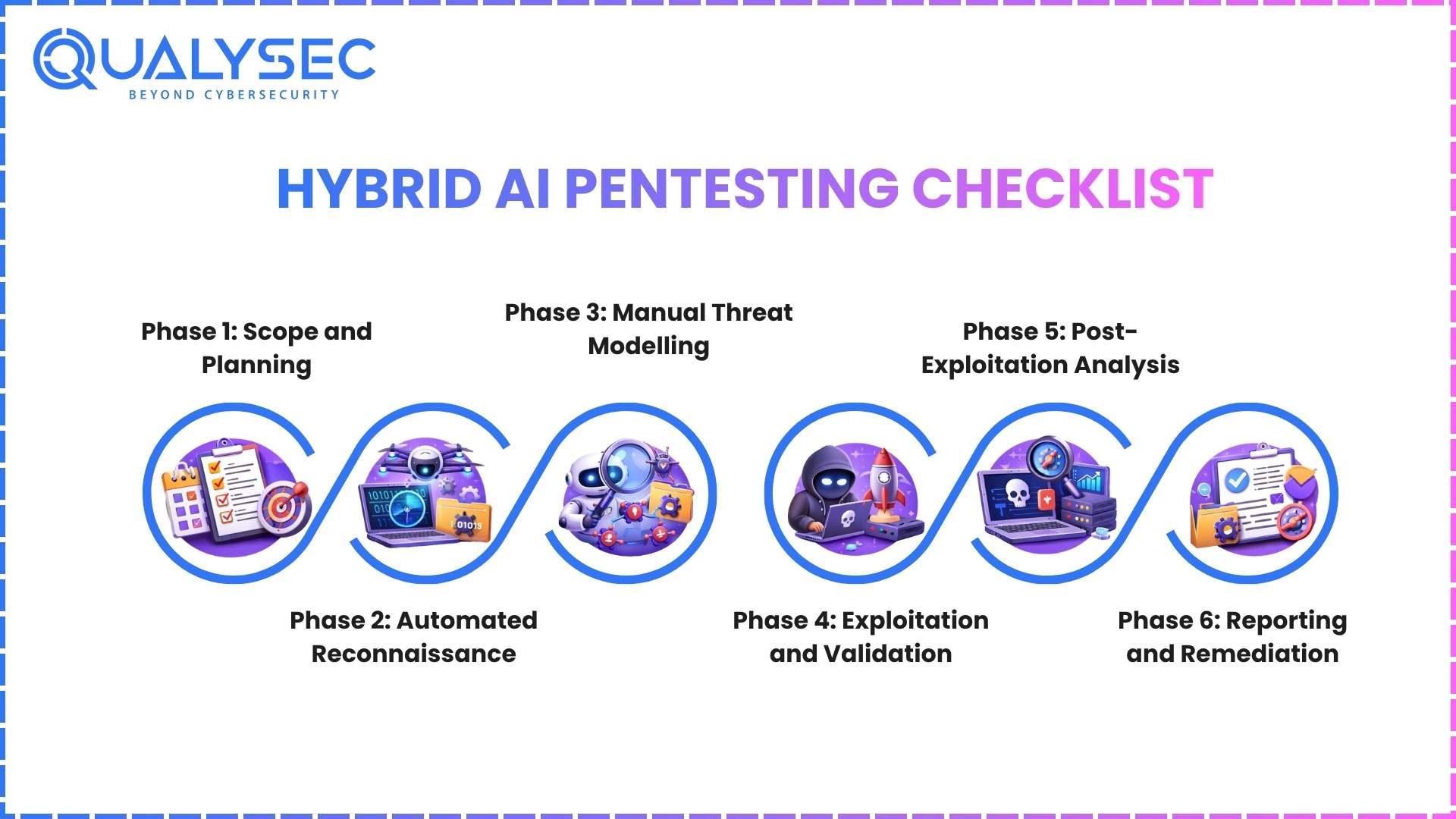
A formalised AI pentesting checklist helps ensure the engagement is focused and comprehensive. In the absence of a defined process, it is easy to leave out important assets or ignore significant defects by teams. The following is the way hybrid testing generally runs.
- Phase 1: Scope and Planning: Determine the target systems, rules of engagement and testing boundaries. It involves APIs, cloud resources, mobile applications, and any AI-based elements.
- Phase 2: Automated Reconnaissance: Scan with AI pentesting tools to find exposed services, open ports, and known vulnerabilities. Instruments gather data about subdomains, technology stacks and misconfigurations at scale.
- Phase 3: Manual Threat Modelling: Human testers check the data obtained. They define high-value targets and map real-world threat situations by business context.
- Phase 4: Exploitation and Validation: Testers will strive to exploit their weaknesses. They test business logic vulnerabilities, broken authentication and privilege escalation. This measure verifies the existence of a vulnerability or not.
- Phase 5: Post-Exploitation Analysis: Once testers have accessed, they check the extent of movement. They evaluate the lateral motion, exposure of data, and damage that might occur to operations.
- Phase 6: Reporting and Remediation: The final report has an executive summary and technical details. It aligns results with such standards of compliance as ISO 27001, PCI DSS, and HIPAA. There is also clear remediation guidance to teams.
This is a systematic method of making sure that AI security testing is done on all layers. It is also able to develop a repeatable process that gets better with each engagement cycle.
Why Can’t Automated Testing Alone Protect AI Systems?
Known vulnerability patterns can be tested quickly and efficiently through automated testing. It has, however, got definite boundaries when used in complex environments. This is the reason why it is dangerous to depend only on automation.
- Business logic defects are lacking in automated tools. A logic issue is a payment system that has negative refunds. Any scanner can detect this without the workflow.
- Artificial intelligence brings about novel threats. Quick injection, AI jailbreak, and data poisoning demand innovative human experimentation. They are not typical CVE-listed vulnerabilities.
- False positives are time-consuming. Scanners tend to raise issues that cannot be exploited. Noise is filtered out, and attention is given to genuine risks using manual validation.
- Context matters. Even a medium-severe vulnerability in a publicly-facing health records platform is much more perilous than the same vulnerability in an in-house wiki.
The Verizon 2025 DBIR analysed over 22,000 incidents and 12,195 confirmed breaches. Credential abuse and vulnerability exploitation remained the top entry points (Verizon DBIR 2025). Most of these entry points have chained weaknesses which can only be identified by human-based AI penetration testing.
In a field such as AI in fintech, the existence of one unnoticed bug can be disastrous in terms of financial cost. In artificial intelligence in healthcare, risks compromise AI diagnostic tools, which can result in patient safety risks. AI cybersecurity requires quickness and comprehensiveness. This is what hybrid testing provides.
Contact Qualysec now to schedule a Human-Led Risk Assessment today.
What Are the Key AI Penetration Testing Tools Used in Hybrid Engagements?
An effective hybrid engagement involves a combination of AI penetration testing tools with manual ones. Some of the tools and their functions are compared below.
| Tool Category | Purpose | Human Role |
| AI-powered vulnerability scanners | Detect known CVEs and misconfigurations | Validate findings and remove false positives |
| Automated reconnaissance platforms | Map subdomains, open ports, tech stacks | Prioritise targets based on business value |
| Fuzzing tools | Test input handling and edge cases | Design custom test cases for logic flaws |
| Prompt injection frameworks | Test LLM and AI model boundaries | Craft creative jailbreak and injection scenarios |
| Credential testing tools | Check for weak or reused passwords | Test privilege escalation and lateral movement |
| Compliance mapping engines | Map findings to ISO, PCI DSS, HIPAA | Write executive summaries and risk assessments |
AI pentesting tools are fast and comprehensive. Nevertheless, creative exploitation, as well as business risk assessment, requires skilled testers. The hybrid approach highlights the effectiveness of combining these factors to improve accuracy and reduce missed vulnerabilities.
Companies that implemented AI and automation in their security efforts saved USD 1.9 million on each breach and reduced their breach lifecycle by 80 days. These savings are through quicker detection. However, the nature of the findings is a matter of human skill in directing the process.
Industry insights also validate that hybrid models decrease the remediation time. Developers get the unambiguous, tested results, rather than lengthy and harsh scan reports.
Why Is Qualysec the Best Choice for Human-Led AI Penetration Testing?
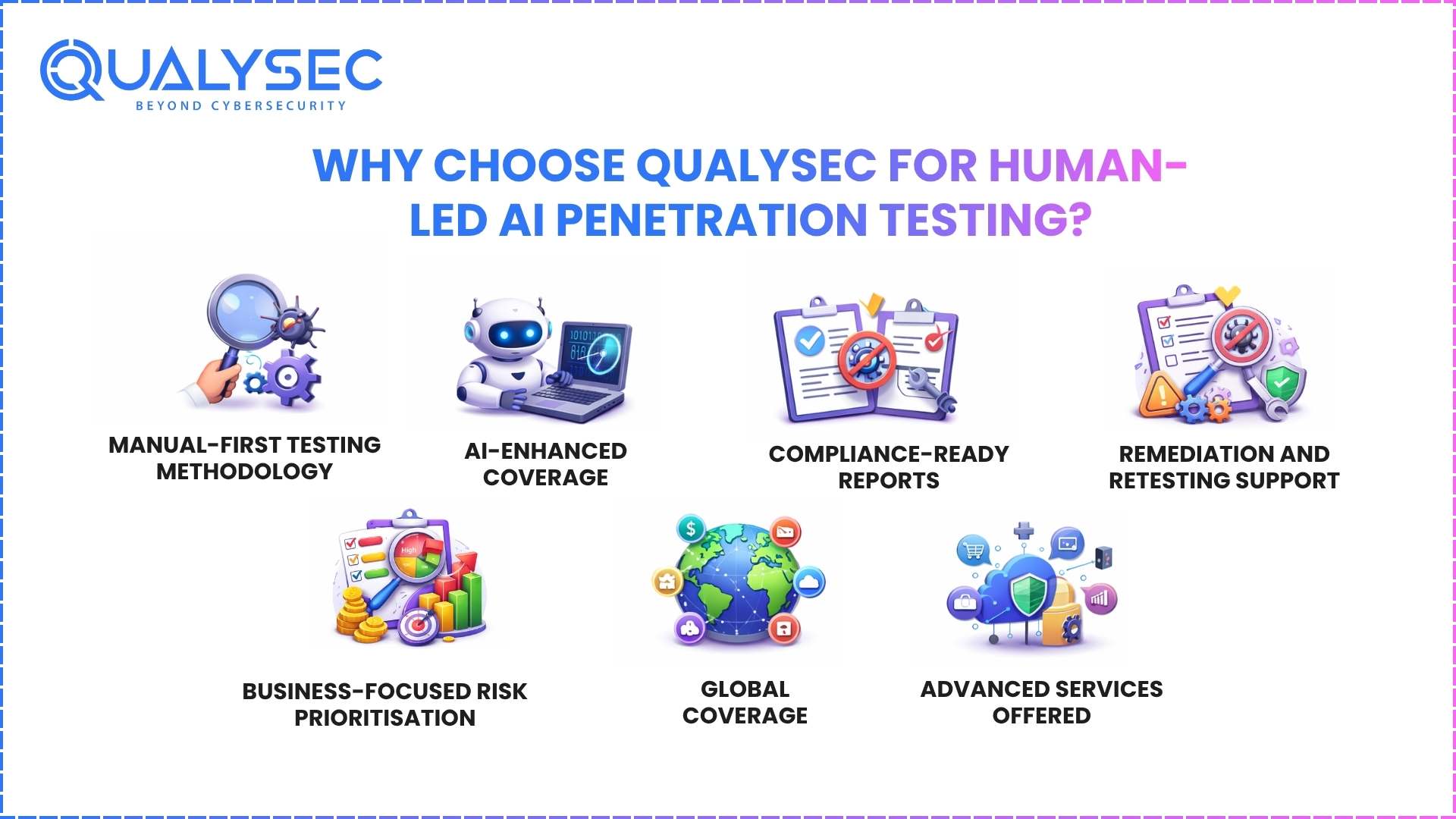
Qualysec stands out as a leading provider of human-led AI penetration testing services globally. The company follows a process-driven, manual-first approach. This makes sure that it is thoroughly tested beyond the surface scan.
What makes Qualysec different:
- Manual-first testing methodology: Tools are not the only reason to do most work, but expert testers are. Through hands-on analysis, business logic flaws, multi-step exploits, and chained vulnerabilities are detected.
- AI-enhanced coverage: The AI pentesting tools are employed in reconnaissance and automated scanning by Qualysec. This is to cover a wide area without missing the depth.
- Compliance-ready reports: Findings in reports are mapped to ISO 27001, PCI DSS, HIPAA, SOC 2, and GDPR. This simplifies and accelerates audits.
- Remediation and retesting support: The team collaborates directly with developers to resolve the problems. Once they have fixed them, they retest to be sure the issues are resolved.
- Business-focused risk prioritisation: Qualysec does not present a list of vulnerabilities in general, but rather points out what has the greatest impact on revenue, operations, and compliance.
- Global coverage: Qualysec is a global consultant to fintech, healthcare, SaaS, e-commerce, and enterprise customers.
- Services offered: Web app, API, mobile app, cloud, network, and AI/LLM system penetration testing.
Regardless of whether you work in AI in the fintech industry or are dealing with artificial intelligence in the healthcare platforms, Qualysec provides the results that you can implement. Since the banking industry and SaaS are among the areas of AI use, their team prioritises AI security in the financial sector. The pragmatic nature of AI security testing is that it guarantees that technical rigour and business-level transparency are incorporated in every engagement.
How Often Should AI Systems Be Penetration Tested?
The frequency is dependent on the system, the data that the system deals with and the regulatory environment. However, the following is suggested by best practice:
- Once a year to comply with PCI DSS, HIPAA and ISO 27001.
- Upon each significant release or update, in order to identify new vulnerabilities that arise with code changes.
- To ensure that the root cause is remedied after any security incident.
- On a quarterly or ongoing basis, in the case of high-risk settings, such as fintech implementations and AI-based healthcare systems.
Organisations using artificial intelligence in healthcare should test more often due to sensitive patient data. In the same way, when new AI penetration testing tools are implemented, teams should revalidate with every integration.
The applications that are AI-driven evolve rapidly. Models get retrained. New pipes are added. Every change has the potential for new exposure. Regular Penetration Testing of AI by humans would guarantee that security is in line with development.
Cobalt’s data shows the median time to resolve a serious finding is 50 days. The larger companies spend up to 61 days. This cycle is reduced by regular testing. It also develops a track record which the auditors and partners can rely upon.
Conclusion
Human-led AI penetration testing is not a trend. It is the best means of securing modern digital systems. The speed and scale of AI tools are introduced. Human testers introduce innovativeness and business acumen. Combining them, they create a hybrid model which reveals more profound flaws and provides more definite results.
The cybersecurity threats posed by AI are gaining momentum all over the world, and organisations cannot risk loopholes in their testing. The future of AI cybersecurity lies in proactive and hybrid strategies. An effective AI pentesting checklist, the appropriate AI penetration testing tools, and human tester expertise form a defence that is adaptable to emerging threats.
Start testing smarter. Blend automation and expert analysis. Incorporate hybrid AI security testing into your security program.


































































































































0 Comments